

Pimax Crystal
More actions
| Pimax Crystal | |
|---|---|

| |
| Basic Info | |
| VR/AR | Virtual Reality |
| Type | Head-mounted display |
| Subtype | PC VR, Standalone VR |
| Platform | SteamVR, Pimax Play, Pimax Store (standalone)[1][2] |
| Creator | Pimax |
| Developer | Pimax |
| Manufacturer | Pimax |
| Announcement Date | May 31, 2022 (online event, PDT; announced as "Crystal QLED" and reported June 1, 2022)[3][4][5] |
| Release Date | May 24, 2023 (Pimax's listed release date; the first international pre-order batch was collected by FedEx on May 23)[6][7] |
| Price | US$1,599 (2023 advertised starting price; announced at US$1,899); US$1,449 without controllers (Crystal-Sim)[8][9][10] |
| Website | https://jp.pimax.com/en/products/pimax-crystal |
| Versions | Original Crystal ("Crystal OG"); Crystal-Sim (2023 edition without controllers)[7][10] |
| Requires | Compatible Windows PC for PC VR; onboard apps in standalone mode[1] |
| System | |
| Operating System | Android (standalone); Windows 10/11 host (PC VR)[1] |
| Chipset | Qualcomm Snapdragon XR2 (first generation) and Pimax PC VR engine dual-processor chips[2][8] |
| CPU | Snapdragon XR2 in standalone mode; host PC CPU in PC VR[1] |
| GPU | Adreno 650 in standalone mode; host PC GPU in PC VR[1] |
| Storage | |
| Storage | 256 GB[1] |
| Memory | 8 GB[1] |
| Display | |
| Display | Dual QLED (quantum dot) LCDs with Mini-LED backlighting and local dimming[11][8] |
| Peak Brightness | 200 nits (manufacturer specification)[8] |
| Resolution | 2880 × 2880 pixels per eye; 5760 × 2880 combined[11][8] |
| Pixel Density | 35 PPD at center with standard lenses (manufacturer specification)[12] |
| Refresh Rate | 72, 90 or 120 Hz; 144 and 160 Hz listed as testing modes in 2023[11][8] |
| Image | |
| Field of View | 130° diagonal with standard lenses (manufacturer, May 2024)[12] |
| Horizontal FoV | 115° (manufacturer, standard lenses, May 2024)[12] |
| Vertical FoV | 105° (manufacturer, standard lenses, May 2024)[12] |
| Peak Pixel Density | 35 PPD with standard lenses (manufacturer specification)[12] |
| Foveated Rendering | Eye-tracked dynamic foveated rendering, enabled by firmware in September 2023; application support varies[13][2] |
| Optics | |
| Optics | Replaceable glass aspheric lenses; standard 35 PPD lenses[11][1] |
| Ocularity | Binocular[1] |
| IPD Range | 58-72 mm, motorized manual or automatic adjustment[8][1] |
| Adjustable Diopter | No; glasses accommodation described in the manual[1] |
| Passthrough | Not supported as of July 2023 (manufacturer FAQ); in July 2024 Pimax said the Crystal Super would support passthrough "like the Crystal and Crystal Light"[14][15] |
| Tracking | |
| Tracking | 6DoF inside-out using four cameras; optional Lighthouse faceplate[11] |
| Base Stations | Required for optional Lighthouse faceplate; not required for built-in inside-out tracking[16][1] |
| Eye Tracking | Tobii, 120 Hz[8] |
| Hand Tracking | Optional Ultraleap accessory compatibility documented July 2023[14] |
| Body Tracking | SteamVR trackers with Lighthouse faceplate in PC VR[16] |
| Rotational Tracking | Yes[1] |
| Positional Tracking | Yes[1] |
| Tracking Volume | Room-scale; needs suitable lighting for camera tracking[1] |
| Play Space | Room-scale[1] |
| Latency | 15 ms motion-to-photon (manufacturer's September 2023 specification)[8] |
| Audio | |
| Audio | Off-ear speakers; optional DMAS headphones[8] |
| Microphone | Three microphones[8] |
| 3.5mm Audio Jack | Yes[8] |
| Camera | Four outward tracking cameras and two inward eye-tracking cameras[1] |
| Connectivity | |
| Connectivity | DisplayPort 1.4, USB, Wi-Fi 6E, Bluetooth 5.1[1] |
| Ports | DisplayPort 1.4, three USB-C, mini-HDMI and 3.5 mm audio[1][8] |
| Wired Video | DisplayPort[1] |
| Wireless Video | Wi-Fi Airlink beta for original Crystal (September 2025); separate 60G Airlink accessory in external beta from early 2025, not yet shipped as of November 2025[17][18] |
| WiFi | Wi-Fi 6E (2.4, 5 and 6 GHz bands)[1] |
| Bluetooth | 5.1[1] |
| Power | Replaceable rear battery in both modes, with external USB power assistance in PC VR[19][20] |
| Battery Capacity | 6000 mAh replaceable rear battery plus 120 mAh internal reserve for hot swapping[8] |
| Battery Life | 2-3 hours standalone (manufacturer's July 2023 estimate); about 2.5 to 4 hours per battery in PC VR (reviewer figures)[14][21][22] |
| Charge Time | About 2 hours in Rob Cole's 2023 review trial[23] |
| Device | |
| Dimensions | 280.10 × 108.20 × 135.90 mm (manufacturer listing; axes unspecified)[8] |
| Weight | 960 g including battery (PC Gamer and Trusted Reviews figures); 1,150 g with battery in MIXED's review; 1160 g in a 2023 loan-unit measurement with battery, DMAS and attached tether laid on the counter[24][22][21][23] |
| Headstrap | Adjustable rear dial and top strap; removable audio modules[1] |
| Haptics | Controller vibration[1] |
| Color | Black[1] |
| Sensors | Four tracking cameras and inward eye-tracking cameras[1] |
| Input | Pimax controllers; compatible SteamVR controllers with Lighthouse faceplate; optional hand-tracking accessory[1][16][14] |
| Compliance | FCC and CE compliance reported by Pimax in July 2023[14] |
The Pimax Crystal is a virtual reality headset made by Pimax, with both tethered PC VR and standalone operating modes. Pimax announced it in 2022 under the name "Crystal QLED" and sold it as the Pimax Crystal; on its later series comparison page, Pimax calls the original model the "Crystal OG" to distinguish it from the Pimax Crystal Light and Pimax Crystal Super.[4][7] The original model has two 2880 × 2880-pixel displays, replaceable glass aspheric lenses and built-in Tobii eye tracking. Pimax specifies 35 pixels per degree at the center with its standard lenses.[11] A Snapdragon XR2 processor runs onboard applications, while PC VR uses a DisplayPort connection to a computer. The original Crystal's battery is required in both modes.[1][19]
Pimax revealed the headset at a price of US$1,899 and began shipping it to pre-order customers in May 2023 at a reduced price of US$1,599, with eye tracking and standalone mode disabled. Both features were enabled by a firmware update in September 2023.[9][25][2] A controller-less Crystal-Sim edition for racing and flight simulation followed in September 2023.[10] The later Crystal Light and Crystal Super are separate models, with different hardware and operating capabilities.[26] In September 2026, Pimax's online store still listed the original Crystal at US$1,599 but showed every variant as unavailable, and its series comparison page listed the Crystal OG as out of stock.[27][7]
History and development
Announcement
Pimax introduced the headset at a 2022 event advertised for May 31 at 1 p.m. Pacific Daylight Time. Its presentation emphasized glass lenses and a choice between standalone and PC-connected use, alongside the company's earlier wide-field-of-view headsets.[3] UploadVR reported the announcement on June 1, 2022 as "Pimax Crystal QLED", a US$1,899 dual-mode headset that Pimax claimed would have the highest angular resolution on the consumer market.[4] Road to VR described it as broadly similar to the company's upcoming Pimax Reality 12K QLED, but with a lower resolution, a narrower field of view and a lower price. Road to VR placed it in direct competition with the Varjo Aero, which cost about US$2,000 and did not include controllers or tracking base stations.[5] Pimax said the Crystal would ship in the third quarter of 2022.[4] The announced price and launch window were announcement terms rather than the eventual shipping date and price.[3][9]
According to Pocket-lint, the announced US$1,899 package included the headset, two controllers, a speaker system, a 6,000 mAh battery and the wide field of view 35 PPD lens.[28] Road to VR reported that an optional SteamVR Tracking faceplate would cost US$200 at launch and that Pimax was developing a stereo camera faceplate for color passthrough.[5] Pimax named BRINK Traveler, cyubeVR and BoomBox as standalone titles at the announcement.[4]
Pimax held a Pimax Crystal launch event on its YouTube channel on 1 November 2022.[29][30]
Delays and CES 2023
The third-quarter 2022 date slipped. At CES 2023, Pimax said that the first headsets would be delivered at the end of January 2023 and that full production capacity would not be reached until the middle of the year. Road to VR's hands-on, published 19 January 2023, found the image a clear step up in edge-to-edge clarity over earlier Pimax headsets. The same hands-on reported noticeable blur during head movement, which the writer suspected was persistence blur, and noted that the standalone mode and key accessories had no release date.[29]
Shipping and firmware updates
Pimax shipped headsets to a beta test group in April 2023. On May 24, 2023, it reported that FedEx had collected the first international pre-order batch the previous day; eye tracking and standalone operation were disabled on those initial shipments.[6] Pimax said that all orders placed before 30 May would ship within two months, and MIXED listed the price at that point as US$1,599 or 1,499 euros excluding VAT.[25] UploadVR noted that the headset was arriving months after Pimax's original third-quarter 2022 target. It also reported that eye tracking and standalone mode were not available at launch and that the maximum refresh rate was 120 Hz, with 160 Hz available only in a "testing mode".[9] Pimax's own series comparison page gives the Crystal OG's release date as May 24, 2023.[7] The company's September 2023 product page advertised a starting price of US$1,599.[8]
On 11 September 2023 Pimax released firmware that enabled eye tracking, including foveated rendering and automatic interpupillary distance (IPD) adjustment, and opened standalone mode as a public beta, initially with eight applications.[2][13] UploadVR described the headset as a change in direction for Pimax, which had been known for ultra-wide field of view headsets and here prioritized angular resolution instead.[2]
Crystal-Sim
On 25 September 2023 Pimax added a second version, the Crystal-Sim, aimed at racing and flight simulation players. It was sold in a "Crystal-Sim Flight" and a "Crystal-Sim Racing" variant for US$1,449, or US$1,549 with the Lighthouse faceplate. Pimax described it as an update to the Crystal without controllers, because flight simulation players often use a yoke and racing players a steering wheel, and with an added lower refresh-rate option: the Crystal-Sim offered 72 Hz as well as 90 Hz and 120 Hz.[10] MIXED described it as a limited edition and reported four simulation faceplate color schemes, Sky Blue and Sunset Orange for flight and Flash Green and Ruby Red for racing; it noted that the Lighthouse faceplate normally cost US$199.[31]
Pimax's Crystal-Sim specification listed 2880 × 2880 pixels per eye, QLED and Mini-LED display, 200 nits, glass aspheric 35 PPD lenses with a field of view listed as "125°/140°" (axes not labeled), a 58-72 mm IPD range, a 6000 mAh battery, the same Snapdragon XR2 and PC VR engine chips with 8 GB of memory and 256 GB of storage, and 120 Hz Tobii eye tracking. The package listed the headset, two USB-C cables, a DisplayPort cable, the power and connection hub kit, a charging dock and batteries (listed as "Charging Dock/Battery *2") and one promotional faceplate, but no controllers. Pimax gave the cable length as 5 m (16.25 ft).[10] Later Pimax accessory listings treat the Crystal-Sim together with the original Crystal: the wide-FOV lens and the 60G Airlink were both listed as compatible with the "Crystal and Crystal Sim".[32][33]
Later developments
In November 2023 the Crystal was named a CES 2024 Innovation Awards honoree in the XR & Spatial Computing category of the awards run by the Consumer Technology Association.[34][35]
In April 2024 Pimax announced two wired, PC-only derivatives, the Crystal Light and the Crystal Super.[36] The Crystal Light removed the original model's Snapdragon processor, battery, standalone operation, eye tracking and interchangeable-lens system. Crystal Super introduced a different replaceable optical-engine system. Pimax's 2024 announcement said that introducing those products did not at that time mean discontinuing the original Crystal.[26] At the same event Pimax announced a US$300 60 GHz wireless adapter for the original Crystal, which UploadVR noted had been promised at the headset's reveal almost two years earlier.[36] Its history is described under Wireless history below.
Current status
Pimax's series comparison page, which lists the original model as "Crystal OG" next to the Crystal Light and Crystal Super, gives it a price of US$1,599 and an availability of "Out of stock". The page describes the Crystal OG as "Wireless-ready" and heavier because of its rear battery, and lists its eye tracking as "Dynamic", against "Fixed" for the Crystal Light.[7] An archived copy of the Pimax store page from 17 September 2026 lists four variants, the headset (US$1,599), a version without controllers (US$1,449), the headset with the Lighthouse faceplate (US$1,798) and an "Ultimate Bundle" (US$1,999), all marked sold out or unavailable.[27] The same page directed shoppers to the Crystal Light when the original model was out of stock.[27][37] No Pimax source consulted announces a formal discontinuation.
On 6 October 2026 Pimax announced the Pimax Crystal Pro, a separate wireless headset. In its launch FAQ, Pimax answered the question whether the Crystal Pro's Wi-Fi dongle works with older Pimax headsets: "It works with the original Crystal. It does not work with the Crystal Light or Crystal Super."[38]
Display and optics
Panels and refresh rates
Each eye has a 2880 × 2880-pixel QLED LCD with Mini-LED backlighting and local dimming. Pimax's current original-Crystal product listing gives 72, 90 and 120 Hz display modes.[11] The September 2023 specification advertised 200-nit brightness, a 20,000:1 local-dimming contrast ratio, 100% NTSC color coverage, HDR and a motion-to-photon latency of 15 ms. These are manufacturer specifications, rather than independent measurements of effective brightness, contrast or application-level HDR behavior.[8] UploadVR described the panels as LCDs with a quantum dot layer; Mini-LED backlighting gives contrast close to OLED, with some blooming as a tradeoff.[4] In its review, Trusted Reviews counted more than 2,000 dimming zones per eye.[22]
The 2022 presentation proposed 160 Hz. By September 2023, the product specification listed 144 and 160 Hz as testing modes alongside 90 and 120 Hz. The current product listing does not list those higher rates as standard operating modes.[3][8][11] Pimax's Crystal-Sim announcement of September 2023 listed a 72 Hz option, which the original Crystal's product specification of the same month did not include.[10][8]
Interchangeable lenses and field of view
The lenses are made of glass rather than plastic. Pimax said this raises brightness and reduces glare and aberration.[4] In its CES Innovation Awards entry Pimax called the Crystal the first VR headset with glass aspheric lenses and said this is why it was named Crystal.[34] The standard lenses are glass aspheric lenses rated by Pimax at 35 PPD in the center. They can be removed after undoing their retaining screws, allowing lens replacement.[11][1] At the announcement Pimax listed a 42 PPD configuration with a 120° diagonal field of view and a 35 PPD configuration with a 140° diagonal field of view.[5] The shipping headset comes with the 35 PPD lens.[12] Pimax has published different field of view figures for that lens over time:
| Source | Lens | Horizontal | Vertical | Diagonal |
|---|---|---|---|---|
| Pimax announcement (June 2022)[5] | 42 PPD | Not stated | 120° | |
| Pimax announcement (June 2022)[5] | 35 PPD | Not stated | 140° | |
| Pimax Crystal product page (September 2023)[8] | 35 PPD | 125° | Not stated | 140° |
| Pimax Crystal-Sim specification (September 2023)[10] | 35 PPD | "125°/140°" (axes not labeled) | ||
| "Pimax Crystal FOV" article (May 2024)[12] | 35 PPD (standard) | 115° | 105° | 130° |
Pimax's May 2024 field-of-view article explains that face shape, eye position and cushion thickness affect the view, so these published figures should be read with their dates and lens configuration.[12] When shipping began, UploadVR reported that beta testers put the wider lens at around 105° horizontally in practice, against Pimax's claim of 120°.[9]
The announcement included the narrower-view 42 PPD lens option.[3][5] Pimax also developed an optional wider field of view lens for the original Crystal. According to Pimax it keeps 35 PPD at the center but has a smaller sweet spot than the standard lens.[12] In July 2024, Pimax reported shipping the first wide-FOV batches and said they had met mixed responses, partly because of lower stereo overlap. It offered waiting customers a US$50 discount coupon instead of the lens and said it had temporarily prioritized glass lens production for the Crystal Light.[39] The "Crystal Wide FOV Lens" was later listed on the Pimax store at US$129. The listing offered a US$70 discount to customers who had bought the Crystal before 31 July 2023 and chose to give up the 42 PPD lens; the standard production lens specification remains 35 PPD. It identifies compatibility with original Crystal and Crystal Sim, excludes Crystal Light and Crystal Super, and requires a 15 mm face cushion.[32]
IPD and glasses
At the announcement Pimax listed motorized automatic IPD adjustment, an eye relief range of 12-20 mm and diopter adjustment of 0-7.[5] The production headset's motorized interpupillary-distance adjustment covers 58-72 mm. Users can adjust IPD with the headset's buttons or software, or enable automatic adjustment using eye tracking. The manual states that there is no built-in myopia adjustment and describes accommodation for many glasses narrower than 150 mm, while warning against contact between glasses and headset lenses.[1][8] In its review, MIXED wrote that the Crystal "is not suitable for people who wear glasses".[21]
Eye tracking and foveated rendering
The original Crystal's Tobii eye tracker is specified at 120 Hz. Pimax's September 2023 specification described sub-degree accuracy and five-point calibration; automatic IPD adjustment does not eliminate gaze calibration. The February 2024 support guide describes eye tracking and auto-IPD as options enabled through Pimax Play, supported by a Tobii runtime.[8][40]
Dynamic foveated rendering uses the gaze position to concentrate rendering quality around where the user looks. Pimax built it into its desktop client rather than requiring each game to support it, and said it works with almost all SteamVR games.[2] In its feature-release announcement, Pimax reported frame-rate improvements of 15-40% in selected games with the feature enabled. This is a manufacturer benchmark range, not a guaranteed improvement for every application, graphics card or rendering configuration.[13]
For VRChat, Pimax's May 2024 guide describes a community VRCFaceTracking module that passes Crystal eye-tracking data to the application, with VRCFaceTracking running and OSC enabled in VRChat. The module provides eye-data integration and can animate a user's eyes.[41][13]
Processing, operating modes and power
PC VR and standalone architecture
The headset combines a first-generation Qualcomm Snapdragon XR2 with what Pimax calls customized PC VR engine dual-processor chips. The original user guide lists Adreno 650 graphics, 8 GB RAM, 256 GB storage and Android for onboard operation.[1][2][8] A physical mode switch selects PC VR or all-in-one operation; changing it while the headset is on restarts the headset.[20]
PC VR sends the computer's rendered image through DisplayPort. For PC use a cable connects to the headset and splits into a DisplayPort plug and two USB plugs.[42] Pimax's quick guide shows the DisplayPort plug connected to the computer's GPU, two USB plugs connected to the powered USB hub, the hub connected to the computer, and its power adapter connected separately.[20] The September 2023 specification listed a custom 4.5 m DisplayPort cable as standard.[8]
The archived original user guide's minimum PC configuration is Windows 10 or 11, an NVIDIA RTX 2070, an Intel Core i5-12500 or AMD Ryzen 7 3700X, and 16 GB RAM. Pimax's September 2023 system recommendation added one DisplayPort 1.4 output, one USB-A 3.0 port and one USB-A 2.0 port, and its April 2023 FAQ recommended an RTX 3080 or better. These are dated vendor requirements; the rendering workload of a particular application still determines usable settings.[1][8][19]
Standalone mode launched as a public beta in September 2023 with eight apps on the Pimax Store: Whirligig VR Media Player, X-Fitness, Pierhead Arcade 2, Labyrinth Trap VR, Z Show, Voxel Fly, Frog & Froggie and OpenBrush. Pimax listed Hitstream, David Slade Mysteries: Case Files and First Person Tennis as coming soon.[2][13] Pimax said the Pimax Portal would share the same standalone library.[13] Trusted Reviews counted 12 titles in February 2024.[22] The onboard catalog and PC SteamVR library are separate software environments.[2]
Batteries and charging
The headset uses a replaceable 6000 mAh battery mounted at the rear of the headband, with a 120 mAh internal reserve that allows the main battery to be swapped without turning the headset off. Two batteries are included.[8][24] Pimax explains that the Snapdragon platform needs battery power even when connected to a PC, and MIXED and Trusted Reviews both reported that a charged battery is needed even in tethered PC VR mode.[19][21][22] Pimax's July 2023 question-and-answer article estimated 2-3 hours of standalone use. PC-connected use can receive external USB power, but the battery requirement remains.[14][20] MIXED reported that the battery ran out after about two and a half hours in its use, while Trusted Reviews measured about four hours per battery in PC mode, rising to six to eight hours with the powered USB hub that was later added to the kit.[21][22]
Pimax's quick guide instructs users to switch the headset to low-power mode before a hot swap, wait until the blue battery light goes out, and replace the battery within one minute.[20] According to Pimax, the included controllers have built-in 600 mAh batteries charged over USB-C.[8]
Wireless history
Wi-Fi 6E and a modular wireless interface were part of the original hardware design. At the announcement Pimax described two PC VR modes: streaming over home Wi-Fi, and a high-fidelity mode using a DisplayPort cable or a dedicated WiGig transmitter sold separately.[1][3][4] When shipping began in May 2023, UploadVR reported that the WiGig transmitter was planned to be sold separately at a later date.[9]
The 60 GHz accessory became the Pimax 60G Airlink. Pimax's 2024 Frontier announcement again described it as a forthcoming accessory.[26] The set consists of a receiver attached to the Crystal and a transmitter connected to the PC by HDMI. In a status update on its blog, Pimax said it was still working on signal stability and was not ready to give a shipping date.[43] In August 2025 the store page offered it as a pre-order that "Starts shipping from Q3 2025".[44] In a delivery update dated 13 November 2025, Pimax said an external beta of the 60G Airlink for the original Crystal had started at the beginning of that year. It said the visual performance had been well received but that connection stability still needed work, that it was improving both hardware and software before mass production and shipping, and that "The current ETA for the 60G Airlink shipment is set for next year."[18] The Pimax store lists the 60G Airlink at US$299 as compatible only with the Crystal and Crystal Sim, and in September 2026 it showed the product as temporarily out of stock.[33] The third-generation 60G Airlink kit that Pimax announced with the Crystal Pro in October 2026 is a different product, and Pimax's launch FAQ does not say whether it supports the original Crystal.[38]
Separately from the 60 GHz accessory, Pimax described Wi-Fi Airlink streaming for the original Crystal ("OG Crystal WiFi-Airlink") as being in beta in its September 2025 Pimax Play roadmap.[17] In its October 6, 2026 FAQ, it said a newly announced Wi-Fi dongle would support original Crystal, but not Crystal Light or Crystal Super. That statement concerned the Wi-Fi dongle specifically.[38]
Tracking and input
Four outward-facing cameras on the front edges of the headset provide six-degree-of-freedom inside-out head and controller tracking without external base stations. Two additional cameras face inward for eye tracking. The original manual calls for adequate room lighting and a suitable clear play area.[1][11][4]
Pimax's July 2023 FAQ said passthrough was not supported at that time and discussed mixed reality as a future development.[14] In its July 2023 review PC Gamer also reported that the Crystal had no video passthrough.[24] In a July 2024 question-and-answer post about the Crystal Super, Pimax said the Crystal Super would support passthrough "like the Crystal and Crystal Light".[15]
The Pimax controllers have tracking rings, thumbsticks, triggers, grip buttons, face buttons, menu/system buttons, USB-C charging and vibration. The manual identifies X/Y buttons on the left controller and A/B on the right.[1] Pimax gives each controller a weight of 126 g.[8] Trusted Reviews compared their button layout to the Quest 2 controllers.[22] Pimax's May 2024 comparison described partial finger and thumb sensing through capacitive sensors. These sensors detect contact with the controller.[45]
An optional Lighthouse faceplate switches the headset to outside-in SteamVR Tracking in PC VR. Pimax's September 2024 guide requires base stations and lists Pimax Sword, Valve Index and HTC Vive controllers, plus Vive Tracker and Tundra Tracker support. The guide says the faceplate is incompatible with all-in-one mode.[16] MIXED reported the faceplate price as US$179.[21] Pimax also documented compatibility with its Ultraleap hand-tracking accessory in July 2023. In its September 2025 Pimax Play roadmap, native hand tracking for SLAM-tracked headsets was still described as planned, separately from the existing accessory.[14][17]
Audio and physical design
Pimax's original specification lists off-ear speakers built into the strap, an optional high-fidelity DMAS audio upgrade, one 3.5 mm audio socket and three microphones. DMAS changes the audio modules; the user guide separately describes adjustment of the top strap and rear headband dial, plus replacement of the face cushion and audio modules.[8][1][22] Trusted Reviews reported that the DMAS upgrade cost US$99.[22]
The headset measures 280.10 × 108.20 × 135.90 mm.[8] Weights in reviews range from 960 g with the battery (PC Gamer and Trusted Reviews) to 1,150 g including the battery (MIXED). Trusted Reviews measured 1.1 kg with the optional DMAS earphones fitted.[24][22][21] In a September 2023 guest review for Skarredghost, Rob Cole weighed his loan headset at 1160 g with the rear battery and DMAS fitted and the attached tether resting on the kitchen counter. He reported roughly two hours to recharge a battery with the charger he tried, and around four hours of typical PC VR use before low-battery warnings. Those observations apply to that unit, accessories and charging arrangement. He praised visual detail but described lens-position sensitivity, peripheral distortion, weight and fit problems, and evolving controller tracking. His loan units and firmware changed during the review, making it a record of early experience rather than a current controlled comparison.[23]
Software
Pimax Play handles headset setup, firmware updates, floor level, controller pairing, play area setup, settings and software management, with SteamVR used for compatible PC VR applications.[1][42] In October 2024, Pimax released Pimax Play 1.32 with its native OpenXR runtime and Quad Views integration, while describing the runtime as a beta. The same release's upscaling feature supported Crystal Light; Pimax said support for original Crystal was still in development.[46] In its 31 December 2024 progress update, Pimax said an "OG Crystal 90Hz Upscale mode" would be included in a closed beta patch.[47]
Reception
Reviews praised the Crystal's image clarity and criticized its weight, setup problems and limited standalone mode.
| Publication | Reviewer | Date | Score |
|---|---|---|---|
| Dexerto[48] | Sayem Ahmed | 17 July 2023 | 3/5 |
| PC Gamer[24] | Jorge Jimenez | 31 July 2023 | 58/100 |
| TechRadar[49] | Aleksha McLoughlin | 14 September 2023 | 3.5/5 |
| MIXED[21] | Benjamin Danneberg | 9 November 2023 | No score |
| Trusted Reviews[22] | Luke Baker | 13 February 2024 | 3.5/5 |
| Laptop Mag[42] | Rael Hornby | 27 July 2024 | 4/5 |
Dexerto's Sayem Ahmed found the image "leaps and bounds sharper than the Quest Pro" with a powerful enough PC and wrote that the headset shines in simulation titles such as Assetto Corsa and Microsoft Flight Simulator, where with enough PC performance it is "an absolute delight". He criticized the unfinished portable mode, the out-of-box firmware update process, "fairly aggressive chromatic aberration", front-heavy weight and controllers that felt too light, and said the price did not justify the premium over the Quest Pro.[48] PC Gamer's Jorge Jimenez called the Crystal "a work in progress". He praised the visuals and swappable batteries but found that standalone mode, wireless streaming and eye tracking did not yet work on his review unit. He also reported controller input lag, setup bugs and no passthrough.[24] TechRadar's review, published after the September 2023 firmware update, noted that eye tracking and standalone mode had since been enabled. It rated PC VR image quality and the DMAS audio highly, and described the standalone mode as working but lacking compelling software.[49]
MIXED's Benjamin Danneberg wrote that the image was very sharp and clear up to the edges and recommended the headset mainly for seated simulation games. He called the standalone mode pointless and criticized the weight, the comfort, a slight but noticeable controller latency and the amount of troubleshooting the headset required.[21] Trusted Reviews said the Crystal "offers image fidelity like no other" and listed its bulk, battery system, standalone mode and lack of mixed reality features as drawbacks.[22] Laptop Mag found that the visuals justified the Crystal's name but that comfort and the standalone experience held it back.[42]
Comparison with competitors
The following is a hardware and historical-price comparison. Each price refers to the date stated, rather than present availability or a current retail quote. Manufacturer PPD figures are not a uniform independent measurement; Qualcomm's Quest Pro listing does not identify its 22 PPD figure as a peak value.
| Feature | Pimax Crystal | Varjo Aero | Meta Quest Pro |
|---|---|---|---|
| Historical US price | US$1,599 advertised starting price (September 2023)[8] | US$1,990 launch price (October 2021)[50] | US$999.99 announced March 2023; effective March 5 in the US and Canada[51] |
| Physical resolution per eye | 2880 × 2880[11] | 2880 × 2720[52] | 1800 × 1920[53] |
| Manufacturer PPD figure | 35 at center, standard lenses[12] | 35 peak[52] | 22[54] |
| Eye tracking | Tobii, 120 Hz[8] | Built-in, 200 Hz[52] | Built-in[55] |
| Onboard standalone apps | Yes; public beta introduced September 2023[2] | No; compatible Windows PC required[52] | Yes[55] |
Use in rendering research
Visual-acuity-consistent foveated rendering
Zhi Zhang, Meng Gai and Sheng Li used Pimax Crystal and HTC Vive Pro Eye in their 2025 study of visual-acuity-consistent foveated rendering, a custom log-polar rendering and reprojection method. Their user-test setup used Falcor, an Intel i7-8700, 8 GB RAM and a GeForce 2080 SUPER; the Crystal render resolution was 3108 × 2624 per eye, distinct from its physical panel resolution. A 20-person pilot compared rendering variants, followed by a 25-person forced-choice study with some participants returning from the pilot. The authors reported preferences for their method in the tested scenes. They also identified temporal flicker, specular-highlight mismatches and peripheral Moiré as limitations. The study tested a research rendering pipeline, not the performance of Pimax's own foveation feature in arbitrary commercial games.[56]
Foveated color quantization
A 2026 Eurographics study by Z. Zhu, G. D. Love and R. K. Dos Anjos used original Crystal at 120 Hz, Unity 2022.3.19's Built-In Rendering pipeline and Tobii XR SDK gaze input to test spatially varying color quantization. Participants compared reference and foveated scenes and reported visible artifacts. The paper reports 29 recruits, 22 participants after visual screening and 21 valid primary-analysis datasets after its false-alarm criterion; those counts describe different analysis stages. From measured perceptual thresholds, the authors estimated up to 83.5% theoretical color-data reduction relative to uniform 24-bit color. They did not establish that percentage as a measured reduction in Crystal wireless traffic, latency or battery consumption. The paper notes individual variability, artifacts during quick gaze shifts and open questions about interaction with video codecs.[57] The publisher's record identifies the paper as part of the 2026 Symposium Track.[58]
Technical specifications summary
| Specification | Original Crystal |
|---|---|
| Display | Two QLED LCDs with Mini-LED backlighting; 2880 × 2880 pixels per eye[11] |
| Combined panel resolution | 5760 × 2880 pixels (16,588,800 total pixels)[8] |
| PPD | Manufacturer-rated 35 at center with standard glass lenses; 42 PPD lens option was announced separately[12][3] |
| Standard-lens FOV | Manufacturer's May 2024 figures: 115° horizontal, 105° vertical, 130° diagonal[12] |
| Refresh rate | 72 / 90 / 120 Hz on the original-model product listing[11] |
| Eye tracking | Tobii, specified at 120 Hz; motorized manual/automatic IPD[8] |
| Head tracking | Four-camera inside-out 6DoF; optional Lighthouse faceplate for PC VR[1][16] |
| Onboard processing | Snapdragon XR2, Adreno 650, 8 GB RAM, 256 GB storage; separate PC VR engine[1][8] |
| Wireless | Wi-Fi 6E hardware; original-Crystal Wi-Fi Airlink documented as beta in September 2025; 60G Airlink in external beta during 2025[1][17][18] |
| Weight evidence | 960 g with battery (PC Gamer, Trusted Reviews); 1,150 g (MIXED); Cole's September 2023 loan unit: 1160 g with battery, DMAS and attached tether resting on the counter[24][22][21][23] |
| Historical price | US$1,599 advertised starting price, September 2023; Crystal-Sim US$1,449 without controllers[8][10] |
See also
Gallery
-
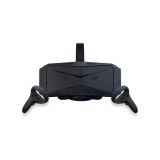 Pimax Crystal with its controllers.
-
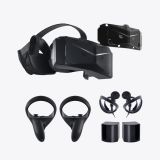 Pimax Crystal headset and accessories.
-
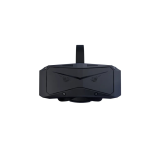 Pimax Crystal, announced as the Crystal QLED.


References
- ↑ 1.00 1.01 1.02 1.03 1.04 1.05 1.06 1.07 1.08 1.09 1.10 1.11 1.12 1.13 1.14 1.15 1.16 1.17 1.18 1.19 1.20 1.21 1.22 1.23 1.24 1.25 1.26 1.27 1.28 1.29 1.30 1.31 1.32 1.33 1.34 1.35 1.36 1.37 1.38 1.39 "Crystal User Guide". Pimax. https://web.archive.org/web/20230812121123/https://pimax.com/wp-content/uploads/2023/06/Crystal-User-Guide.pdf. Retrieved 2026-10-14.
- ↑ 2.00 2.01 2.02 2.03 2.04 2.05 2.06 2.07 2.08 2.09 2.10 David Heaney (2023-09-11). "Pimax Crystal Eye Tracking Enabled, Bringing Foveated Rendering & Automatic IPD". UploadVR. https://www.uploadvr.com/pimax-crystal-eye-tracking-standalone-mode-update/. Retrieved 2026-10-14.
- ↑ 3.0 3.1 3.2 3.3 3.4 3.5 3.6 "Pimax Crystal". Pimax. https://www.youtube.com/watch?v=xFoCQWtCrXM. Retrieved 2026-10-14.
- ↑ 4.0 4.1 4.2 4.3 4.4 4.5 4.6 4.7 4.8 David Heaney (2022-06-01). "Pimax Teases Crystal QLED $1900 Wireless Headset With 3K Per Eye". UploadVR. https://www.uploadvr.com/pimax-crystal-qled-announced/. Retrieved 2026-09-27.
- ↑ 5.0 5.1 5.2 5.3 5.4 5.5 5.6 5.7 Ben Lang (2022-06-01). "Pimax's New Headset is Priced & Positioned to Take on Varjo's Ultra-enthusiast Aero". Road to VR. https://roadtovr.com/pimax-reality-crystal-qled-announcement-price-release-date/. Retrieved 2026-09-27.
- ↑ 6.0 6.1 jaapgrolleman (2023-05-24). "Crystal update May 24: Shipping now to pre-orders". Pimax. https://web.archive.org/web/20230524075019/https://pimax.com/crystal-shipping-orders/. Retrieved 2026-10-14.
- ↑ 7.0 7.1 7.2 7.3 7.4 7.5 "Pimax Crystal Series Comparison: Crystal OG, Light & Super". Pimax Store. Pimax. https://store.pimax.com/pages/pimax-crystal-series-comparison-crystal-og-light-super. Retrieved 2026-10-27.
- ↑ 8.00 8.01 8.02 8.03 8.04 8.05 8.06 8.07 8.08 8.09 8.10 8.11 8.12 8.13 8.14 8.15 8.16 8.17 8.18 8.19 8.20 8.21 8.22 8.23 8.24 8.25 8.26 8.27 8.28 8.29 8.30 8.31 8.32 8.33 8.34 8.35 "Pimax Crystal". Pimax. https://web.archive.org/web/20230930030827/https://pimax.com/crystal/. Retrieved 2026-10-14.
- ↑ 9.0 9.1 9.2 9.3 9.4 9.5 David Heaney (2023-05-24). "Pimax Crystal Finally Shipping, But Key Features Missing At Launch". UploadVR. https://www.uploadvr.com/pimax-crystal-finally-shipping/. Retrieved 2026-09-27.
- ↑ 10.0 10.1 10.2 10.3 10.4 10.5 10.6 10.7 jaapgrolleman (2023-09-25). "Pimax launches 'Crystal-Sim': More Refresh-Rate Options, No Controllers & Updated appearance". Pimax. https://web.archive.org/web/20230925132920/https://pimax.com/pimax-launches-crystal-sim-more-refresh-rate-options-no-controllers-updated-appearance/. Retrieved 2026-10-27.
- ↑ 11.00 11.01 11.02 11.03 11.04 11.05 11.06 11.07 11.08 11.09 11.10 11.11 11.12 "Pimax Crystal". Pimax Japan. https://jp.pimax.com/en/products/pimax-crystal. Retrieved 2026-10-14.
- ↑ 12.00 12.01 12.02 12.03 12.04 12.05 12.06 12.07 12.08 12.09 12.10 12.11 Jaap Grolleman (2024-05-11). "Pimax Crystal FOV". Pimax. https://store.pimax.com/blogs/blogs/pimax-crystal-fov. Retrieved 2026-10-14.
- ↑ 13.0 13.1 13.2 13.3 13.4 13.5 Calvin Yau (2024-05-11). "Pimax releases eye tracking and auto-IPD for its Crystal (and public standalone mode beta)". Pimax. https://store.pimax.com/blogs/blogs/pimax-releases-eye-tracking-and-auto-ipd-for-its-crystal-and-public-standalone-mode-beta. Retrieved 2026-10-14.
- ↑ 14.0 14.1 14.2 14.3 14.4 14.5 14.6 14.7 "AMA July 7, Questions & Answers about the Pimax Crystal". Pimax Support. 2023-07-14. https://support.pimax.com/en/support/solutions/articles/60000948997-ama-july-7-questions-answers-about-the-pimax-crystal. Retrieved 2026-10-14.
- ↑ 15.0 15.1 Jaap Grolleman (2024-07-17). "Crystal Super update Q&A". Pimax Store. Pimax. https://pimax.com/blogs/blogs/crystal-super-update-q-a. Retrieved 2026-09-27.
- ↑ 16.0 16.1 16.2 16.3 16.4 "Lighthouse Faceplate User Guide". Pimax Support. 2024-09-05. https://support.pimax.com/en/support/solutions/articles/60001419274-lighthouse-faceplate-user-guide. Retrieved 2026-10-14.
- ↑ 17.0 17.1 17.2 17.3 Vera Liu (2025-09-19). "Pimax Play Roadmap". Pimax. https://store.pimax.com/blogs/blogs/pimax-play-roadmap. Retrieved 2026-10-14.
- ↑ 18.0 18.1 18.2 Jaap Grolleman (2025-11-13). "Updated Delivery Times for Upcoming Products". Pimax. https://www.pimax.com/explore/blogs/updated-delivery-times-for-upcoming-products. Retrieved 2026-10-27.
- ↑ 19.0 19.1 19.2 19.3 PimaxQuorra (2023-04-20). "Updated Crystal FAQ". Pimax / OpenMR. https://forum.openmr.com/t/updated-crystal-faq/40648. Retrieved 2026-10-14.
- ↑ 20.0 20.1 20.2 20.3 20.4 "Crystal Quick Guide". Pimax Support. 2024-05-20. https://support.pimax.com/helpdesk/attachments/60113831222. Retrieved 2026-10-14.
- ↑ 21.00 21.01 21.02 21.03 21.04 21.05 21.06 21.07 21.08 21.09 Benjamin Danneberg (2023-11-09). "Pimax Crystal review: A step in the right direction, but ...". MIXED. https://mixed-news.com/en/pimax-crystal-review/. Retrieved 2026-09-27.
- ↑ 22.00 22.01 22.02 22.03 22.04 22.05 22.06 22.07 22.08 22.09 22.10 22.11 22.12 Luke Baker (2024-02-13). "Pimax Crystal Review". Trusted Reviews. https://www.trustedreviews.com/reviews/pimax-crystal. Retrieved 2026-09-27.
- ↑ 23.0 23.1 23.2 23.3 Rob Cole (2023-09-15). "Pimax Crystal hands-on: a headset with astonishing visual clarity". Skarredghost. https://skarredghost.com/2023/09/15/pimax-crystal-hands-on-review-2/. Retrieved 2026-10-14.
- ↑ 24.0 24.1 24.2 24.3 24.4 24.5 24.6 Jorge Jimenez (2023-07-31). "Pimax Crystal VR headset review". PC Gamer. https://www.pcgamer.com/pimax-crystal-vr-headset-review/. Retrieved 2026-09-27.
- ↑ 25.0 25.1 Jan Wöbbeking (2023-05-26). "Pimax Crystal: Delivery started with two missing features". MIXED. https://mixed-news.com/en/pimax-crystal-delivery-started-with-two-missing-features/. Retrieved 2026-09-27.
- ↑ 26.0 26.1 26.2 "Pimax reveals two new high-end VR headsets at its annual Frontier keynote". Pimax. 2024-05-13. https://store.pimax.com/blogs/blogs/pimax-reveals-two-new-high-end-vr-headsets-at-its-annual-frontier-keynote. Retrieved 2026-10-14.
- ↑ 27.0 27.1 27.2 "Purchase - Pimax Crystal". Pimax Store. Pimax. 2026-09-17. https://web.archive.org/web/20260917063849/https://store.pimax.com/products/pimax-crystal. Retrieved 2026-10-27.
- ↑ Adrian Willings (2022-06-01). "New Pimax Crystal VR headset combines QLED and Mini-LED tech". Pocket-lint. https://www.pocket-lint.com/ar-vr/news/pc-gaming/161356-pimax-crystal-vr-headset-combines-qled-and-mini-led-tech/. Retrieved 2026-09-27.
- ↑ 29.0 29.1 "Hands-on: Pimax Crystal Touts Impressive Clarity, But Suffers From a (potentially fixable) Flaw". Road to VR. 2023-01-19. https://roadtovr.com/pimax-crystal-hands-on-review-ces-2023-blur/. Retrieved 2026-09-27.
- ↑ Adrian Willings (2022-10-31). "How to watch the Pimax Crystal launch event". Pocket-lint. https://www.pocket-lint.com/ar-vr/news/pc-gaming/163204-how-to-watch-the-pimax-crystal-launch-event/. Retrieved 2026-09-27.
- ↑ Josef Erl (2023-09-26). "Pimax Crystal-Sim: New VR headset announced specifically for VR simulations". MIXED. https://mixed-news.com/en/pimax-crystal-sim-new-vr-headset-announced-specifically-for-vr-simulations/. Retrieved 2026-10-27.
- ↑ 32.0 32.1 "Crystal Wide FOV Lens". Pimax. https://store.pimax.com/products/crystal-wide-fov-lens. Retrieved 2026-10-14.
- ↑ 33.0 33.1 "Purchase - Pimax 60G Airlink". Pimax Store. Pimax. https://store.pimax.com/products/pimax-60g-airlink. Retrieved 2026-09-27.
- ↑ 34.0 34.1 "Pimax Crystal - VR headset with glass aspheric lenses". CES Innovation Awards. Consumer Technology Association. https://www.ces.tech/ces-innovation-awards/2024/pimax-crystal-vr-headset-with-glass-aspheric-lenses/. Retrieved 2026-09-27.
- ↑ "Pimax Crystal Wins at the CES 2024 Innovation Awards". PR Newswire. Pimax. 2023-11-20. https://www.prnewswire.com/news-releases/pimax-crystal-wins-at-the-ces-2024-innovation-awards-301993462.html. Retrieved 2026-09-27.
- ↑ 36.0 36.1 David Heaney (2024-04-15). "Pimax Announces New Wired PC VR Headsets: $700 Crystal Light & $1800 Crystal Super". UploadVR. https://www.uploadvr.com/pimax-crystal-light-and-crystal-super/. Retrieved 2026-09-27.
- ↑ "Purchase - Pimax Crystal". Pimax Store. Pimax. https://store.pimax.com/products/pimax-crystal. Retrieved 2026-09-27.
- ↑ 38.0 38.1 38.2 Jaap Grolleman (2026-10-06). "Pimax Frontier 2026 FAQ". Pimax. https://www.pimax.com/explore/blogs/pimax-frontier-2026-faq. Retrieved 2026-10-14.
- ↑ Jaap Grolleman (2024-07-31). "July Progress Update: 12K, non-local dimming Crystal Light, wide FOV & more". Pimax. https://store.pimax.com/blogs/blogs/july-progress-update-12k-non-local-dimming-crystal-light-wide-fov-more. Retrieved 2026-10-14.
- ↑ "Crystal Eye-Tracking Troubleshooting Steps". Pimax Support. 2024-02-05. https://support.pimax.com/en/support/solutions/articles/60000986033-crystal-eye-tracking-troubleshooting-steps. Retrieved 2026-10-14.
- ↑ Calvin Yau (2024-05-11). "VRChat plugin for the Pimax Crystal". Pimax. https://store.pimax.com/blogs/blogs/vrchat-plugin-for-the-pimax-crystal. Retrieved 2026-10-14.
- ↑ 42.0 42.1 42.2 42.3 Rael Hornby (2024-07-27). "Pimax Crystal VR Headset review: Clear vision, rough edges". Laptop Mag. https://www.laptopmag.com/gaming/vr/pimax-crystal-vr-headset-review-clear-vision-rough-edges. Retrieved 2026-09-27.
- ↑ Calvin Yau. "60G Airlink demo & current status". Pimax Store. Pimax. https://store.pimax.com/blogs/blogs/60g-airlink-demo-current-status. Retrieved 2026-09-27.
- ↑ "Purchase - Pimax 60G Airlink". Pimax Store. Pimax. 2025-08-10. https://web.archive.org/web/20250810001831/https://pimax.com/products/pimax-60g-airlink. Retrieved 2026-10-27.
- ↑ Calvin Yau (2024-05-11). "HP Reverb G2 vs Pimax Crystal". Pimax. https://store.pimax.com/blogs/blogs/hp-reverb-g2-vs-pimax-crystal. Retrieved 2026-10-14.
- ↑ "Pimax Progress Update October 10th". Pimax Japan. 2024-10-10. https://jp.pimax.com/en/blogs/news/pimax-%E9%80%B2%E6%8D%97%E7%8A%B6%E6%B3%81%E6%9B%B4%E6%96%B0-10%E6%9C%8810%E6%97%A5. Retrieved 2026-10-14.
- ↑ Vera Liu (2024-12-31). "Progress Update 31st December". Pimax. https://web.archive.org/web/20250615140124/https://pimax.com/blogs/blogs/progress-update-31st-december. Retrieved 2026-10-27.
- ↑ 48.0 48.1 Sayem Ahmed (2023-07-17). "Pimax Crystal review: Crystal clear VR". Dexerto. https://www.dexerto.com/tech/pimax-crystal-review-2213605/. Retrieved 2026-10-27.
- ↑ 49.0 49.1 Aleksha McLoughlin (2023-09-14). "Pimax Crystal review - undeniably powerful, but unfinished". TechRadar. https://www.techradar.com/reviews/pimax-crystal. Retrieved 2026-09-27.
- ↑ "Varjo Introduces Varjo Aero Headset To Bring the Highest-Fidelity Virtual Reality For Professionals and Leading-Edge VR Users Alike". Varjo. 2021-10-21. https://varjo.com/news/varjo-introduces-varjo-aero-headset-to-bring-the-highest-fidelity-virtual-reality-for-professionals-and-leading-edge-vr-users-alike. Retrieved 2026-10-14.
- ↑ "New Prices for Meta Quest 2's 256GB SKU + Meta Quest Pro". Meta. 2023-03-03. https://www.meta.com/blog/price-drop-news/. Retrieved 2026-10-14.
- ↑ 52.0 52.1 52.2 52.3 "Varjo Aero". Varjo. https://varjo.com/products/aero. Retrieved 2026-10-14.
- ↑ "Render Scale". Meta Horizon OS Developers. 2025-01-09. https://developers.meta.com/vr/documentation/unity/os-render-scale/. Retrieved 2026-10-14.
- ↑ "Meta Quest Pro". Qualcomm. https://www.qualcomm.com/xr-vr-ar/device-finder/meta-quest-pro. Retrieved 2026-10-14.
- ↑ 55.0 55.1 "Meta Quest Pro Is Now Available". Meta. 2022-10-25. https://about.fb.com/news/2022/10/meta-quest-pro-is-now-available/. Retrieved 2026-10-14.
- ↑ Zhi Zhang, Meng Gai, Sheng Li (2025). "Visual Acuity Consistent Foveated Rendering Towards Retinal Resolution". IEEE Transactions on Visualization and Computer Graphics, vol. 31, no. 10, pp. 7121-7136. doi:10.1109/TVCG.2025.3539851. https://iccvm.org/2026/files/papers/ps7_1.pdf. Retrieved 2026-10-14.
- ↑ Z. Zhu, G. D. Love, R. K. Dos Anjos (2026). "Rethinking Color Precision: Real-Time Perceptual Spatial Quantization for Foveated Rendering". Eurographics Symposium on Rendering 2026, Symposium Track. doi:10.2312/sr.20261013. https://rafaelkuffner.github.io/assets/papers/EGSR2026.pdf. Retrieved 2026-10-14.
- ↑ "Rethinking Color Precision: Real-Time Perceptual Spatial Quantization for Foveated Rendering". Eurographics Digital Library. 2026. https://diglib.eg.org/items/312715fd-c3bb-4492-b8c4-d3467513ea1b. Retrieved 2026-10-14.