Pimax Reality 12K QLED
More actions
| Pimax Reality 12K QLED | |
|---|---|

| |
| Basic Info | |
| VR/AR | Virtual Reality |
| Type | Head-mounted display |
| Subtype | Standalone VR, PC VR |
| Platform | Pimax Play (development platform)[1] |
| Creator | Pimax |
| Developer | Pimax |
| Manufacturer | Pimax |
| Announcement Date | October 25, 2021[2] |
| Release Date | In development (manufacturer status checked October 15, 2026)[1] |
| Price | US$2,399 (announced in 2021)[2] |
| Website | https://store.pimax.com/pages/pimax-12k |
| Versions | Pimax Reality 12K QLED |
| Requires | PC VR planned; original standalone mode under reconsideration[3] |
| Predecessor | Pimax 8K X |
| System | |
| Chipset | Qualcomm Snapdragon XR2 (original dual-mode design)[4] |
| Display | |
| Display | Dual 6K QLED (announced); panel technology under development[5] |
| Resolution | 6K per eye target; "12K" across both eyes[3] |
| Refresh Rate | Up to 200 Hz in original PC VR announcement[6] |
| Image | |
| Field of View | 200° horizontal, 135° vertical, 240° diagonal (2021 PC VR claims)[6] |
| Horizontal FoV | 200° PC VR; 150° standalone (2021 claims)[6] |
| Vertical FoV | 135° (2021 claim)[6] |
| Foveated Rendering | Eye-tracked rendering planned[3] |
| Optics | |
| Optics | Combined aspheric/Fresnel "Bionic" lenses (original design)[2] |
| Ocularity | Binocular |
| IPD Range | 57-72 mm, automatic motor adjustment (2021 claim)[7] |
| Passthrough | MR cover proposed in 2021[8] |
| Tracking | |
| Tracking | 6DoF inside-out; optional SteamVR tracking cover (announced)[7] |
| Base Stations | Optional Lighthouse cover proposed[8] |
| Eye Tracking | Tobii (planned)[9] |
| Face Tracking | Announced[7] |
| Hand Tracking | Announced[7] |
| Body Tracking | Camera-based tracking announced[7] |
| Rotational Tracking | Planned[7] |
| Positional Tracking | Planned[7] |
| Audio | |
| Audio | Headstrap speakers; deluxe speaker module proposed[7] |
| Microphone | Three microphones (2021 report)[7] |
| Camera | 11-camera array (2021 announcement)[7] |
| Connectivity | |
| Connectivity | DisplayPort, USB-C, Wi-Fi 6E; optional 60 GHz WiGig (announced)[8][10] |
| Ports | Three USB Type-C, DisplayPort, proprietary WiGig/Pimax IF interfaces (2021 concept)[8] |
| Wired Video | Native PC VR proposed[10] |
| Wireless Video | Wi-Fi 6E and optional 60 GHz WiGig proposed[10] |
| WiFi | Wi-Fi 6E (original design)[10] |
| Power | Rear swappable battery (original design)[7] |
| Battery Capacity | 6,000 mAh (announced)[7] |
| Device | |
| Headstrap | Rear battery and integrated audio shown in announcement design[7] |
| Sensors | 11-camera tracking array (announced)[7] |
| Input | Optically tracked controllers and hand/eye tracking proposed; optional Lighthouse cover[7] |
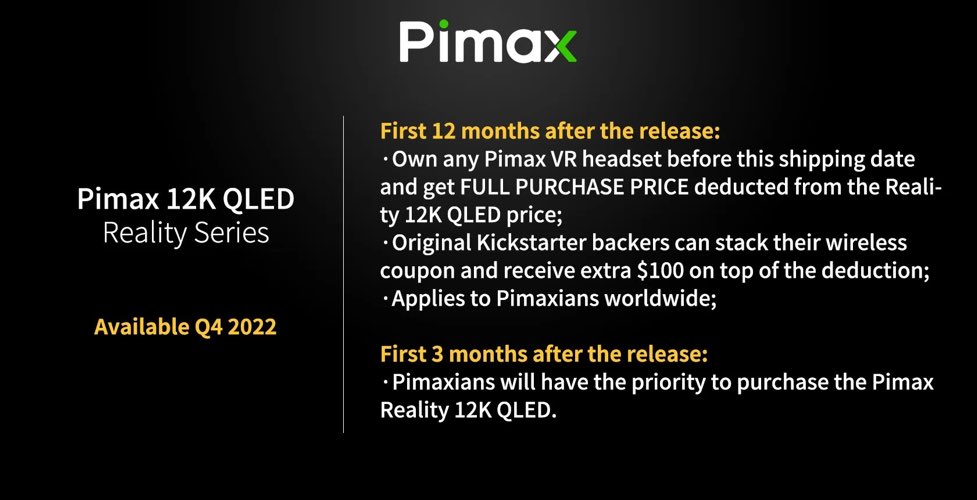
The Pimax Reality 12K QLED is a virtual reality head-mounted display project announced by Pimax on October 25, 2021. The original design combined standalone VR and PC VR, with dual 6K QLED displays, an ultrawide field of view and an announced price of US$2,399. Pimax originally targeted the fourth quarter of 2022.[2][11] Its product page still describes the project as in development. In April 2026, founder Robin Weng said that the 12K would probably become a PC VR headset rather than retain the original dual-mode design.[1][3]
Status
Pimax's project page, checked on October 15, 2026, labels the 12K "In progress" and says that key components are not yet available. It describes shared work with the Crystal and Dream Air series on tracking, controllers, ergonomics, display compression, audio and Pimax Play.[1] Weng's April 3, 2026 answers retained the goal of 6K per eye and an ultrawide field of view, while describing a probable move to PC VR only. These statements leave the original standalone hardware and feature list subject to revision.[3]
History and development
Pimax's October 2021 company account dates its founding to 2014. The company presented the Reality project as part of its own "VR 3.0" roadmap at Pimax Frontier; that wording was Pimax's branding for its proposed hardware and ecosystem.[12]
October 2021 announcement
The online Frontier event took place on October 25, 2021. Contemporary coverage described the 12K as a future hybrid PC/standalone headset, with QLED panels, mini-LED backlighting, eye tracking and replaceable modules. The announced US$2,399 price was a launch proposal rather than a documented retail transaction.[2] The release slide forecast availability in Q4 2022.[11]
Pimax's November 2022 support explanation treated the 12K as the continuation of the 8K X's wide-field approach, while describing Pimax Crystal as a separate product line.[13] A later comparison described shared Snapdragon XR2 hardware, controllers, software updates, automatic IPD and local dimming. That comparison retains old Crystal preorder language despite a May 2024 update date; its undated Q3 demonstration and Q4 roadshow plans do not establish a commercial release.[4]
Design and operation
The 2021 architecture diagram divided the design into a customized PC VR engine and a standalone engine based on Qualcomm Snapdragon XR2. It showed native PC video through a fiber-optic cable, optional 60 GHz WiGig, and Wi-Fi 6E with split rendering. The PC and standalone modes had different advertised resolution, refresh-rate and field-of-view limits.[10][6]
Those were plans for one hybrid headset, rather than evidence that every mode was implemented. Weng's 2026 statement that PC VR only was the probable direction superseded the assumption that standalone operation was a settled requirement.[3]
Display technology
The launch design used two QLED panels with mini-LED backlighting and a reported 4,400 local dimming elements. Pimax described compound aspheric/Fresnel optics as "Bionic" lenses.[2] The project name combines the horizontal resolution of the two eyes; Pimax's 2026 description states the goal as 6K per eye.[3]
Road to VR explicitly labeled its 5,760 × 3,240 per-eye figure an estimate in the original announcement report. It was not a confirmed manufacturer panel specification.[7] Pimax's November 2025 update continued to investigate both LCD and micro-OLED approaches. It described larger panels versus higher pixel density as competing LCD routes, and panel size as a difficulty for micro-OLED. This work did not announce a completed micro-OLED 12K model.[5]
The original mode slide listed PC VR rates of 90, 120, 144, 160 and 200 Hz, compared with 75, 90 and 120 Hz for standalone operation. These are announced operating targets, not measured refresh rates of a shipping headset.[6]
Field of view
Pimax's 2021 mode slide specified 200° horizontal, 135° vertical and 240° diagonal for native PC VR. It gave 150° horizontal, 135° vertical and 200° diagonal for standalone mode.[6] Tom's Hardware reported 210° horizontally at the announcement; the original slide instead shows 200°. The values describe the advertised design and should not be treated as independently measured visible fields of view.[2][6]
Eye tracking
Pimax and Tobii announced their partnership on October 21, 2021, before Frontier. Their release described planned native eye tracking in Pimax's next generation of high-end headsets.[9] Launch coverage described motor-driven automatic IPD adjustment; Road to VR listed an announced 57-72 mm range.[2][7] In 2026, Weng continued to discuss eye-tracked foveated rendering as part of the rationale for a wide-field 12K design, because peripheral regions could render at lower resolution.[3]
Tracking system
The original design proposed inside-out tracking for the headset and controllers. The announced 11-camera breakdown was four cameras for head/hand/controller tracking, two for the eyes, two for the face and three for mouth/body tracking. Launch coverage also listed three microphones and headstrap speakers.[7] Pimax's announcement graphic specifically showed four outward cameras for six-degree-of-freedom inside-out tracking. Its body-tracking illustration described a proposed feature and supplied no independent accuracy test.[2]
An optional Lighthouse cover would add SteamVR tracking. Hand, face and body tracking also appeared among the proposed modules; the announcement does not establish that every accessory would be included in the base price.[8]
Battery and physical design
The announcement design put a swappable 6,000 mAh battery at the rear of the headstrap and integrated speakers into the strap. Battery endurance and final headset weight were unknown in the contemporary specification summary.[7] Although Tom's Hardware described the proposed design as smaller and lighter than Pimax's earlier models, this was announcement coverage, without a measured production weight or dimensions.[2]
Connectivity and modules
Pimax's interface graphic listed three USB Type-C connections, DisplayPort, a proprietary WiGig port and a Pimax IF interface. Its proposed modules included 60 GHz WiGig, a Lighthouse cover, a swappable battery, hand/face/body tracking, a mixed-reality cover, a cellular 5G cover and deluxe speakers. It also invited third-party modules. These illustrated options were an accessory roadmap.[8]
The wireless architecture distinguished Wi-Fi 6E split rendering from the optional 60 GHz WiGig route. Native PC VR used a direct cable connection in the diagram.[10]
Announced specifications
The following table records Pimax's 2021 mode targets. The 2026 PC VR direction means the standalone column remains historical.[6][3]
| Feature | PC VR Mode | Standalone Mode |
|---|---|---|
| Resolution | "12K" across both eyes; 6K per eye target | "8K / 5K" in the announcement slide; exact per-eye dimensions not specified |
| Horizontal FOV | 200° | 150° |
| Vertical FOV | 135° | 135° |
| Refresh Rate | 90, 120, 144, 160 or 200 Hz | 75, 90 or 120 Hz |
| Tracking | Inside-out; optional SteamVR tracking cover | Inside-out |
| Eye Tracking | Tobii planned | Tobii planned |
| Diagonal FOV | 240° | 200° |
The tracking and eye-tracking rows summarize the original shared hardware proposal.[7][9] The table does not state that maximum resolution, refresh rate and field of view were independently demonstrated together.
Development constraints
Pimax's July 2024 explanation said that some early technical solutions had not met its quality requirements. The company described a dual DisplayPort 1.4/dual-bridge attempt whose visual quality it found unsatisfactory, a need for a suitable DisplayPort 2.1 bridge chip, and further lens and housing problems. It said that Crystal Super would arrive first.[14]
The November 2025 update described two remaining component areas: a suitable DisplayPort-to-MIPI bridge and a suitable high-resolution display. Pimax said that available bridge solutions consumed too much power or were too large, while planned alternatives were still being discussed with chip manufacturers. It continued work on both LCD and micro-OLED panel routes.[5]
The published targets describe the project's intended display, tracking and connectivity features. The manufacturer updates describe unresolved engineering work; they do not provide production measurements for latency, weight, battery endurance or a final minimum-PC specification. The current status page and April 2026 answers continue to describe development rather than a new dated release commitment.[1][3]
Trade-in program
The original release slide proposed crediting the full purchase price of a Pimax headset owned before the 12K shipping date toward a 12K purchase during the first year after release. It described worldwide availability, an additional US$100 and stackable wireless coupon for original Kickstarter backers, and priority ordering during the first three months. This was a future program tied to the proposed release.[11]
Pimax's November 2025 update offered eligible owners the option to apply up to half of their trade-in value, capped at US$399, to a complete Crystal Super headset and retain the balance for the 12K. Pimax said the deduction applied to the Prime portion of the price, excluded individual optical engines and did not combine with the separate Crystal-owner discount. These are the terms described in that dated update.[5]
See Also
References
- ↑ 1.0 1.1 1.2 1.3 1.4 "Pimax 12K". Pimax. https://store.pimax.com/pages/pimax-12k. Retrieved 2026-10-15.
- ↑ 2.00 2.01 2.02 2.03 2.04 2.05 2.06 2.07 2.08 2.09 Kevin Carbotte (2021-10-25). "Pimax's Next-Generation Reality 12K QLED VR Headset Defies Belief". Tom's Hardware. https://www.tomshardware.com/news/pimaxs-next-generation-reality-12k-qled-vr-headset-defies-belief. Retrieved 2026-10-15.
- ↑ 3.00 3.01 3.02 3.03 3.04 3.05 3.06 3.07 3.08 3.09 Vera Liu (2026-04-03). "Your questions, Robin's answers". Pimax. https://store.pimax.com/blogs/blogs/your-questions-robins-answers. Retrieved 2026-10-15.
- ↑ 4.0 4.1 Jaap Grolleman (2024-05-10). "The Pimax 12K compared to the Crystal". Pimax. https://store.pimax.com/blogs/blogs/the-pimax-12k-compared-to-the-crystal. Retrieved 2026-10-15.
- ↑ 5.0 5.1 5.2 5.3 Jaap Grolleman (2025-11-24). "12K update & Trade-In program - November 2025". Pimax. https://store.pimax.com/blogs/blogs/12k-update-trade-in-program-november-2025. Retrieved 2026-10-15.
- ↑ 6.0 6.1 6.2 6.3 6.4 6.5 6.6 6.7 6.8 "Native PC VR Mode / Standalone VR Mode". Pimax (2021 announcement slide reproduced by Road to VR). 2021-10-25. https://i0.wp.com/www.roadtovr.com/wp-content/uploads/2021/10/pimax-reality-12k-qled-6.jpg?quality=89&ssl=1. Retrieved 2026-10-15.
- ↑ 7.00 7.01 7.02 7.03 7.04 7.05 7.06 7.07 7.08 7.09 7.10 7.11 7.12 7.13 7.14 7.15 7.16 7.17 7.18 7.19 Ben Lang (2021-10-26). "Pimax Announces Wildly Ambitious New Standalone VR Headset with a Price to Match". Road to VR. https://www.roadtovr.com/pimax-reality-12k-qled-announcement-release-date-price-specs/. Retrieved 2026-10-15.
- ↑ 8.0 8.1 8.2 8.3 8.4 8.5 "Modules made by Pimax". Pimax (2021 announcement slide reproduced by Road to VR). 2021-10-25. https://i0.wp.com/www.roadtovr.com/wp-content/uploads/2021/10/pimax-reality-12k-qled-3.jpg?quality=89&ssl=1. Retrieved 2026-10-15.
- ↑ 9.0 9.1 9.2 "Pimax and Tobii Enter Into Partnership to Make Eye Tracking a Standard Feature in Next Generation Pimax Virtual Reality Headsets". Pimax via GlobeNewswire. 2021-10-21. https://www.globenewswire.com/news-release/2021/10/21/2318720/0/en/Pimax-and-Tobii-Enter-Into-Partnership-to-Make-Eye-Tracking-a-Standard-Feature-in-Next-Generation-Pimax-Virtual-Reality-Headsets.html. Retrieved 2026-10-15.
- ↑ 10.0 10.1 10.2 10.3 10.4 10.5 "Pimax Customized PC VR Engine / Standalone VR Engine". Pimax (2021 announcement slide reproduced by Road to VR). 2021-10-25. https://i0.wp.com/www.roadtovr.com/wp-content/uploads/2021/10/pimax-reality-12k-qled-5.jpg?quality=89&ssl=1. Retrieved 2026-10-15.
- ↑ 11.0 11.1 11.2 "Pimax 12K QLED Reality Series: Available Q4 2022". Pimax (2021 announcement slide reproduced by Tom's Hardware). 2021-10-25. https://cdn.mos.cms.futurecdn.net/gVwS6oDePjeFABN6AEdT5R.jpg. Retrieved 2026-10-15.
- ↑ "Pimax To Unveil Breakthrough "VR 3.0" Virtual Reality Technology at Annual Pimax Frontier Conference". Pimax via PR Newswire. 2021-10-19. https://www.prnewswire.com/news-releases/pimax-to-unveil-breakthrough-vr-3-0-virtual-reality-technology-at-annual-pimax-frontier-conference-301403091.html. Retrieved 2026-10-15.
- ↑ "The difference between Pimax Crystal and Pimax 12K". Pimax Support. 2022-11-01. https://support.pimax.com/en/support/solutions/articles/60000803099-the-difference-between-pimax-crystal-and-pimax-12k. Retrieved 2026-10-15.
- ↑ Jaap Grolleman (2024-07-31). "July Progress Update: 12K, non-local dimming Crystal Light, wide FOV & more". Pimax. https://eu.pimax.com/blogs/blogs/july-progress-update-12k-non-local-dimming-crystal-light-wide-fov-more. Retrieved 2026-10-15.