

HTC Vive Pro Eye
More actions
| HTC Vive Pro Eye | |
|---|---|

| |
| Basic Info | |
| VR/AR | Virtual Reality |
| Type | Head-mounted display |
| Subtype | PC-Powered VR |
| Platform | SteamVR, Viveport |
| Creator | HTC |
| Developer | HTC |
| Manufacturer | HTC |
| Announcement Date | 7 January 2019 (CES 2019) |
| Release Date | 15 May 2019 (Europe, orders opened); 24 May 2019 (China, announced launch date); 6 June 2019 (United States) |
| Price | US$1,599 full kit at US launch (June 2019); US$1,399 full kit and US$799 headset only from March 2020 |
| Website | https://www.vive.com/sea/product/vive-pro-eye/overview/ |
| Versions | Full Kit; Office; Office Arena Bundle |
| Requires | Windows PC with DisplayPort 1.2 and USB 3.0; SteamVR base stations |
| Predecessor | HTC Vive Pro |
| Successor | HTC Vive Pro 2 |
| System | |
| Operating System | Windows 7, 8.1 or later, 10, 11 (host PC) |
| Display | |
| Display | Dual 3.5-inch OLED |
| Resolution | 1440 x 1600 per eye (2880 x 1600 combined) |
| Refresh Rate | 90 Hz |
| Image | |
| Field of View | 110 degrees (HTC figure) |
| Optics | |
| Ocularity | Binocular |
| IPD Range | Adjustable with a dial (no range published by HTC) |
| Passthrough | Dual front-facing cameras |
| Tracking | |
| Tracking | SteamVR Tracking (outside-in, SteamVR Base Station 2.0) |
| Eye Tracking | Yes (Tobii), 120 Hz binocular gaze output, 0.5 to 1.1 degree accuracy within the central 20 degrees (HTC figures) |
| Audio | |
| Audio | Removable Hi-Res certified headphones, high-impedance headphone support |
| Microphone | Dual integrated microphones |
| Camera | Dual front-facing cameras |
| Connectivity | |
| Connectivity | USB-C 3.0, DisplayPort 1.2, Bluetooth; link box to PC |
| Bluetooth | Yes |
| Device | |
| Sensors | SteamVR Tracking, G-sensor, gyroscope, proximity sensor, IPD sensor, eye tracking |
| Input | Two Vive Controllers (2018) in the full kit |
The HTC Vive Pro Eye (marketed as VIVE Pro Eye) is a PC-tethered virtual reality head-mounted display made by HTC. It is a version of the 2018 HTC Vive Pro with built-in eye tracking supplied by the Swedish company Tobii, and HTC aimed it mainly at enterprise customers rather than gamers.[1][2][3] The headset keeps the Vive Pro's two OLED panels (1440 x 1600 pixels per eye, 90 Hz, 110 degree field of view) and uses SteamVR Tracking with external base stations. HTC lists a binocular gaze output of 120 Hz and an eye-tracking accuracy of 0.5 to 1.1 degrees within the central 20 degrees of the field of view.[4]
HTC announced the Vive Pro Eye at CES 2019 on 7 January 2019. It went on sale in Europe on 15 May 2019 and in the United States on 6 June 2019, where the full kit with two base stations and two controllers cost US$1,599.[1][5][6] The eye tracker makes foveated rendering, gaze-based menu selection, attention heat maps and eye movement on avatars possible, and the headset became a common tool in academic eye-tracking research in VR.[7][8] In March 2020 HTC replaced the original Vive Pro with the Vive Pro Eye packages.[9] Its 2021 successor, the HTC Vive Pro 2, has no built-in eye tracking.[10]
Announcement and release
CES 2019 announcement
HTC revealed the Vive Pro Eye at its CES 2019 press conference in Las Vegas on 7 January 2019, describing it as an enterprise product.[1] According to Road to VR, the headset looked largely the same as the Vive Pro, kept its resolution, and had minor changes such as revised headphone padding. HTC said the Vive Pro Eye "is targeted at the enterprise market where eye tracking has a number of immediate benefits" and gave a launch window of the second quarter of 2019, without a price.[11]
On 8 January 2019 Tobii announced that it supplied the eye-tracking technology. In autumn 2018 Tobii had announced an agreement with an unnamed leading VR manufacturer, and it now named that partner as HTC.[2][12] Tobii chief executive Henrik Eskilsson called HTC "one of the most influential companies in the VR industry" and said the integration established eye tracking as a core VR technology.[12]
The CES demonstrations included a foveated rendering version of ZeroLight's BMW car configurator, an MLB Home Run Derby game whose menus could be operated by gaze alone, the Ovation public-speaking trainer, which GamesBeat described as using eye tracking to check that the user looks at the audience (Pocket-lint reported that the Ovation demo it tried did not use eye tracking), and a Lockheed Martin Prepar3D flight-training scenario in which the user activated aircraft systems by looking at them.[3][13]
Release
HTC opened orders in 25 European countries on 15 May 2019, and pre-orders in China opened the same day for a launch on 24 May 2019.[5][14] The headset was not sold on its own at first. The only package was a full kit with the headset, link box, two Vive controllers and two SteamVR Base Station 2.0 units.[5][14] According to VentureBeat, HTC said an additional services package called "Advantage" was required for commercial use; it added a two-year warranty and expedited repairs.[5][14]
The headset launched in the United States on 6 June 2019 at US$1,599 for the full kit. In Canada the price was CA$2,149.[6][15] TechCrunch noted that the US price was US$200 above the US$1,399 Vive Pro bundle, and about four times the price of the Oculus Rift S.[16]
2020 packages and price changes
On 2 March 2020 HTC cut the price of the full kit from US$1,599 to US$1,399 (from £1,499 to £1,299 in the United Kingdom) and added two business packages.[17][18] Vive Pro Eye Office added HTC's business warranty and service plan, which replaced the earlier "Advantage" package. The Vive Pro Eye Office Arena Bundle added two more base stations, for tracking areas of up to 10 m by 10 m, and a 20 m fiber-optic headset cable. Both were scheduled for the second quarter of 2020.[17][18] GamesBeat reported that the headset-only price went from US$999 to US$799 at the same time, and that HTC's 60 GHz wireless adapter remained a separate US$300 purchase.[19]
A week later Road to VR reported that HTC was discontinuing the original Vive Pro, selling off remaining stock, and moving that part of its range to the Vive Pro Eye Full Kit, Office and Office Arena packages. Road to VR called the Vive Pro Eye "effectively the same headset but with eye-tracking".[9]
| Date | Package | Region | Price |
|---|---|---|---|
| 15 May 2019 | Full kit | Europe | €1,708 including VAT (€1,389 before VAT)[5]; £1,499[14] |
| 15 May 2019 (pre-order) | Full kit | China | ¥13,888 including VAT[5] |
| 6 June 2019 | Full kit | United States, Canada | US$1,599; CA$2,149[6][15] |
| 2 March 2020 | Full kit | United States, United Kingdom | US$1,399; £1,299[17] |
| 2 March 2020 | Headset only | United States | US$799[19] |
| Q2 2020 (announced March 2020) | Office | United States, United Kingdom | US$1,599; £1,551[17] |
| Q2 2020 (announced March 2020) | Office Arena Bundle | United States, United Kingdom | US$2,350; £2,280[17] |
Later accessories and successor
In March 2021 HTC announced US sales of the VIVE Facial Tracker, a US$129.99 add-on for the Vive Pro and Vive Pro Eye, from 24 March 2021. The tracker uses two cameras at 60 Hz with an infrared illuminator and, according to HTC, tracks "38 facial movements across the lips, jaw, teeth, tongue, chin, and cheeks".[20]
The HTC Vive Pro 2, announced in May 2021, does not have built-in eye tracking. UploadVR called this "curious" given that the Vive Pro Eye had it, and reported that the Vive Pro 2 and the HTC Vive Focus 3 would instead support the third-party Droolon F2 eye-tracking module, priced at US$299.[10] HTC's Southeast Asia website still had Vive Pro Eye overview and specification pages in October 2026.[4][21]
Design and hardware
Display and optics
The headset has two 3.5-inch OLED panels with 1440 x 1600 pixels each (2880 x 1600 combined), a 90 Hz refresh rate and a 110 degree field of view; Road to VR noted that the resolution was unchanged from the Vive Pro.[4][11] HTC's overview page gives the pixel density as 615 PPI.[21] ZeroLight and academic researchers describe the panels as AMOLED displays.[22][23] The headset adjusts eye relief by changing the lens distance. A dial sets the lens separation (HTC calls it the "Eye Comfort Setting"), and the headset has a sensor that reads this setting.[4] During setup, software tells the user how to turn the dial so that the lenses line up with the eyes.[24][3]
Tracking
The headset and controllers use Valve's SteamVR Tracking, an outside-in system that reads signals from base stations placed around the room. HTC sets no minimum space for standing or seated use. For room-scale use, the two SteamVR Base Station 2.0 units in the kit cover up to 5 m by 5 m, and four base stations cover up to 10 m by 10 m.[4] The headset also has a G-sensor, a gyroscope and a proximity sensor.[4]
Audio, cameras and connections
HTC's US specification page listed Hi-Res certified audio, removable headphones, support for high-impedance headphones and enhanced headphone ergonomics. The headset has two built-in microphones.[25] Two front-facing cameras sit on the visor. HTC recommends Windows 10 for the best results with them, and Windows 7 needs a separate driver.[4] The kit connects to the PC through a link box with a DisplayPort cable and a USB 3.0 cable, and the PC needs a DisplayPort 1.2 output and a USB 3.0 port. HTC lists USB-C 3.0, DisplayPort 1.2 and Bluetooth as the headset's connections.[4][5]
Controllers
The full kit includes two Vive Controllers (2018). Each controller is tracked by SteamVR Tracking 2.0 and has a multifunction trackpad, grip buttons, a dual-stage trigger, a system button, a menu button and a micro-USB charging port.[4]
Package contents
HTC lists the following items in the full kit: the Pro Eye headset, two SteamVR Base Station 2.0 units with two power adapters, two Vive Controllers (2018) with lanyards, micro-USB cables and power adapters, a link box with power adapter, a headset cable, a USB 3.0 cable, a DisplayPort cable, a base-station mounting kit, a cleaning cloth, two earphone hole caps, documentation and a Viveport redemption code.[4]
PC requirements
| Component | Minimum |
|---|---|
| Processor | Intel Core i5-4590 or AMD FX 8350, equivalent or better |
| Graphics | NVIDIA GeForce GTX 970 or AMD Radeon R9 290, equivalent or better |
| Memory | 4 GB RAM or more |
| Video output | DisplayPort 1.2 or newer |
| USB | One USB 3.0 or newer port |
| Operating system | Windows 7, Windows 8.1 or later, Windows 10, Windows 11 |
For enterprise use HTC recommends an NVIDIA GeForce GTX 1070 or Quadro P5000 or above, or an AMD Radeon Vega 56, Radeon Pro WX 7100 or FirePro W9100 or above.[4]
Eye tracking
Hardware and specifications
The eye tracker comes from Tobii, and HTC markets it as "precision eye tracking powered by Tobii".[2][21] HTC publishes these figures:[4]
| Item | Value |
|---|---|
| Gaze data output frequency (binocular) | 120 Hz |
| Accuracy | 0.5 to 1.1 degrees, within the central 20 degrees of the field of view |
| Calibration | 5-point |
| Trackable field of view | 110 degrees |
| Data output | Timestamp (device and system), gaze origin, gaze direction, pupil position, pupil size, eye openness |
| Interface | HTC SRanipal SDK |
| Engine compatibility | Unity, Unreal Engine |
HTC warns that eye surgery, eye disease, heavy makeup and high myopia may affect tracking performance.[4] In GamesBeat's CES demo, calibration asked the user to follow a dot through five positions (center and four corners).[3] Developers can read eye data through HTC's SRanipal SDK or through Tobii's own SDKs; academic studies have used both.[23][26]
Applications
HTC promoted four uses for the eye tracker: foveated rendering, heat maps of where users look, gaze-based menu navigation, and avatars that show the user's eye movements and blinks in collaboration apps.[7] At launch UploadVR expected few SteamVR or Viveport games to add eye-tracking support soon and noted that HTC was working with companies on dedicated enterprise applications instead.[6]
Foveated rendering draws full detail only where the user is looking and less detail in the periphery to reduce the load on the PC.[1] ZeroLight's demonstration for the Vive Pro Eye ran on an NVIDIA Quadro RTX 6000 and used NVIDIA's variable rate shading (VRS). The eye position updated a shading-rate mask every frame, with full-rate shading where the user looked and 2x2 and 4x4 rates further out. For the headset, ZeroLight also upgraded its BMW M Virtual Experience to render at nine times the display resolution (supersampling) to reduce aliasing.[22] At CES 2019 GamesBeat reported an unnamed developer's claim that foveated rendering saved 30 percent of GPU power compared with standard rendering.[3]
Measured performance
Independent studies have measured the eye tracker. Schuetz and Fiehler (Justus Liebig University Giessen, 2022) tested eighteen participants over ten sessions with targets across 30 degrees horizontally and vertically. They found a mean accuracy of 1.08 degrees after outlier correction (0.97 degrees for targets inside the central 20 degrees). Accuracy and precision were best for central gaze and fell off toward the periphery. Calibration worked for every participant, but glasses wearers had significantly lower accuracy and precision, and the two headsets tested differed in accuracy but not in precision. The authors wrote that the Vive Pro Eye "is currently widely used for behavioral experiments in academic research labs".[8]
A 2021 Tübingen study of the headset for home vision testing (perimetry) found that accuracy and precision dropped at the edges of the display and during head movement. Data loss during head movement was about twice that of the head-still phases (7.56 percent against 3.69 percent). The study measured a system latency of 58.1 ms, which the authors considered promising for an at-home aid for people with vision loss.[23]
Stein and colleagues compared eye-tracking delays and end-to-end latencies of three headsets against electrooculography, with participants making 20 degree saccades. The Vive Pro Eye was the slowest of the three. Its results were about the same with HTC's SRanipal SDK and with the Tobii XR SDK (a tracker delay of about 50 ms and an end-to-end latency of about 80 ms), and the authors judged its values "out of the range suitable for gaze-contingent experiments".[26]
| Headset | Tracker delay, first study | Tracker delay, second study | End-to-end latency, second study |
|---|---|---|---|
| FOVE 0 | 15 ms | 16 ms | 45 ms |
| Varjo VR-1 | 36 ms | 36 ms | 57 ms |
| HTC Vive Pro Eye (SRanipal SDK) | 52 ms | 50 ms | 79 ms |
| HTC Vive Pro Eye (Tobii XR SDK) | not tested | 51 ms | 81 ms |
Reception
Coverage of the Vive Pro Eye focused on the eye tracking and on the headset's business focus. After CES demos, UploadVR's Ian Hamilton wrote that the Tobii tracking "seemed to work across a variety of demos but its real-world benefits are still unclear." He reported that members of the ZeroLight team used the tracking with glasses on without problems, but wrote that the supersampling improvements "weren't readily apparent" to him on the Vive Pro panel.[24] Pocket-lint's Dan Grabham said gaze-based menu selection "really does work" and called the headset "clearly aimed at professional uses."[13] GamesBeat saw several eye-tracking glitches that needed software restarts during the CES demos, which appeared to be driver-related.[3] Digital Trends staff found the foveated rendering impressive, but felt its commercial use was "a little creepy."[7]
At the US launch, TechCrunch's Lucas Matney called the US$200 premium over the Vive Pro "a bit healthy" and argued that consumers had little reason to buy the headset until more software supported eye tracking.[16] UploadVR described it as "very much an enterprise-level headset", priced about US$600 above the Valve Index.[6]
See also
- HTC Vive Pro
- HTC Vive Pro 2
- HP Reverb G2 Omnicept Edition
- Pico Neo 2 Eye
- Varjo VR-1
- Eye tracking
- Foveated rendering
- Enterprise VR
Gallery
-
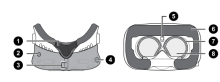 Bottom and interior diagram of HTC Vive Pro Eye; eye trackers are labeled 7.

References
- ↑ 1.0 1.1 1.2 1.3 Jamie Feltham (2019-01-07). "CES 2019: HTC Announces Vive Pro Eye With Integrated Eye-Tracking And Foveated Rendering". UploadVR. https://www.uploadvr.com/htc-vive-pro-eye-announced/. Retrieved 2026-10-12.
- ↑ 2.0 2.1 2.2 David Heaney (2019-01-08). "CES 2019: HTC Vive Pro's Eye Tracking Is Supplied By Tobii". UploadVR. https://www.uploadvr.com/vive-pro-eye-tobii/. Retrieved 2026-10-12.
- ↑ 3.0 3.1 3.2 3.3 3.4 3.5 "HTC Vive Pro Eye hands-on: Gaze into VR's future with foveated rendering". GamesBeat. 2019-01-10. https://gamesbeat.com/htc-vive-pro-eye-hands-on-gaze-into-vrs-future-with-foveated-rendering/. Retrieved 2026-10-12.
- ↑ 4.00 4.01 4.02 4.03 4.04 4.05 4.06 4.07 4.08 4.09 4.10 4.11 4.12 "VIVE Pro Eye Specs". VIVE Southeast Asia. HTC Corporation. https://www.vive.com/sea/product/vive-pro-eye/specs/. Retrieved 2026-10-12.
- ↑ 5.0 5.1 5.2 5.3 5.4 5.5 5.6 Scott Hayden (2019-05-15). "Vive Pro Eye Now Available in Europe Starting at €1,700". Road to VR. https://roadtovr.com/vive-pro-eye-now-available-europe-starting-e1700/. Retrieved 2026-10-12.
- ↑ 6.0 6.1 6.2 6.3 6.4 Jamie Feltham (2019-06-06). "Vive Pro Eye Out Now In The US For $1,599". UploadVR. https://www.uploadvr.com/vive-pro-eye-released/. Retrieved 2026-10-12.
- ↑ 7.0 7.1 7.2 Anita George (2019-06-06). "HTC's Vive Pro Eye, a $1,600 VR headset with eye-tracking, is all business". Digital Trends. https://www.digitaltrends.com/computing/htc-releases-vive-pro-eye-vr-headset-in-the-us/. Retrieved 2026-10-12.
- ↑ 8.0 8.1 Immo Schuetz, Katja Fiehler (2022-09-07). "Eye tracking in virtual reality: Vive Pro Eye spatial accuracy, precision, and calibration reliability". Journal of Eye Movement Research, vol. 15, no. 3. https://doi.org/10.16910/jemr.15.3.3. Retrieved 2026-10-12.
- ↑ 9.0 9.1 Ben Lang (2020-03-09). "HTC Discontinuing Vive Pro and Vive Focus in Favor of Newer Iterations". Road to VR. https://roadtovr.com/htc-discontinuing-vive-pro-and-vive-focus-in-favor-of-newer-iterations/. Retrieved 2026-10-12.
- ↑ 10.0 10.1 Jamie Feltham (2021-05-11). "Vive Pro 2, Focus 3 Getting Eye-Tracking Add-On, Focus Getting Hand-Tracking". UploadVR. https://www.uploadvr.com/vive-pro-2-focus-3-eye-tracking-add-on/. Retrieved 2026-10-12.
- ↑ 11.0 11.1 Ben Lang (2019-01-07). "HTC Announces Vive Pro Eye Headset With Integrated Eye-tracking". Road to VR. https://roadtovr.com/htc-vive-pro-eye-tracking-announcement-ces-2019/. Retrieved 2026-10-12.
- ↑ 12.0 12.1 "Tobii and HTC bring eye tracking to next-gen VR headset". Evertiq. 2019-01-08. https://evertiq.com/news/45366. Retrieved 2026-10-12.
- ↑ 13.0 13.1 Dan Grabham (2019-01-08). "HTC Vive Pro Eye initial review: The future of VR is controller-free". Pocket-lint. https://www.pocket-lint.com/ar-vr/reviews/htc/146709-htc-vive-pro-eye-review/. Retrieved 2026-10-12.
- ↑ 14.0 14.1 14.2 14.3 Jeremy Horwitz (2019-05-15). "HTC's Vive Pro Eye arrives in Europe and China for roughly $2,000". VentureBeat. https://venturebeat.com/2019/05/15/htcs-vive-pro-eye-arrives-in-europe-and-china-for-roughly-2000. Retrieved 2026-10-12.
- ↑ 15.0 15.1 Ro (2019-06-07). "HTC Vive Pro Eye hits stores in USA and Canada". GSMArena. https://www.gsmarena.com/htc_vive_pro_eye_hits_the_the_stores_in_the_usa_and_canada-news-37458.php. Retrieved 2026-10-12.
- ↑ 16.0 16.1 Lucas Matney (2019-06-06). "HTC launches Vive Pro Eye stateside, costs four times as much as Rift S". TechCrunch. https://techcrunch.com/2019/06/06/vive-pro-eye-launches-in-us-costs-four-times-as-much-as-rift-s/. Retrieved 2026-10-12.
- ↑ 17.0 17.1 17.2 17.3 17.4 Jamie Feltham (2020-03-02). "HTC Vive Pro Eye Gets A Price Cut And New Bundles". UploadVR. https://www.uploadvr.com/htc-vive-pro-eye-price-cut/. Retrieved 2026-10-12.
- ↑ 18.0 18.1 Scott Hayden (2020-03-02). "HTC Announces New Vive Pro Eye Packages for Enterprise, Reduces Base Kit to $1,400". Road to VR. https://roadtovr.com/htc-announces-new-vive-pro-eye-packages-enterprise-reduces-base-kit-1400/. Retrieved 2026-10-12.
- ↑ 19.0 19.1 "HTC's Vive Pro Eye headset drops to $799 as lower-end model sells out". GamesBeat. 2020-03-02. https://gamesbeat.com/htcs-vive-pro-eye-headset-drops-to-799-as-lower-end-model-sells-out/. Retrieved 2026-10-12.
- ↑ Ian Hamilton (2021-03-09). "HTC Vive Pro Facial Tracker For Sale In The U.S. This Month". UploadVR. https://www.uploadvr.com/vive-pro-facial-tracker/. Retrieved 2026-10-12.
- ↑ 21.0 21.1 21.2 "VIVE Pro Eye Overview". VIVE Southeast Asia. HTC Corporation. https://www.vive.com/sea/product/vive-pro-eye/overview/. Retrieved 2026-10-12.
- ↑ 22.0 22.1 "Foveated Rendering on the VIVE PRO Eye". ZeroLight. 2019-04-25. https://zerolight.com/news/foveated-rendering-on-the-vive-pro-eye. Retrieved 2026-10-12.
- ↑ 23.0 23.1 23.2 Alexandra Sipatchin, Siegfried Wahl, Katharina Rifai (2021). "Eye-Tracking for Clinical Ophthalmology with Virtual Reality (VR): A Case Study of the HTC Vive Pro Eye's Usability". Healthcare, vol. 9, no. 2, article 180. https://doi.org/10.3390/healthcare9020180. Retrieved 2026-10-12.
- ↑ 24.0 24.1 Ian Hamilton (2019-01-11). "CES 2019 Vive Pro Eye: Impressions Of Tobii Eye Tracking". UploadVR. https://www.uploadvr.com/ces-2019-vive-pro-eye-impressions/. Retrieved 2026-10-12.
- ↑ "VIVE Pro Eye Specs". VIVE United States. HTC Corporation. 2021-04-16. https://web.archive.org/web/20210416103221/https://www.vive.com/us/product/vive-pro-eye/specs/. Retrieved 2026-10-12.
- ↑ 26.0 26.1 26.2 Niklas Stein, Diederick C. Niehorster, Tamara Watson, Frank Steinicke, Katharina Rifai, Siegfried Wahl, Markus Lappe (2021). "A Comparison of Eye Tracking Latencies Among Several Commercial Head-Mounted Displays". i-Perception, vol. 12, no. 1. https://doi.org/10.1177/2041669520983338. Retrieved 2026-10-12.