

Pimax Crystal Super
More actions
| Pimax Crystal Super | |
|---|---|

| |
| Basic Info | |
| VR/AR | Virtual Reality |
| Type | Head-mounted display |
| Subtype | PC VR |
| Platform | SteamVR, Pimax Play, OpenXR |
| Creator | Pimax |
| Developer | Pimax |
| Manufacturer | Pimax |
| Announcement Date | 15 April 2024 (Pimax Frontier)[1] |
| Release Date | 2025 (QLED); micro-OLED shipping reported by January 2026[2][3] |
| Price | Announced from US$1,799 excluding VAT (2024)[4] |
| Website | https://www.pimax.com/product/crystal-super |
| Versions | QLED 50 PPD, QLED 57 PPD, QLED Ultrawide, 8K Micro-OLED |
| Requires | Windows PC, DisplayPort and USB connections[5] |
| Predecessor | Pimax Crystal |
| System | |
| Operating System | Windows |
| Display | |
| Display | QLED + Mini-LED local dimming; Sony micro-OLED option |
| Resolution | QLED: 3840 × 3840 per eye; micro-OLED: 3840 × 3552 per eye[6] |
| Pixel Density | Advertised 50 or 57 PPD (QLED); 53 PPD (micro-OLED) |
| Refresh Rate | 72/90 Hz in optical-engine specifications; see display notes[5] |
| Image | |
| Horizontal FoV | Advertised 127° (50 PPD), 106° (57 PPD), 140° (Ultrawide), 116° (micro-OLED)[6] |
| Foveated Rendering | Eye-tracked dynamic, subject to software/GPU support |
| Optics | |
| Optics | Replaceable optical engines; glass aspheric (QLED), ConcaveView pancake (micro-OLED)[5] |
| Ocularity | Binocular |
| IPD Range | 58-72 mm; automatic adjustment[5][7] |
| Passthrough | Monochrome, documented in the 2024 product FAQ[8] |
| Tracking | |
| Tracking | 6DoF inside-out SLAM; optional Crystal Super Lighthouse Faceplate |
| Base Stations | Required only for the optional Lighthouse tracking configuration[9] |
| Eye Tracking | Yes; published sampling rates conflict (see eye-tracking notes)[6][10] |
| Hand Tracking | Optional hand-tracking module[11] |
| Rotational Tracking | Yes |
| Positional Tracking | Yes |
| Audio | |
| Audio | Built-in earphones; optional DMAS replacement earphones[12] |
| Microphone | Dual microphones[5] |
| 3.5mm Audio Jack | Yes[5] |
| Camera | Four tracking cameras[7] |
| Connectivity | |
| Connectivity | DisplayPort 1.4a, USB 3.0[13] |
| Ports | DisplayPort, USB; accessory USB-C port |
| Wired Video | Yes (DisplayPort) |
| Wireless Video | No |
| Power | External supply; no built-in battery[14] |
| Device | |
| Weight | 966 g with DMAS, as reported in a hands-on review[15] |
| Input | Pimax inside-out controllers; SteamVR controllers with Lighthouse configuration |
The Pimax Crystal Super is a PC-powered virtual reality headset made by Pimax. Its replaceable optical engine contains the displays and lenses, with QLED and micro-OLED configurations. It connects to a Windows computer through DisplayPort and USB, uses camera-based tracking as standard, and supports a model-specific Lighthouse tracking accessory. It has no standalone mode or built-in battery.[4][14]
History and development
Pimax announced Crystal Super alongside Pimax Crystal Light at its Frontier event on 15 April 2024. The announcement proposed interchangeable QLED and micro-OLED display assemblies, built-in eye tracking and PC-only operation. Pimax quoted a starting price of US$1,799 excluding VAT and estimated Q4 2024 shipping.[1][4]
The original Pimax Crystal, which Pimax dates to May 2023, has a different display resolution and includes battery-based features that Super omits. Crystal Super's interchangeable optical engine is also distinct from the original Crystal's replaceable lenses.[16][4]
| Date | Development |
|---|---|
| 7 April 2025 | Pimax's Crystal-series comparison identifies this as Crystal Super's release date.[16] |
| 11 June 2025 | Pimax reported that many 50 PPD QLED headsets had shipped. It described delays caused by QLED-panel shortages and additional quality checks, and offered unshipped customers a change to the separate Ultrawide configuration.[2] |
| 9 September 2025 | Pimax reported fulfillment of 95% of 50 PPD orders, with 57 PPD and Ultrawide production still catching up after component shortages.[17] |
| 3 January 2026 | Pimax said customers had already received micro-OLED engines or complete micro-OLED headsets. It also opened ordering for the Crystal Super Lighthouse Faceplate.[3] |
| 26 May 2026 | Pimax reported that micro-OLED pre-orders placed before 30 April were produced, while giving region-specific estimated delivery windows.[18] |
| 2 October 2026 | Pimax announced resumed micro-OLED optical-engine production and an 8 October limited-batch pre-order opening. Delivery for that batch was estimated for late November or December 2026.[19] |
Display technology
The QLED configurations use 3840 × 3840 pixels per eye, approximately 29.5 million pixels across both panels, with a Mini-LED backlight and local dimming.[4] Pimax calls its dimming system "Local Dimming 2.0" and advertises approximately 2,000 dimming zones and 200-280 nits of brightness.[20]
The micro-OLED engine uses Sony panels with 3840 × 3552 pixels per eye and ConcaveView pancake optics. Its panel resolution, lens system and advertised angular density differ from those of the QLED engines.[6][5]
| Optical engine | Display | Resolution per eye | Optics | Advertised pixels per degree | Advertised horizontal field of view |
|---|---|---|---|---|---|
| QLED 50 PPD | QLED + Mini-LED | 3840 × 3840 | Glass aspheric | 50 | Approximately 127°[6][5] |
| QLED 57 PPD | QLED + Mini-LED | 3840 × 3840 | Glass aspheric | 57 | Approximately 106°[6][5] |
| QLED Ultrawide | QLED + Mini-LED | 3840 × 3840 | Glass aspheric | 50 | Approximately 140°[6][5] |
| 8K Micro-OLED | Sony micro-OLED | 3840 × 3552 | ConcaveView pancake | 53 | Approximately 116°[6][5] |
The 50 PPD engine and the Ultrawide engine are separate configurations. Pimax describes Ultrawide as changing the position of the 50 PPD optics and reducing stereo overlap to increase horizontal field of view.[2]
Pimax's field-of-view guidance states that eye-socket depth, headset position and face-cushion thickness affect the measured result. Its test procedure specifies the user's IPD setting and the standard 11 mm face cushion, and recommends repeated measurements. The advertised angles are therefore not guaranteed measurements for every wearer.[21]
Published refresh-rate documentation is inconsistent. The QLED store specifications and the enterprise optical-engine table list 72/90 Hz, and the micro-OLED comparison gives a 90 Hz maximum. Pimax's general product page lists 90/120 Hz without specifying the engine or operating mode. Its November 2024 FAQ described native-resolution 120 Hz as a planned Labs mode that could change or be withdrawn. These documents do not establish native-resolution 120 Hz operation across all shipped configurations.[7][5][6][20][8]
Modular optical engine system
The headset accepts separate optical engines, allowing a matching QLED or micro-OLED assembly to replace the installed module. Compatibility also depends on the connector generation: Pimax's August 2026 replacement instructions warn that the original 70-pin connector and a newer connector are incompatible. The October 2026 production notice identifies the newer design as 62-pin and says engines are offered for both types, with orders checked against headset serial numbers.[22][19]
Replacing an engine involves removing the facial cover, disconnecting the headset's DisplayPort cable and powering it off. Some headsets have retaining screws that must be removed before taking out the assembly. Optical-engine swapping is consequently not universally tool-free. Pimax directs owners to confirm connector compatibility before installation.[22]
The October 2026 notice says Pimax has reserved repair and warranty stock for both connector generations.[19]
Eye tracking and rendering
Crystal Super includes eye tracking for dynamic foveated rendering and automatic interpupillary-distance adjustment. Pimax identifies Tobii as an eye-tracking partner. Its QLED material advertises 120 Hz capture and ten infrared sensors. Micro-OLED documentation gives conflicting sampling rates: the regional page describes 90 Hz eye tracking, while the general micro-OLED specifications list 120 Hz.[7][16][8][6][10]
Dynamic foveated rendering uses gaze information to concentrate rendering detail around the viewed region. Availability depends on the software and graphics-card path. Pimax's April 2026 support guidance says that DFR and Smart Smoothing are not supported on the AMD GPU platform in Pimax Play.[23]
Calibration also depends on fit and visibility of the eyes. Pimax lists thick glasses or prescription inserts, dirty lenses, loose fit, light leakage and movement during calibration among possible reasons for failure.[24]
Tracking system and input
Inside-out tracking
Four outward-facing cameras support the headset's inside-out SLAM tracking and its matching Pimax controllers without external base stations. The supplied controller design belongs to the Crystal-series inside-out system; it is separate from Pimax's Sword controllers for Lighthouse tracking.[7][8][9]
Pimax documented a black-and-white passthrough view in its November 2024 Crystal Super FAQ. This is distinct from the proposed mixed-reality faceplate discussed in that announcement.[8]
Lighthouse configuration
Using Lighthouse tracking requires the Crystal Super Lighthouse Faceplate and external SteamVR base stations. The accessory contains 28 infrared sensors and uses the headset's bottom USB-C connection. It is specific to Crystal Super, and the original Crystal and Crystal Light faceplates do not fit. Pimax lists compatibility with all four optical-engine configurations.[9]
In that Lighthouse configuration, Pimax lists Sword, Valve Index and HTC Vive controllers, together with VIVE Tracker 1.0/2.0/3.0 and Tundra Trackers.[9]
The installation guide requires removal of the optical engine and the original faceplate, four frame screws, and a USB-C cable connection. Pimax advises contacting support when another accessory already occupies the bottom USB-C port.[25]
Hand input
Pimax's April 2026 support FAQ confirms compatibility with its hand-tracking module; its earlier Crystal Super Q&A describes connecting the Ultraleap module at the bottom USB-C port. Camera-based hand tracking is a separate software development. The June 2026 Pimax EVO announcement included Crystal Super among its planned targets, while noting that its initial hand-tracking release was available on Dream Air and Dream Air SE first.[11][26][27]
Audio system and physical fit
Crystal Super has default earphones, a 3.5 mm headphone jack and dual microphones. DMAS earphones are an optional replacement: the installation guide describes removing the original earphones with a screwdriver and fastening the left and right DMAS units to the headset's existing mounts.[12][5]
Its published IPD range is 58-72 mm with automatic adjustment. Pimax also describes an eye-relief wheel that changes the distance between the eyes and lenses. These adjustments and the face cushion affect fit and the visible field of view.[5][7][8][21] In January 2026, Pimax announced prescription lens inserts for the micro-OLED engine.[3]
The QLED headset has a plastic exterior. Weight depends on the installed equipment: Boosted Media's hands-on QLED review reports 966 g with DMAS fitted.[15]
Connectivity and requirements
Crystal Super uses a wired DisplayPort and USB connection and an external power supply. Pimax's support documentation specifies DisplayPort 1.4a and USB 3.0, a standard 5 m cable, and an adapter rated at 12 V/2 A with a 3.5 × 1.35 mm connector. It says the standard cable is not interchangeable with the 6 m fiber-optic cable and does not recommend particular third-party extension cables, which it has not systematically tested.[13][28][29]
There is no Wi-Fi streaming or Pimax AirLink mode: the headset has no built-in battery and requires a cable during use.[14]
Pimax Play provides the headset's PC software configuration, with SteamVR/OpenVR and OpenXR application paths. Pimax's support site directs owners to application-specific settings and compatibility reports.[7][30]
| Component | Listed minimum | Listed recommended | Listed "Best Experience" |
|---|---|---|---|
| Graphics card | NVIDIA RTX 3070 | NVIDIA RTX 4080 | NVIDIA RTX 4090 |
| CPU | Intel Core i5-12600K | Intel Core i7-13700K | Intel Core i9-14900K |
| Memory | 16 GB | 32 GB | 64 GB |
| Display output | DisplayPort 1.4 | DisplayPort 1.4 | DisplayPort 1.4 |
| Operating system | Windows 10 | Windows 11 | Windows 11 |
The general product page supplies these hardware categories.[20] A separate store page lists an RTX 2080 minimum and an RTX 3070 recommendation. Pimax Business separately recommends RTX 3080/4070-class or higher hardware for enterprise workflows and states that performance varies with engine choice, application, resolution, refresh rate and scene complexity.[7][5]
Applications
Pimax markets Crystal Super for flight and racing simulation, design visualization and enterprise training. Its interchangeable optics provide different documented combinations of display type and field of view.[5][20]
See Also
Gallery
-
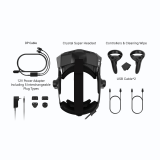 Illustrated Pimax Crystal Super kit layout.

References
- ↑ 1.0 1.1 "Pimax reveals two new high-end VR headsets at its Frontier event". PR Newswire. 2024-04-15. https://www.prnewswire.com/news-releases/pimax-reveals-two-new-high-end-vr-headsets-at-its-frontier-event-302116401.html. Retrieved 2026-10-14.
- ↑ 2.0 2.1 2.2 "Update on shipping & option to change to the Ultrawide". Pimax. 2025-06-11. https://au.pimax.com/blogs/blogs/update-on-shipping-option-to-change-to-the-ultrawide. Retrieved 2026-10-14.
- ↑ 3.0 3.1 3.2 "Micro-OLED Launch Event: In-depth look at Hardware Upgrades, Shipping & Production". Pimax. 2026-01-03. https://me.pimax.com/blogs/blogs/micro-oled-launch-event-in-depth-look-at-hardware-upgrades-shipping-production. Retrieved 2026-10-14.
- ↑ 4.0 4.1 4.2 4.3 4.4 "Pimax reveals two new high-end VR headsets at its annual Frontier keynote". Pimax. 2024-05-13. https://store.pimax.com/blogs/blogs/pimax-reveals-two-new-high-end-vr-headsets-at-its-annual-frontier-keynote. Retrieved 2026-10-14.
- ↑ 5.00 5.01 5.02 5.03 5.04 5.05 5.06 5.07 5.08 5.09 5.10 5.11 5.12 5.13 5.14 5.15 "Pimax Crystal Super Enterprise". Pimax. https://business.pimax.com/headsets/crystal-super. Retrieved 2026-10-14.
- ↑ 6.00 6.01 6.02 6.03 6.04 6.05 6.06 6.07 6.08 6.09 "Crystal Super Micro-OLED". Pimax. https://au.pimax.com/pages/crystal-super-micro-oled. Retrieved 2026-10-14.
- ↑ 7.0 7.1 7.2 7.3 7.4 7.5 7.6 7.7 "Pimax Crystal Super". Pimax. https://store.pimax.com/pages/pimax-crystal-super. Retrieved 2026-10-14.
- ↑ 8.0 8.1 8.2 8.3 8.4 8.5 "Sync FAQ: Crystal Super, Light, 60G Airlink, Prime, and 12K Trade-in". Pimax. 2024-11-28. https://store.pimax.com/blogs/blogs/sync-faq-crystal-super-light-60g-airlink-prime-big-fov-lenses-and-12k-trade-in. Retrieved 2026-10-14.
- ↑ 9.0 9.1 9.2 9.3 "Crystal Super Lighthouse Faceplate". Pimax. https://store.pimax.com/products/crystal-super-lighthouse-faceplate. Retrieved 2026-10-14.
- ↑ 10.0 10.1 "Crystal Super 8K Micro-OLED". Pimax. https://www.pimax.com/product/crystal-8k. Retrieved 2026-10-14.
- ↑ 11.0 11.1 "Can the Hand Tracking Module Be Used with the Crystal Super?". Pimax Support. 2026-04-03. https://support.pimax.com/en/support/solutions/articles/60001644615-can-the-hand-tracking-module-be-used-with-the-crystal-super-. Retrieved 2026-10-14.
- ↑ 12.0 12.1 "How to install DMAS headphones". Pimax Support. 2025-04-24. https://support.pimax.com/en/support/solutions/articles/60001567403-how-to-install-dmas-headphones. Retrieved 2026-10-14.
- ↑ 13.0 13.1 "Does the Crystal Super Support Extension Cables?". Pimax Support. 2026-04-03. https://support.pimax.com/en/support/solutions/articles/60001644618-does-the-crystal-super-support-extension-cables-. Retrieved 2026-10-14.
- ↑ 14.0 14.1 14.2 "Does the Crystal Super Support Wireless Streaming / WiGig / AirLink?". Pimax Support. 2026-04-03. https://support.pimax.com/en/support/solutions/articles/60001644614-does-the-crystal-super-support-wireless-streaming-wigig-airlink-. Retrieved 2026-10-14.
- ↑ 15.0 15.1 "Pimax Crystal Super - Detailed Review". Boosted Media. https://boostedmedia.net/sim-racing/hardware-reviews/pimax/pimax-crystal-super-detailed-review/3/. Retrieved 2026-10-14.
- ↑ 16.0 16.1 16.2 "Pimax Crystal Series Comparison: Crystal OG, Light & Super". Pimax. https://store.pimax.com/pages/pimax-crystal-series-comparison-crystal-og-light-super. Retrieved 2026-10-14.
- ↑ "Crystal Super Production Update (50 PPD, 57 PPD, Ultrawide)". Pimax. 2025-09-09. https://store.pimax.com/blogs/blogs/crystal-super-production-update-50-ppd-57-ppd-ultrawide-1. Retrieved 2026-10-14.
- ↑ "Pimax Dream Air & Crystal Super — Production & Shipping Update". Pimax. 2026-05-26. https://au.pimax.com/blogs/blogs/pimax-dream-air-crystal-super-production-shipping-update. Retrieved 2026-10-14.
- ↑ 19.0 19.1 19.2 "Back in production: Crystal Super micro-OLED optical engine, pre-orders open October 8th". Pimax. 2026-10-02. https://store.pimax.com/blogs/blogs/back-in-production-crystal-super-micro-oled-optical-engine-pre-orders-open-october-8th. Retrieved 2026-10-14.
- ↑ 20.0 20.1 20.2 20.3 "Crystal Super - Flagship clarity and the widest FOV for pros.". Pimax. https://www.pimax.com/product/crystal-super. Retrieved 2026-10-14.
- ↑ 21.0 21.1 "How to correctly measure the FOV of Crystal Super?". Pimax Support. 2026-04-03. https://support.pimax.com/en/support/solutions/articles/60001644611-how-to-correctly-measure-the-fov-of-crystal-super-. Retrieved 2026-10-14.
- ↑ 22.0 22.1 "How do I replace the optical engine on my Crystal Super?". Pimax Support. 2026-08-31. https://support.pimax.com/en/support/solutions/articles/60001644605-how-do-i-replace-the-optical-engine-on-my-crystal-super-. Retrieved 2026-10-14.
- ↑ "Troubleshooting Guide for the Missing "Smart Smoothing" Feature in Pimax Play". Pimax Support. 2026-04-03. https://support.pimax.com/en/support/solutions/articles/60001644610-troubleshooting-guide-for-the-missing-smart-smoothing-feature-in-pimax-play. Retrieved 2026-10-14.
- ↑ "Headset Eye Tracking Calibration Fails". Pimax Support. 2026-04-03. https://support.pimax.com/en/support/solutions/articles/60001644625-headset-eye-tracking-calibration-fails. Retrieved 2026-10-14.
- ↑ "Crystal Super Lighthouse Faceplate Step-by-Step Guide". Pimax Support. 2026-08-03. https://support.pimax.com/en/support/solutions/articles/60001646936-crystal-super-lighthouse-faceplate-step-by-step-guide. Retrieved 2026-10-14.
- ↑ "Crystal Super update Q&A". Pimax. 2024-07-17. https://store.pimax.com/blogs/blogs/crystal-super-update-q-a. Retrieved 2026-10-14.
- ↑ "Introducing Pimax EVO". Pimax. 2026-06-18. https://me.pimax.com/blogs/blogs/introducing-pimax-play-evo. Retrieved 2026-10-14.
- ↑ "How Long Is the Standard DP Cable for the Crystal Super? Is There a Longer Cable Available?". Pimax Support. 2026-04-03. https://support.pimax.com/en/support/solutions/articles/60001644617-how-long-is-the-standard-dp-cable-for-the-crystal-super-is-there-a-longer-cable-available-. Retrieved 2026-10-14.
- ↑ "Does the Crystal Super Support Third-Party Power Supplies? What Are the Power Specifications?". Pimax Support. 2026-04-03. https://support.pimax.com/en/support/solutions/articles/60001644619-does-the-crystal-super-support-third-party-power-supplies-what-are-the-power-specifications-. Retrieved 2026-10-14.
- ↑ "Game Compatibility Guide". Pimax Support. 2026-04-03. https://support.pimax.com/en/support/solutions/articles/60001644609-game-compatibility-guide. Retrieved 2026-10-14.