

Pimax Crystal Light
More actions
| Pimax Crystal Light | |
|---|---|

| |
| Basic Info | |
| VR/AR | Virtual Reality |
| Type | Head-mounted display |
| Subtype | PC VR |
| Platform | SteamVR, Pimax Play |
| Creator | Pimax |
| Developer | Pimax |
| Manufacturer | Pimax |
| Announcement Date | April 15, 2024[1] |
| Release Date | May 2024 (first batch reported shipped)[2] |
| Price | US$699 announced starting price (2024); US$899 full payment (US store, checked October 14, 2026)[1][3] |
| Website | https://www.pimax.com/product/crystal-light |
| Versions | Pimax Crystal Light |
| Requires | Windows PC, DisplayPort 1.4a, USB 3.0 and external power adapter[3][4] |
| Predecessor | Pimax Crystal |
| System | |
| Operating System | Windows 10/11 (64-bit, manufacturer specification)[3] |
| Chipset | Host PC dependent |
| CPU | Host PC dependent |
| GPU | Host PC; manufacturer minimum list includes RTX 2070 and RX 5700 XT[3] |
| Storage | |
| Storage | Host PC dependent |
| Memory | Host PC dependent |
| Display | |
| Display | QLED LCD with mini-LED local dimming (local-dimming model)[5] |
| Resolution | 2880 × 2880 per eye (16,588,800 pixels across both displays)[5] |
| Pixel Density | 35 PPD (manufacturer rating)[5] |
| Refresh Rate | 72 / 90 / 120 Hz selectable; legacy page also lists 60 Hz[6][5] |
| Image | |
| Field of View | 110° horizontal (current manufacturer specification); earlier advertised values differ[6][7] |
| Horizontal FoV | 110° (manufacturer specification)[6] |
| Vertical FoV | 105° (earlier anniversary-page claim)[7] |
| Foveated Rendering | Fixed 2.0; no built-in eye tracking[5] |
| Optics | |
| Optics | Glass aspheric lenses[5] |
| Ocularity | Binocular |
| IPD Range | 58-72 mm, manual wheel adjustment[5][8] |
| Adjustable Diopter | Prescription inserts offered separately; not a diopter-adjustment specification[9] |
| Passthrough | Grayscale camera view (documented in 2024 reviews)[10] |
| Tracking | |
| Tracking | 6DoF inside-out tracking; optional Lighthouse faceplate[5] |
| Base Stations | Not required for inside-out mode; required for optional Lighthouse mode[11] |
| Eye Tracking | No built-in eye tracking[5] |
| Hand Tracking | EVO camera-based support listed as coming soon (checked October 14, 2026)[12] |
| Body Tracking | Compatible external SteamVR trackers with Lighthouse faceplate[11] |
| Rotational Tracking | Yes |
| Positional Tracking | Yes |
| Play Space | Room-scale VR |
| Audio | |
| Audio | Integrated speakers; 3.5 mm jack; optional DMAS upgrade[5] |
| Microphone | Two microphones[5] |
| 3.5mm Audio Jack | Yes |
| Camera | Four inside-out tracking cameras[6] |
| Connectivity | |
| Connectivity | DisplayPort 1.4a, USB 3.0[6] |
| Ports | PC-side DisplayPort and USB; 3.5 mm audio jack[4][5] |
| Wired Video | Yes (DisplayPort) |
| Wireless Video | No |
| Power | External adapter connected to the tether[4] |
| Battery Capacity | N/A (tethered) |
| Battery Life | N/A (tethered) |
| Charge Time | N/A |
| Device | |
| Weight | 815 g (manufacturer headset rating)[5] |
| Headstrap | Adjustable rear dial and top strap[4] |
| Haptics | Controllers[6] |
| Sensors | Four tracking cameras[6] |
| Input | Pimax inside-out controllers; compatible SteamVR controllers with Lighthouse faceplate[13][11] |
The Pimax Crystal Light is a high-resolution PC VR head-mounted display developed by Pimax, announced on April 15, 2024 at the company's Frontier event with a starting price of US$699.[1] It retains the 2880 × 2880 per-eye displays and glass aspheric lenses of the original Pimax Crystal, but removes the standalone processor, battery and built-in eye tracking. It uses a tethered computer for rendering and supports either camera-based inside-out tracking or an optional Lighthouse faceplate.[14][15]
Pimax reported its first batch shipped in May 2024. The US store still listed the local-dimming headset at US$899 for full payment when checked on October 14, 2026; shipping and taxes are additional. The manufacturer lists two controllers, a DisplayPort cable and a power adapter in the standard package.[2][3][5] Pimax listed the Crystal Light as in stock in the US in its October 15, 2026 shipping update.[16]
History and development
Pimax heritage and previous products
Pimax's earlier line included the 5K and 8K headsets before the original Crystal.[17] Its wide-field-of-view PC VR line preceded Crystal, which combined PC VR with a standalone mode. Contemporary launch coverage described Crystal Light as a lower-cost, PC-only derivative of Crystal, and Crystal Super as a separate higher-resolution product.[15] Removing standalone computing, eye tracking and automatic lens spacing reduced the feature set; the retained glass lenses and display resolution distinguished the Light from a lower-resolution redesign.[14]
April 2024 announcement and first shipments
Pimax opened pre-orders on the day of the announcement and said shipping would begin in May 2024.[1] Road to VR and UploadVR reported prices of US$700 for the base model and US$900 for the version with mini-LED local dimming.[14][15] Pimax's dated announcements page recorded that the first batch had shipped by May 27, 2024. Its May 31 progress update also said the first batch had shipped, following alpha and beta testing and the start of mass production.[2][18] These statements document the first batch, rather than simultaneous delivery to every customer or market.
Release and pricing changes
In August 2024, Pimax said regular purchases of the non-local-dimming version were on hold while it optimized that panel. Pimax said customers who had pre-ordered it at US$699 would receive a headset with local dimming enabled for a free 15-day trial, after which the feature could be kept with a US$200 upgrade.[19] The notice tied the optional upgrade to the headset serial number and said local dimming would disable after the trial if the customer did not purchase it. This arrangement concerned the non-local-dimming pre-order cohort.[19] An August 20, 2024 progress update confirmed that shipments to this cohort were under way.[20]
In November 2024, Pimax stated that the Crystal Light had originally launched at US$899 and added a Pimax Prime option starting at US$599 upfront, with the remainder paid through 24 months of US$11.99 Prime payments or a one-time payment of US$269.[21] The lower upfront figure was part of a payment arrangement, rather than the complete headset price. Pimax's March 2025 troubleshooting page said an expired trial or unpaid subscription could leave a headset unavailable until payment.[22]
The store's October 14, 2026 listing displayed US$899 for its full-payment option. It also listed a 14-day return guarantee for qualifying newly purchased headsets and a 12-month product warranty, with conditions and regional rules; the listing explicitly excluded shipping and taxes from the displayed price.[3] Historical financing figures should be read with their dates rather than treated as a current checkout offer. Pimax's October 15, 2026 shipping update, which used the US market as its example, listed the Crystal Light as "In Stock" with an estimated fulfillment time of 3-5 business days after payment. The update said estimates for several in-stock models had shortened from 5-7 business days, described the figures as estimates rather than guaranteed delivery dates, and said timelines vary by product, configuration and region.[16]
Crystal Super and the wider range
Crystal Super was announced alongside Crystal Light, with higher-resolution displays and retained eye tracking. The announcement described QLED and micro-OLED configurations for Super, which is a separate product in the Crystal family.[15] Pimax's December 2025 buying guide described Pimax Dream Air as expanding its range rather than replacing Crystal Light or Pimax Crystal Super.[23] The Crystal Light store page continued to offer the Light alongside Crystal Super when checked in October 2026.[3] This is product-line context, rather than a confirmed direct-successor relationship.
On October 6, 2026, at its Frontier 2026 event, Pimax announced the Pimax Crystal Pro, a wireless PC VR headset priced at US$1,399, alongside the Pimax Ringless VR Controllers.[24] MIXED noted that Pimax's own comparison page gave the Crystal Pro the same display figures as the Crystal Light: QLED panels with mini-LED local dimming, 2880 x 2880 pixels per eye, 35 PPD, 110 degrees horizontal field of view, glass aspheric lenses and 72, 90 or 120 Hz, with four-camera inside-out tracking on both. The same page listed no eye tracking for the Crystal Light, while the Crystal Pro has eye tracking and ships with built-in Wi-Fi streaming; MIXED reported that Pimax's store feed listed the Crystal Light at US$899 on October 6.[25] Pimax's Frontier FAQ says the Crystal Pro can also be used over a single DisplayPort cable "the same way as the Crystal Light and Crystal Super", and that the USB Wi-Fi dongle included with the Crystal Pro works with the original Crystal but "does not work with the Crystal Light or Crystal Super". The FAQ gives spring 2027 as the start of Crystal Pro shipping.[26]
Design philosophy
Accessible high-end PC VR
The Light's design removes features needed for standalone or wireless operation while retaining the original Crystal's display resolution. At launch, the lower announced starting price concerned the non-local-dimming configuration; the local-dimming configuration carried a higher price.[15] The original Crystal store listing still displayed US$1,599 and temporarily out-of-stock status when checked on October 14, 2026.[27]
Simulators and modular components
Pimax markets the Light for PC simulation and gaming. Its product page lists Microsoft Flight Simulator 2024, DCS, iRacing, IL-2 Sturmovik and "Le Mans 24h" as game partners.[28] Interchangeable tracking faceplates, a DMAS audio upgrade and separately offered prescription inserts provide specific expansion options.[11][5][9] These accessories have their own compatibility requirements and do not add the original Crystal's standalone processor or built-in eye tracking.
Display technology
QLED LCD and mini-LED local dimming
The local-dimming version uses quantum-dot LCD panels marketed as QLED, with mini-LED backlighting. Each display has 2880 × 2880 pixels. Across both panels this is 16,588,800 pixels, or about 16.6 megapixels; it is a display-pixel count rather than a guaranteed application render resolution.[5] The non-local-dimming configuration and its delayed shipment arrangement are separate parts of the 2024 release history.[19]
Local dimming changes backlight output across the image. In his August 2024 review, John Yan found it helpful in dark scenes but said aggressive settings could hide details in some scenes. His report described selectable dimming levels, rather than a uniform improvement in every game.[29] The specification establishes local-dimming support; it does not by itself establish a standardized HDR input format or a measured contrast ratio.
Pixels per degree and color
Pimax rates Crystal Light at 35 pixels per degree and advertises quantum-dot color reproduction.[5][6] That angular-resolution figure is a manufacturer rating. The checked specification does not identify it as an average across the entire view or provide separate peak and average figures. Likewise, a panel description does not guarantee that all games, scenes and viewing positions look equally sharp.
Refresh rates and rendering resolution
The current product specification lists 72, 90 and 120 Hz. Pimax's legacy store specification also lists 60 Hz. These are selectable display modes, rather than evidence of adaptive synchronization with each application's instantaneous frame rate.[6][5]
Pimax's August 22, 2024 tutorial describes a 90 Hz Upscale Mode selected through Pimax Play and optionally combined with fixed foveated rendering. The tutorial acknowledges a sharpness tradeoff compared with native resolution.[30] The current product page describes rendering at 2160 × 2160 before upscaling to the native panel resolution.[6] These settings reduce the rendered workload; the native 2880 × 2880 panel count remains unchanged. Actual frame rate depends on the application, settings and computer.
Field of view
Advertised coverage
The current product specification and legacy standard product page both list 110° horizontal field of view. Pimax's separate one-year anniversary page still lists 115° horizontal, 105° vertical and 130° diagonal.[6][5][7] These are differently dated or maintained manufacturer listings; the checked sources do not establish a hardware change that reconciles them. Horizontal, vertical and diagonal angles should not be combined into a single interchangeable "115-130°" specification.
Reported measurements and fit
In August 2024, Yan reported an HMDQ result of 103.3° horizontal, 103.7° vertical and 121.7° diagonal, and a personal TestHMD result of about 104° horizontal and 102° vertical. The first values came from a software tool; the second reflected his own visible field and fit. They are observations from his setup, rather than universal dimensions for every wearer.[29]
Optics
Glass aspheric lenses
The Light uses glass aspheric lenses, while the original Crystal's automatic IPD mechanism and interchangeable-lens feature were removed in the Light's launch design.[5][14] In his 2024 review, Yan attributed a 1% lens light-loss figure and an approximately 90% pancake-lens comparison to Pimax. He did not report measuring optical transmission.[29] Those figures describe an attributed claim, not an independently established efficiency comparison for all lens systems. Yan also found that achieving a clear view took more fit adjustment than with his Quest 3; once adjusted, most of the view was clear apart from the extreme edges in his setup.[29]
IPD adjustment and prescription options
The manufacturer specifies manual IPD adjustment from 58 to 72 mm. A wheel on the upper-left part of the headset changes lens spacing.[5][8] The manual describes rear-dial and top-strap adjustments for fit and warns against forcibly moving the lens cylinders.[4]
The manual says the headset accommodates most prescription glasses, with clearance needed to prevent contact between the glasses and headset lenses. Pimax also offers a HonsVR prescription-lens bundle.[4][9] Prescription inserts are corrective accessories; their availability is not a built-in adjustable-diopter specification.
Tracking system
Inside-out tracking
Four integrated cameras track the headset and Pimax controllers with six degrees of freedom. This mode does not require external base stations.[6][5] Pimax's February 2025 tracking guide identifies processor capacity, USB 3.0 connection, room-lighting frequency, mirrors and reflective objects as factors to investigate when tracking jitters.[31] That is troubleshooting guidance, rather than a published error distribution or guarantee of sub-millimeter accuracy.
The Pimax Ringless VR Controllers, announced on October 6, 2026, replace the tracking ring of earlier Pimax controllers with infrared LEDs read by the headset cameras, combined with a motion sensor and camera-based hand tracking.[24][26] In its Frontier FAQ, Pimax answered "Yes!" when asked whether they are compatible with the Crystal Light, Crystal Super, Dream Air and Dream Air SE.[26] Pimax said at the announcement that their pricing and shipping dates would be announced later.[24]
SteamVR Lighthouse
The optional Lighthouse faceplate permits external base-station tracking. Pimax's guide requires base stations and recommends two or more for coverage; it lists compatible Pimax Sword, Index and HTC Vive controllers, plus Vive and Tundra trackers.[11] Its 2026 tracking guide discusses base-station 1.0 and 2.0 setups, warns against mixing the generations in one setup, and describes selecting Lighthouse mode in Pimax Play.[32] This supports external body tracking accessories in compatible applications, rather than an integrated full-body sensor system.
Faceplate selection depends on the headset revision. The original Crystal Lighthouse Faceplate listing specifies Crystal Light serial numbers with P1 in positions seven and eight. The newer Crystal Light Lighthouse Faceplate listing specifies P2/F2 in those positions and excludes P1.[33][34] These parts should not be treated as universally interchangeable across all Crystal Light units or across Crystal Light, original Crystal and Crystal Super.
Fixed foveated rendering
Pimax lists Fixed Foveated Rendering 2.0 for the Light.[5] It prioritizes the center of the rendered view and reduces detail toward the periphery. Because the Light lacks built-in eye tracking, this region does not follow the user's gaze. Alan Truly's November 2024 review described adjustable foveation that could also be switched off.[10] Pimax's May 2024 progress update additionally reported quad-view rendering support despite the absence of eye tracking.[18] Application support and configuration still matter; a supported rendering technique does not establish a fixed performance gain.
Passthrough
Both 2024 hands-on reports describe a grayscale passthrough view. Yan documented toggling it by double-tapping the headset; Truly described low-resolution surroundings useful for finding objects or adjusting computer settings.[29][10] This corrects the assumption that the Light has no passthrough, without implying a high-quality color mixed-reality camera system.
Physical design and audio
Weight, headstrap and construction
Pimax's specification lists 815 g for the headset. Yan's informal scale measurement was approximately 930 g for his reviewed unit; his stated measurement method was not a standardized bare-headset comparison.[5][29] Accessory and measurement boundaries therefore matter when comparing figures.
The manual identifies the facial foam, headstrap, top strap and built-in speakers. A rear dial tightens or loosens the fit, and the top strap adjusts vertical position and weight distribution.[4] Studioform Creative separately offers a Crystal/Crystal Light counterweight that wraps around the rear strap, advertised as 5 oz (140 g).[35] This is an optional accessory, rather than part of Pimax's 815 g specification or a tested comfort guarantee.
Speakers and microphones
Crystal Light has integrated audio, a 3.5 mm jack and two microphones, with an optional DMAS audio upgrade.[5] It can be used with its supplied speakers rather than requiring separate headphones. In his 2024 review, Yan considered the standard audio weak and suggested alternate headphones or the DMAS upgrade; this was his assessment of a supplied review unit. He also reported clear recorded speech through the microphone when using OBS, supporting its use for voice chat without establishing a laboratory audio-quality measurement.[29]
Connectivity and PC requirements
DisplayPort, USB and external power
The tether connects to the computer through DisplayPort and USB, with a separate power adapter connected to the cable. Pimax specifies DisplayPort 1.4a and USB 3.0.[4][3] The headset is PC-only; the original Crystal's standalone battery and processor were removed, and the launch design did not support the original Crystal's 60 GHz wireless module.[14][15]
For laptops, the store requires a direct GPU output through Mini DisplayPort or a suitable USB-C port, with an adapter meeting its DisplayPort 1.4a requirement. A USB-C connector alone does not demonstrate the required graphics connection.[3]
Manufacturer system requirements
The 2024 manual lists an RTX 2070 or above, an Intel Core i5-12500 or AMD Ryzen 7 3700X or above, and at least 16 GB RAM.[4] The store's requirements page groups specific supported GPUs by workload. Its minimum tier includes RTX 2070, RTX 2080, RTX 3060 Ti, RTX 3070, RTX 4060 and RX 5700 XT/RX 6700 XT; its recommended tier includes RTX 3080, RTX 3090, RTX 4070 and RX 6800/6800 XT/6900 XT/6950 XT. These are manufacturer examples, not a rule that every higher-numbered GPU has equivalent capability.[3]
The current list specifies 16 GB RAM and 5 GB spare storage for minimum and recommended configurations, 32 GB RAM and 10 GB spare storage for its best-experience tier, and Windows 10 x64 or Windows 11. Pimax describes the minimum tier as suitable for simpler games and less demanding simulation settings, rather than a promise of full-resolution 120 Hz simulation on the minimum GPU.[3]
Software
Pimax Play and application support
Pimax Play manages the headset connection, firmware and display settings. The manual describes a Windows 10/11 client and installation of OpenXR or OpenVR applications, including SteamVR applications.[4] In his November 2024 review, Truly tested with an RTX 4070 Super and Core i7-14700F, adjusted render quality and refresh modes, and ran an Oculus Rift title after opening Meta Link for authentication.[10] That is a documented test of particular software, rather than a guarantee that every SteamVR or Rift title works without configuration.
Pimax Play 2.0.3, published in Pimax's August 7, 2026 progress update, added a Wide FOV mode for the Crystal Light and Dream Air, along with advanced Quad View and FOV cropping adjustments; the release notes do not give a field-of-view angle for the mode.[36] Version 2.0.4, dated September 20, 2026 on Pimax's downloads page, includes Crystal Light firmware V1.0.22, which the notes describe only as fixing "compatibility issues"; Pimax said the release would be "gradually rolled out to all users over the next two weeks".[37]
Pimax EVO
In June 2026, Pimax released Pimax EVO, an experimental client supporting Crystal Light, Crystal Super, Dream Air and Pimax Dream Air SE. Its announced features included a 6DoF recline mode, a room-tracking offset, in-headset video recording, camera-based hand tracking and an "Open Port" interface for third-party plugins, beginning with a native SteamVR driver developed with Sboys3.[38]
When checked on October 14, 2026, the EVO FAQ still listed hand tracking for Crystal Light as coming soon and the Sboys3 SteamVR driver for Crystal Light as in development. Those features should not be assumed to work on Crystal Light because they are already available for a different supported headset.[12] The page describes EVO as a separate client but explains that installation replaces the current Pimax Play installation and embeds the regular Pimax Play experience, allowing switching while retaining settings, profiles and pairings.[12]
Use cases and reception
The original display resolution, optional base-station route and native PC connection make simulation a central marketed use. Pimax names Microsoft Flight Simulator, DCS and iRacing; its anniversary-page material also discusses Assetto Corsa Competizione.[6][7] A separate Australian promotion for 2025 also marketed the Light for X-Plane 12.[39] General PC VR gaming, social applications and viewing media depend on the selected application and its input requirements.[10]
Truly's November 2024 hands-on praised image detail and local dimming but identified the tether and low-resolution grayscale passthrough as limitations. His stated test machine used an RTX 4070 Super and Core i7-14700F.[10] Yan's August review used an AMD Ryzen 7 7800X3D and RTX 4090; it found fit and per-game tuning more demanding than simply reading the advertised display numbers. Gaming Nexus disclosed that Pimax supplied the review unit.[29] These dated reports are observations from particular units and settings, rather than laboratory comparisons or evidence about every later firmware release.
Comparison with high-end PC VR
This comparison retains the original Crystal, first-generation Bigscreen Beyond and Valve Index as historical context. The original Crystal store still showed temporarily out-of-stock status on October 14, 2026.[27] Valve had confirmed that Index manufacturing stopped in 2025, and its current sunset page says existing owners remain supported on Steam and SteamVR while remaining components are sold separately.[40][41] Headset prices and complete kits are different purchase units, so the figures below are explicitly bounded.
| Feature | Crystal Light | Pimax Crystal | Bigscreen Beyond (original) | Valve Index |
|---|---|---|---|---|
| Documented price/status | US$699 announced starting price; US$899 full-payment store listing, October 2026[1][3] | US$1,599 listing; temporarily out of stock, October 2026[27] | US$999 displayed on original-model store listing[42] | No longer produced; remaining components sold separately[41] |
| Native display resolution per eye | 2880 × 2880[5] | 2880 × 2880[27] | 2560 × 2560[42] | 1440 × 1600[41] |
| Manufacturer angular-resolution rating | 35 PPD[5] | 35 PPD[27] | 32 PPD[43] | Not given in the cited specification |
| Field of view specification | 110° horizontal on current product page; older anniversary claims differ[6][7] | No common measurement specified here | Up to 102° in June 2023 update; 70-72 mm IPD versions excluded from that improvement[43] | Manufacturer describes about 20° more than HTC Vive for typical users, rather than a universal 130° angle[41] |
| Refresh rates | 72 / 90 / 120 Hz; legacy list also includes 60 Hz[6][5] | 72 / 90 / 120 Hz[27] | 75 / 90 Hz; 90 Hz uses an upscaling path, 75 Hz does not[44] | 80 / 90 / 120 / 144 Hz[41] |
| Lenses | Glass aspheric[5] | Glass lenses[27] | Pancake[42] | Double-element, canted design[41] |
| Eye tracking | No built-in eye tracking[5] | Tobii eye tracking[27] | Not compared here; this column covers the original Beyond | Not compared here |
| Weight basis | 815 g manufacturer headset rating[5] | Not compared without a common accessory/measurement basis | 127 g manufacturer headset rating[42] | Not compared without a common accessory/measurement basis |
These figures come from separate manufacturer documents and dates. They are not a controlled comparison of perceived clarity, eye box, latency or comfort.
Strengths and limitations
The retained high-resolution panels, glass optics, local-dimming option and choice of tracking routes are documented features.[5] The PC tether, lack of built-in eye tracking and manual IPD are design constraints.[15][8] Fixed foveation can reduce peripheral detail, while full-resolution rendering can require substantial computer resources.[10] The manufacturer's 815 g figure and dated reviewer observations also make fit relevant to choosing the headset; they do not establish an objective comfort score.[5][29]
Technical specifications summary
| Specification | Details |
|---|---|
| Display | QLED LCD with mini-LED local dimming on the local-dimming model[5] |
| Resolution | 2880 × 2880 per eye; 16,588,800 pixels across both panels[5] |
| PPD | 35 pixels per degree, manufacturer rating[5] |
| Field of view | Current manufacturer rating: 110° horizontal; earlier anniversary page: 115° horizontal, 105° vertical, 130° diagonal[6][7] |
| Refresh rate | 72 / 90 / 120 Hz on current product page; legacy page also lists 60 Hz[6][5] |
| Lenses | Glass aspheric[5] |
| Tracking | 6DoF inside-out, four cameras; optional revision-compatible Lighthouse faceplate[6][33][34] |
| IPD | 58-72 mm, manual wheel adjustment[5][8] |
| Weight | 815 g manufacturer headset rating; not a controlled cross-model measurement[5] |
| GPU requirements | Manufacturer minimum list includes RTX 2070; recommended tier includes RTX 3080/RTX 4070 and RX 6800-class examples, with application/settings limits[3] |
| Price | US$699 announced starting price in 2024; US$899 full payment displayed in US store, checked October 14, 2026, excluding taxes and shipping[1][3] |
See Also
Gallery
-
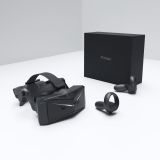 Pimax Crystal Light with its packaging and controllers.

References
- ↑ 1.0 1.1 1.2 1.3 1.4 1.5 Pimax (2024-04-15). "Pimax reveals two new high-end VR headsets at its Frontier event". PR Newswire. https://www.prnewswire.com/news-releases/pimax-reveals-two-new-high-end-vr-headsets-at-its-frontier-event-302116334.html. Retrieved 2026-10-14.
- ↑ 2.0 2.1 2.2 "Announcements". Pimax. https://store.pimax.com/pages/announcements. Retrieved 2026-10-14.
- ↑ 3.00 3.01 3.02 3.03 3.04 3.05 3.06 3.07 3.08 3.09 3.10 3.11 3.12 3.13 "Purchase - Pimax Crystal Light". Pimax Store. https://store.pimax.com/products/pimax-crystal-light. Retrieved 2026-10-14.
- ↑ 4.00 4.01 4.02 4.03 4.04 4.05 4.06 4.07 4.08 4.09 "Crystal Light User Guide". Pimax. 2024. https://cdn.shopify.com/s/files/1/0127/3767/5323/files/Crystal_Light_User_Guide_240618.pdf?v=1718878251. Retrieved 2026-10-14.
- ↑ 5.00 5.01 5.02 5.03 5.04 5.05 5.06 5.07 5.08 5.09 5.10 5.11 5.12 5.13 5.14 5.15 5.16 5.17 5.18 5.19 5.20 5.21 5.22 5.23 5.24 5.25 5.26 5.27 5.28 5.29 5.30 5.31 5.32 5.33 5.34 5.35 5.36 5.37 5.38 5.39 "Pimax Crystal Light". Pimax Store. https://store.pimax.com/pages/crystal-light. Retrieved 2026-10-14.
- ↑ 6.00 6.01 6.02 6.03 6.04 6.05 6.06 6.07 6.08 6.09 6.10 6.11 6.12 6.13 6.14 6.15 6.16 6.17 "Crystal Light - Premium PCVR made accessible.". Pimax. https://www.pimax.com/product/crystal-light. Retrieved 2026-10-14.
- ↑ 7.0 7.1 7.2 7.3 7.4 7.5 "Pimax Crystal Light One Year Anniversary Edition". Pimax. https://store.pimax.com/pages/pimax-crystal-light-one-year-anniversary-edition. Retrieved 2026-10-14.
- ↑ 8.0 8.1 8.2 8.3 "How to Adjust the IPD of the Crystal Light?". Pimax Support. 2024-09-09. https://support.pimax.com/en/support/solutions/articles/60001304305-how-to-adjust-the-ipd-of-the-crystal-light-. Retrieved 2026-10-14.
- ↑ 9.0 9.1 9.2 "Pimax Crystal Light + Free HonsVR Prescription Lenses Bundle". Pimax Store. https://store.pimax.com/products/pimax-crystal-light-free-honsvr-prescription-lenses-bundle. Retrieved 2026-10-14.
- ↑ 10.0 10.1 10.2 10.3 10.4 10.5 10.6 Alan Truly (2024-11-05). "Pimax Crystal Light review: a new standard for affordable PC VR". Digital Trends. https://www.digitaltrends.com/computing/pimax-crystal-light-review/. Retrieved 2026-10-14.
- ↑ 11.0 11.1 11.2 11.3 11.4 "Lighthouse Faceplate User Guide". Pimax. https://store.pimax.com/pages/lighthouse-faceplate-user-guide. Retrieved 2026-10-14.
- ↑ 12.0 12.1 12.2 "Pimax EVO". Pimax Store. https://pimax.com/pages/pimax-play-evo. Retrieved 2026-10-14.
- ↑ "How to pair your controllers". Pimax Support. 2024-06-27. https://support.pimax.com/en/support/solutions/articles/60001313400-how-to-pair-your-controllers. Retrieved 2026-10-14.
- ↑ 14.0 14.1 14.2 14.3 14.4 Ben Lang (2024-04-15). "Pimax Reveals New High-end PC VR Headsets Focused on Affordability & Performance". Road to VR. https://roadtovr.com/pimax-crystal-light-super-announcement-release-date-price/. Retrieved 2026-10-14.
- ↑ 15.0 15.1 15.2 15.3 15.4 15.5 15.6 David Heaney (2024-04-15). "Pimax Announces New Wired PC VR Headsets: $700 Crystal Light & $1800 Crystal Super". UploadVR. https://www.uploadvr.com/pimax-crystal-light-and-crystal-super/. Retrieved 2026-10-14.
- ↑ 16.0 16.1 "Pimax October 2026 Shipping Update". Pimax blog. Pimax. 2026-10-15. https://www.pimax.com/explore/blogs/pimax-october-2026-shipping-update. Retrieved 2026-10-27.
- ↑ Pimax (2023-01-12). "Pimax Shows the Future of VR at CES2023 with New VR Products for Consumers". PR Newswire. https://www.prnewswire.com/news-releases/pimax-shows-the-future-of-vr-at-ces2023-with-new-vr-products-for-consumers-301719499.html. Retrieved 2026-10-14.
- ↑ 18.0 18.1 Jaap Grolleman (2024-05-31). "Pimax Progress Update - May 31". Pimax. https://store.pimax.com/blogs/blogs/pimax-progress-update-may-31. Retrieved 2026-10-14.
- ↑ 19.0 19.1 19.2 "Update on Non-Local Dimming Crystal Light Shipments". Pimax. https://store.pimax.com/pages/update-on-non-local-dimming-crystal-light-shipments. Retrieved 2026-10-14.
- ↑ Jaap Grolleman (2024-08-20). "Pimax Progress Update - August 20". Pimax. https://store.pimax.com/blogs/blogs/pimax-progress-update-august-20. Retrieved 2026-10-14.
- ↑ Vera Liu (2024-11-22). "Pimax launches the World's First Retina-Level VR headset, with the Crystal Super reaching 57 PPD". Pimax. https://store.pimax.com/blogs/blogs/pimax-launches-the-worlds-first-retina-level-vr-headset-with-the-crystal-super-reaching-57-ppd. Retrieved 2026-10-14.
- ↑ "Troubleshooting - Screen off Issue". Pimax Support. 2025-03-07. https://support.pimax.com/en/support/solutions/articles/60001506972-troubleshooting-screen-off-issue. Retrieved 2026-10-14.
- ↑ "Best VR Headsets 2026: Steam Frame, Crystal Super and PCVR Choices". Pimax. 2025-12-31. https://store.pimax.com/blogs/highlights/2026-vr-buying-guide-choosing-the-right-headset-for-you. Retrieved 2026-10-14.
- ↑ 24.0 24.1 24.2 Jaap Grolleman (2026-10-06). "Pimax Unveils Crystal Pro with Native Foveated Streaming, Sending the GPU's Native Image Wirelessly to the Headset". Pimax blog. Pimax. https://www.pimax.com/explore/blogs/pimax-unveils-crystal-pro-with-native-foveated-streaming-sending-the-gpus-native-image-wirelessly-to-the-headset. Retrieved 2026-10-27.
- ↑ Chris Steven (2026-10-07). "Pimax's $1,399 Crystal Pro uses the same panels and lenses as the $899 Crystal Light". MIXED. https://mixed-news.com/en/pimax-crystal-pro-same-panels-lenses-as-crystal-light/. Retrieved 2026-10-27.
- ↑ 26.0 26.1 26.2 Jaap Grolleman (2026-10-06). "Pimax Frontier 2026 FAQ". Pimax blog. Pimax. https://www.pimax.com/explore/blogs/pimax-frontier-2026-faq. Retrieved 2026-10-27.
- ↑ 27.0 27.1 27.2 27.3 27.4 27.5 27.6 27.7 "Purchase - Pimax Crystal". Pimax Store. https://store.pimax.com/products/pimax-crystal. Retrieved 2026-10-14.
- ↑ "Crystal Light - Premium PCVR made accessible.". Pimax. https://www.pimax.com/product/crystal-light. Retrieved 2026-10-27.
- ↑ 29.0 29.1 29.2 29.3 29.4 29.5 29.6 29.7 29.8 John Yan (2024-08-01). "Pimax Crystal Light". Gaming Nexus. https://www.gamingnexus.com/Article/14068/Pimax-Crystal-Light/. Retrieved 2026-10-14.
- ↑ Pimax Store (2024-08-22). "Set Up Upscale Mode on Pimax Crystal Light for the Best VR Experience". Pimax. https://store.pimax.com/blogs/crystal-light-tutorials/set-up-upscale-mode-vr. Retrieved 2026-10-14.
- ↑ "Tracking issue guide". Pimax Support. 2025-02-27. https://support.pimax.com/en/support/solutions/articles/60001496242-tracking-issue-guide. Retrieved 2026-10-14.
- ↑ Vera Liu (2026-04-16). "The Ultimate Guide to Lighthouse Tracking". Pimax. https://store.pimax.com/blogs/blogs/the-ultimate-guide-to-lighthouse-tracking-ref-gbc. Retrieved 2026-10-14.
- ↑ 33.0 33.1 "Crystal Lighthouse Faceplate". Pimax Store. https://store.pimax.com/products/pimax-crystal-lighthouse-faceplate. Retrieved 2026-10-14.
- ↑ 34.0 34.1 "Crystal Light Lighthouse Faceplate". Pimax Store. https://store.pimax.com/products/crystal-light-lighthouse-faceplate. Retrieved 2026-10-14.
- ↑ "Pimax Crystal/Crystal Light Counter Balance 5 Oz (140 gram)". Studioform Creative. https://www.studioformcreative.com/product-page/pimax-crystal-100-gram-counter-balance-only. Retrieved 2026-10-14.
- ↑ Vera Liu (2026-08-07). "Progress Update August 7th". Pimax blog. Pimax. https://www.pimax.com/explore/blogs/progress-update-august-7th. Retrieved 2026-10-27.
- ↑ "Downloads". Pimax. Pimax. https://www.pimax.com/support/downloads. Retrieved 2026-10-27.
- ↑ Vera Liu (2026-06-18). "Introducing Pimax EVO". Pimax. https://store.pimax.com/blogs/blogs/introducing-pimax-play-evo. Retrieved 2026-10-14.
- ↑ "Level Up Your VR Journey This Spring!". Pimax. https://store.pimax.com/pages/level-up-your-vr-journey-this-spring. Retrieved 2026-10-14.
- ↑ Matt Tate (2025-11-13). "Valve confirms that it has stopped making the Index VR headset". Engadget. https://www.engadget.com/ar-vr/valve-confirms-that-it-has-stopped-making-the-index-vr-headset-150324456.html. Retrieved 2026-10-14.
- ↑ 41.0 41.1 41.2 41.3 41.4 41.5 "Valve Index Sunset". Valve. https://store.steampowered.com/hardware/valveindex. Retrieved 2026-10-14.
- ↑ 42.0 42.1 42.2 42.3 "Bigscreen Beyond". Bigscreen. https://store.bigscreenvr.com/products/bigscreen-beyond. Retrieved 2026-10-14.
- ↑ 43.0 43.1 "Announcing Bigscreen Beyond's Enhanced FOV, Clarity, and Expanded IPD Range". Bigscreen. 2023-06-01. https://store.bigscreenvr.com/blogs/beyond/development-update-5. Retrieved 2026-10-14.
- ↑ "Display Technology Explained: DSC, Resolution, Refresh Rate, and Visual Fidelity Insights". Bigscreen. 2023-09-29. https://store.bigscreenvr.com/blogs/beyond/development-update-10. Retrieved 2026-10-14.