

Viture One
More actions
| Viture One | |
|---|---|

| |
| Basic Info | |
| VR/AR | Augmented Reality |
| Type | AR Glasses |
| Subtype | Smart Glasses |
| Platform | VITURE |
| Developer | VITURE |
| Manufacturer | VITURE |
| Announcement Date | April 2022 (Kickstarter campaign) |
| Release Date | 31 December 2022 (first shipments to Kickstarter backers); 16 May 2023 (retail launch) |
| Price | US$549 list price; US$439 launch promotion (May 2023) |
| Website | https://www.viture.com/ |
| Versions | Viture One Lite (2024) |
| Successor | Viture Pro |
| Display | |
| Display | 2x Micro-OLED; 1,800 nits brightness; 50,000:1 contrast ratio; 120-inch virtual screen |
| Resolution | 1920 x 1080 per eye (55 PPD) |
| Refresh Rate | 60 Hz |
| Image | |
| Field of View | 43° |
| Optics | |
| Optics | Birdbath optics; electrochromic outer film (3-40% optical transmittance) |
| Ocularity | Binocular |
| IPD Range | 57.5-69.5 mm |
| Adjustable Diopter | 0.0D to -5.0D (one dial per eye) |
| Tracking | |
| Tracking | 3DoF (built-in IMU; beta mode added by firmware in May 2023) |
| Eye Tracking | No |
| Hand Tracking | No |
| Audio | |
| Audio | HARMAN AudioEFX speakers with reverse sound field |
| Connectivity | |
| Connectivity | USB-C (DisplayPort Alt Mode) through a magnetic pogo-pin cable |
| Power | No built-in battery; powered by the connected device |
| Device | |
| Weight | 78g |
| Color | Black, blue, white |
| Sensors | IMU; wearer detection |
| Input | Mode button, adjustment rocker, two myopia dials |
The VITURE One is a consumer augmented reality smart glasses developed by VITURE, first shipped to crowdfunding backers at the end of 2022 and sold at retail from 2023. It is a pair of tethered display glasses: two Micro-OLED panels show the picture from a connected phone, computer, handheld or console as a virtual screen that VITURE compares to a 120-inch display, with 55 pixels per degree (PPD) at 1920 x 1080 per eye and 60 Hz.[1] The glasses have no internal processor or storage and draw power from the connected device.[2][1] VITURE describes the One as the first XR glasses with electrochromic film, which darkens the outer lenses at the press of a button, and its speakers were developed with HARMAN.[3]
The One was funded on Kickstarter in 2022, where 5,069 backers pledged US$3,098,187 against a US$20,000 goal.[4] VITURE shipped the first glasses to backers on 31 December 2022 and opened retail sales on 16 May 2023.[5][6] TIME named it one of the Best Inventions of 2022, and it was a CES 2023 Innovation Awards honoree.[7][8] VITURE later released the cheaper Viture One Lite and the Viture Pro, which the company calls its "full second generation" of products.[9]
History and development
Design and crowdfunding
The glasses were designed by the design studio Layer, led by Benjamin Hubert. In Layer's description, the frames were meant to read as "lifestyle led" fashion eyewear rather than a technical device, with the display hidden behind curved frame lines, the speaker grille in the temple, concealed dials at the top of the frame and an interchangeable nose bridge that slides into a keyhole detail.[10][11]
VITURE, then described as a San Francisco start-up, ran the Kickstarter campaign in April and May 2022 under the title "VITURE One - Game & Stream Anywhere, Anytime".[4][11] The campaign marketed the glasses for cloud gaming, console remote play and streaming, together with two accessories: a neckband computer and a mobile dock.[4] In its first backer update on 22 April 2022, VITURE said Kickstarter staff had picked the campaign as a "Project We Love".[12] By mid-May, Tom's Guide reported about US$2.5 million from just over 4,000 backers.[11]
| Pack | Contents | Kickstarter pledges from | Stated MSRP |
|---|---|---|---|
| XR Glasses Only | Glasses | US$399 | US$549 |
| Cloud Pack | Glasses and Neckband | US$499 | US$678 |
| Dock Pack | Glasses and Mobile Dock | US$499 | US$678 |
| Ultimate Pack | Glasses, Neckband and Mobile Dock | US$599 | US$807 |
All tiers listed an estimated delivery of October 2022.[4]
During the campaign VITURE added stretch goals (a native 3D movie player at US$1.5 million, head gaze control at US$2.0 million, a matte finish at US$2.5 million and a neckband charging case at US$3.0 million) and said it would not make major upgrades to the core hardware in stretch goals because of the risk of delays.[12] In May 2022 it announced add-ons including a magnetic prescription lens frame for users beyond the built-in myopia range, an adapter for charging the host device while in use, and a lens cover, because the electrochromic lenses never become fully opaque.[13] A backer poll on the matte color, with 1,865 votes, was won by Classic Blue (Matte Indigo).[13]
The partner for the audio was not named during the campaign; Tom's Guide reported that VITURE only described it as a "prestigious speaker company".[11] VITURE announced the HARMAN partnership in a backer update on 17 July 2022.[13]
Delays and shipping
Kickstarter fulfillment slipped past the October 2022 estimate. In a launch timeline updated on 29 December 2022, VITURE said the glasses were shipping, Kickstarter pledges first, and that it had extended its trial program to the Neckband and Mobile Dock, which were expected to begin shipping in late January or early February 2023.[14] VITURE later dated the first shipment of glasses to backers to the last day of 2022.[5]
In a press release on 8 February 2023, VITURE announced that it had officially begun shipping to Kickstarter backers, that pre-orders started at US$479, and that full retail availability would follow in spring 2023. The release also said the company would demonstrate the glasses at the 2023 Game Developers Conference in San Francisco.[15] Backer updates from February and March 2023 described a ramp-up limited by quality control, an extended Chinese New Year break, a new smaller "Size 0" nose pad added after some early users found the glasses fit best without any nose pad, and a partnership with Lensology for custom prescription lenses. Mobile Dock shipments began in March 2023, and by mid-March the Neckband had entered mass production after four production builds.[16] By 21 June 2023, VITURE reported almost 2,000 Neckbands shipped in Jet Black and more than 600 in Matte Blue.[17]
Retail release
The VITURE One went on general sale on VITURE's website on 16 May 2023. Laptop Mag reported a promotional launch price of US$439 against a usual retail price of US$549, and noted that playing Nintendo Switch games required the Dock Pack.[6] Later in 2023 the glasses were also sold through Amazon, which VITURE said gave it its first holiday season with Prime shipping.[5] XDA Developers listed the glasses at US$439 alone and US$568 with the Mobile Dock in October 2023, and Gaming Nexus reported a Black Friday price of US$389 on 20 November 2023.[2][18]
Before retail launch, TechRadar listed four packages in September 2022: the glasses for US$479, the Dock Pack for US$568, the Cloud Pack for US$588 and the Ultimate Pack for US$677.[19] TIME's November 2022 entry gave US$479 for the glasses and US$588 with the neckband.[7]
Design and hardware
Display
The VITURE One uses dual Micro-OLED displays. VITURE's specifications for the glasses are:[1]
- 1920 x 1080 resolution per eye (Full HD)
- 55 PPD (pixels per degree) on a virtual screen VITURE describes as 120 inches
- 60 Hz refresh rate (VITURE states that the One supports only 60 Hz)
- 43° field of view
- 1,800 nits brightness, adjustable in seven levels
- 50,000:1 contrast ratio
- 129% sRGB color gamut
- 57.5-69.5 mm IPD range
- Native full side-by-side 3D video at 3840 x 1080
Reviews from 2022 and 2023 gave a contrast ratio of 5000:1 instead.[19][18] Gaming Nexus wrote that the 55 PPD figure was higher than the Xreal Air, Oculus Quest 2 and HP Reverb G2, with no perceivable screen door effect, deep OLED blacks and slight blurriness at the left and right edges of the image.[18] XDA Developers described the picture as equivalent to a 120-inch screen placed about 8-10 feet away, a little smaller than the virtual screen of the Rokid Max once viewing distance is taken into account.[2] In 9to5Mac's test, the picture was roughly equivalent to an 80-inch screen on a living-room wall.[20]
The displays use birdbath optics, which XDA described as reflecting the image through a series of prisms rather than pointing the panels directly at the eyes.[2] Gaming Nexus found the 43-degree diagonal field of view slightly smaller than the Xreal Air's 46 degrees and on par with the Rokid Air.[18]
Electrochromic lens technology
A key differentiating feature is the electrochromic film on the outer lenses, which VITURE describes as its own invention and says made the One the first device of its kind.[21] Pressing the mode button toggles the film between a clear and a darkened state.[1] VITURE lists an optical transmittance of 3-40% and a switching time of 0.3 seconds for the One, against 0.5-40% and 0.1 seconds for the later Pro.[1] The "AR" and "VR" modes in the quick guide refer to the two states of the film, and VITURE told early buyers to toggle the film four or five times on first use so that it could reach its optimal state.[16] A firmware update in May 2023 improved the electrochromic films.[22]
The darkened film does not block all light: VITURE said during the campaign that the lenses are never fully opaque, and it sells a separate Lens Shade that blocks more light.[13][1] Gaming Nexus wrote that the dimming did not help on sunny days or in some lighting conditions.[18] XDA wrote that the only other time it had seen such glass on AR glasses was a Xiaomi prototype.[2] See Electrochromic dimming for the technology in general.
Build quality
- Weight: 78 grams (VITURE specification); glasses case 280 g[1]
- VITURE describes the frame as built from aircraft-grade alloys with titanium hinges.[3] XDA wrote that most of the material is still plastic, with aluminum reinforcing the hinge area, which made the arms feel less flimsy than those of competitors.[2]
- Removable nose pads in four sizes; size 4 can be bent to fit[1]
- Spring hinges and no vertical arm adjustment; Gaming Nexus reported that VITURE left out arm adjustment to keep the arms robust[18]
Gaming Nexus noted that the outer side of the right arm becomes warm during use and that the nose pads could pop off.[18] TechRadar's 2022 hands-on was based on a prototype: none of the three nose clips supplied made the glasses sit correctly on the reviewer's face, which made the edges of the image blurry. TechRadar had believed the unit was the final product; after VITURE said it was a prototype, TechRadar turned the article into a hands-on and removed its rating until it could test the final product.[19]
Audio
The audio system was developed in partnership with HARMAN and uses its AudioEFX technology:[1]
- Speaker grilles on top of each arm[2]
- A reverse sound field design that, according to VITURE, keeps sound leakage to 30 decibels at 20 cm from the speakers[1]
- Open-ear design for ambient awareness
Reviewers disagreed on volume and leakage. XDA found the speakers louder and fuller than most rival glasses, at the cost of more leakage, while Gaming Nexus found them not as loud as others and 9to5Mac found them essentially inaudible to people nearby.[2][18][20]
Connectivity
The VITURE One requires a source device via USB-C:
- A 110 cm USB-C to magnetic connector cable attaches to pogo pins on the right arm[14][18]
- No internal processor or storage[2]
- The host must output video over USB-C (DisplayPort Alt Mode); VITURE names the Steam Deck, ROG Ally, MacBook, iPad and many Android phones[1]
- Google Pixel phones of the period did not output video over USB-C, so they could not drive the glasses directly[19][18]
- The iPhone 15 series works without an adapter because of its switch to USB-C[2]
- SpaceWalker companion app for enhanced features[5]
VITURE presents the magnetic connector as a safety feature: the cable can be connected one-handed and breaks away if it catches on something.[3] XDA and Gaming Nexus would have preferred a standard USB-C port, so that any USB-C cable could replace a damaged one.[2][18]
Controls
The left arm carries a mode button and an adjustment rocker. By default the rocker changes brightness; a double press of the mode button switches it to volume. A single press toggles the electrochromic film, a long press switches between 2D and 3D modes, and a triple press turns 3DoF mode on or off.[1][18][22]
Features
3DoF head tracking
The glasses contain an inertial measurement unit. Firmware version 01.0.01.008_230503 added a "Pin Mode" (3DoF) that keeps the virtual screen fixed in space when the wearer turns their head, activated with a triple press of the mode button, together with wearer detection, which turns the screen off one minute after the glasses are taken off.[22] VITURE calls the One the first XR glasses with 3DoF built into the glasses themselves, and still labels the feature a beta.[3][1] XDA pointed out that the Xreal Air needed an extra accessory for the same function.[2] Gaming Nexus found that the image distorted slightly while the head moved and drifted over time, so the screen needed to be recentered.[18]
VITURE published an SDK for Android and one for Linux that give developers access to the glasses' IMU data, control over 2D and 3D modes and a choice of output resolutions (3840 x 1080 or 1920 x 1080).[23][24] On the Steam Deck, VITURE directs users to the XR Gaming plugin for Decky Loader to pin the game screen in space.[1]
Native 3D video support
The glasses accept full side-by-side 3D video at 3840 x 1080; a long press of the mode button switches modes.[1] Gaming Nexus watched side-by-side 3D videos from a Samsung phone and called 3D viewing a highlight.[18] A June 2023 firmware update shortened the switch between 2D and 3D modes.[22]
Myopia adjustment
Dials above each lens adjust the virtual image from 0.0D to -5.0D for nearsighted users.[1] 9to5Mac's reviewer, with a prescription of -4.75, could focus the image without lens inserts.[20] For stronger prescriptions or astigmatism, a magnetic Prescription Lens Frame takes the user's own lenses.[1]
SpaceWalker and iPhone support
In September 2023 VITURE introduced the HDMI XR Adapter for Lightning iPhones, with built-in Bluetooth and a 2.8-hour battery, together with the SpaceWalker app for iOS. SpaceWalker added multiple virtual screens, an XR web browser, use of the iPhone as a touchpad and laser pointer, and a VR video player.[17] By the end of 2023 it also played spatial video recorded on the iPhone 15 Pro, a format Apple introduced with iOS 17.2, and VITURE released an optional USB-C XR Charging Adapter for the iPhone 15.[5][3] XDA found the iOS app smoother than anything else it had tested apart from the Apple Vision Pro, although it crashed a couple of times.[2] 9to5Mac found 360-degree video in SpaceWalker disappointing because the viewer turns the image with a finger instead of with head movement.[20]
Accessories
Neckband
The VITURE One Neckband is a wearable computer that connects to the glasses by cable and runs an Android TV based system with streaming apps preinstalled.[8][19] TechRadar's 2022 prototype ran Android 11 TV OS, had 128 GB of storage, weighed 170 g and lasted about three and a half hours.[19] VITURE's June 2023 update listed a 3-hour battery, a charging case that recharges the band up to two more times, a D-pad and dedicated buttons, head-gaze navigation, a fan with a Quiet Mode, USB storage support and a companion app that turns a phone into a touchpad.[17] VITURE partnered with the remote-play apps PSPlay and XBXPlay and made both free for Neckband owners.[3]
Mobile Dock
The Mobile Dock adds HDMI input for devices such as the Nintendo Switch, can connect two pairs of glasses for local co-op or shared viewing, and has a 13,000 mAh battery.[21][3][25] In CGMagazine's test it kept a Switch running at full charge for several hours of play.[25]
Other accessories
Laptop Mag listed a Lens Shade at US$19, a prescription lens frame at US$29 and a charging adapter at US$49, and criticized the Lens Shade being sold separately when the Xreal Air included one.[26] The Lens Shade, the Prescription Lens Frame and the USB-C to magnetic connector cable are also compatible with the VITURE Pro, and the Lens Shade and frame with the One Lite.[1]
Reception
Reviewers praised the picture, the build and the feature set, and criticized the price, the 60 Hz panel and the proprietary cable.
Praise:
- XDA Developers called the One "the most capable pair of AR/XR glasses I've tested yet" and wrote that in hardware they were "clearly ahead of its contemporaries", citing the electrochromic film, sturdier hinge and 3DoF capabilities[2]
- High 55 PPD pixel density with no screen door effect, and deep OLED blacks (Gaming Nexus)[18]
- Laptop Mag's Jason England called them "simply the best XR glasses you can buy right now", praising the picture, the Harman-tuned spatial audio and the easy setup[26]
- Sturdy aluminum-reinforced hinges[2]
- Built-in myopia dials and the magnetic prescription lens frame[18][20]
Criticism:
- 60 Hz refresh rate, when some rival glasses offered 120 Hz[18]
- 43° FOV slightly narrower than some competitors[18]
- Requires a USB-C source device with video output[2][19]
- Proprietary magnetic connector[2][18]
- Price of entry: CGMagazine called it "a steep price for what is essentially a glorified floating screen"[25]
TechRadar's hands-on of a prototype unit found good contrast in dark scenes and no noticeable input lag, but fit problems that blurred the edges of the image. It said it could not recommend the prototype and pointed readers to the Nreal Air (later renamed Xreal Air), whose design and performance it found much better.[19][26]
| Publication | Reviewer | Date | Score |
|---|---|---|---|
| TechRadar | Hamish Hector | 25 September 2022 | None (prototype hands-on; rating removed)[19] |
| Laptop Mag | Jason England | 3 July 2023 | 4/5, Editor's Choice[26] |
| XDA Developers | Ben Sin | 12 October 2023 | 9/10[2] |
| Gaming Nexus | John Yan | 19 November 2023 | 9 ("Class Leading")[18] |
| CGMagazine | Zubi Khan | 29 March 2024 | 7[25] |
Awards
TIME included the Viture One XR Glasses in its list of the Best Inventions of 2022, in an entry titled "TV to Go".[7] The One was a CES 2023 Innovation Awards honoree in the Gaming category.[8] VITURE also lists a Fast Company 2022 Innovation by Design Award, a 2023 Good Design Award, a 2023 iF Design Award and a 2023 Red Dot award.[15][5]
Variants and successors
- Viture One Lite: Budget version announced on 1 January 2024, with standard USB-C input and non-dimmable outer lenses, nearly US$100 cheaper than the One[5]
- Viture Pro: Premium model with 120 Hz and upgraded electrochromic film, released in 2024 as VITURE's "full second generation" of products[9][1]
In October 2026, VITURE's US online store listed six glasses models (the "Phantom Beast" edition, the Viture Pro 2, the Viture Beast and the three Viture Luma models), and the One was not among them.[27] VITURE Academy still documents the One, and several accessories remain listed as compatible with it.[1]
See also
Gallery
-
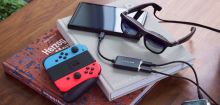 VITURE One with a Nintendo Switch.

References
- ↑ 1.00 1.01 1.02 1.03 1.04 1.05 1.06 1.07 1.08 1.09 1.10 1.11 1.12 1.13 1.14 1.15 1.16 1.17 1.18 1.19 "Pro & One Series XR Glasses". VITURE Academy. VITURE. https://www.viture.com/en-US/academy/xr-glasses/pro-one-series. Retrieved 2026-10-13.
- ↑ 2.00 2.01 2.02 2.03 2.04 2.05 2.06 2.07 2.08 2.09 2.10 2.11 2.12 2.13 2.14 2.15 2.16 2.17 Ben Sin (2023-10-12). "Viture One review: The most capable AR glasses so far". XDA Developers. https://www.xda-developers.com/viture-one-review/. Retrieved 2026-10-13.
- ↑ 3.0 3.1 3.2 3.3 3.4 3.5 3.6 "10 Innovations That Set VITURE One Apart From The Rest". VITURE Blog. VITURE. https://www.viture.com/en-US/blog/10-innovations-that-set-viture-one-apart-from-the-rest. Retrieved 2026-10-13.
- ↑ 4.0 4.1 4.2 4.3 "VITURE One - Game & Stream Anywhere, Anytime". Kickstarter. VITURE. https://web.archive.org/web/20221110210038/https://www.kickstarter.com/projects/viture/viture-game-and-stream-anywhere-anytime/description. Retrieved 2026-10-13.
- ↑ 5.0 5.1 5.2 5.3 5.4 5.5 5.6 "Retrospective: 2023 In Review". VITURE Blog. VITURE. 2024-01-01. https://www.viture.com/en-US/blog/retrospective-2023-in-review. Retrieved 2026-10-13.
- ↑ 6.0 6.1 Kimberly Gedeon (2023-05-16). "These hotly anticipated AR glasses are finally launching - play on a 120-inch screen TV anywhere". Laptop Mag. https://www.laptopmag.com/news/these-hotly-anticipated-glasses-let-you-game-on-your-back-and-you-can-finally-buy-em. Retrieved 2026-10-13.
- ↑ 7.0 7.1 7.2 Jared Lindzon (2022-11-10). "Viture One XR Glasses: The 200 Best Inventions of 2022". TIME. https://time.com/collections/best-inventions-2022/6225478/viture-one-xr-glasses/. Retrieved 2026-10-13.
- ↑ 8.0 8.1 8.2 "VITURE One - CES 2023 Innovation Awards Honoree". CES. Consumer Technology Association. https://web.archive.org/web/20230608152615/https://www.ces.tech/innovation-awards/honorees/2023/honorees/v/viture-one.aspx. Retrieved 2026-10-13.
- ↑ 9.0 9.1 "2024 In Review: VITURE's Greatest Year Yet.". VITURE Blog. VITURE. https://www.viture.com/en-US/blog/2024-in-review-vitures-greatest-year-yet. Retrieved 2026-10-13.
- ↑ LAYER (2022-04-22). "LAYER designs 'VITURE one', a fashionable + smart eyewear system". designboom. https://www.designboom.com/design/layer-viture-one-smart-eyewear-system-04-22-2022/. Retrieved 2026-10-13.
- ↑ 11.0 11.1 11.2 11.3 Sanjana Prakash (2022-05-17). "These XR glasses for gaming just racked up $2.5 million on Kickstarter". Tom's Guide. https://www.tomsguide.com/news/these-xr-glasses-for-gaming-just-racked-up-dollar25-million-on-kickstarter. Retrieved 2026-10-13.
- ↑ 12.0 12.1 "Project Updates for VITURE One - Game & Stream Anywhere Anytime (page 5)". BackerKit. VITURE. https://viture.backerkit.com/hosted_preorders/project_updates?page=5. Retrieved 2026-10-13.
- ↑ 13.0 13.1 13.2 13.3 "Project Updates for VITURE One - Game & Stream Anywhere Anytime (page 4)". BackerKit. VITURE. https://viture.backerkit.com/hosted_preorders/project_updates?page=4. Retrieved 2026-10-13.
- ↑ 14.0 14.1 "Roadmap". VITURE. VITURE. 2022-12-29. https://web.archive.org/web/20221231082545/https://www.viture.com/launch-timeline. Retrieved 2026-10-13.
- ↑ 15.0 15.1 "VITURE One glasses now going out to backers". Gaming Nexus. 2023-02-08. https://www.gamingnexus.com/News/57948/VITURE-One-glasses-now-going-out-to-backers/. Retrieved 2026-10-13.
- ↑ 16.0 16.1 "Project Updates for VITURE One - Game & Stream Anywhere Anytime (page 2)". BackerKit. VITURE. https://viture.backerkit.com/hosted_preorders/project_updates?page=2. Retrieved 2026-10-13.
- ↑ 17.0 17.1 17.2 "Project Updates for VITURE One - Game & Stream Anywhere Anytime (page 1)". BackerKit. VITURE. https://viture.backerkit.com/hosted_preorders/project_updates. Retrieved 2026-10-13.
- ↑ 18.00 18.01 18.02 18.03 18.04 18.05 18.06 18.07 18.08 18.09 18.10 18.11 18.12 18.13 18.14 18.15 18.16 18.17 18.18 18.19 John Yan (2023-11-19). "VITURE One Review". Gaming Nexus. https://www.gamingnexus.com/Article/13953/VITURE-One/. Retrieved 2026-10-13.
- ↑ 19.0 19.1 19.2 19.3 19.4 19.5 19.6 19.7 19.8 Hamish Hector (2022-09-25). "VITURE One XR Glasses: Smart glasses, not so smart design". TechRadar. https://www.techradar.com/reviews/viture-one-xr-glasses-review. Retrieved 2026-10-13.
- ↑ 20.0 20.1 20.2 20.3 20.4 Ben Lovejoy (2024-01-31). "Viture One XR glasses could be my Vision Pro stand-in for now". 9to5Mac. https://9to5mac.com/2024/01/31/viture-one-xr-glasses-review/. Retrieved 2026-10-13.
- ↑ 21.0 21.1 "The Innovations That Won VITURE One A Spot On TIME Best Inventions of 2022". VITURE Blog. VITURE. 2022-11-18. https://web.archive.org/web/20221123200124/https://www.viture.com/blog/the-innovations-that-won-viture-one-a-spot-on-time-best-inventions-of-2022. Retrieved 2026-10-13.
- ↑ 22.0 22.1 22.2 22.3 "XR Glasses Firmware Release Updates". VITURE. VITURE. https://web.archive.org/web/20240114080500/https://www.viture.com/release-updates/xr-glasses-firmware. Retrieved 2026-10-13.
- ↑ "VITURE One SDK for Android". VITURE Developer. VITURE. 2024-01-08. https://web.archive.org/web/20240114080455/https://www.viture.com/developer/viture-one-sdk-for-android. Retrieved 2026-10-13.
- ↑ "VITURE One SDK for Linux". VITURE Developer. VITURE. 2023-12-28. https://web.archive.org/web/20240114080456/https://www.viture.com/developer/viture-one-sdk-for-linux. Retrieved 2026-10-13.
- ↑ 25.0 25.1 25.2 25.3 Zubi Khan (2024-03-29). "Viture One XR AR Glasses Review". CGMagazine. https://www.cgmagonline.com/review/hardware/viture-one-xr-ar-glasses/. Retrieved 2026-10-13.
- ↑ 26.0 26.1 26.2 26.3 Jason England (2023-07-03). "Viture One XR Glasses: An expensive game changer". Laptop Mag. https://www.laptopmag.com/reviews/viture-one-xr-glasses. Retrieved 2026-10-13.
- ↑ "Glasses". VITURE. VITURE. https://www.viture.com/en-US/search/glasses. Retrieved 2026-10-13.