

Rokid Air
More actions
| Rokid Air | |
|---|---|

| |
| Basic Info | |
| VR/AR | Augmented Reality |
| Type | AR Glasses |
| Subtype | Consumer AR |
| Platform | External video display; legacy Rokid Air/AR app |
| Creator | Rokid |
| Developer | Rokid |
| Manufacturer | Rokid |
| Announcement Date | 13 July 2021 (Kickstarter launch)[1] |
| Release Date | 26 December 2021 (shipping began, according to Rokid)[2] |
| Website | https://global.rokid.com/ |
| Versions | Rokid Air |
| Requires | USB-C DisplayPort video source; compatible Android phone for legacy AR mode[3] |
| Successor | Rokid Max[4] |
| System | |
| Operating System | Host dependent; legacy AR app requires Android 10 or later[3] |
| Display | |
| Display | Binocular OLED[5] |
| Resolution | 1920 × 1080 per eye[6] |
| Refresh Rate | 60Hz (English-language specification)[6] |
| Image | |
| Field of View | 43° diagonal[7] |
| Optics | |
| Optics | Birdbath optics[7] |
| Ocularity | Binocular |
| Adjustable Diopter | Yes (0 to -5.00 D), separately for each eye[8] |
| Passthrough | Optical see-through[7] |
| Tracking | |
| Tracking | IMU; 3DoF mode documented in legacy phone app[6][3] |
| Audio | |
| Audio | Two directional speakers[6] |
| Microphone | Two noise-canceling microphones (manufacturer description)[6] |
| Connectivity | |
| Connectivity | USB-C DisplayPort[8] |
| Ports | USB-C |
| Wired Video | USB-C DisplayPort; HDMI with an adapter[3] |
| Wireless Video | Through a separate wireless adapter[3] |
| Power | External device via USB-C[1] |
| Battery Capacity | No internal battery[8] |
| Device | |
| Weight | 83g (manufacturer specification)[6] |
| Sensors | 9-axis IMU/magnetometer sensor fusion; proximity sensor[6] |
| Input | Host controls; brightness button; phone touchpad and voice control in legacy app[8][3] |
The Rokid Air is a consumer pair of augmented reality display glasses developed by Rokid. It connects to an external video source and provides a binocular personal display through see-through optics. Its original software distinguishes ordinary screen projection from an AR environment supplied by a compatible Android phone.[3] Rokid announced its crowdfunding campaign in July 2021 and reported that customer shipping began on 26 December 2021.[1][2]
History and development
Rokid was founded in Hangzhou in July 2014.[9] It opened the Kickstarter campaign on 13 July 2021. The announcement described host-powered glasses with voice control and adjustable focus for nearsighted users.[1] The company's later product timeline records a September 2021 launch for Air and a separate October 2021 launch for Rokid Air Pro, the model intended for exhibitions and cultural tourism.[9] These are distinct products.
On 29 December 2021, Rokid stated that mass production had been completed by mid-December and that shipping had started on 26 December. The same release reported more than 10,000 orders across 76 countries and identified Indiegogo InDemand as a sales channel after crowdfunding.[2] The shipping date refers to the manufacturer's reported start of fulfillment, rather than a guarantee that all backers received glasses on that date. Rokid's timeline places the subsequent Rokid Max in March 2023.[9]
Display and optical system
Rokid Air has two 1920 × 1080 displays and a stated 43° field of view. The manufacturer lists 60Hz in its English-language technical specifications.[6] The original-device research description identifies the optics as birdbath and the 43° angle as diagonal.[7] The OLED displays are also identified in the museum study by Cheng and colleagues.[5]
The glasses have a focus adjustment knob for each eye, with a stated myopia adjustment range of 0 to -5.00 diopters. The hardware manual describes adjusting one eye at a time. It cautions that this adjustment does not accommodate myopia outside that range, hyperopia or astigmatism.[8] The adjustment therefore does not establish that every prescription-glasses wearer can use the display without additional correction.
| Item | Specification and scope |
|---|---|
| Resolution | 1920 × 1080 for each eye; the manufacturer's notation is 1920*1080*2.[6] |
| Field of view | 43°; described as diagonal in the original-device research methods.[6][7] |
| Refresh rate | 60Hz in the English-language technical specification.[6] |
| Display brightness | 1800nits, as advertised by Rokid. The specification does not identify the measurement plane or test conditions.[6] |
| Contrast ratio | 100000:1, as advertised by Rokid.[6] |
| Virtual screen | Marketed as a 120-inch virtual screen.[2] |
| Focus adjustment | 0 to -5.00 D myopia adjustment, separately for each eye.[8] |
The brightness and contrast figures above are manufacturer specifications. They do not constitute independent measurements of perceived brightness or a controlled comparison with other glasses.
Physical design and audio
The manufacturer specifies a weight of 83g, two directional speakers and two microphones described as noise-canceling. It also lists a nine-axis IMU/magnetometer sensor-fusion system and a proximity sensor.[6] The hardware manual identifies the nose pads, separate focus knobs, brightness button, speakers and USB-C connector. Its sleep-mode instructions, explicitly limited to the Rokid Air app, state that removing the glasses turns off the display and wearing them again wakes it.[8]
The English technical specification lists four brightness levels.[6] The glasses have no internal battery and obtain power from the attached device. The supplied items in the hardware manual are the glasses, USB-C cable, cleaning cloth and portable bag.[8] Folding the temples is illustrated in the same manual; it cautions against forcing them beyond their mechanical range.[8]
Connectivity and software
Projection and AR modes
| Mode in the original documentation | Function | Documented requirements |
|---|---|---|
| Projection Mode | Uses the glasses as an external display for the host's image.[3] | Direct USB-C connection to a video source supporting DisplayPort, or an appropriate external adapter.[3] |
| AR Mode | Opens the phone-based Rokid Air app's virtual 3D environment.[3] | A compatible Android phone running Android 10 or later, with USB-C DisplayPort output and USB OTG.[3] |
The original manual lists direct display connections to compatible Android phones and tablets, USB-C iPads, MacBooks and PCs with DisplayPort output. It separately describes an HDMI-to-USB-C connection for HDMI PCs and consoles such as PlayStation 4, Xbox and a docked Nintendo Switch, and a wireless adapter for screen casting.[3] A USB-C connector alone does not satisfy the manual's DisplayPort requirement. Wireless casting uses an external adapter; it is not a built-in wireless video connection in the glasses.[3]
These compatibility descriptions belong to the original Air documentation. The manual lists particular phone models and chipset variants, including Qualcomm versions of several Samsung models. Its Android requirement applies to the legacy AR app, while projection mode also includes non-Android hosts.[3] It does not establish that every later phone, operating-system update or adapter works with the original Air.
Interaction and applications
The legacy app uses the phone screen as a touchpad. The manual describes one-finger pointer movement and selection, two-finger scrolling or page changes, and a three-finger swipe to show the launcher. Some games replace the touchpad with phone-screen controller buttons; supported games can also use a Bluetooth controller connected to the phone.[3]
Voice commands in the documented preinstalled applications open apps, return to the launcher, navigate menus and control brightness, volume or video playback. The manual describes User Guide, AR Store, Cinema, Browser, Files and Settings. Its media player supports local 3D video and 180° or 360° panoramic video.[3] These are documented legacy functions, rather than a promise that all of the original online services or third-party apps remain available.
The app manual explicitly describes a 3DoF mode and a long press of Home to reset picture orientation.[3] That phone-software function should be distinguished from independent stabilization of any video source. In a support note dated 20 June 2024 about Air, Max and Max 2, Rokid stated that Air was incompatible with the 3DoF algorithm discussed for Station 2 because of IMU limitations.[10]
Research uses
Museum learning
A 2025 study in Frontiers in Psychology identifies Rokid Air as the glasses used for AR exhibits at Wuhan Natural History Museum. The researchers analyzed 266 completed visitor surveys after sessions of about 20-30 minutes. The questionnaire measured perceived information quality, immersion, learning motivation, wearable comfort and other constructs with seven-point rating scales. The statistical model found associations among these ratings, including a positive relationship between learning motivation and reported academic achievement. The study concerns one museum and its content; it is not a controlled comparison of headset models or an objective test of improved learning caused by the glasses.[5]
Fluorescence imaging
Shmuylovich and colleagues used modified Rokid Air glasses in the FAR-Pi research system, published in Scientific Reports in 2024. They connected a Raspberry Pi computer through a powered HDMI-to-USB-C adapter, added imaging and illumination hardware, and disconnected one eye's display to avoid misalignment of a non-stereoscopic camera image between the eyes. An added beamsplitter aligned the imaging module's optical path with the user's eye. The paper includes benchtop tests and fluorescence-imaging tests in four mice and describes the system as a proof of concept requiring further validation for surgical use. Those results apply to the assembled and modified FAR-Pi system, rather than to unmodified consumer Air glasses.[7]
See also
Gallery
-
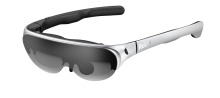 Three-quarter view of Rokid Air.
-
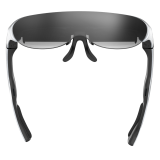 Rokid Air with its temples open.


References
- ↑ 1.0 1.1 1.2 1.3 Rokid (2021-07-13). "Rokid Air Announces Launch of Advanced 4K AR Glasses With 120" Virtual Screen & Voice Control AI". PR Newswire. https://www.prnewswire.com/news-releases/rokid-air-announces-launch-of-advanced-4k-ar-glasses-with-120-virtual-screen--voice-control-ai-301332409.html. Retrieved 2026-10-14.
- ↑ 2.0 2.1 2.2 2.3 Rokid (2021-12-29). "Rokid Air Smashes Crowdfunding Goals and Begins Shipping as the Most Funded AR Glasses of 2021". GlobeNewswire. https://www.globenewswire.com/news-release/2021/12/29/2358831/0/en/rokid-air-smashes-crowdfunding-goals-and-begins-shipping-as-the-most-funded-ar-glasses-of-2021.html. Retrieved 2026-10-14.
- ↑ 3.00 3.01 3.02 3.03 3.04 3.05 3.06 3.07 3.08 3.09 3.10 3.11 3.12 3.13 3.14 3.15 3.16 "Rokid Air User Manual: Everything you need to know about Rokid Air". Rokid. https://static.rokidcdn.com/website/air/0.1.0/Rokid%20Air%20%E8%BD%AF%E4%BB%B6%E8%AF%B4%E6%98%8E%E4%B9%A6%E8%8B%B1%E6%96%87%E7%89%88.pdf. Retrieved 2026-10-14.
- ↑ Rokid (2023-03-22). "Rokid leads the charge in AR tech innovation with the new Rokid Max AR glasses set". PR Newswire. https://www.prnewswire.com/news-releases/rokid-leads-the-charge-in-ar-tech-innovation-with-the-new-rokid-max-ar-glasses-set-301778211.html. Retrieved 2026-10-14.
- ↑ 5.0 5.1 5.2 Anping Cheng; Weiru Zhang; Anran Feng; Yunmengru Wu; Wanjun Li (2025-01-29). "Exploring psychological dimensions of augmented reality in education: a study on learning motivation and achievement in museums". Frontiers in Psychology 16: 1514117. doi:10.3389/fpsyg.2025.1514117. Retrieved 2026-10-14.
- ↑ 6.00 6.01 6.02 6.03 6.04 6.05 6.06 6.07 6.08 6.09 6.10 6.11 6.12 6.13 6.14 "Rokid Air: Tech Specs". Rokid. https://air.rokid.com/product. Retrieved 2026-10-14.
- ↑ 7.0 7.1 7.2 7.3 7.4 7.5 Leonid Shmuylovich; Christine M O’Brien; Karen Nwosu; Samuel Achilefu (2024-10-17). "Frugal engineering-inspired wearable augmented reality goggle system enables fluorescence-guided cancer surgery". Scientific Reports 14: 24402. doi:10.1038/s41598-024-75646-0. Retrieved 2026-10-14.
- ↑ 8.0 8.1 8.2 8.3 8.4 8.5 8.6 8.7 8.8 "Rokid Air User Manual". Rokid. https://static.rokidcdn.com/website/air/0.1.0/Rokid%20Air%20User%20Manual.pdf. Retrieved 2026-10-14.
- ↑ 9.0 9.1 9.2 "About Us". Rokid. https://www.rokid.com/en-US/about. Retrieved 2026-10-14.
- ↑ "Does Air/Max/Max2 support 3DoF independently?". Rokid. 2024-06-20. https://global.rokid.com/blogs/max-2/does-air-max-max2-support-3dof-independently. Retrieved 2026-10-14.