

Pico 4 Ultra
More actions
| Pico 4 Ultra | |
|---|---|
 
| |
| Basic Info | |
| VR/AR | Virtual reality, Mixed reality |
| Type | Head-mounted display |
| Subtype | Standalone VR |
| Developer | Pico (ByteDance) |
| Manufacturer | Pico |
| Announcement Date | 20 August 2024 (China); 3 September 2024 (Europe and Asia-Pacific) |
| Release Date | 2 September 2024 (China); 20 September 2024 (Europe and Asia-Pacific) |
| Price | 4,299 RMB (China launch price); EUR 599 / GBP 529 (Europe and UK launch price); 89,800 yen (Japan launch price, 104,900 yen from 1 May 2026) |
| Website | https://www.picoxr.com/global/products/pico4-ultra |
| Versions | Pico 4 Ultra, Pico 4 Ultra Enterprise |
| Requires | PICO account |
| Predecessor | Pico 4 |
| System | |
| Operating System | PICO OS (Android-based) |
| Chipset | Qualcomm Snapdragon XR2 Gen 2 |
| GPU | Adreno 740 |
| Storage | |
| Storage | 256 GB (UFS 3.1) |
| Memory | 12 GB LPDDR5 |
| SD Card Slot | No |
| Display | |
| Display | Dual 2.56-inch LCD |
| Resolution | 2160 x 2160 per eye (1200 PPI); default rendering resolution 1920 x 1920 per eye |
| Refresh Rate | 90 Hz |
| Image | |
| Field of View | 105 degrees |
| Average Pixel Density | 20.6 PPD (22.5 PPD in the central area, manufacturer figures) |
| Optics | |
| Optics | Pancake lenses |
| Ocularity | Binocular |
| IPD Range | 58-72 mm, stepless motorized adjustment |
| Passthrough | Full color, dual 32 MP cameras (8 MP output) |
| Tracking | |
| Tracking | 6DoF inside-out, four environment tracking cameras |
| Eye Tracking | No |
| Hand Tracking | Yes |
| Audio | |
| Audio | Dual stereo speakers |
| Microphone | Four microphones, spatial audio recording |
| Camera | 2 x 32 MP color passthrough cameras, 1 x iToF depth camera, 4 x environment tracking cameras |
| Connectivity | |
| Connectivity | Wi-Fi 7, Bluetooth 5.3 |
| Ports | USB-C |
| WiFi | Wi-Fi 7 (802.11 a/b/g/n/ac/ax/be) |
| Bluetooth | Bluetooth 5.3 |
| Power | Internal battery in rear of head strap; 45 W fast charging (QC 4.0 / PD 3.0) |
| Battery Capacity | 5700 mAh rated, 5770 mAh typical (21.9 Wh) |
| Battery Life | Up to about 3 hours of video playback (MIXED test); around 4 hours at best (Trusted Reviews test) |
| Device | |
| Weight | About 580 g (304 g front, 276 g rear) |
| Material | Plastic |
| Color | Light gray |
| Sensors | 4 environment tracking cameras, 2 x 32 MP color cameras, iToF depth sensor, proximity sensor, IMU |
| Input | Ring-free 6DoF controllers (2 x AA batteries each), hand tracking; optional PICO Motion Trackers |
The Pico 4 Ultra (styled PICO 4 Ultra by its maker) is a standalone virtual reality and mixed reality head-mounted display developed by Pico, the XR hardware subsidiary of ByteDance.[1] Road to VR described it as a platform refresh of the Pico 4.[2] It uses the Qualcomm Snapdragon XR2 Gen 2 chipset, the same chip as the Meta Quest 3, paired with 12 GB of RAM and 256 GB of storage.[2]
Pico revealed the headset on 20 August 2024 and began shipping it in China on 2 September 2024 at a price of 4,299 yuan.[3][2][4] It was released in Europe and parts of Asia-Pacific on 20 September 2024, with a recommended retail price of EUR 599, but was not launched in North America.[5][6]
Compared with the Pico 4, the Ultra adds dual 32-megapixel color passthrough cameras, an indirect time-of-flight (iToF) depth sensor, ring-free controllers, a 5700 mAh battery with 45 W charging and Wi-Fi 7. UploadVR reported that it was the first headset to support the Wi-Fi 7 standard.[4][7]
As of October 2026 the Pico 4 Ultra is still Pico's current consumer headset.[8] Like the Pico 4, it has not been sold in North America.[9] Pico's next headset, the Pico Space Pro (developed as Project Swan), was delayed to the fourth quarter of 2026, and Pico has said that apps which run on the Pico 4 Ultra will also run on it.[10][11]
Announcement and release
Background
ByteDance acquired Pico in August 2021 without disclosing the price. At the time, IDC ranked Pico as the third-largest VR headset maker worldwide in the first quarter of 2021.[12] The Pico 4 Ultra followed the Pico 4 and keeps its general design, including the rear-mounted battery. TechRadar noted that the two headsets look much the same at a glance.[13]
China launch
Pico unveiled the headset on 20 August 2024 and opened preorders in China the same day, with shipping scheduled for 2 September 2024.[2][4] IT之家 gave the price as 4,299 yuan for the 12 GB + 256 GB model, and TechNode reported the same figure; Road to VR and UploadVR rounded it to 4,300 RMB.[3][14][2][4] A pair of PICO Motion Trackers cost 399 yuan in China, and the first batch of headsets was sold with motion trackers included.[3] At that point ByteDance had not said which other countries would get the headset. Road to VR noted that it had already been certified in South Korea.[2][4]
Europe and Asia-Pacific launch
On 3 September 2024 Pico announced the international launch. Preorders in Europe opened on 6 September and the headset went on sale on 20 September 2024.[5][6] In Japan, preorders opened on 12 September 2024 for release on 20 September at 89,800 yen including tax.[15] UploadVR listed the launch countries as the UK, Germany, France, Italy, Spain, the Netherlands, Belgium, Austria, Switzerland, Norway, Denmark, Sweden, Finland, Japan, South Korea, Singapore, Malaysia and Thailand, and reported that the headset was not launching in North America.[5] Preorders placed between 6 and 19 September included a pair of PICO Motion Trackers and four games: Blade & Sorcery: Nomad, Infinite Inside, Let's Get Fit VR and FootPool.[6]
| Region | Preorders | Release | Launch price |
|---|---|---|---|
| China | 20 August 2024 | 2 September 2024 | 4,299 RMB[3] |
| Europe | 6 September 2024 | 20 September 2024 | EUR 599[6] |
| United Kingdom | 6 September 2024 | 20 September 2024 | GBP 529[13] |
| Japan | 12 September 2024 | 20 September 2024 | 89,800 yen (tax included)[15] |
| South Korea, Singapore, Malaysia, Thailand | - | 20 September 2024[5] | - |
| North America | No consumer launch[5] | ||
Later pricing
In April 2026 Pico announced that the Japanese price of the 256 GB model would rise from 89,800 yen to 104,900 yen (tax included) from 1 May 2026, citing rapid exchange-rate changes and higher costs for electronic components and logistics. Accessories were not affected.[16]
Status and successor
On 2 March 2026 Pico announced the specifications of its next headset, then called Project Swan: micro-OLED panels at 4000 pixels per inch, a main processor with twice the CPU and GPU performance of the Snapdragon XR2 Gen 2 used in the Pico 4 Ultra, a custom coprocessor for computer vision, and a new operating system, Pico OS 6. Pico said that all apps that run on the Pico 4 Ultra would also run on the new headset.[10] The device, named the Pico Space Pro, was to be presented at a launch event that Pico announced in August 2026; days later Pico cancelled the event and moved the release to the fourth quarter of 2026.[11] In an article of 11 October 2026 UploadVR still referred to the XR2 Gen 2 "in today's Pico 4 Ultra and Meta Quest 3 headsets".[8]
Enterprise version
A business model, the Pico 4 Ultra Enterprise, is sold through Pico's business channel. In China it was announced alongside the consumer model at 7,499 yuan and went on sale on 3 September 2024.[3] As of October 2026, Pico's business price list showed it in a 12 GB + 256 GB configuration at US$850 MSRP and a 16 GB + 256 GB configuration at US$1,199 MSRP.[17]
Design and hardware

Design and weight
Pico puts the total weight at about 580 g. Of that, 304 g sits at the front and 276 g at the rear, where the battery acts as a counterweight.[1] TechRadar compared this with 586 g for the Pico 4. It described the casing as light gray plastic and found that the counterbalanced strap helped comfort, but that the facial interface and rigid head strap cushion held it back. Pico does not include a silicone facial interface in the box.[13] The box contains two controllers, two wrist straps, a glasses spacer, a face foam, four AA batteries and a USB-C to USB-C cable.[7]
Display and optics
The headset has two 2.56-inch displays with a resolution of 2160 x 2160 per eye (1200 PPI) at 90 Hz, viewed through pancake lenses with a 105-degree field of view. Interpupillary distance adjusts steplessly from 58 mm to 72 mm.[7] The adjustment is motorized: Pico's Chinese specification sheet describes it as electric, and GamesRadar+ noted that the lens distance can be changed electronically but not manually.[18][19] UploadVR described the field of view as 105 x 105 degrees, against 110 x 96 degrees for the Quest 3.[4] In its hands-on, UploadVR wrote that the headset uses the same lenses and displays as the Pico 4, with 25% higher peak brightness, and that the lenses did not match the edge-to-edge clarity of the Quest 3's.[20] GamesMarket identified the panels as fast LCDs, and TechRadar's specification list gives the display type as two LCD screens.[6][13]
Pico lists an average of 20.6 pixels per degree, with 22.5 PPD in the central area.[7] It says the screens are 25% brighter than on the Pico 4, and that the default rendering resolution of 1920 x 1920 per eye is 62% higher than the Pico 4's.[1][7]
Processor, memory and storage
The Snapdragon XR2 Gen 2 is a 4 nm chip.[4] Pico's specification sheet states that CPU performance improves by 20% and GPU performance by 250%. The chip is paired with 12 GB of LPDDR5 memory and 256 GB of UFS 3.1 storage.[7] Only one consumer configuration was offered.[13] TechRadar found that its test games ran smoothly in VR and mixed reality. It had not yet found an app that needed the extra 4 GB of RAM over the 8 GB in the Quest 3.[13]
Cameras, passthrough and depth sensing
For mixed reality, the headset has two 32-megapixel color see-through cameras, one iToF depth-sensing camera and four environment tracking cameras.[7] Pico says the passthrough image is 8 MP with 22.5 PPD in the center, and that frames are aligned at 72 Hz in mixed reality.[1] According to footnotes on Pico's Chinese product page, the 8 MP image is produced by combining four pixels of the 32 MP camera image into one, and fewer than 8 million pixels are actually shown because the cameras keep a margin for head movement and the square camera image is cropped to the round passthrough view. The same page defines 72 Hz frame alignment as the display and the color cameras both running at 72 Hz in mixed reality mode, a feature it said would arrive in a later over-the-air update.[21] UploadVR put the passthrough angular resolution at 20.6 PPD, against 18 PPD for Quest 3. It also reported that the time-of-flight depth sensor is used to build a 3D mesh of the environment.[4][5] TechRadar described the passthrough as a vibrant image with less, though not zero, distortion than earlier Pico headsets. The base Pico 4 had a single 16 MP camera and no depth sensor.[13] In UploadVR's hands-on, passthrough showed no double imaging on moving hands and had a slightly sharper image than the Quest 3, but the view skewed when the wearer turned their head. UploadVR attributed this to depth correction that relies only on the headset's continuously updated scene mesh, without reprojecting each camera view from a per-frame depth estimate as the Quest 3 does. It also had no dynamic occlusion, so virtual objects always appeared in front of the user's hands and arms.[20]
Controllers and tracking
Tracking is six degrees of freedom inside-out, using the four environment cameras.[7] The controllers drop the tracking ring of earlier Pico controllers. Pico says they are about 60 mm tall, 50% shorter than the previous generation.[1] UploadVR reported that they weigh half as much as the old arc-shaped controllers and resemble the Quest 3's Touch Plus controllers with a less curved handle.[4] Each controller runs on two AA batteries.[7] Pico says the controllers use its Centaur multi-modal tracking algorithm and HyperSense haptics.[1] GamesRadar+ found that controller tracking struggled in dim rooms and at times in well-lit ones, and PC Gamer reported less precise tracking when the controllers were held low at the user's side.[19][22]
The headset supports hand tracking, and users can switch between controllers and hands.[23] Pico also sells PICO Motion Trackers for full-body tracking in compatible apps. Pico says each tracker weighs about 27 g and combines an IMU with 12 infrared sensors, tracking at up to 200 Hz; with Pico's tracking algorithm it captures 24 skeletal points with a motion-capture latency of about 20 milliseconds.[1] IT之家 reported a battery life of about 25 hours per tracker.[3] In April 2025 Pico added a Motion Tracker Waist Version (EUR 50 or GBP 40), a single tracker with a longer waist strap that allows basic standalone body tracking with three trackers in total. OS 5.14 added an Enhanced Tracking mode for up to five trackers, intended to improve thigh, knee and forearm tracking. UploadVR listed VRChat, Blade & Sorcery: Nomad, Les Mills Dance and Racket Club among the apps supporting body tracking, along with PC VR through PICO Connect or Virtual Desktop.[9][1] Outside preorder bundles, a pair cost GBP 80 or EUR 90 at launch.[5] TechRadar described them as foot trackers and called them possibly the best reason to buy the headset.[13]
Audio, battery and connectivity
The headset has dual stereo speakers and four microphones that support spatial audio recording.[7] It has no headphone jack, so Bluetooth is the only option for external audio.[23] The battery has a rated capacity of 5700 mAh (5770 mAh typical) and supports 45 W fast charging over QC 4.0 and PD 3.0.[7] UploadVR gave the capacity as 21.9 Wh and a full charge time of about one hour.[4] In Trusted Reviews' test, a Quick Charge compatible charger bought separately reached 71% in 30 minutes and a full charge in a little over an hour. The reviewer got around four hours of use at best, and about half that in demanding games.[23]
The Pico 4 Ultra supports Wi-Fi 7 (802.11be) and Bluetooth 5.3.[7] Pico claims wireless transmission speeds of over 3.0 Gbps and streaming latency as low as 5 milliseconds, a latency reduction of up to 30% compared with its previous models.[1] Its specification sheet adds that streaming latency drops further when Wi-Fi 7 multi-link operation (MLO) is enabled under HBS mode.[7] For PC streaming the headset supports AV1 video encoding and fragment decoding; Pico says the latter cuts decoding latency by about 2 milliseconds.[1] The only port is a USB-C connector on the left side of the headset.[22][19]
Software and features
The headset runs Pico's Android-based PICO OS.[1][13] UploadVR reported that the system can show up to 20 windows at once in a 360-degree bubble.[5] In this PanoScreen workspace a single window can be enlarged to 280 inches.[1] At launch windows could only move along the fixed bubble around the user, not closer or further away.[20] The PICO Connect app mirrors the screen of a Mac, Windows PC, iPhone or Android device to the headset, with up to three displays at once.[1] In China the headset also has a built-in store for phone apps, and spatial videos can be published to Douyin.[21] Pico's PC streaming works over Wi-Fi or a USB-C cable. TechRadar found it worked very well in testing and seemed a little more reliable than Meta's Air Link.[13] MIXED reported that Half-Life: Alyx streamed flawlessly at high settings over a Link cable in its PC VR test.[24]
The headset records spatial video at up to 2048 x 1536 pixels, 60 frames per second and 50 Mbps, with spatial audio. It plays spatial photos and videos captured on iPhone and Apple Vision Pro through hardware MV-HEVC decoding.[1] UploadVR noted a built-in editing app for publishing the videos to TikTok.[5]
At the European launch, Pico said its store offered more than 70 mixed reality apps and more than 900 VR apps, including 600 games, alongside SteamVR integration.[6] TechRadar found most of the titles it searched for, but noted a lack of notable exclusives beyond the TikTok VR app.[13]
Software updates
Several features listed at launch, including phone screen mirroring and keyboard and mouse support, were promised for later over-the-air updates.[1] The main PICO OS releases for the headset are listed below.
| Version | Date | Main changes |
|---|---|---|
| 5.12.0 (Pico 4 and Pico 4 Ultra) | November 2024 | Phone screen mirroring through PICO Connect (Android and iOS); Bluetooth keyboard and mouse in Home Space; sharper text and distance control in PanoScreen; less passthrough distortion at close range; faster hand tracking and better waist-tracker accuracy when sitting or lying down[25] |
| 5.13.0.U | Rollout from 26 March 2025 | Free placement of windows by distance and position; 2D-to-3D photo conversion; playback of iPhone 16 spatial photos and videos; a "Performance Tuner" developer setting; frame interpolation in PICO Connect; a hand-tracking-only mode; improved low-light passthrough[26] |
| 5.14 | August 2025 | Travel Mode for planes and trains; Enhanced Tracking with up to five Motion Trackers; Pico says head and hand tracking were also improved[9] |
Comparison with Meta Quest 3
The table follows the comparisons published by UploadVR and TechRadar at launch.
| Feature | Pico 4 Ultra | Meta Quest 3 |
|---|---|---|
| Chipset | Snapdragon XR2 Gen 2 | Snapdragon XR2 Gen 2[2] |
| RAM | 12 GB | 8 GB[5] |
| Storage | 256 GB | 128 GB (base model)[13] |
| Field of view (UploadVR) | 105 x 105 degrees | 110 x 96 degrees[4] |
| Front visor weight | 304 g | 397 g[20] |
| Passthrough angular resolution | 20.6 PPD | 18 PPD[5] |
| Charging | 45 W | 18 W[5] |
| Wi-Fi | Wi-Fi 7 | Wi-Fi 6E[5] |
| UK price at Pico 4 Ultra launch | GBP 529 | GBP 479.99[13] |
Reception
Reviews praised the hardware and criticized the software library.
| Publication | Reviewer | Date | Score |
|---|---|---|---|
| TechRadar | Hamish Hector | 3 September 2024 | 4/5[13] |
| GamesRadar+ | Duncan Robertson | 12 September 2024 | 4/5[19] |
| Trusted Reviews | Alex Walker-Todd | 30 September 2024 | 4.5/5[23] |
| PC Gamer | James Bentley | 14 October 2024 | 75/100[22] |
| Pocket Tactics | Callum Self | 7 May 2025 | 7/10[27] |
In its review, TechRadar said the headset had "a lot going for it" but was "once again let down by its software support". It listed the Motion Trackers, the specifications for the price and the simple interface as positives, and the lack of major exclusives, the missing silicone facial interface and a paid add-on feature as negatives.[13]
Trusted Reviews called it "a superb headset with outstanding tracking". It praised the balanced design and performance, but said Meta still had the edge in "high-profile and exclusive games".[23]
MIXED's Josef Erl was more critical. He praised the sharp image in the lens sweet spot, the passthrough, the controllers and PC streaming. He criticized ghosting and reflections in the lenses, pressure from the rigid headband, "imprecise and clumsy" hand tracking, a store that lagged far behind Meta's in apps, and low-quality spatial video. He concluded that the headset was not a serious competitor to the Quest 3. He also raised concerns about long-term support, given reports about ByteDance's resources for Pico.[24]
GamesRadar+ called it "an excellent standalone VR headset for gaming". It praised the weight balance and found that Red Matter 2 ran more smoothly than Asgard's Wrath 2 on the Quest 3, but rated the Quest 3's speakers and controller haptics higher.[19] PC Gamer concluded that the headset "offers a reasonable alternative to Meta's best if you haven't committed yet, but not a reason to ditch it if you have", and noted that it was not sold in the United States.[22] Pocket Tactics listed its performance and PC streaming as strengths, and limited availability in the US and a lack of exclusives over the Quest 3 as weaknesses.[27] In its pre-review hands-on, UploadVR called it "the first true Quest 3 competitor", while writing that it was "held back by outdated lenses".[20]
Specifications
| Specification | Details |
|---|---|
| Chipset | Qualcomm Snapdragon XR2 Gen 2 (4 nm)[4] |
| Memory and storage | 12 GB LPDDR5, 256 GB UFS 3.1[7] |
| Display | Dual 2.56-inch LCD, 2160 x 2160 per eye, 1200 PPI[7] |
| Rendering resolution | 1920 x 1920 per eye[7] |
| Refresh rate | 90 Hz[7] |
| Optics and field of view | Pancake lenses, 105 degrees[7] |
| Angular resolution | 20.6 PPD average, 22.5 PPD central[7] |
| IPD adjustment | 58-72 mm, stepless, motorized[18] |
| Cameras | 2 x 32 MP color see-through, 1 x iToF depth, 4 x environment tracking[7] |
| Audio | Dual stereo speakers, 4 microphones[7] |
| Wireless | Wi-Fi 7, Bluetooth 5.3[7] |
| Battery | 5700 mAh rated, 5770 mAh typical, 45 W fast charging[7] |
| Weight | About 580 g (304 g front, 276 g rear)[1] |
| Controllers | Ring-free, 2 x AA batteries each[7] |
| Port | USB-C[22] |
| Operating system | PICO OS (Android-based)[1] |
See also
- Pico VR
- Pico 4
- Pico 4 Ultra Enterprise
- PICO OS
- ByteDance
- Qualcomm Snapdragon XR2 Gen 2
- Meta Quest 3
- Standalone VR
- Mixed reality
- Pico 4 Ultra vs Meta Quest 3
- Pico Space Pro
Gallery
-
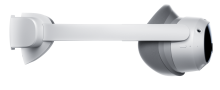 Side view of PICO 4 Ultra.
-
 PICO 4 Ultra lenses.


References
- ↑ 1.00 1.01 1.02 1.03 1.04 1.05 1.06 1.07 1.08 1.09 1.10 1.11 1.12 1.13 1.14 1.15 1.16 "PICO 4 Ultra". PICO Global. Pico. https://www.picoxr.com/global/products/pico4-ultra. Retrieved 2026-09-27.
- ↑ 2.0 2.1 2.2 2.3 2.4 2.5 2.6 Scott Hayden (2024-08-20). "Pico Reveals 'Pico 4 Ultra' Headset, Launching in China Next Month". Road to VR. https://roadtovr.com/pico-ultra-4-vr-mr-headset-china-release/. Retrieved 2026-09-27.
- ↑ 3.0 3.1 3.2 3.3 3.4 3.5 远洋 (2024-08-20). "字节跳动 PICO 4 Ultra MR 混合现实一体机发布:支持双目彩色透视,售价 4299 元". IT之家. https://www.ithome.com/0/789/800.htm. Retrieved 2026-10-17.
- ↑ 4.00 4.01 4.02 4.03 4.04 4.05 4.06 4.07 4.08 4.09 4.10 4.11 David Heaney (2024-08-20). "Pico 4 Ultra Launches In China With Specs Slightly Superior To Quest 3". UploadVR. https://www.uploadvr.com/pico-4-ultra-china-launch/. Retrieved 2026-09-27.
- ↑ 5.00 5.01 5.02 5.03 5.04 5.05 5.06 5.07 5.08 5.09 5.10 5.11 5.12 David Heaney (2024-09-03). "Pico 4 Ultra Launches In Europe & Asia-Pacific On September 20, Preorders Open Friday". UploadVR. https://www.uploadvr.com/pico-4-ultra-europe-apac-preorders/. Retrieved 2026-09-27.
- ↑ 6.0 6.1 6.2 6.3 6.4 6.5 Marcel Kleffmann (2024-09-03). "New "Ultra" VR/MR Headset from Pico Comes to Europe". GamesMarket. https://www.gamesmarket.global/pico-4-ultra-new-ultra-vrmr-headset-from-pico-comes-to-europe-9a7c50d910b4dd443cf794846516b6a5/. Retrieved 2026-09-27.
- ↑ 7.00 7.01 7.02 7.03 7.04 7.05 7.06 7.07 7.08 7.09 7.10 7.11 7.12 7.13 7.14 7.15 7.16 7.17 7.18 7.19 7.20 7.21 7.22 7.23 "PICO 4 Ultra Specs". PICO Global. Pico. https://www.picoxr.com/global/products/pico4-ultra/specs. Retrieved 2026-09-27.
- ↑ 8.0 8.1 Luna (2026-10-11). "Pico Space Pro Headset Spotted In Japanese Regulatory Filings". UploadVR. https://www.uploadvr.com/pico-space-pro-headset-spotted-in-japanese-regulatory-filings/. Retrieved 2026-10-17.
- ↑ 9.0 9.1 9.2 David Heaney (2025-08-14). "Pico 4 Ultra Gets Enhanced Body Tracking With 5 Pico Trackers & Travel Mode". UploadVR. https://www.uploadvr.com/pico-4-ultra-travel-mode-enhanced-body-tracking-5-pico-trackers/. Retrieved 2026-10-17.
- ↑ 10.0 10.1 David Heaney (2026-03-02). "Pico's Next Headset Has 4000 PPI Micro-OLEDs, Powerful New Chip & Next-Gen OS". UploadVR. https://www.uploadvr.com/pico-project-swan-official-display-compute-specs-announcement/. Retrieved 2026-10-17.
- ↑ 11.0 11.1 Luna (2026-09-05). "Pico Space Pro Appears To Receive FCC Certification Following Delay To Q4". UploadVR. https://www.uploadvr.com/pico-space-pro-appears-to-receive-fcc-certification-following-delay-to-q4/. Retrieved 2026-10-17.
- ↑ Kyt Dotson (2021-08-30). "TikTok owner ByteDance acquires VR headset maker Pico". SiliconANGLE. https://siliconangle.com/2021/08/30/tiktok-owner-bytedance-acquires-vr-headset-maker-pico/. Retrieved 2026-09-27.
- ↑ 13.00 13.01 13.02 13.03 13.04 13.05 13.06 13.07 13.08 13.09 13.10 13.11 13.12 13.13 13.14 Hamish Hector (2024-09-03). "Pico 4 Ultra review: powerful, but second fiddle to the Meta Quest 3 VR headset". TechRadar. https://www.techradar.com/computing/virtual-reality-augmented-reality/pico-4-ultra-review. Retrieved 2026-09-27.
- ↑ "ByteDance launches Pico 4 Ultra in China, competing with Apple Vision Pro". TechNode. 2024-09-03. https://technode.com/2024/09/03/bytedance-launches-pico-4-ultra-in-china-competing-with-apple-vision-pro/. Retrieved 2026-10-17.
- ↑ 15.0 15.1 "新型VR/MRヘッドセット「PICO 4 Ultra」が9月20日に日本発売 価格は89,800円(税込)". MoguLive. 2024-09-12. https://www.moguravr.com/pico-4-ultra-2/. Retrieved 2026-09-27.
- ↑ "VRヘッドセット「PICO 4 Ultra」5月1日より価格改定で104,900円に値上げ 為替・部品コスト高騰が背景". MoguLive. 2026-04-10. https://www.moguravr.com/pico-4-ultra-price-revision-2026/. Retrieved 2026-09-27.
- ↑ "Pricing - PICO Business". PICO Business. Pico. https://business.picoxr.com/global/pricing. Retrieved 2026-10-17.
- ↑ 18.0 18.1 "PICO 4 Ultra 技术规格". PICO (China). Pico. https://www.picoxr.com/cn/products/pico4-ultra/specs. Retrieved 2026-10-17.
- ↑ 19.0 19.1 19.2 19.3 19.4 Duncan Robertson (2024-09-12). "Pico 4 Ultra review: "The Quest 3 competitor the industry needs"". GamesRadar+. https://www.gamesradar.com/hardware/vr/pico-4-ultra-review/. Retrieved 2026-10-17.
- ↑ 20.0 20.1 20.2 20.3 20.4 David Heaney (2024-09-04). "Pico 4 Ultra Hands-On Impressions: Is It Really Better Than Quest 3?". UploadVR. https://www.uploadvr.com/pico-4-ultra-hands-on-impressions/. Retrieved 2026-10-17.
- ↑ 21.0 21.1 "PICO 4 Ultra VR-MR 一体机". PICO (China). Pico. https://www.picoxr.com/cn/products/pico4-ultra. Retrieved 2026-10-17.
- ↑ 22.0 22.1 22.2 22.3 22.4 James Bentley (2024-10-14). "Pico 4 Ultra review". PC Gamer. https://www.pcgamer.com/hardware/vr-hardware/pico-4-ultra-review/. Retrieved 2026-10-17.
- ↑ 23.0 23.1 23.2 23.3 23.4 Alex Walker-Todd (2024-09-30). "Pico 4 Ultra Review". Trusted Reviews. https://www.trustedreviews.com/reviews/pico-4-ultra. Retrieved 2026-09-27.
- ↑ 24.0 24.1 Josef Erl (2024-09-03). "Pico 4 Ultra Review: Quest 3 remains unmatched". MIXED. https://mixed-news.com/en/pico-4-ultra-review/. Retrieved 2026-09-27.
- ↑ Tomislav Bezmalinovic (2024-11-08). "Major update for Pico 4 & 4 Ultra brings a host of new features & improvements". MIXED. https://mixed-news.com/en/pico-update-5-12-0/. Retrieved 2026-10-17.
- ↑ Tomislav Bezmalinovic (2025-03-27). "Pico 4 Ultra gets OS features that I will miss on Meta Quest". MIXED. https://mixed-news.com/en/pico-os-update-5-13-0-u/. Retrieved 2026-10-17.
- ↑ 27.0 27.1 Callum Self (2025-05-07). "Pico 4 Ultra review - a fantastic VR headset that's lacking in one department". Pocket Tactics. https://www.pockettactics.com/pico-4-ultra-review. Retrieved 2026-10-17.