

Even Realities G1
More actions
| Even Realities G1 | |
|---|---|

| |
| Basic Info | |
| VR/AR | Smart Glasses |
| Type | Smart glasses |
| Subtype | AI Glasses, Notification Glasses |
| Platform | iOS, Android[1] |
| Creator | Even Realities |
| Developer | Even Realities |
| Manufacturer | Even Realities |
| Announcement Date | 26 June 2024[2] |
| Release Date | 25 June 2024 (manufacturer's security-support listing); G1 B introduced November 2024[3][4] |
| Price | US$599 base (£594 in the UK); US$749 with prescription lenses (historical); direct sales ended 15 September 2026[5][6][7] |
| Website | https://www.evenrealities.com/g1 |
| Versions | G1 A (panto/round), G1 B (rectangular) |
| Requires | Paired iOS or Android smartphone and the dedicated Even G1 app[8] |
| Successor | Even Realities G2 |
| System | |
| Operating System | Even OS user interface; iOS/Android companion app[2] |
| Display | |
| Display | Green monochrome MicroLED projectors and optical waveguides[1] |
| Peak Brightness | 1000 nits (manufacturer)[1] |
| Resolution | 640 × 200 per eye[1][5] |
| Refresh Rate | 20 Hz[1] |
| Image | |
| Field of View | 25° (manufacturer; axis unspecified)[1] |
| Optics | |
| Optics | Optical waveguides[1] |
| Ocularity | Binocular[1] |
| IPD Range | 54-80 mm pupillary-distance fit range (reported in a 2025 review)[5] |
| Adjustable Diopter | Prescription lenses available[1] |
| Passthrough | Optical see-through; 98% manufacturer-listed transmission[1] |
| Tracking | |
| Rotational Tracking | HeadUp gesture for dashboard access[9] |
| Audio | |
| Audio | No built-in speaker[5] |
| Microphone | Two built-in microphones[1] |
| Camera | No[10] |
| Connectivity | |
| Connectivity | Bluetooth Low Energy 5.2[1] |
| Ports | USB-C on charging case; wireless charging surfaces on glasses[11] |
| Bluetooth | BLE 5.2[1] |
| Power | Rechargeable lithium-ion battery; not user-replaceable[12] |
| Battery Capacity | 160 mAh glasses; 2000 mAh case (reported in 2025 review)[5] |
| Battery Life | Up to 1.5 days per charge; case provides 2.5 recharges (manufacturer estimates)[1] |
| Charge Time | Typically 2-3 hours (manufacturer)[10] |
| Device | |
| Dimensions | 5.4 x 5.2 x 1.4 in (open, Tom's Guide)[6] |
| Weight | 44 g (reported in 2025 review); 1.5 oz (Tom's Guide)[5][6] |
| Material | Magnesium-alloy frame with sandstone coating; titanium-alloy and silicone temple support[2] |
| Headstrap | Eyeglass temples with screwless hinge[1] |
| Color | Grey, Green, Brown (G1 A); Grey, Brown (G1 B)[13][14] |
| Sensors | Ambient light sensor; microphones; head-motion input[9] |
| Input | Temple-tip TouchBars; HeadUp; voice controls added in the 2025 app[15] |
The Even Realities G1 (sold as Even G1) is a pair of smart glasses developed by Even Realities, announced on 26 June 2024 and priced from US$599. It was the company's first product and was sold in two frame styles, G1 A and G1 B, until Even Realities ended direct sales on 15 September 2026.[2][5][7] Its binocular green display shows information such as notifications, navigation directions, translated speech and teleprompter text through transparent lenses. An iOS or Android phone supplies the companion app and connections to online services.[2][1] The G1 has no camera or built-in speaker. Its frame uses magnesium and titanium alloys, with electronics concentrated around the hinges and temple tips. A 2025 review reported a weight of 44 g.[5]
Even Realities announced a successor, the Even Realities G2, on 12 November 2025.[16] For the G1 after the end of direct sales, the company says existing units continue to work with the Even App and retain applicable warranty coverage and customer support; its published security support period will not end before 25 June 2029.[7]
History and development
Company background and design heritage
Even Realities' June 2024 announcement described the G1 as its first product. The company said its engineers had previous experience with luxury eyewear brands Lindberg and Mykita, and attributed the frame design to that experience. This describes staff backgrounds rather than a G1 partnership with either brand.[2] TechCrunch reported in July 2026 that the company was started in 2023, with co-founders from Apple and luxury eyewear companies.[17]
Introduction and frame variants
Even Realities announced the G1 Digital Glasses on 26 June 2024, with a user interface called Even OS and functions including Translate, Navigate, Teleprompt and QuickNotes.[2] The company's retrospective places the G1 introduction in June and the rectangular G1 B launch in November 2024. It also records a September appearance at the Silmo Paris eyewear exhibition and, by December, in-store try-on at 169 stores in ten countries. These are historical figures from the company.[4]
The two frame styles are G1 A, with panto or round rims, and G1 B, with rectangular rims. Their product pages list Grey, Green and Brown for G1 A, and Grey and Brown for G1 B.[13][14] Daniel Cooper's April 2025 review listed US$599 for non-prescription glasses, an additional US$150 for prescription lenses and US$100 for clip-on sunglasses. The prescription configuration therefore cost US$749 in that listing.[5]
Successor and discontinuation
According to a July 2026 TechCrunch report, Even Realities launched the G1 in 2024 as its first product and exceeded its own 10,000-unit sales target; founder and chief executive Will Wang said the company was the first in the category to sell more than 10,000 pairs.[17] These sales and category claims were statements from the chief executive. The G2, announced and opened for orders on 12 November 2025, launched at US$599, the same price as the G1, alongside the optional Even R1 smart ring at US$249. Engadget reported the manufacturer's comparisons of 54 percent slimmer G2 temples and two days of battery life, compared with the G1's one and a half days.[16]
Even Realities stopped selling the G1 directly on 15 September 2026. Its notice says the change affects only product availability, not warranty coverage, statutory consumer rights, or the G1's published security support period, which will not end before 25 June 2029; repairs or replacements remain subject to the warranty policy and the availability of parts and replacement products.[7] On 15 October 2026, both G1 A and G1 B store pages still stated that the G1 was no longer available for purchase and displayed sold-out status. The same pages, checked again on 17 October 2026, still carried the notice. This establishes the manufacturer's direct-sales status rather than availability from every retailer.[13][14]
The company's UK Product Security and Telecommunications Infrastructure (PSTI) statement lists the G1, described there as "Digital Glasses, G1", with a release date of 25 June 2024 and a security-update end of life "no earlier than" 25 June 2029, the same minimum period given in the discontinuation notice.[3] Its support pages also separate the G1 from the newer products in software: the current Even Realities App pairs only with the G2 and the Even R1 ring, and G1 owners use a dedicated Even G1 app.[8] Even Hub, the plug-in store described in an April 2026 support article, is an app platform designed specifically for the G2.[18]
For secondhand purchases, Even Realities' general guidance says it has no official refurbished or pre-owned program. Its warranty normally stays with the first purchaser, but the original owner can ask support for a one-time transfer of the remaining warranty term to a buyer; the warranty period runs from the delivery date of the original order.[19]
Design philosophy
The G1 combines ordinary eyewear frame shapes with a display for short pieces of information. Even Realities' original announcement emphasized daily wear, weight balance and unobtrusive interaction; its design claims should be distinguished from measurements of comfort or social acceptance.[2] The hardware omits a camera and speakers, while touch surfaces at the temple tips and a head-raising gesture control the display. The G1 does not provide the large color video screen described by contemporary reviews of display glasses such as Xreal and Viture products.[5][6]
Its optical see-through design keeps the real scene visible through the lenses. The display illuminates the pixels used for information while leaving the background unlit. The manufacturer describes the default virtual display as about two meters in front of the wearer.[1][9] Later app notes added a setting described as display-distance adjustment; they do not document a change to the optics' focal distance.[15]
Display technology
Dual waveguide and green display
Each eye sees a rectangular, green monochrome display through an optical waveguide. The manufacturer identifies the image source as Micro LED, and Cooper's review reports 640 × 200 pixels per eye. The display refreshes at 20 Hz.[1][5] Even Realities calls the projector, waveguide and prescription-lens arrangement HAOS, for Holistic Adaptive Optical System.[2]
| Display property | Documented G1 value | Interpretation |
|---|---|---|
| Image source | Green MicroLED | Single-color information display, rather than full-color video. |
| Display resolution | 640 × 200 per eye | Per-eye figure reported in the contemporary review; not a combined binocular pixel count. |
| Refresh rate | 20 Hz | Display refresh rate, not a measured tracking update rate or interaction latency. |
| Field of view | 25° | Manufacturer value; the product table does not identify a horizontal, vertical or diagonal axis. |
| Brightness | 1000 nits | Manufacturer value; measurement position and test conditions are not specified in the product table. |
| Light transmission | 98% | Manufacturer-listed "Passthrough" figure for the transparent optics, rather than camera passthrough. |
The manufacturer product table supplies the display, field-of-view, brightness and transmission figures above.[1] The per-eye resolution is also described in Cooper's review.[5]
Independent optical analysis
In an August 2024 analysis on his KGOnTech display-technology blog, Karl Guttag identified the G1's image source as Jade Bird Display's green-only 640 × 480 MicroLED panel, the same panel family used in the monocular Vuzix Z100. He had seen the G1 only in videos and in an hour-long video call with chief executive Will Wang, so his conclusions come from published through-the-lens videos and photographs rather than his own measurements.[20]
Guttag wrote that the waveguide shows a wide, short image placed above the wearer's straight-ahead view, so that text does not block forward vision. Calibrating a reviewer's smartphone photograph taken through the optics against a high-resolution image of the same JBD panel, he estimated that the G1 displayed only about 550 by 150 pixels, roughly 86% of the panel's horizontal pixels and 31% of its vertical pixels. He linked the reduced image height to lower power use and heat, and to the small size and weight of the frame. He also described the waveguide's pantoscopic tilt, which directs stray "eye glow" light downward so that an observer typically sees it only if the wearer tilts the head significantly, and judged the waveguides more transparent than other green monochrome waveguides he had seen (better than 90%).[20] His pixel estimate is an approximation from video frames, not a manufacturer figure; Even Realities lists the display as 640 × 200.[1]
Brightness adaptation and viewing
An ambient light sensor supports automatic brightness adjustment.[9] Readability depends on the surroundings: in his July 2025 G1 B review, Darragh Murphy found the display readable in much of his outdoor use, but said it disappeared against a bright, clear blue sky. Cooper noticed a slight gold tint within the waveguide region when looking at a white computer page. These are individual reviewers' observations rather than optical transmission or luminance measurements.[6][5]
AI features
Even AI and model options
Even AI accepts spoken questions and presents text answers. The original control is a press-and-hold of the left temple-tip TouchBar, followed by release after speaking.[9] The manufacturer's developer documentation describes microphone audio sent to the phone over Bluetooth, conversion to text by the app, a request to a large language model and transmission of the answer back to the glasses. That workflow does not establish that the language model runs on the glasses themselves.[21]
The iOS app's version 1.4.0 notes, dated 13 December 2024, added Perplexity and ChatGPT as selectable options for Even AI. The current manufacturer AI page lists ChatGPT and Perplexity, with an Even G1-only footnote attached to ChatGPT; much of that page describes the newer G2.[15][22]
The iOS version 1.6.0 notes, dated 5 June 2025, introduced Even AI in beta with an Even LLM described as a proprietary model for G1, a "Hey Even" wake command while the Dashboard is on, and English voice commands for G1 features. These dated software additions extend the original touch controls; they should not be read as identical launch capabilities or a guarantee that every function works without a phone.[15]
Voice-input limits
The G1 has no built-in camera. Its FAQ says image capture and automatic recognition of text being looked at are unavailable in the G1 AI input workflow.[10] The companion app also lets the user choose the speech-input language for Even AI and QuickNote.[9] Murphy's July 2025 review reported cut-off questions and incorrect replies from Even AI. Switching providers improved answers in his account, but did not resolve all timing problems. This reports his experience with that software, not a measured error rate for all G1 units.[6]
Smart features
Notification display and dashboard
The Dashboard brings up information after a head-raising gesture, with settings for which widgets and notifications appear. The guide describes time, date, weather, calendar events, quick notes and unread messages. In his review, Murphy reported that the HeadUp activation angle could be set between 0 and 60 degrees.[6] Notification permission is needed for the Even App and the relevant phone apps; some apps must be manually added to the glasses' notification list.[9] Dashboard widgets for stocks, news and notes were documented in the December 2024 app update, followed by Map and Calendar options in version 1.5.0 on 26 January 2025.[15]
In his April 2025 review, Cooper described news categories and selected publishers, notification previews and incoming messages, but said replies still required the phone. Those observations describe the reviewed software. Later voice controls are documented separately in the app's release history.[5][15]
Navigate starts with a destination entered in the companion app, then displays turn-by-turn directions and a simplified map in the glasses. Raising the head shows a route overview. The G1 guide describes walking and cycling; Cooper's review likewise tested walking and cycling options.[9][5] In a developer response published on the US App Store on 9 March 2025, Even Realities said it did not then support driving navigation. Walking or cycling navigation should therefore not be described as a documented driving mode.[15]
Translation and transcription
Translate captures speech and displays translated text. The guide describes choosing source and target languages in the app, reading the translation at normal eye level and raising the head to see the source text. The FAQ says translation needs an internet connection to cloud services.[9][10] Language lists changed over time: the FAQ lists 22, and marks Arabic, Hindi and Bengali as languages that cannot be displayed on the glasses, adding that translated text is available; Cooper's April 2025 review reported 24 supported languages; and subsequent iOS release notes document additions such as Ukrainian and Swiss German, then Greek and Hungarian. A historical language count is not a complete current guarantee for every speech or display language.[10][5][15] In his May 2025 TechRadar review, Alastair Jennings found free French-to-English translation accurate, with a delay of a few seconds.[23]
Basic Translate is free. The separate Translate Pro service is sold in prepaid time packs. On 17 October 2026 its support page listed $4.99 for one hour, $23.99 for five hours and $44.99 for ten hours, with a one-hour free trial. The same page says G1 A pre-orders placed before 21 August 2024 receive free unlimited Translate Pro use. These are time-based charges, rather than a documented recurring subscription requirement for all translation.[24] The feature-pricing page also lists QuickNote, Navigate, Teleprompt, Even AI and Notification as free functions.[25]
Transcribe supplies live captions of spoken words. Its addition to the iOS app was documented in version 1.5.0 on 26 January 2025, including saved transcription records and AI summaries. Version 1.5.2 on 22 February 2025 added use of the phone's microphone for Translate and Transcribe, and version 1.6.4 on 12 March 2026 described an upgraded Transcribe model "with higher accuracy and lower latency".[15] A laboratory comparison of the earlier transcription system is described below; it did not test the accuracy of every later model update.[26]
Teleprompter
Teleprompt displays an imported or typed script. The guide documents three modes: AI mode follows the speaker's speech, Manual mode supports page changes, and Automatic mode scrolls at a constant speed. Manual controls include the phone's volume buttons and temple-tip touches.[9] External Bluetooth page-turners work by sending volume-up and volume-down commands to the phone, which the app converts into page changes; the company's test for compatibility is whether the remote changes music volume on a locked phone.[27] The FAQ describes four to eight visible lines at once.[10] Both 2025 reviewers considered the teleprompter useful for presentations, with Murphy noting that it followed his speech. Their accounts are usability observations rather than controlled comparisons of speech performance.[5][6] Jennings was more critical: in his recorded test footage he appeared slightly cross-eyed while reading a full script, and switching to a list of bullet points made the feature far more usable for him.[23]
QuickNote
QuickNote uses the right TouchBar to capture a spoken note of up to 30 seconds. The guide describes cloud processing into a titled note with a body and tags. If there is no internet connection, the voice input is stored temporarily and processed when connectivity returns. Notes can be edited in the app and selected for the Dashboard.[9] Cooper reported that his reviewed version allowed audio playback in the phone app and text sharing of notes.[5]
Physical design
The G1 A and G1 B have different lens shapes but share the G1 display and app functions. Their manufacturer listings distinguish the colors and frame style, rather than describing the G1 B as a separate generation.[13][14] The launch announcement describes a magnesium-alloy frame with a sandstone coating, titanium-alloy and silicone temple support, and a patented screwless hinge. Electronics in the hinges and temple tips account for their thicker appearance compared with ordinary eyeglasses.[2][5]
Published weights differ. Cooper reported 44 g, and Tom's Guide listed 1.5 ounces and dimensions of 5.4 x 5.2 x 1.4 inches with the temples open.[5][6] Design-award entries describe a lighter frame: the Red Dot entry says "weighing just 30 grams" and the Good Design Award entry says "30+g", while Guttag reported in 2024 that the company had said only that the G1 weighed less than 40 grams.[28][29][20]
The G1 came in a single frame size. Cooper reported a manufacturer-claimed pupillary-distance fit range of 54-80 mm for that size. This is a reported fit range, not a mechanical interpupillary-distance adjustment or a claim of correct fit for every face.[5] The G1 guide says temple width and nose-pad arms can be adjusted and recommends professional optical-store fitting rather than adjustment without suitable tools.[9] Individual comfort reports and the manufacturer's design goals do not establish universal all-day comfort.
Prescription support
Even Realities offered prescription and non-prescription G1 lenses, integrating prescription correction with the display optics. The product page describes individually surfaced lenses and clip-on sunglasses; the two store listings identify single-vision prescription options.[1][13][14] The US$150 prescription surcharge and US$100 sunglass clip price are historical 2025 figures, not current sales offers.[5]
Guttag described the prescription correction as optically glued to the waveguide, unlike the snap-in or clip-on prescription lens inserts used by other display glasses. He wrote that this is thinner and lighter and avoids reflections from an air gap, but that a changed prescription means buying new glasses, whereas an insert can simply be replaced.[20] Cooper reported that users with changed prescriptions could send the glasses back to the company for replacement lenses, at €230 in the EU or €240 (US$260) elsewhere at the time of his review. Optical-store adjustment of the frame should not be confused with authorization to replace the digital lenses like ordinary removable lenses.[5][9]
Battery and charging
Even Realities rates the G1 for up to one and a half days per full charge, depending on use, and its battery-containing case for two and a half additional recharges. The FAQ gives a typical charging time of two to three hours.[1][10] Cooper's review reported a 160 mAh glasses battery and a 2000 mAh case battery; he regularly obtained about a day and a half under his own use.[5] That observation is not a standardized endurance test. The safety document says the lithium-ion battery is not user-replaceable.[12]
The glasses charge in their folded case through wireless charging contact surfaces; the case has a USB-C power port. The Quick Guide specifies folding the left temple first and shows a case indicator that switches between glasses and case battery level depending on whether the glasses are inside. An orange flashing indicator means they are not correctly folded or positioned.[11]
The manufacturer also documents a charging-case firmware update dated 30 July 2025 for charging and connection issues. Its instructions distinguish the supplied charging-only cable from a data-capable USB cable required by the updater. This is a separate case-maintenance procedure, rather than video input through the glasses.[30]
Connectivity and software
G1 connects to a phone using Bluetooth Low Energy 5.2. The Even App handles setup, feature settings and firmware updates.[1][9] The US App Store listing, first released on 31 July 2024 and checked on 17 October 2026, requires iOS 16.0 or later; its most recent version was 1.6.5, released on 9 June 2026. The manufacturer also documents Android compatibility, but that does not establish support for every phone or an identical app-version history on both operating systems.[15][1]
| iOS app version | Date | Documented addition |
|---|---|---|
| 1.4.0 | 13 December 2024 | Perplexity and ChatGPT selection, display-distance adjustment, Dashboard stocks/news/notes, QuickNote checklists, Polish, Czech, Portuguese and Turkish language support, and lower charging-case standby consumption. |
| 1.5.0 | 26 January 2025 | Transcribe with saved records and summaries; Dashboard Map and Calendar; TouchBar and notification-display settings. |
| 1.5.2 | 22 February 2025 | Phone-microphone input for Translate and Transcribe. |
| 1.5.4 | 21 March 2025 | Ukrainian and Swiss German translation support. |
| 1.5.6 | 5 April 2025 | French, Spanish and Italian as app system languages and news sources. |
| 1.6.0 | 5 June 2025 | Even AI beta with Even LLM, "Hey Even" while Dashboard is on, and English voice commands. |
| 1.6.2 | 1 August 2025 | Greek and Hungarian speech languages for Translate; Even LLM response-speed update. |
| 1.6.3 | 21 November 2025 | G1 warranty period shown in Device Info; bug fixes. |
| 1.6.4 | 12 March 2026 | Upgraded Transcribe model, described as more accurate with lower latency; stock search by company name. |
| 1.6.5 | 9 June 2026 | Fixes for Norwegian translation and for Navigate failing to launch on certain phone models. |
These entries come from the developer's iOS release notes, rather than independent feature testing or a complete Android release log.[15]
Developer access
Even Realities recorded open-source support in its November 2024 retrospective and publishes an Even Demo app with G1 Bluetooth documentation. Its examples describe separate left- and right-side Bluetooth connections, AI microphone data, paged text and 1-bit 576 × 136 BMP image transmission. The bitmap example size is a demo format, not a replacement for the G1's 640 × 200 display specification.[4][21] The public documentation establishes a route for custom phone applications; it does not establish a general native app store or unrestricted on-glasses software installation. The company's later Even Hub plug-in platform is documented for the G2, not the G1.[18]
The current G1 product FAQ says the Even R1 ring supports G2 interaction and is not yet compatible with G1. Planned expansion of compatibility is not existing G1 functionality.[1]
Documented issues
The manufacturer's Known Issues page, checked on 17 October 2026, still listed issue 016 as open: higher-than-expected phone battery consumption under certain conditions, reported on 16 March 2025. It listed older charging, notification and Bluetooth problems as fixed, with versions identified for several fixes. These are the statuses on the retained support page, not a measurement of how often current users experience those problems.[27]
Audio
The G1 has two microphones for speech input and no built-in speaker or bone-conduction audio. It displays AI answers and captions as text; audio playback described in the review takes place on the paired phone.[1][5] Camera-free and speaker-free hardware does not make cloud processing local: the guide expressly describes online processing for QuickNote and translation, and the developer example routes speech through the phone.[9][21]
Water resistance and care
The manufacturer describes G1 resistance to splashes and light rain. It does not supply an IP rating on the G1 product table or FAQ. The charging case is not water-resistant, and the safety document excludes submersion and extended water exposure.[1][10][12] The cleaning guide says to avoid running-water washing and ultrasonic cleaning, and to apply cleaning spray to a microfiber cloth rather than directly into the frame.[31]
The safety document gives typical operating temperatures of -10°C to 40°C, storage temperatures of -20°C to 45°C, and charging temperatures of 0°C to 40°C. These are manufacturer recommendations, not measured endurance limits. Its FCC section states Part 15 compliance and Class B testing; this is the company's compliance statement.[12]
Warranty
The G1 FAQ describes a limited warranty against manufacturing defects of two years in Europe and one year in other regions.[10] The company's current warranty policy, revised on 16 October 2026, gives one year from delivery for the main unit and charging case, or two years for purchases in the European Union or the European Free Trade Association, in addition to statutory consumer rights. It excludes scratches from use and damage from unauthorized lens installation or replacement, and sets a refundable inspection fee of US$80 where applicable law permits one.[32] iOS app version 1.6.3 (21 November 2025) made the remaining G1 warranty period viewable in the app's Device Info screen.[15]
Comparison with smart glasses
The G1's text display differs from the 2023 Ray-Ban Meta model discussed in Cooper's review, which emphasizes photography and audio and has no heads-up display. Meta's original announcement specifies a 12 MP camera, speakers and a starting US$299 price for that 2023 model.[5][33] Brilliant Labs Frame provides a 640 × 400 color micro-OLED display with a prism optic and a 720p camera; Brilliant Labs documents use with Noa or custom phone apps.[34][35] Amazon's 2023 Echo Frames announcement instead describes Alexa voice access and speakers, with prices starting at US$269.99.[36] These historical model comparisons do not describe the complete current range or identical AI, optics and prescription costs.
| Feature | Even Realities G1 | Brilliant Labs Frame | Ray-Ban Meta (2023) |
|---|---|---|---|
| Display | Binocular green waveguide display, 640 × 200 per eye | 640 × 400 color micro-OLED with prism optics | No heads-up display |
| AI/app interface | Even AI with selectable model options and later Even LLM beta | Noa or custom apps | Meta AI; the original announcement limited launch availability to US beta |
| Camera | No | 720p camera | 12 MP camera |
The G1 figures and Ray-Ban display comparison are documented in Cooper's review; the Frame specifications and app options come from Brilliant Labs' manuals, and the Ray-Ban camera and original AI availability from Meta's 2023 announcement.[5][34][35][33]
Reception
Reviews
| Publication | Reviewer | Date | Score | Frame reviewed |
|---|---|---|---|---|
| Engadget | Daniel Cooper | 7 April 2025 | 78/100 | G1 A[5] |
| TechRadar | Alastair Jennings | 20 May 2025 | 4/5 | G1 B, grey[23] |
| Tom's Guide | Darragh Murphy | 18 July 2025 | 3.5/5 | G1 B[6] |
Cooper listed the G1's light weight, appearance, navigation, translation and teleprompter among its strengths, and its fussy controls and dependence on the phone among its weaknesses; he described price as the biggest obstacle.[5] Jennings called navigation the feature he used almost daily in London and praised transcription, while criticizing the teleprompter's effect on his on-camera gaze and an Even AI that gave US-centric answers to UK questions.[23] Murphy praised the everyday look and comfort but considered the glasses "incredibly pricey for what they offer", comparing the G1's US$599 with US$299 for the Ray-Ban Meta glasses.[6]
Design awards
The G1 received three design awards in 2025. It won an iF Design Award 2025 in the Product Design discipline, Eyewear category, which Even Realities announced on 6 March 2025.[37][38] It was a winner of the Red Dot Award: Product Design 2025 in the Smart Glasses category; the entry credits an in-house team of Dan Hu, Philipp Haffmans, Gang Zhao, Zhuo Deng and Leilei Lian.[28] Even Realities announced on 20 October 2025 that the G1 had won a 2025 Good Design Award, the Japanese program run by the Japan Institute of Design Promotion, where the entry is titled "Smart Eyewear".[29][39] These awards judge design entries; they are not technical tests of the display or software.
Research
Social acceptability
A 2025 IHIET paper by Mohammad Jeelani and Michael Prieto, affiliated with Magic Leap, included G1 among six head-mounted products. Twenty-nine participants were recruited internally at an AR company; each received training and scripted tasks with four of the six devices. They answered a 15-item modified WEAR questionnaire using a five-point scale. Figure 1 reports G1's overall score as 3.32 out of 5, compared with 4.09 for Ray-Ban Meta and 2.47 for Apple Vision Pro. Figure 2 gives G1 a design-and-aesthetics score of 3.56.[40]
This measures opinions in a short employee focus-group exercise. It does not demonstrate that G1 is indistinguishable from regular glasses to the general public, nor does it measure long-term comfort or bystander acceptance. The paper proposes larger, longitudinal and bystander studies, and does not report a separate G1 participant count or inferential uncertainty for the plotted scores.[40]
Laboratory speech-to-text comparison
A November 2025 paper in Frontiers in Neurology compared G1, Meizu MYVU IMIKI, Xreal AIR and Epson Moverio BT-40 for speech transcription. The test used a sound booth, frontal speech and noise, German number and monosyllabic tests at 65 and 80 dB, and the Oldenburger sentence test (OLSA). Its methods describe a normal-hearing volunteer with regular reading abilities. Table 1 identifies G1 software as version 1.5, with Bluetooth connection and online communication.[26]
| Test condition | G1 result in the paper's table of best scores |
|---|---|
| Numbers, 65 dB | 90% |
| Numbers, 80 dB | 100% |
| Monosyllables, 65 dB | 45% |
| Monosyllables, 80 dB | 80% |
| OLSA in quiet | 99% |
| OLSA in noise | +3.5 dB |
The figures are the paper's reported results for the tested configuration. The authors explicitly call it a technical device comparison rather than a clinical study. They identify limitations in noise and difficult speech conditions. These scores do not establish clinical benefit for patients with hearing loss, an accuracy percentage for unrestricted conversations, or the performance of every later G1 software update.[26]
Strengths and limitations
The G1 offers binocular text viewing, prescription options and phone-based navigation, notes, translation and teleprompting in eyeglass frames. Those functions and the quoted one-and-a-half-day runtime distinguish its intended use from high-refresh-rate video display glasses.[1][5] Contemporary reviewers valued the low weight and teleprompter or navigation functions, while identifying phone dependence, limited controls, display washout in bright conditions and inconsistent AI responses.[5][6]
The display is monochrome and refreshes at 20 Hz. There is no camera or built-in speaker, and online speech features depend on a paired phone and its connectivity. Translate Pro is separately charged for users outside the specified pre-order entitlement. Direct manufacturer sales have ended; continuing support follows the terms and availability limits of the discontinuation notice.[1][9][24][7]
Technical specifications summary
| Specification | Documented details |
|---|---|
| Optical system | Binocular optical waveguides and green MicroLED projectors; 640 × 200 per eye; 25° manufacturer-listed field of view; 20 Hz refresh.[1][5] |
| AI and input | Even AI with model options; temple-tip TouchBars and HeadUp; later iOS Even AI beta added Even LLM and voice controls.[15][9] |
| Weight and materials | 44 g reported in a 2025 review; magnesium-alloy frame, titanium-alloy and silicone temple support.[5][2] |
| Fit | Adjustable nose-pad arms and temple width; 54-80 mm pupillary-distance fit range reported by Cooper, rather than adjustable mechanical IPD.[9][5] |
| Frame styles | G1 A (panto/round), G1 B (rectangular); style-specific colors.[13][14] |
| Historical pricing and status | US$599 base, US$749 with prescription lenses in the 2025 review; direct sales ended 15 September 2026.[5][7] |
See also
- Even Realities
- Even Realities G2
- Jade Bird Display
- Vuzix Z100
- Smart Glasses
- AI Glasses
- Waveguide Display
Gallery
-
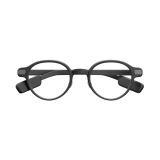 Grey G1 A frame with its temples folded.

References
- ↑ 1.00 1.01 1.02 1.03 1.04 1.05 1.06 1.07 1.08 1.09 1.10 1.11 1.12 1.13 1.14 1.15 1.16 1.17 1.18 1.19 1.20 1.21 1.22 1.23 1.24 1.25 1.26 1.27 1.28 1.29 "Even G1 Smart Glasses | Everyday Eyewear with Display". Even Realities. https://www.evenrealities.com/g1. Retrieved 2026-10-17.
- ↑ 2.00 2.01 2.02 2.03 2.04 2.05 2.06 2.07 2.08 2.09 2.10 Even Realities (2024-06-26). "Even Realities Unveils G1 Digital Glasses: Seamlessly Blending Beautiful Aesthetics with Everyday Functionality". PR Newswire. https://www.prnewswire.com/news-releases/even-realities-unveils-g1-digital-glasses-seamlessly-blending-beautiful-aesthetics-with-everyday-functionality-302182962.html. Retrieved 2026-10-17.
- ↑ 3.0 3.1 Even Realities. "UK PSTI Statement of Compliance". Even Support Center. https://support.evenrealities.com/hc/en-us/articles/14519551777295-UK-PSTI-Statement-of-Compliance. Retrieved 2026-10-17.
- ↑ 4.0 4.1 4.2 "A year of innovation: Even Realities 2024.". Even Realities. 2024-12-31. https://www.evenrealities.com/blogs/news/a-year-of-innovation-even-realities-2024. Retrieved 2026-10-15.
- ↑ 5.00 5.01 5.02 5.03 5.04 5.05 5.06 5.07 5.08 5.09 5.10 5.11 5.12 5.13 5.14 5.15 5.16 5.17 5.18 5.19 5.20 5.21 5.22 5.23 5.24 5.25 5.26 5.27 5.28 5.29 5.30 5.31 5.32 5.33 5.34 Daniel Cooper (2025-04-07). "Even Realities G1 review: Limited but effective smart glasses". Engadget. https://www.engadget.com/wearables/even-realities-g1-review-limited-but-effective-smart-glasses-140059586.html. Retrieved 2026-10-17.
- ↑ 6.00 6.01 6.02 6.03 6.04 6.05 6.06 6.07 6.08 6.09 6.10 6.11 Darragh Murphy (2025-07-18). "I wore the Even Realities G1 for a month, and they're smart glasses I'd actually wear despite their flaws". Tom's Guide. https://www.tomsguide.com/computing/smart-glasses/even-realities-g1-smart-glasses-review. Retrieved 2026-10-17.
- ↑ 7.0 7.1 7.2 7.3 7.4 7.5 Even Realities (2026-09-15). "Even G1 Sales Discontinuation Notice". Even Support Center. https://support.evenrealities.com/hc/en-us/articles/17564427335823-Even-G1-Sales-Discontinuation-Notice. Retrieved 2026-10-17.
- ↑ 8.0 8.1 Even Realities. "Even Realities App Download". Even Support Center. https://support.evenrealities.com/hc/en-us/articles/14463585968399-Even-Realities-App-Download. Retrieved 2026-10-17.
- ↑ 9.00 9.01 9.02 9.03 9.04 9.05 9.06 9.07 9.08 9.09 9.10 9.11 9.12 9.13 9.14 9.15 9.16 9.17 Even Realities. "User guide". Even Support Center. https://support.evenrealities.com/hc/en-us/articles/14301335051023-User-guide. Retrieved 2026-10-17.
- ↑ 10.0 10.1 10.2 10.3 10.4 10.5 10.6 10.7 10.8 Even Realities. "General FAQs". Even Support Center. https://support.evenrealities.com/hc/en-us/articles/13489269281167-General-FAQs. Retrieved 2026-10-17.
- ↑ 11.0 11.1 Even Realities. "Quick Guide: Even G1". Even Support Center. https://support.evenrealities.com/hc/article_attachments/15913878793103. Retrieved 2026-10-15.
- ↑ 12.0 12.1 12.2 12.3 Even Realities. "Health & safety". Even Support Center. https://support.evenrealities.com/hc/en-us/articles/14301342658191-Health-safety. Retrieved 2026-10-17.
- ↑ 13.0 13.1 13.2 13.3 13.4 13.5 "Buy Even G1 A Smart Glasses | Configure Color, Lens & Accessories". Even Realities. https://www.evenrealities.com/products/g1-a. Retrieved 2026-10-17.
- ↑ 14.0 14.1 14.2 14.3 14.4 14.5 "Buy Even G1 B Smart Glasses | Configure Color, Lens & Accessories". Even Realities. https://www.evenrealities.com/products/g1-b. Retrieved 2026-10-17.
- ↑ 15.00 15.01 15.02 15.03 15.04 15.05 15.06 15.07 15.08 15.09 15.10 15.11 15.12 Even Realities Ltd.. "Even G1". App Store. https://apps.apple.com/us/app/id6499140518. Retrieved 2026-10-17.
- ↑ 16.0 16.1 Ian Carlos Campbell (2025-11-12). "Even Realities' G2 smart glasses can be controlled with a smart ring". Engadget. https://www.engadget.com/wearables/even-realities-g2-smart-glasses-can-be-controlled-with-a-smart-ring-151500125.html. Retrieved 2026-10-15.
- ↑ 17.0 17.1 Kate Park (2026-07-06). "Smart glasses maker Even Realities hits $1B valuation with $150M funding led by Meituan, Tencent". TechCrunch. https://techcrunch.com/2026/07/06/smart-glasses-maker-even-realities-hits-1b-valuation-with-150m-funding-led-by-meituan-tencent/. Retrieved 2026-10-15.
- ↑ 18.0 18.1 Even Realities (2026-04-03). "Even Hub". Even Support Center. https://support.evenrealities.com/hc/en-us/articles/15688149217167-Even-Hub. Retrieved 2026-10-17.
- ↑ Even Realities. "About pre-owned / Unofficial Orders". Even Support Center. https://support.evenrealities.com/hc/en-us/articles/14309458419087-About-pre-owned-Unofficial-Orders. Retrieved 2026-10-17.
- ↑ 20.0 20.1 20.2 20.3 Karl Guttag (2024-08-18). "Even Realities G1: Minimalist AR Glasses with Integrated Prescription Lenses". KGOnTech. https://kguttag.com/2024/08/18/even-realities-g1-minimalist-ar-glasses-with-integrated-prescription-lenses/. Retrieved 2026-10-17.
- ↑ 21.0 21.1 21.2 Even Realities. "Even Demo". GitHub. https://github.com/even-realities/EvenDemoApp. Retrieved 2026-10-15.
- ↑ "AI Glasses with ChatGPT & Auto Real-time Prompts". Even Realities. https://www.evenrealities.com/ai-glasses. Retrieved 2026-10-15.
- ↑ 23.0 23.1 23.2 23.3 Alastair Jennings (2025-05-20). "Even Realities Even G1 AR glasses review". TechRadar. https://www.techradar.com/computing/even-realities-g1-review. Retrieved 2026-10-17.
- ↑ 24.0 24.1 Even Realities. "Translate Pro plan". Even Support Center. https://support.evenrealities.com/hc/en-us/articles/14301378759695-Translate-Pro-plan. Retrieved 2026-10-17.
- ↑ Even Realities. "Features & pricing". Even Support Center. https://support.evenrealities.com/hc/en-us/articles/14301353212815-Features-pricing. Retrieved 2026-10-15.
- ↑ 26.0 26.1 26.2 Helge Rhodin, Imran Ersoy, Sefa Aygun, Christoph J. Pfeiffer, Anna Lisa Vollmer, Ingo Todt (2025-11-05). "Comparison of augmented reality glasses for the assistive communication support of hearing loss". Frontiers in Neurology, vol. 16, art. 1635699. https://doi.org/10.3389/fneur.2025.1635699. Retrieved 2026-10-17.
- ↑ 27.0 27.1 Even Realities. "Known Issues". Even Support Center. https://support.evenrealities.com/hc/en-us/articles/14309475255183-Known-Issues. Retrieved 2026-10-17.
- ↑ 28.0 28.1 "Even G1". Red Dot. Red Dot GmbH & Co. KG. 2025. https://www.red-dot.org/project/even-g1-78294. Retrieved 2026-10-17.
- ↑ 29.0 29.1 "Smart Eyewear". Good Design Award. Japan Institute of Design Promotion. 2025. https://www.g-mark.org/en/gallery/winners/28237. Retrieved 2026-10-17.
- ↑ Even Realities. "Even G1 Case Upgrade". Even Support Center. https://support.evenrealities.com/hc/en-us/articles/14309515401743-Even-G1-Case-Upgrade. Retrieved 2026-10-15.
- ↑ Even Realities. "Cleaning & storage recommendation". Even Support Center. https://support.evenrealities.com/hc/en-us/articles/14301393254415-Cleaning-storage-recommendation. Retrieved 2026-10-15.
- ↑ Even Realities (2026-10-16). "Warranty Policy". Even Support Center. https://support.evenrealities.com/hc/en-us/articles/13558587234575-Warranty-Policy. Retrieved 2026-10-17.
- ↑ 33.0 33.1 Meta (2023-09-27). "Introducing the New Ray-Ban | Meta Smart Glasses". Meta. https://about.fb.com/news/2023/09/new-ray-ban-meta-smart-glasses/. Retrieved 2026-10-15.
- ↑ 34.0 34.1 Brilliant Labs. "Frame Hardware Manual". Brilliant Documentation. https://docs.brilliant.xyz/frame/hardware/. Retrieved 2026-10-15.
- ↑ 35.0 35.1 Brilliant Labs. "Frame". Brilliant Documentation. https://docs.brilliant.xyz/frame/frame/. Retrieved 2026-10-15.
- ↑ Amazon (2023-09-20). "Amazon Unveils Next Generation Echo Show 8, All-New Echo Hub, and New Echo Frames". Amazon US Press Center. https://press.aboutamazon.com/2023/9/amazon-unveils-next-generation-echo-show-8-all-new-echo-hub-and-new-echo-frames. Retrieved 2026-10-15.
- ↑ "Even Realities G1". iF Design. iF International Forum Design. 2025. https://ifdesign.com/en/winner-ranking/project/even-realities-g1/680098. Retrieved 2026-10-17.
- ↑ "Even G1 Wins iF Design Award 2025 for Smart Eyewear". Even Realities. 2025-03-06. https://www.evenrealities.com/blogs/news/even-g1-secures-if-design-award-2025. Retrieved 2026-10-17.
- ↑ "Even G1 Wins 2025 Good Design Award for Smart Eyewear". Even Realities. 2025-10-20. https://www.evenrealities.com/blogs/news/the-2025-good-design-award-goes-to-even-g1. Retrieved 2026-10-17.
- ↑ 40.0 40.1 Mohammad Jeelani, Michael Prieto (2025). "Using the Wearable Acceptability Range (WEAR) Scale to Rate Social Acceptability of Mixed Reality and AI Enabled Head-Mounted Wearables". Human Interaction and Emerging Technologies (IHIET 2025), AHFE Open Access vol. 197, pp. 350-356. https://doi.org/10.54941/ahfe1006751. Retrieved 2026-10-17.