

Brilliant Labs Frame
More actions
| Brilliant Labs Frame | |
|---|---|

| |
| Basic Info | |
| VR/AR | Augmented Reality |
| Type | Smart glasses |
| Subtype | AI Glasses |
| Platform | iOS, Android (companion app) |
| Creator | Brilliant Labs |
| Developer | Brilliant Labs |
| Manufacturer | Brilliant Labs |
| Announcement Date | 8 February 2024 |
| Release Date | Pre-orders opened 8 February 2024; first batch scheduled to ship 15 April 2024; shipping by early May 2024 |
| Price | US$349 (launch price); US$448 with built-in prescription lenses |
| Website | https://brilliant.xyz/ |
| Versions | Smokey Black, Cool Gray and H20 (transparent) frame colors |
| Requires | iOS or Android smartphone with the Noa app or another Frame host app |
| Predecessor | Brilliant Monocle |
| Successor | Brilliant Labs Halo |
| System | |
| Operating System | Open-source firmware with a Lua virtual machine |
| Chipset | Nordic nRF52840 Bluetooth microcontroller; Lattice CrossLink-NX LIFCL-17 FPGA (graphics and camera acceleration) |
| CPU | 32-bit Arm Cortex-M4F at 64 MHz |
| Storage | |
| Storage | 1 MB flash (microcontroller) |
| Memory | 256 KB RAM (microcontroller) |
| Display | |
| Display | 0.23-inch Micro-OLED, up to 16 colors per frame |
| Resolution | 640 x 400 |
| Image | |
| Field of View | 20 degrees diagonal (manufacturer figure) |
| Optics | |
| Optics | Micro-OLED bonded to a prism assembly (described by Brilliant Labs as a geometric prism optic); non-polarized 50/50 beam splitter and curved mirror according to an independent analysis |
| Ocularity | Monocular (right eye) |
| IPD Range | Designed for 58-72 mm |
| Adjustable Diopter | No (optional prescription lenses) |
| Passthrough | Yes (optical see-through) |
| Tracking | |
| Tracking | No spatial tracking |
| Eye Tracking | No |
| Hand Tracking | No |
| Audio | |
| Audio | No built-in speaker |
| Microphone | TDK ICS-41351 MEMS microphone |
| Camera | Omnivision OV09734 720p color camera (images captured at 1280 x 720 and cropped to 720 x 720) |
| Connectivity | |
| Connectivity | Bluetooth 5.3 (Bluetooth Low Energy) to a host device |
| Ports | 5V charging terminal for the Mister Power charging cradle (cradle has USB Type-C) |
| WiFi | No (via phone) |
| Bluetooth | 5.3 |
| Power | Built-in rechargeable lithium-ion battery; Mister Power charging cradle with its own 140 mAh battery |
| Battery Capacity | 210 mAh (two 105 mAh cells) |
| Battery Life | All day at estimated normal use together with Mister Power (manufacturer claim) |
| Device | |
| Weight | Just less than 40 g (manufacturer figure) |
| Material | Nylon plastic |
| Color | Smokey Black, Cool Gray, H20 (transparent) |
| Sensors | Camera, microphone, MEMSIC MC6470 6-axis IMU (3-axis accelerometer with tap detection, 3-axis e-compass) |
| Input | Tap gestures, voice (through a paired phone app) |
The Brilliant Labs Frame (sold as Frame) is a pair of open-source AI glasses with a small monocular display, made by the Singapore-based company Brilliant Labs. Brilliant Labs announced Frame and opened pre-orders on 8 February 2024 at US$349, or US$448 with prescription lenses, and began shipping it in spring 2024.[1][2][3] The glasses pair with a smartphone over Bluetooth, and the company's Noa app sends what the wearer says and sees to cloud AI services, including OpenAI's ChatGPT and Whisper and the Perplexity search engine, then shows the answer on the display in front of the right eye.[4]
Frame weighs just less than 40 grams according to Brilliant Labs. A 640 x 400 micro-OLED display is bonded to a prism optic and gives a field of view of about 20 degrees diagonally, which the company compares to an iPad held at arm's length.[4][5] The firmware, the FPGA code, the Noa app and the hardware design files are published on GitHub, and Brilliant Labs aimed the product at developers and people it calls "imaginative hackers".[5][6][7]
Frame is the successor to the clip-on Brilliant Monocle and was followed by Brilliant Labs Halo, which Brilliant Labs announced on 31 July 2025.[8] As of October 2026, the Brilliant Labs website lists Halo as its only product, and Frame is no longer offered in the company's store.[9]
History and development
Brilliant Labs and Monocle
Brilliant Labs was founded in 2019. Before Frame, it sold the Monocle, a clip-on display unit for existing glasses, also at US$349; in June 2023 the company raised US$3 million from investors including Oculus co-founder Brendan Iribe.[1] Frame keeps the open-source approach of Monocle: TechCrunch reported at launch that developers would get documentation, the open-source codebase and the hardware schematics.[1] Brilliant Labs later wrote that, like Monocle, Frame "allowed us to deepen our roots in the open source community".[10]
February 2024 announcement
Brilliant Labs announced Frame on 8 February 2024, together with an investment from John Hanke, then the chief executive of Niantic; TechCrunch put the company's total financing at US$6 million after that investment.[1] The company described the round frame design as an "homage" to historical figures including John Lennon, and Business Insider reported that it cited the circular glasses of Lennon, Steve Jobs and Gandhi.[1][11]
At announcement, Noa combined several third-party AI models: Perplexity's conversational search engine, OpenAI's GPT-4 for text, Stability AI's Stable Diffusion for image generation and OpenAI's Whisper for speech recognition. TechCrunch reported that Brilliant Labs eventually wanted to run lightweight machine-learning models on the glasses themselves.[1] TechRadar described the assistant starting as an "egg" on the display that hatches into an avatar.[12]
In an ask-me-anything session reported by MIXED on 13 February 2024, the company said it chose a right-eye-only display, a 640 x 400 resolution and no speaker to keep weight and power draw down, and that Frame runs Lua instead of the MicroPython used on Monocle. The team also said the glasses are not waterproof but should survive sweat or light rain, that it does not store users' prompts or the AI responses, and that it was working to support more prescriptions, including lenses for astigmatism.[13]
Release and sales
An archived copy of the Frame store page from 4 April 2024 said that pre-orders shipped free and that the first batch would ship on 15 April 2024.[4] By 3 May 2024 it read "Shipping now on a first-come first-served basis" and warned that, because of high demand, buyers should expect a little over a month for Frame to ship; the same warning was still shown in June 2024.[3][14] Display analyst Karl Guttag noted on 9 May 2024 that Brilliant Labs had started shipping Frame.[15]
In May 2024, MIXED reported a worldwide launch of Frame at a pre-order price of US$349 through June. Brilliant Labs added Anthropic's Claude 3, Meta's Llama 3 and Stable Diffusion to Noa alongside Perplexity, Whisper and GPT-4o, and started a Developer Partner Program with twice-monthly office hours and a planned hackathon.[16]
On 3 August 2024, Brilliant Labs held a hackathon with Niantic at which, according to the company, more than 50 developers built applications combining AI and AR on Frame.[17] In November 2024 the company's blog highlighted community-made Frame projects, among them a demo that overlays location pins for points of interest using bearing calculated on the phone from Frame's magnetometer and accelerometer data, an app that sends images from a web-based image generation model to the display, and a sprite viewer that reduces PNG and JPG images to fit Frame's memory and color limits.[18]
Some color and prescription combinations were listed as sold out during 2024 and 2025.[14][19] By March 2025 the store also offered an "Rx Clip-On" with a personal prescription through the partner retailer SmartBuyGlasses.[19] In an archived copy of 4 July 2025, the store listed Frame only in Smokey Black at US$349 and marked it sold out.[7]
Succession by Halo
Brilliant Labs announced Halo on 31 July 2025. Engadget described it as the company's second-generation smart glasses and contrasted its wayfarer styling with the "Panto-styled" Frame.[8] Road to VR also noted Frame as the slimmer display unit that followed Monocle.[20] In a blog post of 13 August 2025, Brilliant Labs wrote that it "learned a lot of hard lessons from developing and manufacturing Frame" and wanted to build that learning into Halo.[10] The current Brilliant SDK packages support both Frame and Halo, while the older Frame-only packages still work but lack newer features.[21]
Design and hardware
Frame and fit
Frame has thick round frames made of nylon plastic and weighs 39 grams according to TechCrunch; the store page gave "just less than 40g".[1][4] It was sold in three colors: Smokey Black, Cool Gray and the transparent H20.[2][12] Brilliant Labs designed Frame for an interpupillary distance range of 58-72 mm and suggested an Eye Measure app to check suitability.[4] The glasses come with 3 mm and 2 mm nose bridge adaptors, and the documentation says choosing the right one "is key to seeing the full display area".[22] Guttag reported that Brilliant Labs described the single frame size as between medium and large in its AMA, with flexible temples for different head widths.[15]
Display and optics
The display is a 0.23-inch micro-OLED with 640 x 400 RGB pixels. Its 8-bit YCbCr interface allows 255 colors, but the FPGA design shows a maximum of 16 colors per frame, and the Lua API renders up to 16 colors at a time.[5][23] The panel is optically bonded to a prism assembly that directs the image into the right eye as a transparent floating image with a 20 degree field of view. Brilliant Labs describes the lenses as "thin and light 6mm lenses", not including optional prescription lenses.[5]
In his May 2024 analysis, Guttag wrote that Monocle and Frame share the same basic optical architecture: a non-polarized 50/50 beam splitter and a mostly spherical curved mirror, which he classified as a "look through the beamsplitter" type of birdbath. Because the light passes the 50/50 splitter twice, he estimated that at most about 25% of the display's light reaches the eye. Some light also projects forward out of the glasses (front projection, or "eye glow"). He wrote that Brilliant Labs chose "the simplest and most economical design possible", trading brightness and forward light leakage for inexpensive injection-molded plastic optics. In Frame the optics are made of three parts so that the beam splitter and mirror sit nearer the center of the line of sight, although the virtual image still appears below it.[15]
Brilliant Labs published no official brightness value. Press reports gave different panel figures: MIXED reported 1,800 nits, and Android Central, as quoted by Guttag, reported a Sony 0.23-inch micro-OLED rated at 3,000 nits. Guttag pointed out that such numbers describe the display panel, not the light reaching the eye, and estimated at most about 750 nits to the eye if the panel figure is correct.[13][15]
Processing and sensors
A Nordic nRF52840 microcontroller with a 32-bit Arm Cortex-M4F CPU at 64 MHz, 1 MB of flash storage and 256 KB of RAM runs the system, the Lua interpreter, Bluetooth and power management. A Lattice CrossLink-NX LIFCL-17 FPGA accelerates graphics and the camera.[5][24] The FPGA has 17,000 logic cells, 432 kb of embedded block RAM and 2.56 Mb of large RAM; it talks to the microcontroller over SPI, has no physical programming interface, receives its design over SPI at boot and is shut down when not needed to save power. Power is distributed by an Analog Devices MAX77654 power management IC, which also includes the battery charger.[5] Brilliant Labs says Frame is meant to run its official firmware; custom firmware is possible, but reaching the microcontroller's physical debug port on the back of the circuit board requires destructive disassembly of the glasses.[5]
The front camera is an Omnivision OV09734, a low-power 720p color sensor; images are captured at 1280 x 720 and cropped to 720 x 720 before transfer over Bluetooth. TechRadar reported that the camera sits on the nose bridge.[5][12] Audio input comes from a TDK ICS-41351 MEMS microphone, and a MEMSIC MC6470 six-axis IMU combines a three-axis accelerometer with tap detection and a three-axis e-compass.[5] The documentation gives the microphone a dynamic range of -35.5 dB to 129.5 dB; it connects directly to the microcontroller, and the standard firmware records at 4 to 16 bits sample depth and 4 kHz to 20 kHz sample rate. The microcontroller converts the IMU's raw readings into angles for detecting head position, and an interrupt line from the accelerometer allows always-on tap detection for navigating app interfaces.[5] Frame has no speaker; Brilliant Labs recommends wireless earbuds paired with the phone for audio.[4]
Battery and charging
Frame has a 210 mAh built-in lithium-ion battery made up of two 105 mAh cells.[5] TechRadar reported that the batteries sit in the ends of the temples.[12] Brilliant Labs claims all-day battery life at estimated normal use when Frame is used together with its "Mister Power" charging cradle.[4] In the February 2024 AMA, the company said heavy use would last about three hours and that its internal testing of frequent normal use gave about six or seven hours.[13] The hardware documentation lists a typical operating current of 80 mA (45 mA minimum, 100 mA maximum), a sleep current of 580 microamperes and a shutdown current of 132 microamperes.[5] Reviewers reported a range of results: Pocket-lint's Ian Carlos Campbell got close to 30 hours in standby and about six hours of regular use, with camera requests draining the battery fastest, while Forbes contributor Ben Sin sometimes got five to six hours outdoors and at other times ran out after two hours, depending on cellular reception and how often he asked for scene analysis.[25][26]
Mister Power is included with Frame. It has its own 140 mAh battery and a USB Type-C port, charges the glasses through a 5V terminal on the back of the frame, and is also used for factory reset and unpairing.[5] 9to5Google described it connecting through the nose bridge so that a USB-C cable can be plugged in.[27] Frame turns off and charges when docked, and according to the documentation Frame and the cradle docked together take around two hours to charge fully.[22]
Prescription lenses
Frame was sold with or without built-in prescription lenses. At pre-order launch the prescription option cost US$448 and supported only spherical corrections from -0.5 to -4.0.[2] By April 2024 the store accepted sphere values from -6.00 to +3.00, cylinder values from -2.00 to +2.00 with an axis, and a pupillary distance of 58 to 72 mm.[4] Guttag reported that Brilliant Labs partnered with AddOptics to make prescription lenses bonded to the Frame optic.[15] The store FAQ also allowed a local optician to bond a lens that is flat on one side to Frame's optic, at the owner's own risk.[7]
Specifications
| Specification | Details |
|---|---|
| Display | 0.23-inch micro-OLED, 640 x 400 RGB pixels, up to 16 colors per frame[5] |
| Field of view | 20 degrees diagonal (manufacturer figure)[5][4] |
| Optics | Display bonded to a prism assembly, right eye only[5] |
| Processor | Nordic nRF52840 (Arm Cortex-M4F, 64 MHz), 1 MB flash, 256 KB RAM[5] |
| FPGA | Lattice CrossLink-NX LIFCL-17: 17,000 logic cells, 432 kb embedded block RAM, 2.56 Mb large RAM[5] |
| Power management | Analog Devices MAX77654 PMIC with integrated charger[5] |
| Camera | Omnivision OV09734, 720p color[5] |
| Microphone | TDK ICS-41351 MEMS; recording at 4-16 bits and 4-20 kHz[5] |
| Motion sensor | MEMSIC MC6470 6-axis IMU with tap detection[5] |
| Speaker | None; use earbuds paired with the phone[4] |
| Battery | 210 mAh built in (two 105 mAh cells); 140 mAh in the Mister Power cradle[5] |
| Current draw | 80 mA typical operating (45-100 mA); 580 microamperes sleep; 132 microamperes shutdown[5] |
| Wireless | Bluetooth 5.3; radio power -20 dBm to 8 dBm; sensitivity -95 dBm[5] |
| Weight | Just less than 40 g (manufacturer figure)[4] |
| Lenses | 6 mm thick, not including optional prescription lenses[5] |
| Operating temperature | 0 to 45 degrees Celsius; storage -20 to 60 degrees Celsius[5] |
| AI models (Noa, 2024) | GPT-4, GPT-4o, Whisper, Perplexity, Stable Diffusion, Claude 3, Llama 3[1][16] |
| Open source | Firmware, FPGA code and Noa app on GitHub; hardware design files published[5][24] |
| Launch price | US$349; US$448 with prescription lenses[2] |
Software and features
Noa app and AI features
Noa is Brilliant Labs' first-party app for Frame, available for iOS and Android. Out of the box it lets the wearer ask questions about what they are looking at, translate speech or text live, and query the internet in real time.[4][22] The App Store listing, "Noa for Frame", describes GPT-powered chat, web search and translation started by tapping Frame; the app keeps the chat history, and a Tune page adjusts Noa's style, tone, format, GPT temperature and response length. A Hack page shows the Bluetooth transactions between Noa and Frame so developers can learn the protocol.[28] The iOS app was first released on 7 May 2024, and its latest version, 1.6.3, was released on 21 March 2025.[28] The Noa source code is on GitHub as a Flutter app and serves as an example of how to build Frame apps.[6]
The May 2024 update added two-way conversations and a "wild card mode" that offers historical facts, news and location-based suggestions. MIXED also listed price comparison by scanning products and checking the calorie content of food among Noa's uses.[16] Domus reported that most of the computing happens on the phone rather than on the glasses.[29] In 2024 the store FAQ said display language support was limited to Latin-script languages such as English, French, Italian and German, with Japanese and Chinese in development.[4]
AI usage limits
At launch, Brilliant Labs made its AI services free subject to a daily cap and said an optional paid tier would follow, with the free tier always remaining.[2][4][29] By July 2024 the store page described the free tier as subject to a monthly cap instead.[30]
Developer platform
Frame does not install apps itself. It runs a Lua virtual machine "based on the latest public release of Lua" and works mainly as a peripheral for host apps that send Lua scripts and data over Bluetooth Low Energy; the standard Lua io and os libraries are not present.[21][23] The Lua API covers the display (text and bitmaps), camera capture, microphone streaming, IMU direction and tap callbacks, Bluetooth messaging, a file system, decompression, time and sleep functions.[23] Brilliant Labs offers a Python SDK for Mac, Linux and Windows, a Flutter SDK for iOS and Android, and AR Studio, an extension for Visual Studio Code.[21] Because Frame has no app launcher or app installation system, the documentation tells developers to share their work by publishing the host app through app stores or open-source repositories.[21]
Frame uses Bluetooth Low Energy bonding and must pair with a host before any communication. A Frame that is already paired has to be reset with the pinhole button on the charging cradle before it can pair with a new host. It exposes a single Bluetooth service with one characteristic for transmitting and one for receiving: the host sends Lua strings, Frame returns results, and raw byte data such as graphics or audio can be sent on the same channels with a prefix byte. Each message is limited by the connection's MTU length, which the documentation says is commonly 27 to 251 bytes, so larger scripts must first be saved to Frame as files. Apps built on the higher-level libraries upload a Lua main loop that runs on Frame and exchanges typed messages with the host instead of single REPL commands.[31]
For Python, the original packages were a low-level library, frame-ble, and an application-level library, frame-msg, which passes images, streamed audio, IMU data and rasterized text between host and glasses.[32] The documentation says these still work but that active development has moved to renamed successors. On PyPI, brilliant-ble (version 3.4.0, 6 October 2026) and brilliant-msg (version 7.1.2, 1 October 2026) are described as supporting both Frame and Halo; the Flutter counterparts are brilliant_ble and brilliant_msg.[32][33][34][35]
The firmware for the nRF52840 and the FPGA RTL code are published in the frame-codebase repository under the ISC License.[24][36] The hardware documentation links schematics, STL models and mechanical drawings for Frame, the charging cradle and the prescription clip.[5] The most recent firmware release, v25.278.1113 of 5 October 2025, fixed a buffer overflow in the Lua REPL write function that could allow remote code execution over Bluetooth.[37] Its release notes said that the Noa app had not yet been updated with this firmware.[37]
Firmware releases
Frame-compatible apps notify the user when a firmware update is available.[22] The release notes say Frame can be updated automatically through AR Studio or the Noa app, or manually over the air with Nordic's nRF Connect app.[38] Brilliant Labs published 18 firmware releases on GitHub between May 2024 and October 2025; as of 17 October 2026, v25.278.1113 is the latest.[38] Dates below are the GitHub publication dates.
| Version | Date | Main changes |
|---|---|---|
| v24.149.1416 | 28 May 2024 | First official release[38] |
| v24.155.0847 | 3 June 2024 | Microphone buffer fixes; static RAM allocation cut from 171k to 77k; microphone API changed[38] |
| v24.179.0818 | 27 June 2024 | Four JPEG quality levels for camera capture[38] |
| v24.198.1118 | 16 July 2024 | Faster raw camera reads[38] |
| v24.200.1206 | 18 July 2024 | Colored text and character spacing for display text[38] |
| v24.220.1445 | 7 August 2024 | Pairing screen and Bluetooth name show "Frame" plus the last two digits of the MAC address[38] |
| v24.227.1307 | 15 August 2024 | Watchdog resets the firmware after 6 seconds if it locks up[38] |
| v24.241.0836 | 28 August 2024 | Pairing state on the display; Bluetooth throughput for iOS and macOS raised from 50 kB/s to 60 kB/s[38] |
| v24.248.0928 | 4 September 2024 | Bluetooth throughput for iOS and macOS raised to more than 65 kB/s; JPEG read glitch fixed[38] |
| v24.255.0646 | 11 September 2024 | Faster, more stable camera auto-exposure; gamma correction in the image pipeline[38] |
| v24.267.0914 | 23 September 2024 | A single click of the reset button fully resets Frame[38] |
| v24.276.1359 | 2 October 2024 | Automatic white balance; display power saving[38] |
| v24.282.1117 | 8 October 2024 | Further camera power saving[38] |
| v24.310.0800 | 5 November 2024 | Camera auto-exposure bug fixes[38] |
| v25.008.1013 | 8 January 2025 | Variable resolution, JPEG quality modes and panning for camera capture[38] |
| v25.031.0924 | 31 January 2025 | LZ4 decompression API[38] |
| v25.080.0838 | 21 March 2025 | Less camera image noise; better default auto-exposure; clearer pairing and update text[38] |
| v25.278.1113 | 5 October 2025 | Fix for a Bluetooth remote code execution vulnerability in the Lua REPL[37] |
Reception
In a hands-on published on 31 May 2024, 9to5Google's Ben Schoon called Frame "a disappointing stepping stone to something better". He found the display legible and its resolution sharper than he remembered Google Glass to be, but wrote that the prism is "very visible at the center of the right-side lens", sits in the line of sight and gave him a headache after a few minutes; in his unit the display showed only white text. He reported no setup instructions in the box, an Android app that would not get past sign-in on his phone, and glasses that were too small for his face. He liked the Mister Power charging method and wrote that he would not necessarily advise buying Frame "unless you're a developer".[27]
Guttag's analysis described Frame's specifications as generally at the low end for display and camera, and raised the visibility of the beam splitter seams and the forward light projection as concerns for wearers.[15]
Forbes contributor Ben Sin, who wore Frame for several weeks in Los Angeles, Milan and Hong Kong, wrote that it looked normal enough that, as far as he knew, nobody in public gave it a second look, although the prism showed as a distorted strip in the right lens up close. Noa described scenes, solved math problems, translated text and speech and looked up live information, but it could be slow on weak cell reception (usually responding within 20 seconds, by his account) and misread scenes or text in what he estimated were under 10% of requests. He considered the US$350 price likely too high for the average consumer.[26]
In Pocket-lint's review of 1 August 2024, Ian Carlos Campbell found the glasses light and comfortable, but noted loose hinges, an over-sensitive tap sensor that sometimes started the microphone when he adjusted the glasses, and visible reflections and slight magnification from the prism even when the display was off. He described the displayed text and images as monochromatic but very clear, with slight ghosting depending on the nose bridge adaptor. Answers usually took about three seconds. In the software section he wrote that the only real problem he had was how often Frame disconnected from the Noa app, and he described the hardware as "pretty rough around the edges". He recommended Frame to developers and concluded that it was "better as a proof of concept than anything else"; for everyone else, "wait and see". The review's product card scored Frame 3 out of 5.[25]
See also
- Brilliant Labs
- Brilliant Monocle
- Brilliant Labs Halo
- AI Glasses
- Smart glasses
- Birdbath optics
- Optical see-through
- Even Realities G1
- Vuzix Z100
- Meta Ray-Ban Display
- Ray-Ban Meta
Gallery
-
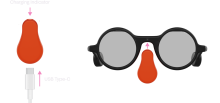 Frame charging diagram.

References
- ↑ 1.0 1.1 1.2 1.3 1.4 1.5 1.6 1.7 Rita Liao (2024-02-08). "AR glasses with multimodal AI nets funding from Pokémon GO creator". TechCrunch. https://techcrunch.com/2024/02/08/ar-glasses-with-multimodal-ai-attracts-funding-from-pokemon-go-founder/. Retrieved 2026-10-14.
- ↑ 2.0 2.1 2.2 2.3 2.4 "Frame". Brilliant Labs. Brilliant Labs (archived 8 February 2024 by the Internet Archive). 2024-02-08. https://web.archive.org/web/20240208151712/https://brilliant.xyz/products/frame. Retrieved 2026-10-14.
- ↑ 3.0 3.1 "Frame". Brilliant Labs. Brilliant Labs (archived 3 May 2024 by the Internet Archive). 2024-05-03. https://web.archive.org/web/20240503025349/https://brilliant.xyz/products/frame. Retrieved 2026-10-14.
- ↑ 4.00 4.01 4.02 4.03 4.04 4.05 4.06 4.07 4.08 4.09 4.10 4.11 4.12 4.13 "Frame". Brilliant Labs. Brilliant Labs (archived 4 April 2024 by the Internet Archive). 2024-04-04. https://web.archive.org/web/20240404175340/https://brilliant.xyz/products/frame. Retrieved 2026-10-14.
- ↑ 5.00 5.01 5.02 5.03 5.04 5.05 5.06 5.07 5.08 5.09 5.10 5.11 5.12 5.13 5.14 5.15 5.16 5.17 5.18 5.19 5.20 5.21 5.22 5.23 5.24 5.25 5.26 5.27 5.28 "Hardware". Brilliant Documentation. Brilliant Labs. https://docs.brilliant.xyz/frame/hardware/. Retrieved 2026-10-14.
- ↑ 6.0 6.1 "noa-flutter: The Noa app for iOS and Android". GitHub. Brilliant Labs. https://github.com/brilliantlabsAR/noa-flutter. Retrieved 2026-10-14.
- ↑ 7.0 7.1 7.2 "Frame". Brilliant Labs. Brilliant Labs (archived 4 July 2025 by the Internet Archive). 2025-07-04. https://web.archive.org/web/20250704214427/https://brilliant.xyz/products/frame. Retrieved 2026-10-14.
- ↑ 8.0 8.1 Daniel Cooper (2025-07-31). "Brilliant Labs launches its second-generation smart glasses". Engadget. https://www.engadget.com/wearables/brilliant-labs-launches-its-second-generation-smart-glasses-130000032.html. Retrieved 2026-10-14.
- ↑ "Brilliant Labs". Brilliant Labs. Brilliant Labs. https://brilliant.xyz/. Retrieved 2026-10-14.
- ↑ 10.0 10.1 "Road to Halo - Part 1 of 4". Brilliant Labs Announcements. Brilliant Labs. 2025-08-13. https://brilliant.xyz/blogs/announcements/road-to-halo-part-1-of-4. Retrieved 2026-10-14.
- ↑ Lakshmi Varanasi (2024-02-11). "For $350, you too can have glasses with 'AI superpowers' (and look like a modern-day Gandhi)". Business Insider. Yahoo News Canada. https://ca.news.yahoo.com/350-too-glasses-ai-superpowers-162758303.html. Retrieved 2026-10-14.
- ↑ 12.0 12.1 12.2 12.3 Cesar Cadenas (2024-02-09). "These new smart glasses can teach people about the world thanks to generative AI". TechRadar. Yahoo Tech. https://tech.yahoo.com/ai/articles/smart-glasses-teach-people-world-200407435.html. Retrieved 2026-10-14.
- ↑ 13.0 13.1 13.2 Alan Truly (2024-02-13). "How Brilliant Labs made 39 gram lightweight AI smart glasses Frame possible". MIXED. https://mixed-news.com/en/brilliant-labs-ama-explains-design-goals-tradeoffs-and-future-capabilities/. Retrieved 2026-10-14.
- ↑ 14.0 14.1 "Frame". Brilliant Labs. Brilliant Labs (archived 22 June 2024 by the Internet Archive). 2024-06-22. https://web.archive.org/web/20240622091614/https://brilliant.xyz/products/frame. Retrieved 2026-10-14.
- ↑ 15.0 15.1 15.2 15.3 15.4 15.5 Karl Guttag (2024-05-09). "Brilliant Labs Frame AR with AI Glasses & a Little More on the Apple Vision Pro". KGOnTech. https://kguttag.com/2024/05/09/brilliant-labs-frame-ar-with-ai-glasses-a-little-more-on-the-apple-vision-pro/. Retrieved 2026-10-14.
- ↑ 16.0 16.1 16.2 Josef Erl (2024-05-21). "AI smart glasses with Chat GPT-4o, Claude 3, Stable Diffusion and more now available worldwide". MIXED. https://mixed-news.com/en/ai-smart-glasses-with-chat-gpt-4o-claude-3-stable-diffusion-and-more-now-available-worldwide/. Retrieved 2026-10-14.
- ↑ "Hackathon - August 3rd 2024". Brilliant Labs Announcements. Brilliant Labs. 2024-10-10. https://brilliant.xyz/blogs/announcements/hackathon-august-3rd-2024. Retrieved 2026-10-17.
- ↑ "CitizenOne's Frame Projects". Brilliant Labs Announcements. Brilliant Labs. 2024-11-21. https://brilliant.xyz/blogs/announcements/citizenones-frame-projects-%F0%9F%9B%A0%EF%B8%8F. Retrieved 2026-10-17.
- ↑ 19.0 19.1 "Frame". Brilliant Labs. Brilliant Labs (archived 25 March 2025 by the Internet Archive). 2025-03-25. https://web.archive.org/web/20250325151556/https://brilliant.xyz/products/frame. Retrieved 2026-10-14.
- ↑ Scott Hayden (2025-08-01). "Brilliant Labs Unveils All-day Smart Glasses with Color Display, Pre-orders Launch at $300". Road to VR. https://roadtovr.com/brilliant-labs-halo-smart-glasses-price-release-date/. Retrieved 2026-10-14.
- ↑ 21.0 21.1 21.2 21.3 "Frame SDK". Brilliant Documentation. Brilliant Labs. https://docs.brilliant.xyz/frame/frame-sdk/. Retrieved 2026-10-14.
- ↑ 22.0 22.1 22.2 22.3 "Frame". Brilliant Documentation. Brilliant Labs. https://docs.brilliant.xyz/frame/frame/. Retrieved 2026-10-14.
- ↑ 23.0 23.1 23.2 "Lua API Reference". Brilliant Documentation. Brilliant Labs. https://docs.brilliant.xyz/frame/frame-sdk-lua/. Retrieved 2026-10-14.
- ↑ 24.0 24.1 24.2 "frame-codebase: The complete codebase for Frame". GitHub. Brilliant Labs. https://github.com/brilliantlabsAR/frame-codebase. Retrieved 2026-10-14.
- ↑ 25.0 25.1 Ian Carlos Campbell (2024-08-01). "Brilliant Labs Frame review: Smart glasses are going to be popular, just not yet". Pocket-lint. https://www.pocket-lint.com/brilliant-labs-frame-ai-glasses-review/. Retrieved 2026-10-17.
- ↑ 26.0 26.1 Ben Sin (2024-07-31). "Brilliant Labs' Frame AI Smart Glasses Review: Future Of Personal Computing". Forbes. https://www.forbes.com/sites/bensin/2024/07/31/brilliant-labs-frame-ai-smart-glasses-review-future-of-personal-computing/. Retrieved 2026-10-17.
- ↑ 27.0 27.1 Ben Schoon (2024-05-31). "Hands-on: Frame by Brilliant Labs is a disappointing stepping stone to something better". 9to5Google. https://9to5google.com/2024/05/31/brilliant-labs-frame-hands-on/. Retrieved 2026-10-14.
- ↑ 28.0 28.1 "Noa for Frame". App Store. Apple. https://apps.apple.com/us/app/noa-for-frame/id6482980023. Retrieved 2026-10-14.
- ↑ 29.0 29.1 Andrea Nepori (2024-02-14). "These glasses put AI in front of your eyes". Domus. https://www.domusweb.it/en/news/gallery/2024/02/13/brilliant-labss-frame-glasses-put-ai-in-front-of-your-eyes.html. Retrieved 2026-10-14.
- ↑ "Frame". Brilliant Labs. Brilliant Labs (archived 16 July 2024 by the Internet Archive). 2024-07-16. https://web.archive.org/web/20240716172123/https://brilliant.xyz/products/frame. Retrieved 2026-10-14.
- ↑ "Talking to Frame Over Bluetooth". Brilliant Documentation. Brilliant Labs. https://docs.brilliant.xyz/frame/frame-sdk-bluetooth-specs/. Retrieved 2026-10-17.
- ↑ 32.0 32.1 "Python". Brilliant Documentation. Brilliant Labs. https://docs.brilliant.xyz/frame/frame-sdk-python/. Retrieved 2026-10-17.
- ↑ "brilliant-ble". PyPI. Python Software Foundation. https://pypi.org/project/brilliant-ble/. Retrieved 2026-10-17.
- ↑ "brilliant-msg". PyPI. Python Software Foundation. https://pypi.org/project/brilliant-msg/. Retrieved 2026-10-17.
- ↑ "Flutter". Brilliant Documentation. Brilliant Labs. https://docs.brilliant.xyz/frame/frame-sdk-flutter/. Retrieved 2026-10-17.
- ↑ "frame-codebase LICENSE.md". GitHub. Brilliant Labs. https://github.com/brilliantlabsAR/frame-codebase/blob/main/LICENSE.md. Retrieved 2026-10-14.
- ↑ 37.0 37.1 37.2 "Release v25.278.1113". GitHub. Brilliant Labs. 2025-10-05. https://github.com/brilliantlabsAR/frame-codebase/releases/tag/v25.278.1113. Retrieved 2026-10-14.
- ↑ 38.00 38.01 38.02 38.03 38.04 38.05 38.06 38.07 38.08 38.09 38.10 38.11 38.12 38.13 38.14 38.15 38.16 38.17 38.18 "Releases - brilliantlabsAR/frame-codebase". GitHub. Brilliant Labs. https://github.com/brilliantlabsAR/frame-codebase/releases. Retrieved 2026-10-17.