

Varjo XR-4
More actions
| Varjo XR-4 | |
|---|---|
 
| |
| Basic Info | |
| VR/AR | Mixed Reality, Virtual Reality |
| Type | Head-mounted display |
| Subtype | PC-Powered VR |
| Platform | SteamVR, OpenXR |
| Developer | Varjo |
| Manufacturer | Varjo |
| Announcement Date | November 27, 2023 |
| Release Date | Enterprise orders opened November 2023; first shipments announced for December 2023 |
| Price | US$3,990 (standard XR-4 launch price); refreshed series pricing on request |
| Website | https://varjo.com |
| Versions | XR-4, XR-4 Focal Edition, XR-4 Secure Edition; original and 2026 hardware |
| Requires | Compatible Windows PC with NVIDIA graphics |
| Predecessor | Varjo XR-3 |
| System | |
| Operating System | Windows 10/11 (host PC; see system requirements) |
| Display | |
| Display | Two mini-LED displays with local dimming |
| Peak Brightness | 200 nits (manufacturer specification) |
| Resolution | 3840 x 3744 per eye |
| Pixel Density | Up to 51 PPD |
| Refresh Rate | 75 or 90 Hz |
| Image | |
| Field of View | 120° x 105° (manufacturer specification) |
| Horizontal FoV | 120° |
| Vertical FoV | 105° |
| Peak Pixel Density | 51 PPD |
| Foveated Rendering | Eye-tracked |
| Optics | |
| Optics | Variable-resolution aspheric lenses |
| Ocularity | Binocular |
| IPD Range | 56-72 mm (automatic adjustment) |
| Passthrough | Fixed focus (XR-4); gaze-driven autofocus (Focal Edition) |
| Tracking | |
| Tracking | Inside-out; SteamVR tracking depends on hardware version |
| Base Stations | Not required for inside-out tracking; required for SteamVR tracking |
| Eye Tracking | 200 Hz |
| Hand Tracking | Integrated Varjo tracking; Ultraleap accessory supported |
| Rotational Tracking | Supported (6DoF headset tracking) |
| Positional Tracking | Supported (6DoF headset tracking) |
| Audio | |
| Audio | Integrated speakers with DTS spatial audio |
| Microphone | Two integrated noise-cancelling microphones |
| 3.5mm Audio Jack | Yes |
| Camera | Two 20-megapixel passthrough cameras |
| Connectivity | |
| Connectivity | Separate DisplayPort display cable and USB-C data connection via powered adapter |
| Wired Video | DisplayPort |
| Power | External USB-C power supply through headset adapter |
| Device | |
| Weight | Original front section: 665 g; original complete headset: 1021 g (reported at launch) |
| Material | Magnesium frame; foam/PU leather cushion and silicone light blocker (original design) |
| Headstrap | Adjustable headband with rear counterweight |
| Color | Light grey shell with black inner parts (original design) |
| Sensors | Eye tracking, positional tracking cameras, 300 kpix LiDAR and RGB ambient light sensor |
| Input | Varjo Controllers, compatible SteamVR controllers, hand tracking, headset touch controls |
| Cable Length | 5 m display and data cables supplied; 15 m extension available |
The Varjo XR-4 is a professional PC-powered mixed reality and virtual reality head-mounted display announced on November 27, 2023, by Varjo Technologies. It combines high-resolution displays with camera passthrough and is intended for training, simulation and other industrial applications. The series includes the fixed-focus XR-4, the XR-4 Focal Edition with gaze-driven camera autofocus, and Secure Edition configurations for restricted environments.[1][2]
Varjo announced refreshed hardware on October 8, 2025; its manuals identify this as the XR-4 Series (2026). The refresh retains the series' display specifications while changing its fit, camera arrangement, tracking support and PC adapter. Hardware and software support through 2030 is a commitment stated by Varjo. Advanced software features depend on the headset's Varjo Base license.[3][4][5]
History
Announcement and original hardware
Varjo took enterprise orders from the November 27, 2023 announcement and announced that first shipments would start in December 2023. A dedicated manufacturing line for the XR-4 Secure Edition, at a new facility in Espoo, Finland, was due to begin operating the same month. Contemporary coverage listed a starting price of US$3,990 or EUR 3,990.[1][6]
Compared with the XR-3's separate focus and context displays, the XR-4 uses one display per eye. In the launch interview with CNBC, chief product officer Patrick Wyatt linked the simpler display arrangement and production scale to reduced costs. The XR-3 had dual 12-megapixel passthrough cameras, compared with the XR-4's two 20-megapixel cameras.[7][8] The series also introduced inside-out tracking, integrated speakers and microphones, and Varjo Controllers developed with Razer. These are documented changes; the display's maximum 51 pixels per degree is not a uniform value across the whole image.[9][1][10][11]
The launch prices reported for the standard XR-4 and Focal Edition were US$3,990 and US$9,990. At launch the series did not require the annual subscription associated with the earlier enterprise headsets. This historical pricing and licensing position differs from the later paid feature tiers.[12][13]
Software changes and 2025 refresh
In March 2025 Varjo announced a division between free Varjo Base and paid Varjo Base Pro, using March 25, 2025 as the headset purchase cutoff. Contemporary reports quoted $2,500 annually per headset or $5,000 for a perpetual Pro license. Varjo's release notes date the software release introducing the model, Varjo Base 4.10, to April 10, 2025. Headsets purchased before the cutoff receive a Legacy license covering features included through 4.10; later Pro additions are excluded.[12][14][15][5] The March 2025 report stated that Secure Edition headsets purchased after the cutoff included a Pro license.[14]
In April 2025 Varjo Base 4.10 added built-in hand tracking as a beta feature. It works from the headset's video passthrough camera streams together with depth data from the built-in time-of-flight sensor, so no extra hardware is needed; the Ultraleap Leap Motion Controller 2 accessory remains supported and takes priority in automatic mode when connected.[16]
In July 2025 Varjo announced that general support for the older XR-3, VR-3 and Aero would end on January 1, 2026, and that it was concentrating manufacturing on the XR-4 Series. This was the support policy reported at that time.[17]
On October 8, 2025, Varjo announced a refreshed XR-4 Series intended for cockpit trainers, vehicle simulators and ground training systems. Compared with the original model it has a redesigned headband with a slimmer rear counterweight, an optional chin strap, a new front plate compatible with SteamVR tracking, optimized autofocus passthrough cameras, hand occlusion, a night mode and a new headset adapter for a more stable PC connection. Varjo guarantees hardware and software support for the series through 2030. The refreshed headsets are sold to industrial and government customers in over 40 countries, now including India and Turkey, with pricing available on request.[3] Varjo's support site calls these units the XR-4 Series (2026), and they require Varjo Base 4.13 or newer.[18]
Varjo's November 2025 design explanation describes more contact with the cheeks, a lower rear band, alternative cable routing and cameras tilted down by 10°. The refreshed Focal Edition moves the passthrough region downward to cover the lower display area used for physical controls. The original series required a choice of inside-out or base-station tracking hardware; every refreshed headset includes both tracking options. These hardware changes should be distinguished from improvements delivered to existing headsets through Varjo Base updates.[19]
Integrated systems and continuing software support
In February 2026 Varjo added Integrated XR Systems, which bundle an XR-4 Series headset with a certified workstation, pre-installed software, licenses, extended warranty and support services. Varjo priced the system at EUR 24,990 with the XR-4 and EUR 29,990 with the XR-4 Focal Edition.[20]
The February 26 announcement specifies 2026 headsets, workstations made by SCHENKER or RAVE Computer, and offline licenses. The included software suite comprises Windows 11 Pro, Varjo Base Pro, Varjo Lab Tools, NVIDIA App, Steam and SteamVR, with sample applications and setup tools. The quoted figures are starting prices for complete systems, rather than headset-only prices.[20]
The support directory checked on October 14, 2026 lists Varjo Base 4.16 as its latest Main release. Released on July 22, 2026, it supports the XR-4 Series. Its changes include new occlusion controls, improved controller and headset tracking, and persistent spatial-anchor extensions for OpenXR. Release-candidate entries are listed separately.[21][22]
Technical specifications
Displays and optics
The following are manufacturer specifications, not independent measurements of every wearer or optical configuration. The current product page lists 3840 x 3744 pixels per eye, up to 51 PPD and a 120° x 105° field of view. Varjo's optical explanation calls the lenses variable-resolution aspheric optics; central angular resolution should therefore be distinguished from the resolution of the peripheral image.[8][10]
| Component | Specification or qualification |
|---|---|
| Displays | Two mini-LED displays with local dimming; one display per eye.[10][11] |
| Pixel count | 3840 x 3744 per eye. This is about 14.4 million pixels per eye, or 28.8 million across both displays, calculated from the published dimensions.[8] |
| Angular resolution | Up to 51 pixels per degree, rather than uniform 51 PPD throughout the field of view.[10][11] |
| Field of view | 120° horizontal x 105° vertical, as specified by Varjo. Eye relief and headset positioning affect the usable view.[8][23] |
| Brightness and contrast | 200 nits; 1:10,000 contrast ratio with local dimming.[24] |
| Color gamut | 98% sRGB and 96% DCI-P3.[8] |
| Refresh rates | 75 Hz or 90 Hz, selected in Varjo Base. Varjo recommends 90 Hz for VR; 75 Hz reduces rendering load and increases the foveated focus area and Focal Edition's vertical passthrough view.[25] |
| Eye tracking and IPD | 200 Hz gaze tracking; automatic interpupillary-distance adjustment over the published 56-72 mm range.[8] |
Passthrough cameras and depth sensing
Both the standard XR-4 and Focal Edition have two 20-megapixel passthrough cameras. Varjo describes about 33 PPD for the fixed-focus camera view and up to 51 PPD for the autofocus Focal Edition. The megapixel figure describes the cameras, while the PPD figures describe angular detail in the passthrough view; they should not be treated as interchangeable resolutions.[2][8]
The LiDAR depth sensor is specified at 300 kpix with a range of 7 m. The earlier XR-3's specified depth-sensing range was 40 cm-5 m.[7] The XR-4's depth information supports mixed-reality occlusion and the Focal Edition's focus-distance selection. An RGB ambient light sensor is also listed. The depth sensor's range is distinct from the headset's positional tracking area.[8][26]
The original 2023 specification list published by The Ghost Howls quoted 30 fps for depth sensing and approximately 22 ms passthrough latency. These were launch specifications, not measurements of the current software or the refreshed hardware; depth update rate also differs from display refresh.[13]
Software and viewing conditions affect the resulting image. For example, the original 4.1 beta release notes listed unoptimized passthrough image quality and latency, imperfect alignment of real and virtual content, and autofocus problems. Later releases changed the foveated image, calibration and color processing; those early limitations describe a dated software state.[27]
Gaze-driven autofocus: Focal Edition
The Focal Edition changes the focus of the passthrough cameras according to what the wearer looks at. Varjo's technical account describes 200 Hz gaze measurements combined with LiDAR samples and gaze convergence to select a focus distance. It gives the optical actuator's end-to-end travel as less than a millisecond. This actuator figure is distinct from the delay of the complete capture, processing and display system.[26]
The variable camera focus trades a narrower depth of field for greater detail at the selected distance. Varjo describes the design as useful for reading physical cockpit instruments, labels and checklists at their normal working distances. Its May 2026 comparison explains that the standard fixed-focus XR-4 can instead be used where physical surroundings provide context and the main content is virtual. This is the manufacturer's use-case guidance.[2]
Physical design, audio and connections
Varjo's account of the original design identifies a magnesium frame, a foam and PU leather face cushion, and a silicone light blocker. It describes a 665 g front section and a rear counterweight. The contemporary launch specification list reported 1021 g for the complete original headset. These original weights should not be used as measurements of the redesigned 2026 hardware.[23][13]
Both manuals show top and rear adjustment wheels, a quick-release control, and a button for changing the lens-to-eye distance. The 2026 manual additionally explains adjustable/removable side pads and two rear-pad positions, including space for eyeglass temples.[28][4]
The headset has built-in speakers with DTS spatial audio, two noise-cancelling microphones and a 3.5 mm headphone connector. The manuals show separate display and data cables: DisplayPort connects directly to the graphics card, while the USB-C data cable passes through a powered headset adapter. Power for that adapter comes from the supplied charger. This is a two-cable PC connection.[1][13][4]
The supplied display and data cables are each 5 m long. Varjo lists 15 m extension cables as an accessory. The 2026 setup specifies the LB-5 adapter, powered from the charger's 60 W port.[28][8][18]
Tracking and input
Headset tracking
Inside-out tracking uses the headset's positional tracking cameras to scan physical features in the room. The manuals identify four positional cameras on the headset.[28] Varjo's setup guide requires suitable lighting and warns that reflective surfaces can interfere. Room setup establishes the floor and forward direction, and the headset can remember its last environment. Inside-out tracking does not need external base stations.[29]
SteamVR tracking is a separate route using up to four base stations. The original manuals identify base-station versions separately from the original inside-out models. The 2026 lineup combines both routes in each unit; selecting SteamVR tracking still requires the corresponding base-station setup. Support for third-party tracking plugins is an advanced licensed feature.[28][18][19][5]
In Varjo Base 4.16, Varjo documented automatic drift correction, improved room recognition and more stable alignment after putting the headset away. The release notes also improved controller detection when controllers re-enter the cameras' view. These are stated software changes, rather than guarantees of submillimeter accuracy in every environment.[22]
Controllers and hand tracking
The original non-Secure retail package included two Varjo Controllers, developed with Razer. The manual shows a thumbstick, A/B and menu buttons, trigger, grip button, USB-C charging port and detachable hand strap. It states that controllers were not included with Secure Edition and are incompatible with no-radio Secure versions. The current product page lists Varjo Controllers as optional.[1][28][8]
Built-in Varjo hand tracking was introduced free of charge in Base 4.10. It uses stereo passthrough images and time-of-flight depth data, with machine-learning inference performed on the CPU. The developer-facing implementation exposes 26 hand landmarks through XR_EXT_hand_tracking and aiming, pinching, grasping and poking through XR_EXT_hand_interaction. Compatible OpenXR applications must support the relevant input APIs.[16]
At introduction, Varjo described the feature as beta, with gesture reliability and latency limitations, and specified typical office lighting of 200-500 lux. It works with both fixed-focus and autofocus headsets, at the documented 75/90 Hz passthrough settings; this does not specify a guaranteed hand-tracking rate equal to the display rate. An attached Ultraleap Leap Motion Controller 2 takes priority in Automatic mode. Base 4.16 later improved thumb-joint detection.[16][22]
Hand tracking is an input method; hand occlusion controls whether images of real hands appear over virtual content. The latter is separately licensed and is not part of the free hand-tracking entitlement.[5]
Software ecosystem and licensing
Varjo Base is the Windows software required to set up and run the headset. The 2026 setup requires a commercial Varjo Account and Base 4.13 or newer, and enables the Varjo OpenXR and OpenVR runtimes. SteamVR software is required for OpenVR applications and when using SteamVR base-station tracking.[18][30]
The XR-4's launch ecosystem included Unity, Unreal Engine, Autodesk VRED and NVIDIA Omniverse. Varjo also described cloud streaming and collaboration through Varjo Reality Cloud. Those launch integrations describe supported professional workflows, not a guarantee that every engine feature or third-party application works identically.[1][10]
Base, Pro and Legacy feature tiers
The following selection summarizes the current published license matrix checked on October 14, 2026. Legacy applies to qualifying pre-March 25, 2025 purchases; it retains the professional features included through Base 4.10 and does not include every later Pro addition. Pro licenses are headset-specific and cannot be transferred after activation.[5][18]
| Capability | Base | Base Pro | Base Legacy |
|---|---|---|---|
| VR rendering; video passthrough with alpha mask; depth occlusion | Included | Included | Included |
| Inside-out tracking, hardware-supported SteamVR tracking, Varjo Controllers, hand tracking and markers | Included | Included | Included |
| Eye tracking for foveated rendering, autofocus, UI interaction and headset positioning; automatic IPD | Included | Included | Included |
| Focal Edition autofocus, integrated microphones and DTS audio | Included | Included | Included |
| Chroma key, blend control mask, camera data stream, video post-process shader and HDR environment cubemap | Not included | Included | Included |
| 3D reconstruction, programmatic camera/IPD controls, third-party tracking plugins, motion-platform support with base-station tracking versions and eye-tracking research data | Not included | Included | Included |
| Hand occlusion, People occlusion (beta), Night mode and masking in Varjo Base | Not included | Included | Not included |
| Command-line interface, configuration file and "Simulate a headset without Varjo Base Pro features" | Not included | Included | Not included |
| Multiple applications and disabling Varjo UI/branding | Not included | Included | Included |
The matrix is Varjo's published feature allocation, not a test of those features. Core OpenVR/OpenXR and DirectX 11/12, OpenGL and Vulkan compatibility is listed in all three columns.[5]
A later license update requires Base 4.15, 4.14.1, 4.13.2 or newer to restore affected Pro features on standard and Focal Edition units. Secure Edition Pro plus Secure offline requires Base 4.14 or newer. Varjo lists ordinary Legacy licenses, offline-only packages and headsets without licenses as unaffected, while some repair/replacement Legacy keys need individual checking.[31]
Selected release history
| Date | Release or change | XR-4 relevance |
|---|---|---|
| December 20, 2023 | Base 4.0 beta | First beta-level support for the XR-4 Series and Varjo Controllers; passthrough, tracking and autofocus limitations documented.[27] |
| February 15, 2024 | Base 4.1 beta | Added remembered room setup and changes to controller tracking; image quality and latency remained listed as unoptimized.[27] |
| October 1, 2024 | Base 4.4 | Increased the foveated focus area, improved blending/color, and reduced foveation latency by 10-40 ms depending on configuration, according to Varjo. This is a change in foveation latency, not a total passthrough-latency measurement.[27] |
| April 10, 2025 | Base 4.10 | Implemented the Pro license model, free hand-tracking beta and a commercial-account requirement.[15] |
| October 8, 2025 | Refreshed hardware announcement | Revised headband, camera arrangement, tracking front plate and adapter; identified in support as the 2026 Series.[3][18] |
| July 22, 2026 | Base 4.16 Main release | Added unified occlusion settings and People occlusion beta, completed the command-line interface's beta phase, and added persistent-anchor OpenXR support.[22] |
Development directions described in 2025
Varjo's November 2025 account described AI-upscaled passthrough and object masking/tracking as areas under investigation, expressly separating them from product commitments. It also discussed frame-rate and visual-artifact challenges. The later documented People occlusion beta is a specific Base 4.16 feature and should be distinguished from the broader research directions.[19][22]
Variants
| Edition | Camera focus and intended use | Important distinctions |
|---|---|---|
| XR-4 | Fixed-focus passthrough, described by Varjo at about 33 PPD; virtual content and contextual physical surroundings.[2] | Original inside-out and base-station versions differ. The refreshed series supports both.[28][19] |
| XR-4 Focal Edition | Gaze-driven autofocus for detailed physical instruments, text and near-field interaction; up to 51 PPD passthrough.[2] | Camera autofocus is an edition-specific feature; both editions share the display specifications.[2] |
| XR-4 Secure Edition | Fixed-focus and autofocus configurations for restricted governmental/defense settings.[24] | Assembled in Finland and described by Varjo as TAA compliant; offline use and optional omission of radio components. No-radio controller restrictions apply.[24][28] |
The model identifiers also distinguish configurations. The original manual lists HS-10 (fixed focus), HS-10A (autofocus), HS-10B/HS-10C (corresponding base-station versions), and HS-10D/HS-10E for autofocus Secure no-radio configurations. The 2026 manual lists HS-10B for fixed focus, HS-10C for autofocus and HS-10E for Secure autofocus without radio. A model identifier should be read together with its manual and hardware generation.[28][4]
System requirements
As checked on October 14, 2026, Varjo lists two desktop performance tiers and a separate laptop configuration. The minimum tier is a baseline for simpler VR/MR scenes; the best-performance tier targets native-resolution, demanding simulation and visualization workloads. Both desktop tiers require Windows 10 (64-bit) or Windows 11, 3 GB for Varjo Base, a DisplayPort 1.4 or newer output and a chipset-connected USB-C port supporting at least USB 10Gbps. AMD graphics cards are not supported in this published list.[30]
| Component | Minimum-performance desktop | Best-performance desktop |
|---|---|---|
| CPU class and examples | Modern 8-core desktop CPU: Intel Core i7-13700K, 4th Gen Intel Xeon w7-2475X, AMD Ryzen 7 7700X | High-end 16-core workstation/enthusiast CPU: Intel Core Ultra 9 285K, 4th Gen Intel Xeon w9-3495X, AMD Ryzen 9 9950X3D |
| GPU examples | NVIDIA RTX PRO 4500 Blackwell, RTX 5000 Ada, GeForce RTX 5070 Ti, RTX 4080 or RTX 3090 | NVIDIA RTX PRO 6000 Blackwell Workstation Edition or GeForce RTX 5090 |
| RAM | 32 GB | 64 GB |
| Varjo Base storage | 3 GB | 3 GB |
| Video output | DisplayPort 1.4 or newer | DisplayPort 1.4 or newer |
| USB data | Chipset-connected USB-C, USB 10Gbps or higher | Chipset-connected USB-C, USB 10Gbps or higher |
| OS | Windows 10 64-bit or Windows 11 | Windows 10 64-bit or Windows 11 |
These rows reproduce Varjo's listed configuration examples; the application and rendering settings also determine workload.[30]
The listed laptop configuration uses 32 GB RAM, an Intel Core 9 275HX or AMD Ryzen 9 9955HX, and an RTX PRO 5000 Blackwell Generation Laptop or GeForce RTX 5090 Laptop GPU with the specified 150 W TGP plus 25 W Dynamic Boost. Varjo describes this tier as comparable to minimum desktop performance and recommends desktops for best performance. A laptop display adapter must support 8K, DisplayPort 1.4 or newer and Display Stream Compression, and connect to an output routed directly to the NVIDIA GPU. USB-C DisplayPort Alt Mode is relevant when using that type of laptop adapter; it does not turn the headset's two cables into one.[30]
High-throughput USB support includes multiple IN transactions. Varjo lists compatible Intel 600/700/800-series and AMD chipsets and offers a verified PCIe expansion card where needed. Its accessory page identifies the Startech PEXUSB311AC3 and warns that firmware compatibility is not guaranteed for cards purchased elsewhere.[32][33]
The software requirements specify Windows 10 version 1809 or later or Windows 11 version 21H2 or later, Varjo Base, a compatible NVIDIA driver and SteamVR where required. These are Varjo's compatibility requirements, rather than a statement of Microsoft's lifecycle support for Windows.[30]
Industry applications and research
Documented professional uses
The XR-4 launch covered simulation, design/engineering, healthcare and architectural visualization. Its published customer statements include early XR-4 testing by Rivian for design/material review and PaleBlue for European Space Agency astronaut-training scenarios. These are manufacturer-published customer accounts, not independently measured productivity or safety improvements.[1]
| Example | Documented scope |
|---|---|
| Design and engineering | Varjo's launch account describes Rivian's early XR-4 evaluation with VRED and includes Volvo Cars' commentary on virtual/physical prototyping.[1] |
| Flight and ground simulation | The October 2025 refresh is intended for cockpit trainers, vehicle simulators and ground training. Published partner statements describe Rheinmetall driving simulators and Cole Engineering's RVCT work.[3] |
| Restricted training systems | The Secure Edition page describes Varjo's involvement in the US Army RVCT Air program, covering Apache, Chinook and Blackhawk training. The statement identifies a training system, not certification of the headset for controlling an aircraft.[24][4] |
| Research and visualization | The studies below used the XR-4 in controlled classroom and ultrasound-phantom environments, with application-specific outcomes.[34][35] |
Augmented-virtuality classroom feasibility study
A 2026 PLOS ONE study used the XR-4 with Sennheiser HD 300 headphones in a green-painted laboratory. In a single-group experiment, 104 undergraduates watched a 15-minute prerecorded monoscopic 360° lecture. Chroma-key compositing replaced the room with the recorded classroom while retaining views of the participant's body and physical desk. Mean scores on a 10-item immediate-recall test rose from 2.61 to 4.29; participants reported moderate presence and mild cybersickness.[34]
The study measured feasibility and short-term recall after one passive lesson. It had no live-classroom or flat-video control, did not test long-term retention, and did not establish that XR-4 hardware caused the score change. Its young, single-university sample and seated, short exposure limit generalization to other users or extended interactive training.[34]
Ultrasound visualization experiment
A 2026 Communications Engineering study built AR-VIU, a custom volumetric ultrasound system using the XR-4 and Unreal Engine 5.3. Eighteen participants, nine novices and nine experts, performed object-identification and localization tasks with four combinations of 2D/3D imaging and monitor/AR display. The authors used gelatin and commercial tissue-mimicking phantoms, not patient procedures.[35]
The AR conditions reduced geometric-mean localization error relative to the 2D monitor condition: 5.18 mm for 2D/AR and 5.46 mm for AR-VIU, versus 10.53 mm for 2D/screen. Novices tended to prefer AR-VIU while experts preferred the familiar 2D/screen workflow. The custom volumetric system updated at about 1.4-2 volumes per second, and participants reported reliability and ergonomic concerns. These are results for the experimental imaging/display system, not a general headset tracking-accuracy specification or evidence of improved patient outcomes.[35]
Market reception
Contemporary launch reporting emphasized the standard model's lower starting price and removal of the previous annual subscription. The Ghost Howls' announcement coverage explicitly withheld a final judgment until a try-on, while CNBC discussed the enterprise audience and simpler display arrangement.[13][9]
In an August 6, 2024 hands-on report, UploadVR's David Heaney described clear virtual detail, bright displays and improved contrast, but found peripheral distortion and brightness inconsistencies. His roughly 45-minute Focal Edition demonstration was comfortable yet felt loose on his face. He judged the passthrough less convincing than expected and less favorably than Apple Vision Pro, with near-field scale/distortion and limited detail; he also noted that the room lighting was not ideal. These impressions concern the tested original hardware and software, before the 2025 refresh and subsequent updates.[11]
Support and deployment
The refreshed series' stated support horizon is 2030. Its current product page lists standard, Focal and Secure versions, and the 2026 setup and license documentation describe the hardware/account requirements. Offline capability should be checked against the purchased configuration: the Secure Edition is designed for offline deployment and the integrated workstation bundles include offline support.[3][8][18][24][20]
See Also
- Mixed reality
- Varjo Technologies
- Varjo XR-3
- Varjo Aero
- Apple Vision Pro
- LiDAR
- Inside-out tracking
- Foveated rendering
- TAA compliance
Gallery
-
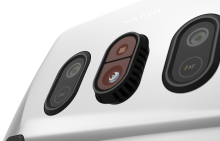 Camera modules in the 2023 Varjo XR-4 series. (c) Varjo.

References
- ↑ 1.0 1.1 1.2 1.3 1.4 1.5 1.6 1.7 "Varjo Releases New XR-4 Series to Deliver Mixed Reality Experiences Indistinguishable from Natural Sight". Varjo. 2023-11-27. https://varjo.com/press-release/varjo-releases-new-xr-4-series-to-deliver-mixed-reality-experiences-indistinguishable-from-natural-sight/. Retrieved 2026-10-14.
- ↑ 2.0 2.1 2.2 2.3 2.4 2.5 Valeria Acevedo (2026-05-18). "XR-4 or XR-4 Focal Edition? How to choose for your use case". Varjo. https://varjo.com/blog/xr-4-or-xr-4-focal-edition-how-to-choose-the-right-passthrough-for-your-use-case. Retrieved 2026-10-14.
- ↑ 3.0 3.1 3.2 3.3 3.4 "Varjo Launches Mixed Reality Headsets Purpose-Built for Training Across Air, Land, and Sea". Varjo. 2025-10-08. https://varjo.com/news/varjo-launches-mixed-reality-headsets-purpose-built-for-training-across-air-land-and-sea. Retrieved 2026-10-14.
- ↑ 4.0 4.1 4.2 4.3 4.4 "User guide: XR-4 Series (2026)". Varjo. https://support.varjo.com/hubfs/1-Help%20Center/6-Downloads/XR-4_Series_2026_User_guide_V0018978_1.1.pdf?hsLang=en. Retrieved 2026-10-14.
- ↑ 5.0 5.1 5.2 5.3 5.4 5.5 "Varjo Base Pro license for XR-4 Series". Varjo Support. https://support.varjo.com/hc/en-us/varjo-base-pro-for-xr-4. Retrieved 2026-10-14.
- ↑ Sam Sprigg (2023-11-27). "Varjo announces new XR-4 series of headsets starting at $3,990". Auganix. https://www.auganix.org/xr-news-varjo-announces-new-xr-4-series-of-headsets/. Retrieved 2026-10-14.
- ↑ 7.0 7.1 "Varjo XR-3". Varjo. https://varjo.com/products/varjo-xr-3/. Retrieved 2026-10-14.
- ↑ 8.00 8.01 8.02 8.03 8.04 8.05 8.06 8.07 8.08 8.09 8.10 "Varjo XR-4 Series". Varjo. https://varjo.com/products/xr-4/. Retrieved 2026-10-14.
- ↑ 9.0 9.1 Ryan Browne (2023-11-27). "Finnish startup Varjo launches new $3,990 mixed-reality headset to take on Apple, Microsoft". CNBC. https://www.cnbc.com/2023/11/27/finnish-startup-varjo-launches-3990-xr-4-mixed-reality-headset.html. Retrieved 2026-10-14.
- ↑ 10.0 10.1 10.2 10.3 10.4 Ferhat Sen (2024-01-31). "Get to Know the Varjo XR-4 Series: Transforming Professional Workflows with Highest-Immersion Virtual and Mixed Reality". Varjo. https://varjo.com/blog/get-to-know-the-varjo-xr-4-series-transforming-professional-workflows-with-highest-immersion-virtual-and-mixed-reality. Retrieved 2026-10-14.
- ↑ 11.0 11.1 11.2 11.3 David Heaney (2024-08-06). "Varjo XR-4 Hands-On: Stunning VR Quality With Disappointing Passthrough". UploadVR. https://www.uploadvr.com/varjo-xr-4-hands-on/. Retrieved 2026-10-14.
- ↑ 12.0 12.1 David Heaney (2025-03-18). "Varjo XR-4 To Require $2500/Year Subscription For Advanced Mixed Reality Features". UploadVR. https://www.uploadvr.com/varjo-xr-4-to-require-2500-year-subscription-for-advanced-mixed-reality-features/. Retrieved 2026-10-14.
- ↑ 13.0 13.1 13.2 13.3 13.4 Skarredghost (2023-11-27). "Varjo announces XR-4 mixed reality headset with impressive resolution". The Ghost Howls. https://skarredghost.com/2023/11/27/varjo-xr-4-price-resolution/. Retrieved 2026-10-14.
- ↑ 14.0 14.1 Scott Hayden (2025-03-17). "Varjo is Moving Some Advanced Headset Features Behind a $2,500 Annual Paywall". Road to VR. https://www.roadtovr.com/varjo-moves-advanced-features-2500-paywall/. Retrieved 2026-10-14.
- ↑ 15.0 15.1 "Release notes – Varjo Base 4.10". Varjo Support. 2025-04-10. https://support.varjo.com/hc/en-us/release-notes-for-varjo-base-4.10. Retrieved 2026-10-14.
- ↑ 16.0 16.1 16.2 Tarek Mohsen (2025-04-22). "Introducing Integrated Hand Tracking for Varjo XR-4 Series". Varjo. https://varjo.com/blog/introducing-integrated-hand-tracking-for-varjo-xr-4-series. Retrieved 2026-10-14.
- ↑ Scott Hayden (2025-07-18). "Varjo is Pulling Support for All of Its Older XR Headsets Next Year". Road to VR. https://www.roadtovr.com/varjo-stops-support-xr-3-aero-2026-date/. Retrieved 2026-10-14.
- ↑ 18.0 18.1 18.2 18.3 18.4 18.5 18.6 "Setting up XR-4 Series (2026)". Varjo Support. https://support.varjo.com/hc/en-us/setting-up-xr-4-series-2026. Retrieved 2026-10-14.
- ↑ 19.0 19.1 19.2 19.3 Patrick Wyatt (2025-11-24). "Why We’re Refreshing the XR-4 Series for Mission-Critical Training". Varjo. https://varjo.com/blog/why-were-refreshing-the-xr-4-series-for-mission-critical-training. Retrieved 2026-10-14.
- ↑ 20.0 20.1 20.2 "Varjo Launches Ready-to-Deploy XR Systems for Secure and Air-Gapped Environments". Varjo. 2026-02-26. https://varjo.com/news/varjo-launches-ready-to-deploy-xr-systems-for-secure-and-air-gapped-environments. Retrieved 2026-10-14.
- ↑ "Recently added". Varjo Support. https://support.varjo.com/hc/en-us/recently-added. Retrieved 2026-10-14.
- ↑ 22.0 22.1 22.2 22.3 22.4 "Release notes – Varjo Base 4.16 Main release". Varjo Support. 2026-07-22. https://support.varjo.com/hc/en-us/release-notes-varjo-base-4.16. Retrieved 2026-10-14.
- ↑ 23.0 23.1 Tuomas Nylén (2024-03-26). "Product Design Story of the Varjo XR-4 Series: Next-Generation Headsets Optimized for Comfort and Usability". Varjo. https://varjo.com/blog/design-and-ergonomics-of-the-varjo-xr-4-series-next-generation-headsets-optimized-for-comfort-and-usability. Retrieved 2026-10-14.
- ↑ 24.0 24.1 24.2 24.3 24.4 "Varjo XR-4 Secure Edition – TAA certified mixed reality for secure environments". Varjo. https://varjo.com/products/xr-4-secure-edition/. Retrieved 2026-10-14.
- ↑ "Refresh rate – XR-4 Series". Varjo Support. https://support.varjo.com/hc/en-us/refresh-rate. Retrieved 2026-10-14.
- ↑ 26.0 26.1 Ville Timonen (2024-05-16). "XR-4 Features Explained: World’s First Gaze-Driven XR Autofocus Camera System". Varjo. https://varjo.com/blog/xr-4-features-explained-worlds-first-gaze-driven-xr-autofocus-camera-system. Retrieved 2026-10-14.
- ↑ 27.0 27.1 27.2 27.3 "Release notes – Varjo Base 4.7.1 and older". Varjo Support. https://support.varjo.com/hc/en-us/varjo-base-release-notes-4.7.1-and-older. Retrieved 2026-10-14.
- ↑ 28.0 28.1 28.2 28.3 28.4 28.5 28.6 28.7 "User guide: XR-4, XR-4 Focal Edition, XR-4 Secure Edition". Varjo. https://downloads.varjo.com/docs/Varjo_XR-4_XR-4_Focal_Edition_XR-4_Secure_Edition_User_guide_V0018749_1.4.pdf. Retrieved 2026-10-14.
- ↑ "Setting up Varjo inside-out tracking". Varjo Support. https://support.varjo.com/hc/en-us/setting-up-varjo-inside-out-tracking. Retrieved 2026-10-14.
- ↑ 30.0 30.1 30.2 30.3 30.4 "System requirements for XR-4 Series". Varjo Support. https://support.varjo.com/hc/en-us/xr-4-series-system-requirements. Retrieved 2026-10-14.
- ↑ "Varjo license update". Varjo Support. https://support.varjo.com/hc/en-us/varjo-license-update. Retrieved 2026-10-14.
- ↑ "XR-4 USB compatibility". Varjo Support. https://support.varjo.com/hc/en-us/xr-4-usb-compatibility. Retrieved 2026-10-14.
- ↑ "PCIe expansion card for XR-4 Series headsets". Varjo Support. https://support.varjo.com/hc/en-us/pcie-expansion-card-for-xr-4-series. Retrieved 2026-10-14.
- ↑ 34.0 34.1 34.2 Kelly D. Carrasco; Andre M. Escarzaga; Melanie Gonzalez; Andrew Rosenfelder; Nicolas Beltran; Cory Ford; Kai Miguel; Leah C. A. Scott; Andres Carrasco (2026-08-21). "Short-term factual recall, presence, and visio-vestibular discomfort in a 360° augmented-virtuality classroom environment: A feasibility study". PLOS ONE 21 (8): e0356395. doi:10.1371/journal.pone.0356395. Retrieved 2026-10-14.
- ↑ 35.0 35.1 35.2 Jason F. Hou; Shrihari Viswanath; Cinay Dilibal; Bowen Wu; Tanisha Shende; Canan Dagdeviren (2026-06-10). "Real-time 3D ultrasound in augmented reality accelerates training and narrows novice–expert performance gaps". Communications Engineering 5: 107. doi:10.1038/s44172-026-00692-7. Retrieved 2026-10-14.