

TCL RayNeo X2
More actions
| TCL RayNeo X2 | |
|---|---|

| |
| Basic Info | |
| VR/AR | Augmented Reality |
| Type | Smart glasses |
| Subtype | AR Glasses, Standalone AR |
| Platform | RayNeo OS (Android-based)[1][2] |
| Creator | TCL / RayNeo[3] |
| Developer | RayNeo (incubated by TCL; established in 2021)[4] |
| Manufacturer | RayNeo (TCL RayNeo branding)[3] |
| Announcement Date | 4 January 2023 (CES)[3] |
| Release Date | International backer shipments reported from May 2024; China pre-orders: October 2023[5][6] |
| Price | US$649 / US$699 crowdfunding tiers; US$899 campaign RRP (February 2024); US$850 reported retail (September 2024); US$499 US listing, sold out (checked 14 October 2026)[4][6][7] |
| Website | https://www.rayneo.com/products/tcl-rayneo-x2 |
| Versions | X2; TCL RayNeo X2 Lite was announced separately[8] |
| Requires | Onboard compute and battery; companion phone for initialization/Wi-Fi configuration, network access for connected services[9][6] |
| Successor | RayNeo X3 Pro[10] |
| System | |
| Operating System | RayNeo OS (Android-based)[1][2] |
| Chipset | Qualcomm Snapdragon XR2 (Gen 1)[2] |
| Storage | |
| Storage | 128 GB[7] |
| Memory | 6 GB[7] |
| Display | |
| Display | Binocular full-color MicroLED with diffractive waveguides[1] |
| Peak Brightness | Up to 1,000 nits in original launch/current summary; 1,500 nits also advertised (see Display)[3][7][4] |
| Resolution | 640 × 480 per eye[6] |
| Pixel Density | 32 PPD (manufacturer figure)[2] |
| Image | |
| Field of View | 25° (manufacturer; axis unspecified)[2] |
| Optics | |
| Optics | Diffractive Waveguide display[1] |
| Ocularity | Binocular[7] |
| Adjustable Diopter | Separate prescription insert; see fitting requirements[11] |
| Passthrough | Optical see-through[7] |
| Tracking | |
| Tracking | 6DoF SLAM and plane detection (SDK capabilities)[2] |
| Base Stations | No external tracking infrastructure described for native SLAM[2] |
| Face Tracking | Face-recognition SDK / face-following translation subtitles[2][7] |
| Rotational Tracking | 3DoF head control; 6DoF SLAM[2] |
| Positional Tracking | 6DoF SLAM (application-dependent)[2] |
| Audio | |
| Audio | Two temple speakers; advertised Whisper Mode[4] |
| Microphone | Three microphones[9] |
| Camera | 16 MP front camera; 1080p at 30 fps; advertised image stabilization[2][7] |
| Connectivity | |
| Connectivity | Wi-Fi 5; Bluetooth 5.2; USB 2.0[1] |
| Ports | Magnetic USB charging/data connector[11][9] |
| WiFi | Wi-Fi 5, 2.4/5 GHz, 802.11 a/b/g/n/ac (TCL specification)[1] |
| Bluetooth | Bluetooth 5.2[7] |
| Power | Built-in battery[2] |
| Battery Capacity | 590 mAh[7] |
| Battery Life | Reviewed: 1-2 h continuous display/features; around 5 h mainly audio/occasional capture (September 2024)[6] |
| Device | |
| Dimensions | Global store: 190.5 × 165.5 × 66.5 mm unfolded; 60 × 165.5 × 66.5 mm folded; China specification differs (see Physical design)[7] |
| Weight | 119 g (TCL China); 120 g (UploadVR report, September 2024)[1][6] |
| Material | Soft plastic arms / padded temple ends in reviewed unit[6] |
| Headstrap | Eyeglass temples and replaceable nose pad[11] |
| Color | Black[7] |
| Sensors | Front camera; GPS, inertial/magnetic/pressure/proximity sensors (TCL inventory)[1] |
| Input | Temple touch, voice functions, RayNeo Ring 3DoF pointer[7] |
The TCL RayNeo X2 (also sold as the RayNeo X2) is a standalone augmented reality smart glasses device developed by RayNeo, a company incubated by TCL and established in 2021.[3][4][7] Announced at CES 2023, it combines onboard Snapdragon XR2 processing, 6 GB of RAM, 128 GB of storage and a 590 mAh battery with binocular full-color MicroLED waveguide displays.[3][7] The glasses can run their own applications; initial setup and some connected functions still use a companion phone.[9][6] TCL first offered the X2 to developers through a global program in 2023, and early press coverage treated it mainly as a developer platform rather than a finished consumer product.[12][13]
The X2 supports camera capture, translation subtitles, notifications and navigation, with temple touch controls, voice functions and a RayNeo Ring controller. Its developer SDK exposes 6DoF spatial tracking and plane detection, alongside simpler head-controlled interfaces.[7][2] RayNeo marketed the display as the first binocular full-color MicroLED optical-waveguide implementation in AR glasses; this is the manufacturer's stated display distinction.[3] On 14 October 2026, RayNeo's US store listed the X2 at US$499 and marked it sold out; the company identifies the X3 Pro as its replacement.[7][10]
History and development
TCL and RayNeo
TCL presented the X2 alongside its NXTWEAR S display glasses at CES 2023. The products served different roles: the NXTWEAR S was a connected viewing accessory with micro-OLED panels, while the X2 put its processor, battery and see-through interface in the eyewear itself. TCL described RayNeo as an AR hardware, software and applications business incubated by TCL Electronics and established in 2021. The announcement named Howie Li as chief executive of TCL RayNeo.[3] Li told Dezeen that the company wanted to build an AR ecosystem around the X2, including "a series of original AR games developed by our team".[14]
Announcement and release
The 4 January 2023 announcement proposed developer availability in selected regions by the end of the first quarter, followed by a later commercial launch. It also cautioned that some features would arrive in phases or selected regions. These were launch plans, not a confirmed worldwide shipping date.[3] At the show, TechRadar reported that TCL hoped to launch the glasses by the end of the second quarter of 2023 after the developer phase; no price had been announced.[15]
TCL opened pre-orders for the RayNeo X2 in China in October 2023, with a retail price of 4,499 yuan, ahead of a release in other markets.[5] The global crowdfunding campaign on Indiegogo began on 27 February 2024, with a Super Early Bird price of US$649, an Early Bird price of US$699 and a recommended retail price of US$899.[4] The campaign announcement projected shipments from March. MIXED described the Indiegogo campaign as the first opportunity to order the X2 directly from the United States, after a limited-quantity launch in China in 2023.[16] Shipments to Indiegogo backers began in May 2024, and in September 2024 UploadVR reported that the glasses were sold at US$850.[4][6]
Developer programs
On 20 April 2023, TCL launched the TCL RayNeo X2 Global Developer Program, which it also called the Morpheus Plan. The first recruitment round ran from 20 April to 31 May 2023 and was open to individuals and organizations. Selected participants were offered early access to X2 working samples, Android- and Unity-based development tools and community support on Discord; finalists whose work was included in the X2 application ecosystem were promised royalties. At that time TCL expected mass production of the glasses later in 2023.[12]
On 22 January 2024, RayNeo announced the RayNeo AI Challenge, a contest for AI applications and agents on the X2. It had two tracks: an application track using AI interfaces and the RayNeo ARDK, and an agent track for AI agents built in RayNeo AI Studio with natural language, open to entrants regardless of their development skills. RayNeo offered an incentive pool of around US$150,000, with top cash rewards of up to US$10,000, and accepted applications until 15 March 2024. Participants could receive a complimentary trial of the X2.[17][16]
Availability and successor
On 14 October 2026, the X2 product page on RayNeo's official US store listed the glasses at US$499 and marked them as sold out.[7] In an August 2026 comparison post, RayNeo identified the X2 as the earlier product replaced by the X3 Pro and said that it had not announced plans to restock it.[10] A sold-out listing establishes that store's inventory status; it does not establish when existing devices' software or connected services stop working.
The successor X3 Pro uses a Qualcomm Snapdragon AR1 Gen 1 chipset instead of the X2's Snapdragon XR2 and integrates Google's Gemini assistant. After an earlier launch in China, RayNeo announced a December 2025 launch in the US and other global markets; a contemporary December review covered the available product at US$1,299, with a lower introductory price advertised by RayNeo at US$1,099.[18][19]
The TCL RayNeo X2 Lite was a separate announcement on 25 October 2023. RayNeo specified an AR1 Gen 1 platform, an approximately 60 g frame and a 30° field of view, and forecast a Q3 2024 release. Those announced figures are not X2 specifications, and the forecast is not evidence that the Lite shipped.[8]
Design and physical fit
The X2 uses a folding eyeglass frame with a front camera, touch areas on both temples and speakers near the ears. In his September 2024 review, David Heaney reported the X2's weight as 120 g and described soft plastic arms, thick padding at their ends and soft nose padding. He found the counterbalance comfortable, while noting that the weight and bulk remained noticeable.[6]
TCL's China specification lists 119 g and dimensions of 190.77 × 165.63 × 55.86 mm, with a caveat that configuration, manufacturing and measurement methods can affect dimensions. RayNeo's global store instead lists 190.5 × 165.5 × 66.5 mm unfolded and 60 × 165.5 × 66.5 mm folded. The published figures differ; neither source identifies a product revision that explains the difference.[1][7]
The user manual describes adjusting the nose pads to raise or lower the glasses and replacing the pad if necessary to see the complete image. The package includes a case, magnetic charging cable, cleaning cloth, a replacement nose pad and a prescription-lens frame.[11] Prescription correction uses fitted lenses in that separate frame. The manual recommends myopia prescriptions from -0.00 to -12.00 and astigmatism from -0.00 to -4.00, and says that this arrangement does not support presbyopia. Its assembly instructions show the insert fastening into a groove in the glasses. These are the manual's fitting specifications, rather than a mechanical diopter dial or a universal guarantee for every prescription.[11]
Display technology
MicroLED and waveguides
The X2 combines full-color MicroLED image sources with diffractive waveguides and transparent lenses. The two eyes can receive different images. RayNeo's developer specification gives 640 × 480 resolution, a 25° field of view and 32 pixels per degree. UploadVR describes the resolution as 640 × 480 per eye. The manufacturer does not identify the field-of-view axis in the inspected specification, so 25° should not be relabeled as either a horizontal or diagonal measurement.[1][2][6]
TCL's original CES announcement gave image brightness of up to 1,000 nits and contrast of up to 100,000:1. RayNeo's February 2024 crowdfunding release advertised 1,500 nits of to-eye brightness. The US product page checked in October 2026 contains a 1,000-nit description and a separate 1,500-nit promotional block; TCL's China page also advertises 1,500 nits. These are published manufacturer claims with differing values, not independent measurements or a verified change between hardware versions.[3][4][7][1]
Visibility and optical limitations
The wearer views the surroundings through the lenses, with digital information superimposed. In September 2024, Heaney reported that he could see the display outdoors on a sunny day, but also saw streaks of colored light through the waveguides when looking at screens or toward the sun. He found dark-mode screen text smeared enough that he needed to remove the glasses to read it. He considered the small field of view usable for a head-up display but restrictive for finding and following objects placed in an AR scene.[6]
Processing and software
The X2 has a Snapdragon XR2 Gen 1 platform, 6 GB of RAM and 128 GB of storage. RayNeo calls its interface RayNeo OS; its Android development tools describe installing applications as APKs on the glasses themselves. The architecture therefore differs from display glasses that receive all imagery and power from a tethered phone or computer.[1][7][2]
Onboard processing does not make every function independent of a phone or network. RayNeo's X2 FAQ requires phone pairing for first activation and uses the phone application to enter a Wi-Fi password. The same application transfers captured pictures and videos. The product page and UK download page give older guidance of versions above Android 9 and iOS 10, while the X2 FAQ specifically requires Android 10 or later for its Mercury application. Those different published requirements should not be treated as one tested compatibility list.[9][7][20]
RayNeo's crowdfunding announcement described an AI Studio for creating AI agents with multimodal recognition and online information retrieval. That announcement describes the proposed software ecosystem; it does not establish local execution of GPT-4 or that all AI functions work offline.[4]
Development and app installation
RayNeo's Open Platform has Android and Unity development documentation for X2 applications. Its older Unity ARDK overview states that support would cease after 24 June 2024 and directs new development to OpenXR Unity ARDK. The replacement guide uses Unity 2021.3.6 LTS and requires glasses OS 0.24.04.xx or later for access to some functions. The X2 SDK descriptions include head control, temple input, SLAM, face recognition, plane detection and, in the OpenXR overview, marker recognition.[2]
The X2 FAQ documents APK installation from a computer through Android Debug Bridge, and says system version 1.2.66 and later adds an installation restriction that requires enabling the corresponding permission. It also describes finding installed applications in App Center and checking the Android manifest when an entry is missing. The existence of an APK path does not guarantee that an ordinary phone application's interface or features work correctly in the glasses.[9]
Tracking and spatial interaction
RayNeo documents six-degree-of-freedom SLAM and plane detection as X2 development capabilities. The same SDK separately lists 3DoF head control and gaze-to-select actions for simpler interfaces. A printed X2 marker is supplied for AR calibration so virtual elements can align with the real environment. These capabilities depend on the application's implementation; a fixed notification panel and a world-positioned object are different uses of the display.[2][20]
Heaney's 2024 review found that the stock notification interface and navigation were mainly a head-locked HUD. He described navigation as turn-by-turn instructions, a small map and a directional arrow, rather than floating arrows continuously positioned over the route. In spatial AR examples, he found positional tracking poor and virtual objects easy to lose outside the narrow field of view. He suggested possible explanations but did not establish a hardware or software cause.[6]
AI, translation and everyday applications
Assistant and scene queries
RayNeo marketed the X2's visual assistant as using a multimodal language model and GPT-4 with Vision. It advertised voice conversations, information retrieval and recognition of objects seen by the camera.[7][4] In an original MWC 2024 hands-on, Dean Daley identified the assistant's visible avatar as Grace. He obtained travel suggestions for Barcelona, but reported that the crowded show floor caused it to pick up other people's voices. This was a demonstration account rather than a systematic evaluation of recognition accuracy.[21]
The user manual maps a long press on the left touchpad to waking the voice assistant. In the September 2024 software Heaney reviewed, accessing the character assistant required opening its app from the menu; he found no always-listening wake phrase comparable to the one on Ray-Ban Meta glasses. The documented control and his observed app behavior should not be combined into an unsupported claim that all X2 assistant functions are continuously listening.[11][6] At MWC 2024, Tom Pritchard of Tom's Guide reported that the conversational assistant was powered by ChatGPT 3.5 and that GPT-4 handled object recognition using the glasses' cameras. He saw some lag as answers appeared as text, but found that the assistant understood his requests.[22]
Translation
RayNeo describes Dialogue Translation as Microsoft Azure-powered translation with subtitles that follow a conversation partner's face. The global product page lists English, Chinese, German, French, Spanish, Italian, Japanese and Korean. TCL's China product page also lists these eight languages for transcription and translation.[7][1] Heaney was impressed by face-associated subtitles in his 2024 test, while finding the software laggy and awkward to use. Daley did not test translation successfully on the noisy MWC show floor. Neither account establishes translation accuracy across those languages or reliability in all settings.[6][21] In TCL's CES 2023 demonstration, Matt Bolton of TechRadar held a conversation in which a Chinese speaker's questions appeared as English subtitles after a couple of seconds; the glasses also transcribed a nearby French conversation, and other conversations interfered with the one he was having. TCL told him it was working on limiting pickup to the person in front of the wearer.[15]
The product's advertised uses include message and call notifications, voice-guided navigation, music and hands-free media capture. Heaney could choose which phone applications supplied notification previews, but found the central placement intrusive and the companion connection unreliable. Internet access away from Wi-Fi and viewing captured media depended on the companion connection in his test.[3][6]
RayNeo's global page names Ethereal Drum, AR Bowling and Gluttonous Snake among its AR gaming examples. Its developer program provides a route for additional applications, while APK installation is documented separately. TCL's China page describes WeChat mini-program integration and first-person audio/video calls; those regional ecosystem descriptions are not evidence that the same services were supplied in the international software.[7][2][9][1]
Camera and audio
The front camera is specified as 16 MP, with video at 1080p and 30 fps in the developer and TCL specification. RayNeo advertises image stabilization for first-person capture. The manual's right-temple long-swipe action can be customized for quick photographs or recording, and its status indicator is white for pictures and pulsing red for recording. Captured media can be transferred through the phone app.[2][1][7][11][9]
The glasses have two temple speakers and three microphones. RayNeo advertises Whisper Mode to reduce audio leakage; it is a manufacturer feature claim, rather than a guarantee of private listening. The FAQ distinguishes microphone combinations for recording, translation and the voice assistant, and explicitly describes a camera-recording mode without noise reduction. Heaney found the open-ear speakers suitable for spoken audio and occasional music, while finding camera exposure and grain inferior to his Ray-Ban Meta comparison.[4][9][6]
Input methods
The manual assigns media controls to the left temple and menu controls to the right. On the right, a tap selects or confirms, a double tap goes back or exits, a swipe changes menu selection, and a long swipe can trigger capture. The left temple supports playback controls, swiping for volume/progress and pressing and holding for the voice assistant.[11]
The RayNeo Ring provides an alternative pointer/input device; RayNeo describes its beam as 3DoF. The FAQ supplies a pairing procedure through either the ring's physical button and confirmation prompt or the glasses' device-management settings. TCL's China page calls the ring an optional purchase, whereas Heaney's reviewed international package included one. Package inclusion and native hand tracking should not be inferred merely from the presence of this wearable controller.[7][9][1][6]
Connectivity and battery
TCL specifies Wi-Fi 5 on 2.4/5 GHz with 802.11 a/b/g/n/ac, Bluetooth 5.2 and USB 2.0. Its sensor list includes GPS, gyroscope, acceleration/gravity, pressure, magnetometer and proximity sensing. The glasses' magnetic USB connector uses a dedicated cable; the original quick guide illustrates a USB-A plug at its other end. It is not an on-glasses USB-C video-input socket.[1][11][23]
The built-in battery is 590 mAh. In his September 2024 review, Heaney obtained 1-2 hours of continuous display and feature use, or approximately five hours mainly using audio with occasional camera capture. He also reported substantial standby drain. The included carrying case was not a battery-backed charging case. These are dated observations with different workloads, not a fixed two-hour rating or evidence of all-day active AR operation.[7][6]
RayNeo's developer FAQ warns that high display coverage, especially white content, and high current draw can lead to overheating, shutdown or abnormal display behavior. Its mitigation suggestions include reducing displayed content and brightness. That guidance identifies an application-development constraint, rather than an independently measured maximum temperature or universal failure duration.[9]
Comparison with other AR devices
The products below differ in where they compute and in their display and interaction systems. Values are source-specific; they are not results of a common visual or performance test.
| Feature | RayNeo X2 | Xreal Air 2 Ultra | Vuzix Shield | Magic Leap 2 |
|---|---|---|---|---|
| Architecture | Onboard XR2 and battery; phone-assisted setup/services[2][9] | Tethered USB-C display/spatial accessory using a compatible host[24] | Enterprise Android smart glasses[25] | Enterprise headset with a separate compute pack[26][27] |
| Processor | Snapdragon XR2[7] | Host device[24] | Qualcomm XR1[25] | AMD Zen2[27] |
| Display | Full-color MicroLED diffractive waveguide[1] | Sony micro-OLED[24] | Monochrome green microLED waveguide[25] | LCoS[26] |
| Published brightness | 1,000 / 1,500 nits in different manufacturer statements; see Display[7][4] | Up to 500 nits in 2D; 250 nits in 3D[24] | Numerical value not given in the cited overview[25] | 20-2,000 nits in manufacturer specification[27] |
| Weight | 119 g China specification; 120 g reported by UploadVR[1][6] | 80 g announced January 2024; 83 g current developer specification[28][24] | Not specified in cited overview[25] | 260 g manufacturer figure; the separate compute pack is described in the architecture row[27] |
| Spatial capability | 6DoF SLAM and plane detection in SDK[2] | 6DoF through environmental sensors and compatible host/software[24] | Orientation sensors documented; overview does not establish 6DoF[25] | World-sensing and depth cameras; separate compute architecture[27][26] |
| Dated US prices | US$850 reported retail, September 2024[6] | US$699 preorder, January 2024[28] | No verified figure supplied by cited overview[25] | Base edition MSRP US$3,299 announced July 2022[29] |
The X2 was reported at US$850 in September 2024 and is sold out on the official US listing checked in October 2026.[6][7] Magic Leap states that Magic Leap 2 is no longer for sale, with support and warranty for existing devices continuing through 31 December 2027.[30]
Research using the X2
Social acceptability
A 2025 IHIET proceedings study by Mohammad Jeelani and Michael Prieto of Magic Leap included the X2 among six head-worn devices. Twenty-nine participants recruited internally at an AR company each tried four devices, performed scripted tasks and answered 15 adapted WEAR-scale questions on a five-point scale. Figure 1 gives the X2 an overall score of 2.61, between XREAL Air 2 at 2.58 and Even Realities G1 at 3.32. The study evaluated participants' perceived social acceptability after demonstrations, not actual public or bystander responses. The recruitment setting, limited sample, changed response scale and lack of longitudinal testing restrict generalization; it does not substantiate an unqualified claim that X2 glasses are socially accepted or suitable for all-day wear.[31]
Object-search assistance prototype
A 2026 study by researchers at Schepens Eye Research Institute and Northeastern University used a custom Android application on the X2 to capture camera frames and return directional stereo beeps. The prototype did not use AR functionality. Inference for the laboratory evaluation ran on an external Mac computer using YOLOWorld, rather than the retail assistant or a wholly standalone X2 implementation.[32]
Five male volunteers aged 23-57, four normally sighted and one with low vision, performed eight search tasks per device while blindfolded. The authors reported average completion times of 38 versus 96 seconds for tabletop tasks and 73 versus 164 seconds for room tasks with the prototype versus Ray-Ban Meta/Meta AI (both p<0.001). A separate demonstration with a blind woman used an iPhone and YOLOE. The authors described a small proof-of-concept study with limited tasks and object-recognition reliability, not validation of a commercial mobility aid or evidence of clinical benefit.[32]
Reception
Announcement hands-ons (2023)
In a CES 2023 report, Will Shanklin of Engadget wrote that the frames' "comically oversized nature" made him question TCL's description of a subtle design, and that the X2 was a developer platform rather than a product aimed at consumers, while noting TCL's 1,000-nit brightness and 100,000:1 contrast figures.[13] Matt Bolton of TechRadar called the X2 "the most convincing proof of concept for AR glasses" he had seen, because its features were simple rather than ambitious. He noted that, unlike display glasses such as the Nreal Air, it used the same Snapdragon XR2 chip as Meta's Oculus Quest 2, so a phone should not be needed for every feature. He also said the device was clearly at an early stage; battery life had not been disclosed, and he remained unsure about the social acceptance of a camera worn on the face.[15]
MWC 2024 and launch coverage
At MWC 2024, Pritchard of Tom's Guide wore demonstration units that had not been fitted to his face. Because of the limited viewing angle, he had to wear them about a third of the way down his nose, and he found the ear tips chunky. He described the full-color images as "a little pixelated at times" and the view of the surroundings as darker, like looking through sunglasses. He found the X2 bulky next to normal glasses but streamlined compared with other standalone XR devices, and gave its weight as 120 grams.[22] Writing for MIXED at the start of the Indiegogo campaign, Alan Truly called the glasses "somewhat large and heavy for a pair of glasses" and said this made them most suitable for developers, although anyone could order them.[16] UploadVR's September 2024 review of the shipping product is summarized below and in the sections above.[6]
Strengths and limitations reported in reviews
The X2 combines transparent full-color displays with its own processor, battery, camera and audio, and offers applications for head-up information and spatial AR. Its practical limitations in Heaney's September 2024 review were the narrow field of view, optical streaking, unreliable companion connectivity, awkward touch/ring input, poor positional tracking and short active-use battery life. Those findings describe the reviewed software and unit; they do not demonstrate that all later firmware behaved identically. His positive observations included outdoor display visibility, padded fit and the potential of face-associated translation subtitles.[6]
Technical specifications summary
| Specification | Documented details |
|---|---|
| Processor and memory | Snapdragon XR2 Gen 1; 6 GB RAM; 128 GB storage[2][7] |
| Display | Full-color binocular MicroLED waveguides; 640 × 480 per eye; 25° FoV (axis unspecified); 32 PPD claimed[1][2][6] |
| Brightness and contrast | Differing 1,000/1,500-nit manufacturer claims; up to 100,000:1 contrast[3][4][7] |
| Tracking | Native SDK 6DoF SLAM, plane detection and head control; marker calibration documented[2][20] |
| Camera | 16 MP front camera; 1080p at 30 fps; advertised stabilization[1][7] |
| Audio and input | Two speakers; three microphones; temple touch, voice and Ring input[4][11] |
| Wireless and charging | Wi-Fi 5, Bluetooth 5.2, USB 2.0 magnetic connector, 590 mAh battery[1] |
| Weight | 119 g TCL China specification / 120 g reported by UploadVR[1][6] |
| Assistant and translation | GPT-4 with Vision advertised for visual assistant; Azure-powered face-associated translation across eight listed languages[7] |
| Active-use duration | September 2024 reviewer: 1-2 hours display/features; around five hours mainly audio/occasional capture[6] |
See also
- TCL
- RayNeo
- RayNeo X3 Pro
- TCL RayNeo X2 Lite
- TCL NXTWEAR S
- Micro-LED
- AR Glasses
- Standalone AR
- Waveguide Display
Gallery
-
 TCL RayNeo X2 worn by a model.
-
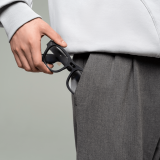 TCL RayNeo X2 held in a hand.


References
- ↑ 1.00 1.01 1.02 1.03 1.04 1.05 1.06 1.07 1.08 1.09 1.10 1.11 1.12 1.13 1.14 1.15 1.16 1.17 1.18 1.19 1.20 1.21 1.22 "TCL雷鸟智能眼镜X2 - 消费级真AR眼镜 (TCL RayNeo X2 product page)". TCL China. https://www.tcl.com/cn/zh/smart-glasses/x2. Retrieved 2026-10-14.
- ↑ 2.00 2.01 2.02 2.03 2.04 2.05 2.06 2.07 2.08 2.09 2.10 2.11 2.12 2.13 2.14 2.15 2.16 2.17 2.18 2.19 2.20 2.21 2.22 2.23 "RayNeo X2 developer documentation: Platform introduction and Unity ARDK overviews". RayNeo Open Platform. https://open.rayneo.com/#/docs/x2. Retrieved 2026-10-14.
- ↑ 3.00 3.01 3.02 3.03 3.04 3.05 3.06 3.07 3.08 3.09 3.10 3.11 "TCL Unveils Groundbreaking Augmented Reality Glasses at CES 2023". TCL. 2023-01-04. https://www.tcl.com/global/en/news/tcl-unveils-groundbreaking-augmented-reality-glasses-at-ces-2023. Retrieved 2026-10-14.
- ↑ 4.00 4.01 4.02 4.03 4.04 4.05 4.06 4.07 4.08 4.09 4.10 4.11 4.12 4.13 "RayNeo X2 AR Glasses Debut Global Crowdfunding on Indiegogo with Early Bird Specials, Paving the Way for a New Era of Visible AI". PR Newswire. 2024-02-27. https://www.prnewswire.com/news-releases/rayneo-x2-ar-glasses-debut-global-crowdfunding-on-indiegogo-with-early-bird-specials-paving-the-way-for-a-new-era-of-visible-ai-302072718.html. Retrieved 2026-10-14.
- ↑ 5.0 5.1 Jed John Ikoba (2023-10-19). "TCL RayNeo X2 AR glasses launch for pre-orders in China ahead of the global release". Gizmochina. https://www.gizmochina.com/2023/10/19/tcl-rayneo-x2-ar-glasses-launch-pre-orders-china-ahead-global-release/. Retrieved 2026-10-14.
- ↑ 6.00 6.01 6.02 6.03 6.04 6.05 6.06 6.07 6.08 6.09 6.10 6.11 6.12 6.13 6.14 6.15 6.16 6.17 6.18 6.19 6.20 6.21 6.22 6.23 6.24 6.25 6.26 David Heaney (2024-09-17). "RayNeo X2 Review: Are The First Standalone AR Glasses More Than A Tech Demo?". UploadVR. https://www.uploadvr.com/rayneo-x2-standalone-ar-glasses-review/. Retrieved 2026-10-14.
- ↑ 7.00 7.01 7.02 7.03 7.04 7.05 7.06 7.07 7.08 7.09 7.10 7.11 7.12 7.13 7.14 7.15 7.16 7.17 7.18 7.19 7.20 7.21 7.22 7.23 7.24 7.25 7.26 7.27 7.28 7.29 7.30 7.31 7.32 7.33 7.34 "RayNeo X2 AI+AR Smart Glasses". RayNeo. https://www.rayneo.com/products/tcl-rayneo-x2. Retrieved 2026-10-14.
- ↑ 8.0 8.1 "RayNeo Introduces Full-color 3D Display Smart Glasses Powered by Snapdragon AR1 at Snapdragon Summit 2023". PR Newswire. 2023-10-25. https://www.prnewswire.com/news-releases/rayneo-introduces-full-color-3d-display-smart-glasses-rayneo-x2-lite-at-snapdragon-summit-2023-301967591.html. Retrieved 2026-10-14.
- ↑ 9.00 9.01 9.02 9.03 9.04 9.05 9.06 9.07 9.08 9.09 9.10 9.11 "RayNeo X2 FAQ". RayNeo. https://www.rayneo.com/pages/faq-x2. Retrieved 2026-10-14.
- ↑ 10.0 10.1 10.2 "RayNeo X3 Pro vs. X2: Best RayNeo AI Smart Glasses for Assistant, Camera & Daily Use (2026)". RayNeo. 2026-08-11. https://www.rayneo.com/blogs/news/rayneo-x3-pro-vs-x2-best-rayneo-ai-smart-glasses-for-assistant-camera-daily-use-2027. Retrieved 2026-10-14.
- ↑ 11.00 11.01 11.02 11.03 11.04 11.05 11.06 11.07 11.08 11.09 "X2 AR Glasses User Manual". RayNeo. https://cdn.shopify.com/s/files/1/0688/8642/9983/files/X2_Manual.pdf?v=1719371819. Retrieved 2026-10-14.
- ↑ 12.0 12.1 "TCL Launches TCL RayNeo X2 Global Developer Program". TCL. 2023-04-20. https://www.tcl.com/eu/en/news/tcl-launches-tcl-rayneo-x2-global-developer-program. Retrieved 2026-10-17.
- ↑ 13.0 13.1 Will Shanklin (2023-01-05). "TCL's huge glasses remind us good AR is difficult". Engadget. https://www.engadget.com/tcl-rayneo-x2-ar-glasses-ces-2023-182523521.html. Retrieved 2026-10-17.
- ↑ Amy Frearson (2023-01-12). "TCL unveils AR glasses that overlay the world with digital info". Dezeen. https://www.dezeen.com/2023/01/12/tcl-rayneo-x2-ar-glasses/. Retrieved 2026-10-17.
- ↑ 15.0 15.1 15.2 Matt Bolton (2023-01-06). "I tried TCL's AR glasses you'll never need (or want) to take off". TechRadar. https://www.techradar.com/opinion/i-tried-tcls-ar-glasses-youll-never-need-or-want-to-take-off. Retrieved 2026-10-17.
- ↑ 16.0 16.1 16.2 Alan Truly (2024-02-27). "RayNeo launches its X2 AR glasses with AI funding for developers". MIXED. https://mixed-news.com/en/rayneo-launches-its-x2-ar-glasses-with-ai-funding-for-developers/. Retrieved 2026-10-17.
- ↑ "RayNeo Launches the World's First AR Glasses-Based Artificial Intelligence Challenge". RayNeo. 2024-01-22. https://www.rayneo.com/blogs/news/rayneo-launches-the-world-s-first-ar-glasses-based-artificial-intelligence-challenge. Retrieved 2026-10-17.
- ↑ "Introducing the RayNeo X3 Pro – Your Next-Generation AR Smart Glasses". RayNeo. 2025-10-28. https://www.rayneo.com/blogs/news/introducing-the-rayneo-x3-pro-your-next-generation-ar-smart-glasses. Retrieved 2026-10-14.
- ↑ James Pero (2025-12-17). "RayNeo X3 Pro Review: These AR Smart Glasses May Haunt My Dreams". Gizmodo. https://gizmodo.com/rayneo-x3-pro-review-these-ar-glasses-may-haunt-my-dreams-2000699219. Retrieved 2026-10-14.
- ↑ 20.0 20.1 20.2 "Download: RayNeo X Series APP and RayNeo X2 Marker". RayNeo UK. https://uk.rayneo.com/pages/download. Retrieved 2026-10-14.
- ↑ 21.0 21.1 Dean Daley (2024-02-28). "TCL's RayNeo X2 smart glasses bring AI and AR together". MobileSyrup. https://mobilesyrup.com/2024/02/28/tcls-rayneo-x2-smart-glasses-bring-ai-and-ar-together/. Retrieved 2026-10-14.
- ↑ 22.0 22.1 Tom Pritchard (2024-02-26). "I just saw TCL's AR glasses of the future, and they're arriving sooner than you might think". Tom's Guide. https://www.tomsguide.com/computing/vr-ar/i-just-saw-tcls-ar-glasses-of-the-future-and-theyre-arriving-sooner-than-you-might-think. Retrieved 2026-10-17.
- ↑ "RayNeo X2 AR Glasses Quick Start Guide". RayNeo. https://cdn.shopify.com/s/files/1/0688/8642/9983/files/X2_Quick_Guide_1.pdf?v=1719397463. Retrieved 2026-10-14.
- ↑ 24.0 24.1 24.2 24.3 24.4 24.5 "XREAL Air 2 Ultra: specifications and compatibility". XREAL Developer. https://developer.xreal.com/. Retrieved 2026-10-14.
- ↑ 25.0 25.1 25.2 25.3 25.4 25.5 25.6 "Vuzix Shield Overview". Vuzix Support. 2023-12-19. https://support.vuzix.com/docs/overview-21. Retrieved 2026-10-14.
- ↑ 26.0 26.1 26.2 "Deep Dive Teardown of the Magic Leap Magic Leap 2 M90AA004 AR Headset". TechInsights. https://www.techinsights.com/blog/deep-dive-teardown-magic-leap-magic-leap-2-m90aa004-ar-headset. Retrieved 2026-10-14.
- ↑ 27.0 27.1 27.2 27.3 27.4 "製品仕様 (Product specifications)". Magic Leap Care. https://www.magicleap.care/hc/ja/articles/7813913215373-%E8%A3%BD%E5%93%81%E4%BB%95%E6%A7%98. Retrieved 2026-10-14.
- ↑ 28.0 28.1 "XREAL Jump-Starts the Future of Affordable, Full-Featured Spatial Computing, Announces XREAL Air 2 Ultra AR Glasses". PR Newswire. 2024-01-07. https://www.prnewswire.co.uk/news-releases/xreal-jump-starts-the-future-of-affordable-full-featured-spatial-computing-announces-xreal-air-2-ultra-ar-glasses-302027773.html. Retrieved 2026-10-14.
- ↑ Sam Sprigg (2022-07-12). "Magic Leap announces September 30 general availability date and pricing structure for Magic Leap 2". Auganix. https://www.auganix.org/magic-leap-announces-september-30-general-availability-date-and-pricing-structure-for-magic-leap-2/. Retrieved 2026-10-14.
- ↑ "Magic Leap 2 Availability". Magic Leap Care. https://www.magicleap.care/hc/en-us/articles/42141361534093-Magic-Leap-2-Availability. Retrieved 2026-10-14.
- ↑ Mohammad Jeelani, Michael Prieto (2025). "Using the Wearable Acceptability Range (WEAR) Scale to Rate Social Acceptability of Mixed Reality and AI Enabled Head-Mounted Wearables". Human Interaction and Emerging Technologies (IHIET 2025), AHFE Open Access vol. 197, pp. 350-356. doi:10.54941/ahfe1006751. https://openaccess-api.cms-conferences.org/articles/download/978-1-964867-73-1_34. Retrieved 2026-10-14.
- ↑ 32.0 32.1 Aditya Singh, Meet Anil Bhanushali, Jingwu Luo, Gang Luo, Shrinivas Pundlik (2026). "Assisting the blind to reach daily objects using smart glasses". Displays, vol. 93, article 103390. doi:10.1016/j.displa.2026.103390. https://pmc.ncbi.nlm.nih.gov/articles/PMC13246143/. Retrieved 2026-10-14.