

Pimax 8K
More actions
| Pimax 8K | |
|---|---|

| |
| Basic Info | |
| VR/AR | Virtual Reality |
| Type | Head-mounted display |
| Subtype | PC-Powered VR |
| Platform | SteamVR and historical Oculus Home compatibility[1] |
| Creator | Pimax |
| Developer | Pimax |
| Manufacturer | Pimax |
| Announcement Date | Prototype shown at CES 2017; crowdfunding launch announced September 19, 2017[2][3] |
| Release Date | Late September 2018 (early backer headsets); general orders announced November 30, 2018 with a waiting period[1] |
| Price | US$900, headset only (November 2018 general-order announcement); campaign tiers differed[1] |
| Website | https://www.pimax.com/ |
| Versions | Original 8K; later Vision 8K Plus and Pimax 8K X are separate products[4] |
| Requires | PC, DisplayPort/USB tether, external power adapter; compatible base stations for positional tracking[5][6] |
| Predecessor | Pimax 4K (earlier product)[3] |
| System | |
| CPU | Host PC |
| GPU | GTX 1080 Ti or AMD equivalent recommended in November 2018 announcement[1] |
| Display | |
| Display | Dual LCD panels, marketed as CLPL (customized low persistence liquid)[1] |
| Resolution | 3840 × 2160 panel pixels per eye; 2560 × 1440 per-eye input upscaled in the headset[1] |
| Refresh Rate | 80 Hz in November 2018 specification and documented 2019 driver capture[1][7] |
| Image | |
| Field of View | Approximately 200° diagonal advertised in November 2018; software and optical measurements differ[1] |
| Horizontal FoV | Mode dependent; see driver geometry and measured Kickstarter Edition results below[8][9] |
| Vertical FoV | 104.27° rendered in cited native-mode dataset; 110° right-eye optical measurement in cited research rig[8][9] |
| Foveated Rendering | PiTool fixed foveated setting; Droolon Pi1 accessory advertised dynamic foveation[5][10] |
| Optics | |
| Optics | Fresnel lenses[11] |
| Ocularity | Binocular[1] |
| IPD Range | Mechanical adjustment; software offsets are separate (see fit section)[12][13] |
| Passthrough | No integrated front-facing camera in original campaign design[12] |
| Tracking | |
| Tracking | SteamVR/Lighthouse positional tracking; PiTool also documents 9-axis mode without base stations[1][5] |
| Base Stations | SteamVR Tracking 1.0 and 2.0 compatibility advertised for the original headset[1] |
| Eye Tracking | Optional Droolon Pi1 accessory, listed by its manufacturer in January 2020[10] |
| Hand Tracking | Optional external hand-tracking module[14] |
| Rotational Tracking | Yes; documented base-station-free seated mode[5] |
| Positional Tracking | With Lighthouse base stations[5] |
| Play Space | Seated in 9-axis mode; standing and room-scale with appropriate tracked setup[5][3] |
| Audio | |
| Audio | External headphones through one 3.5 mm jack; historical KDMAS on-ear upgrade[4] |
| Microphone | Built in[1] |
| 3.5mm Audio Jack | One on original 8K, distinguished from later dual-jack headsets[4] |
| Camera | No integrated front-facing camera in original design[12] |
| Connectivity | |
| Connectivity | DisplayPort 1.4 and USB; external power supply[1][6] |
| Ports | DisplayPort/USB tether, headphone jack; prototype underside USB-C accessory port[15][4] |
| Wired Video | DisplayPort[1] |
| Wireless Video | Proposed campaign module; see dated availability limits below[16] |
| Power | External AC adapter, 5 m adapter-model cable[6] |
| Device | |
| Material | Rigid plastic and foam facial cushion on reviewed October 2017 prototype[15] |
| Headstrap | Soft strap on CES 2019 production demonstrations; later KDMAS compatibility[17][4] |
| Sensors | SteamVR tracking sensor array[15] |
| Input | Compatible SteamVR controllers; original demonstrations used VIVE wands[17] |
| Cable Length | 5 m adapter-model tether[6] |
The Pimax 8K is a PC-tethered virtual reality headset developed by Pimax. It combines two 3840 × 2160 LCD panels with wide-angle Fresnel optics and SteamVR tracking. Its input is 2560 × 1440 per eye, which the headset upscales to the panels; the product name does not mean that it receives a native 7680 × 4320 image.[1][18] A prototype was demonstrated at CES 2017, followed by a 2017 crowdfunding campaign and early backer deliveries in late September 2018. The November 2018 general-order announcement still quoted a waiting period.[2][3][1]
The original 8K should be distinguished from the later Pimax Vision 8K Plus and Pimax 8K X. It was demonstrated with a soft strap and separate headphones, and has a built-in microphone. Its original single audio jack and adapter-powered tether also differ from some later Pimax models.[17][1][4][6]
Hardware
Display resolution and the 8K name
The two panel resolutions total 7680 × 2160 pixels across the eyes, rather than the 7680 × 4320 raster commonly meant by 8K video. Pimax advertised 16.6 million panel pixels in total.[3] In his October 2017 CEATEC hands-on, Richard Lai reported Pimax's explanation that its name referred to the combined horizontal resolution. He also identified the internal scaler and the lower-resolution input supplied by the demonstration computer.[18] The November 2018 specification explicitly listed 3840 × 2160 per display and input upscaled from 2560 × 1440.[1]
Pimax called its LCD implementation CLPL, or customized low persistence liquid. This manufacturer terminology does not establish a measured response time, a universal motion-to-photon latency or the absence of visual artifacts.[12] Contemporary testing found that panel resolution alone did not remove screen door effect, aliasing or optical distortion. Ben Lang's CES 2019 report described reduced screen door visibility compared with first-generation headsets, while still seeing it on the production 8K.[17]
The wider field of view also spreads the display across a larger angular area. Lang's January 2018 prototype assessment cautioned that the improvement in apparent pixel density could not be inferred simply by comparing panel resolutions with the narrower HTC Vive or Oculus Rift.[11]
Optics, field of view and fit
The original design uses canted displays and Fresnel optics. Frank He's January 2017 demonstration report compared its exterior and angled display arrangement with StarVR HMD, and its early mounting arrangement with PlayStation VR. Those observations concern that prototype; later production demonstrations used a soft strap.[2][17]
Pimax advertised an approximately 200° diagonal field of view in its November 2018 specification. Earlier campaign material used 200° without consistently identifying an axis, and its October 2017 FAQ separately claimed at least 150° monocular horizontal and 120° vertical coverage. These advertised quantities describe different axes and development stages.[1][12]
The production demonstrations at CES 2019 offered three software field-of-view settings. Lang found that the middle Normal setting hid much of the remaining edge distortion, and noted that reducing the field also reduced rendering demand. Facial shape and headset placement affected his assessment of the peripheral image.[17]
Documented driver geometry
Richard Musil's HMD Geometry Database calculates rendered view geometry from OpenVR data recorded with the author's hmdq tool. Its original 8K entries at 80 Hz report the following native-mode values. These are driver-reported rendering geometries, rather than measurements through the lenses or guarantees of what every wearer sees.[8][19]
| Original 8K configuration | Rendered binocular horizontal field | Rendered vertical field | Horizontal stereo overlap |
|---|---|---|---|
| Large, native, 80 Hz | 160.29° | 104.27° | 86.79° |
| Normal, native, 80 Hz | 140.29° | 104.27° | 86.79° |
| Small, native, 80 Hz | 120.29° | 104.27° | 86.79° |
The Large dataset was recorded on August 2, 2019 with a reported IPD of 67.0 mm. Its left and right view rotations are -10° and +10°; these are view transforms in the software record, rather than an independent mechanical measurement of panel angles.[7] Musil warns that parallel-projection mode can produce misleading calculated vertical values. The database marks the relevant parallel-mode vertical figures as unreliable, so they should not be substituted for the native-mode values above.[8][19]
Interpupillary adjustment
The headset has mechanical interpupillary distance adjustment. The October 2017 Immersed prototype's dial was not yet functional, while CES 2018 testing found an operational adjuster without an in-headset numeric readout. At CES 2019, the readout was working in the demonstrated production units.[15][11][17]
Pimax's December 2022 family instructions distinguish a mechanical wheel from PiTool pupil-distance and vertical screen offsets. They list 60-70 mm for the wheel and 58-72 mm for software adjustment, but these are family instructions, rather than a verified optical fit range for every original 8K revision.[13] A separate P2 guidance note says the displayed IPD is offset from the actual pupil distance and discusses aligning the eye, lens and display distortion centers. That warning also limits comparisons based only on the number displayed in the headset.[20]
Tracking and controllers
The original 8K incorporates SteamVR tracking, with compatibility advertised for both SteamVR Tracking 1.0 and 2.0 base stations. The November 2018 announcement listed these separately from the proposed controller and base-station bundle, for which no delivery date was then available.[1] CES 2019 demonstrations used VIVE wands and Pimax controller prototypes. Lang reported much improved positional tracking compared with the prior year's prototype, while still noticing additional rotational latency on the 8K compared with the 5K Plus.[17]
The PiTool manual documents two modes: Lighthouse with base stations, and 9-axis mode without them for seated use such as movies or simulation games. The latter does not provide the same tracked room-scale configuration. Room setup and controller pairing are handled through the PC software.[5] Campaign claims that an attachable inside-out tracking module would be available describe a proposed extension, rather than built-in camera tracking on the shipped headset.[16]
The campaign advertised single-base-station 360° positional coverage and broad Valve-accessory compatibility. These were campaign compatibility claims; the CES 2019 account established working VIVE wands and Pimax controller prototypes in its demonstrated setup.[16][12][17]
Connections, power and audio
The original headset uses a DisplayPort/USB tether and a separate power adapter. Pimax's retained 5M Cable For Adapter Models listing explicitly names the original 8K alongside the 5K Plus/XR, requires external power, and excludes the Crystal family, 8K X and 5K Super. It should not be confused with the USB-powered or fiber-optic cables of later models.[6] The December 2022 PiTool manual documents connecting the 5 m adapter-model cable to the discrete GPU's DisplayPort and a PC USB port, with its power adapter plugged into a socket.[5]
The original 8K has a microphone and a 3.5 mm headphone jack. It was still demonstrated with a soft strap and separately supplied headphones in January 2019; the rigid strap and integrated headphone assembly remained promised accessories at that time.[1][17]
A July 2020 Pimax support reply distinguished original 8K/5K Plus/5K XR users, who needed the single-cable KDMAS strap, from later 8K Plus/8K X headsets with two audio jacks. It described KDMAS as on-ear and DMAS as off-ear, and advised against combining the original-model strap with the other speaker systems.[4] The September 2021 DMAS shipment notice restricted that upgrade to blue-housing headsets with two audio jacks, usually the 8K X, 8K Plus and 5K Super. It did not make DMAS an interchangeable upgrade for the original 8K.[21]
Software and performance
PiTool and rendering settings
PiTool supplies headset configuration and game launching alongside SteamVR. Its December 2022 manual documents firmware checks, brightness, pupil-distance and vertical offsets, render quality, a hidden-area mask, parallel-projection compatibility and per-game settings. It also describes importing Steam and Oculus applications. These dated instructions do not guarantee that every historical title or current runtime version works without modification.[5]
Musil's original view-geometry analysis explains the parallel-projection option as a compatibility path for applications that assumed parallel stereo views. Reprojecting those images to the headset's canted views adds rendering overhead. Its effect on reported vertical geometry is separate from the headset's physical field of view.[19]
Refresh rate and Brainwarp
The original 8K's November 2018 specification gave an 80 Hz refresh rate, consistent with the cited August 2019 driver record. Earlier 75/90 Hz, or 150/180 Hz Brainwarp, campaign figures should not be read as verified production panel modes.[1][7][3]
Pimax's original campaign description of Brainwarp proposed alternating the images displayed to the two eyes and claimed a higher perceived refresh rate. These perceived-refresh claims did not establish production panel modes above the documented 80 Hz.[16][1] Frank He's January 2017 report compared the alternating-eye concept with active-shutter stereoscopic glasses. It also identified precise synchronization as a requirement, with a motion-related ghosting concern.[2] In a January 2019 interview, Pimax's Kevin Henderson described its newer BrainWarp beta as similar to asynchronous spacewarp. The later PiTool manual describes intelligent frame filling at half the headset refresh rate, with generated frames completing the displayed sequence.[22][5]
Computer requirements
Requirements published during development changed and need their dates retained. In January 2017, Pimax told Frank He that its prototype recommendation was two GTX 1070 cards or one GTX 1080, with a GTX 980 minimum assuming asynchronous timewarp.[2] Pimax's September 2017 announcement listed a GTX 980/1070 or AMD R9 Nano, or an equivalent or higher GPU.[3] The October 2017 campaign FAQ listed a GTX 980/1070 GPU, Core i5 CPU and 8 GB memory. The November 2018 general-order specification instead recommended a GTX 1080 Ti or AMD equivalent for the 8K.[12][1] Neither list establishes a frame rate across every game, field-of-view setting or supersampling level.
The original display's upscaling separates the PC input resolution from the panel pixel count. Render quality, field-of-view mode, parallel projection and frame filling are additional software choices. They should not be conflated with a change to the physical panel resolution.[1][5][19]
Motion-to-photon latency
Motion-to-photon latency is the delay between a movement and the corresponding display update. In January 2017, Pimax told Frank He that its prototype could achieve 18 ms. Its September campaign announcement instead advertised less than 15 ms. These are dated manufacturer claims, without a common documented test method establishing a universal production-headset latency.[2][3] The CES 2019 hands-on report still observed additional rotational lag on two 8K demonstration headsets compared with the 5K Plus. That observation was qualitative and should not be converted to a measured millisecond result or a guarantee about motion sickness.[17]
Accessories
The campaign proposed eye tracking, hand motion, inside-out tracking, wireless transmission, cooling and other modular extensions. Proposed interfaces and delivery targets do not establish that all modules were delivered with the original headset. The October 2017 Immersed prototype had an underside USB-C accessory port, while its promised front-facing camera was absent from the campaign's base design.[16][15][12]
| Accessory or extension | Documented original-8K scope |
|---|---|
| Hand-tracking module | An external module, rather than cameras integrated into the stock headset. Pimax's December 2022 manual documents its screw mounting, Type-C connection, PiTool detection and separate driver. Applications need hand-tracking support.[14] |
| Droolon Pi1 eye tracking | 7invensun's January 2020 announcement explicitly lists Pimax 8K compatibility. Dynamic foveated rendering is an advertised accessory function; its claimed performance gain is not a benchmark of every original 8K game or PC.[10] |
| KDMAS audio strap | The July 2020 manufacturer reply lists the original 8K among models using this on-ear, single-audio-cable upgrade. Later dual-jack DMAS requirements are different.[4][21] |
| Wireless module | Proposed in the 2017 campaign. In a May 2025 company Q&A, Pimax said only the original Crystal then supported wireless. That dated statement does not establish a shipped wireless module for the original 8K.[16][23] |
| Inside-out tracking module | Proposed campaign extension. It should not be listed as built-in stock tracking or assumed available from the existence of an accessory interface.[16] |
Kickstarter campaign and availability
Pimax announced its campaign on September 19, 2017. The retained Kickstarter page displays a funding period of September 20 to November 4, 2017, with US$4,236,618 pledged by 5,946 backers. The totals cover the campaign's different headset and package tiers, rather than purchases of the original 8K alone.[3][16] The amount exceeded the Oculus Rift campaign's US$2,437,429 from 9,522 backers in 2012.[24]
| Campaign offering | Headset tier | Full package tier | Original estimated delivery |
|---|---|---|---|
| Original Pimax 8K | US$449 early bird; US$499 regular | US$749 early bird; US$799 regular, with two controllers and two base stations | January 2018 headset; February 2018 full package |
| Original Pimax 5K alternative | US$349 early bird; US$399 regular | US$649 early bird; US$699 regular | January 2018 headset; February 2018 full package |
The reward prices and estimates above are retained campaign terms, rather than a record of completed delivery. The 5K was offered with lower-resolution 2560 × 1440 panels per eye; the campaign also offered a separate 8K X tier.[16]
Pimax said it selected Kickstarter to gather feedback from early adopters and developers. Its stated backer benefits were a role in the core community, prioritization of their requests, a retail wait until Kickstarter packages were fulfilled, the lowest planned price, and a Kickstarter version intended to be the consumer version. Those were campaign promises rather than audited fulfillment outcomes.[16]
In a January 2018 update, Pimax said that, taking into account fixes for the final version, backer deliveries were now expected in a Q2 2018 window, and apologized that its initial estimate "was perhaps generous". It planned to show a close-to-mass-production unit, the M1, from mid-March and to test it with a small closed group from the community.[25] In April 2018, Pimax said it had adjusted the lens design three times, with each new tooling costing over US$50,000 to US$100,000 and adding a few weeks. Its parts vendor had scheduled the newest lenses for early May, which Pimax said would let it ship the first M1 pre-production headsets to hand-selected beta testers drawn from its Kickstarter backers. The company also said that the M1 would have an 80 Hz refresh rate, and that the beta would determine whether the M1 was good enough to ship.[26]
On June 29, 2018, Pimax announced that the 8K had entered its mass-production phase. Nine selected beta testers had by then received M1 units. Road to VR reported that adding SteamVR 2.0 tracking sensors to the headset and controllers had extended the backer delivery timeline, and that Pimax planned a business version in a different color from the consumer model.[27] On July 13, 2018, Pimax said it would send a second iteration of the M1 to some testers. Within hours, an alleged leak of internal tester comments criticized build quality, software ease of use, performance, optical distortion and display quality; Road to VR reported that two of the testers, VoodooDE and SweViver, responded that many of those issues had been fixed.[28]
In September 2018, Pimax introduced the Pimax 5K Plus and offered original 8K backers a choice to switch. Its later support documentation records a US$100 accessory coupon for backers making that switch, with product charges distinguished from shipping, handling and taxes.[29][30]
The January 2018 headset estimate was delayed. September's announcement forecast the first shipments by the end of that month, and the November 30 report described early backer headsets arriving from late September. General orders were announced on November 30, 2018 at US$900 for the 8K, while quoting an 81-day shipping wait and a queue that prioritized Kickstarter orders and earlier pre-orders.[29][1] Its February 19, 2019 estimate for a hypothetical November 30 order was a forecast, rather than a confirmed universal retail launch date.[1]
Headsets and campaign accessories had separate schedules. In the January 2019 interview, Henderson still forecast controller production and additional headset shipping, so this account does not establish a date when every campaign reward was completed.[22]
In a forum post published just before CES 2019 and reported by UploadVR on January 7, 2019, Pimax said it had produced 4,650 headsets and shipped 2,027 units to backers; the report did not break these figures down by model. Pimax cited raised quality standards after feedback from early backers, apologized for "being overly optimistic and providing only sporadic official communications", and said it hoped to complete production in mid-January and finish shipping by the end of the month.[31] In a statement reported by UploadVR on January 31, 2019, Pimax told backers that the 8K would not be shipped to all of them that month as previously stated. UploadVR reported that the 4K LCD panels used in the 8K had been rejected at a much higher rate since Pimax introduced stricter quality-assurance testing, and that the remaining shipments would not happen before the Chinese Spring Festival, which ran until February 10. Pimax said by then that it had shipped most of its 5K Plus headsets, while original 8K backers were still waiting.[32]
Ruggedized business edition
In March 2019, Pimax announced business-oriented ruggedized "RE" versions of the 8K, 5K Plus and 5K OLED, and showed samples at GTC 2019 in San Jose, where it co-exhibited with the 3D scanning company Ecoplants.[33] Road to VR reported that the RE models would keep the fundamental specifications, wide field of view and modular expansion of their consumer counterparts, including two USB Type-C accessory ports. In interviews with MRTV and Road to VR, Pimax's head of US operations, Kevin Henderson, listed water resistance, a new foam insert, a rigid head strap, thicker cabling, greater shock tolerance, more robust components, metal buttons, longer-lifespan switches and a protective front cover accessory as ruggedization changes.[34] Pimax aimed the line at high-traffic venues such as location-based entertainment venues, educational and training institutions, and museums, and offered a dedicated support package with it.[33] Henderson estimated that the RE versions would cost about US$500 more per unit than the consumer models and would arrive "in the coming months". Neither report gave a release date or final price.[34][33]
Retained support material
Pimax retains December 2022 setup and accessory documentation for this generation. Their publication and continued accessibility do not establish compatibility with every current PC, operating-system update or SteamVR release.[5][14] On October 14, 2026, its 5 m adapter-model cable page still explicitly identified original 8K compatibility but showed the item as out of stock. This describes that checked replacement listing, not a guaranteed supply of spare parts.[6]
Reception
Prototype hands-on reports
Early reports differed, and concern specific prototypes and short demonstrations. Frank He found high apparent resolution and a wide view at CES 2017, but also low brightness, peripheral distortion, limited binocular overlap and slight smearing. He described Fresnel reflections as subtle in that demonstration, rather than absent from every 8K unit. He thought the wide view helped peripheral awareness, but the optical problems prevented a convincing sense of presence in his session.[2]
At CEATEC in October 2017, Richard Lai reported a comfortable prototype and a peripheral view without an obvious black border in Fruit Ninja. He described it as his most immersive VR gameplay session to that point and did not notice individual subpixels or ghosting. The demonstration was running on a GTX 1080 laptop and used internal upscaling; it was not a controlled test of the eventual production headset.[18]
Kevin Carbotte's separate Immersed 2017 test described a lightweight rigid plastic prototype, a foam facial cushion and an incomplete IPD adjuster. He tried theBlu, Fruit Ninja and Bigscreen beta, appreciating the wider view but finding desktop text less clear than expected. He did not detect a screen-door grid in that session. The prototype repeatedly lost its display, and the supplied VIVE controllers needed wired connections during that demonstration.[15]
Lang's CES 2018 assessment found improved distortion correction but remaining blurred peripheral regions, reflection-like artifacts, screen door visibility and mura. The manufacturer told him the panels were then running at 80 Hz while it still hoped to reach its advertised 90 Hz. The review did not independently measure the claimed 200° field or endorse the claim that screen door effect had been eliminated.[11]
Production demonstrations
At CES 2019, Lang tested the production 8K and 5K Plus and reported improvements in image consistency, removal of the prior horizontal green-line artifacts and much better positional tracking. Remaining screen door effect, edge distortion and the 8K's additional rotational latency qualified those improvements. He also noted the continued use of a soft strap and separate headphones. These observations describe the demonstrated units and reviewer, rather than a population-wide comfort or reliability assessment.[17]
Independent field-of-view research
The Virtual Dimension Center Fellbach's April 2021 report revision explicitly identifies its original Pimax 8K as the Kickstarter Edition (8K KE). It used a 3D-printed head model with two IMX226 USB cameras and 185° fisheye lenses, photographing an AVEC test image displayed through WebVR. The researchers aligned and overlaid the two camera views to estimate binocular coverage.[9]
| Mode on the tested Kickstarter Edition | Measured binocular horizontal field | Mean binocular diagonal field | Measured right-eye vertical field |
|---|---|---|---|
| Large | 132.5° | 141.5° | 110° |
| Normal | 126° | 135.25° | 110° |
| Small (report label: smal) | 130° | 129.5° | 110° |
| Potato | 104° | 115.5° | 110° |
These measurements used the original facial padding. The head model had a fixed 60.5 mm IPD, which could limit alignment through the lens centers. Eye-lens spacing was not measured, and the authors noted camera-focus, image-overlay and reference-sphere errors. The results describe this optical rig and setup; they are distinct from advertised coverage, hmdq rendering geometry and a personal field-of-view measurement.[9]
Gallery
-
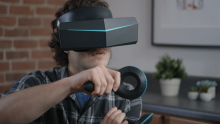 Pimax 8K prototype in its 2017 crowdfunding campaign.

References
- ↑ 1.00 1.01 1.02 1.03 1.04 1.05 1.06 1.07 1.08 1.09 1.10 1.11 1.12 1.13 1.14 1.15 1.16 1.17 1.18 1.19 1.20 1.21 1.22 1.23 1.24 1.25 1.26 Scott Hayden (2018-11-30). "Pimax Announces General Sale of “8K” & “5K” Headsets with 80+ Day Waiting Period". Road to VR. https://roadtovr.com/pimax-announces-official-sale-8k-5k-headsets-80-day-waiting-period/. Retrieved 2026-10-14.
- ↑ 2.0 2.1 2.2 2.3 2.4 2.5 2.6 Frank He (2017-01-14). "Hands-on: PiMAX’s 8K Headset Proves that High FOV VR is Coming". Road to VR. https://www.roadtovr.com/hands-pimaxs-8k-headset-proves-high-fov-vr-coming/. Retrieved 2026-10-14.
- ↑ 3.0 3.1 3.2 3.3 3.4 3.5 3.6 3.7 3.8 Pimax (2017-09-19). "Pimax Launches World’s First 8K VR Headset". Pimax / PR Newswire. https://www.prnewswire.com/news-releases/pimax-launches-worlds-first-8k-vr-headset-645763303.html. Retrieved 2026-10-14.
- ↑ 4.0 4.1 4.2 4.3 4.4 4.5 4.6 4.7 SweViver (2020-07-01). "Confusion about Mas, Dmas, and Kdmas". Pimax support reply / OpenMR. https://forum.openmr.com/t/confusion-about-mas-dmas-and-kdmas/28968. Retrieved 2026-10-14.
- ↑ 5.00 5.01 5.02 5.03 5.04 5.05 5.06 5.07 5.08 5.09 5.10 5.11 "Pitool Operation Manual". Pimax Support. 2022-12-08. https://support.pimax.com/en/support/solutions/articles/60000812306-pitool-operation-manual. Retrieved 2026-10-14.
- ↑ 6.0 6.1 6.2 6.3 6.4 6.5 6.6 "5M Cable For Adapter Models". Pimax Store. https://store.pimax.com/products/5m-cable-for-adapter-models. Retrieved 2026-10-14.
- ↑ 7.0 7.1 7.2 "Pimax 8K (Large FOV, 80Hz)". HMD Geometry Database. 2019-08-02. https://risa2000.github.io/hmdgdb/hmd_cfgs/Pimax8K_Large_Native_R80.html. Retrieved 2026-10-14.
- ↑ 8.0 8.1 8.2 8.3 "HMD Geometry Database". Richard Musil. https://risa2000.github.io/hmdgdb/. Retrieved 2026-10-14.
- ↑ 9.0 9.1 9.2 9.3 Sebastian Mareck; Vitor Macedo; Christoph Runde (2021-04-21). "Bericht #08 Revision 2: Head-Mounted Displays und AR Smart Glasses: Messung des Sichtfelds (Field of View)". Virtual Dimension Center Fellbach. https://ndownloader.figshare.com/files/28719873. Retrieved 2026-10-14.
- ↑ 10.0 10.1 10.2 "七鑫易维VR/AR集成与配件眼球追踪解决方案亮相CES2020". 7invensun. 2020-01-07. https://www.7invensun.com/newsinfo/8549.html. Retrieved 2026-10-14.
- ↑ 11.0 11.1 11.2 11.3 Ben Lang (2018-01-10). "Hands-on: Pimax “8K” Has Come a Long Way but There’s Still Real Kinks to Iron Out". Road to VR. https://roadtovr.com/ces-2018-pimax-8k-hands-on-long-way-kinks-to-iron/. Retrieved 2026-10-14.
- ↑ 12.0 12.1 12.2 12.3 12.4 12.5 12.6 12.7 "Pimax: The World's First 8K VR Headset: FAQ". Pimax 8K VR / Kickstarter. https://www.kickstarter.com/projects/pimax8kvr/pimax-the-worlds-first-8k-vr-headset/faqs. Retrieved 2026-10-14.
- ↑ 13.0 13.1 "IPD Setting". Pimax Support. 2022-12-09. https://support.pimax.com/en/support/solutions/articles/60000812363-ipd-setting. Retrieved 2026-10-14.
- ↑ 14.0 14.1 14.2 "Hand Tracking Manual". Pimax Support. 2022-12-13. https://support.pimax.com/en/support/solutions/articles/60000815077-hand-tracking-manual. Retrieved 2026-10-14.
- ↑ 15.0 15.1 15.2 15.3 15.4 15.5 Kevin Carbotte (2017-10-23). "Getting Fully Immersed With Pimax's 8K VR Headset (Hands On)". Tom's Hardware. https://www.tomshardware.com/news/pimax-8k-vr-headset-trial,35745.html. Retrieved 2026-10-14.
- ↑ 16.00 16.01 16.02 16.03 16.04 16.05 16.06 16.07 16.08 16.09 "Pimax: The World's First 8K VR Headset". Pimax 8K VR / Kickstarter. https://www.kickstarter.com/projects/pimax8kvr/pimax-the-worlds-first-8k-vr-headset. Retrieved 2026-10-14.
- ↑ 17.00 17.01 17.02 17.03 17.04 17.05 17.06 17.07 17.08 17.09 17.10 17.11 Ben Lang (2019-01-09). "Hands-on: Pimax’s Ultrawide “8K” & “5K” Plus See Big Improvements on the Path to Launch". Road to VR. https://roadtovr.com/pimax-8k-5k-plus-big-improvements-hands-on-ces-2019/. Retrieved 2026-10-14.
- ↑ 18.0 18.1 18.2 Richard Lai (2017-10-12). "Chinese startup's '8K' VR headset is surprisingly advanced". Engadget. https://www.engadget.com/2017/10/12/pimax-8k-vr-headset/. Retrieved 2026-10-14.
- ↑ 19.0 19.1 19.2 19.3 Richard Musil (2019-07-29). "VR headset rendered FOV calculation". VR Docs. https://risa2000.github.io/vrdocs/docs/hmd_fov_calculation. Retrieved 2026-10-14.
- ↑ "IPD: Distance between two eye pupil centers". Pimax Support. 2022-12-09. https://support.pimax.com/en/support/solutions/articles/60000812365-ipd-distance-between-two-eye-pupil-centers. Retrieved 2026-10-14.
- ↑ 21.0 21.1 "DMAS Update September 24th 2021". PimaxQuorra / OpenMR. 2021-09-24. https://forum.openmr.com/t/dmas-update-september-24th-2021/37036. Retrieved 2026-10-14.
- ↑ 22.0 22.1 "CES 2019: Interview With Pimax On 8K Headset, Controllers, Shipping Issues, More". UploadVR. 2019-01-15. https://www.uploadvr.com/ces-2019-pimax-interview/. Retrieved 2026-10-14.
- ↑ Jaap Grolleman (2025-05-20). "Pimax Connect Q&A". Pimax Store. https://eu.pimax.com/blogs/blogs/pimax-connect-q-a. Retrieved 2026-10-14.
- ↑ "Oculus Rift: Step Into the Game". Oculus / Kickstarter. https://www.kickstarter.com/projects/1523379957/oculus-rift-step-into-the-game. Retrieved 2026-10-14.
- ↑ Ben Lang (2018-01-25). "Pimax "8K" Headset Kickstarter Deliveries Delayed to Q2". Road to VR. https://www.roadtovr.com/pimax-8k-headset-kickstarter-delayed-q2-2018/. Retrieved 2026-10-27.
- ↑ Scott Hayden (2018-04-23). "Pimax '8K' Sees Further Delays Due to Lens Design, Pre-production Headset Pushed to May Release". Road to VR. https://www.roadtovr.com/pimax-8k-sees-delays-due-lens-design-pre-production-headset-pushed-may-release/. Retrieved 2026-10-27.
- ↑ Scott Hayden (2018-06-29). "Pimax Starts Mass Production Phase of "8K" VR Headset". Road to VR. https://roadtovr.com/?p=167927. Retrieved 2026-10-27.
- ↑ Scott Hayden (2018-07-13). "Update: Pimax to Send Testers Second "8K" Pre-production Headset Amidst Alleged Quality Concerns". Road to VR. https://roadtovr.com/pimax-send-beta-testers-second-8k-pre-production-headset-amidst-alleged-quality-concerns/. Retrieved 2026-10-27.
- ↑ 29.0 29.1 Ben Lang (2018-09-07). "Pimax “8K” to Begin Shipping By Month’s End, Pimax “5K” Plus Announced". Road to VR. https://roadtovr.com/pimax-8k-to-being-shipping-by-months-end-pimax-5k-plus-announced/. Retrieved 2026-10-14.
- ↑ "100$ downgrade coupon for backer". Pimax Support. 2020-08-27. https://support.pimax.com/en/support/solutions/articles/60000679440-100-downgrade-coupon-for-backer. Retrieved 2026-10-14.
- ↑ Jamie Feltham (2019-01-07). "Pimax Apologizes For 8K Delays, Intends To Ship To All Backers By Month's End". UploadVR. https://uploadvr.com/pimax-apologizes-8k-delays/. Retrieved 2026-10-27.
- ↑ David Heaney (2019-01-31). "Pimax 8K Headset Delayed Again, Quality Issues With 4K Panels". UploadVR. https://www.uploadvr.com/pimax-8k-delayed-2019/. Retrieved 2026-10-27.
- ↑ 33.0 33.1 33.2 Sam Sprigg (2019-03-21). "Pimax announces three new 'ruggedized' VR headset models at GTC 2019". Auganix. https://www.auganix.org/pimax-announces-three-new-ruggedized-vr-headset-models-at-gtc-2019. Retrieved 2026-10-27.
- ↑ 34.0 34.1 Scott Hayden (2019-03-18). "Pimax to Launch Ruggedized "8K" VR Headsets for Business This Year". Road to VR. https://roadtovr.com/pimax-ruggedized-re-8k-2019/. Retrieved 2026-10-27.