

PlayStation VR
More actions
| PlayStation VR | |
|---|---|

| |
| Basic Info | |
| VR/AR | Virtual Reality |
| Type | Head-mounted display |
| Subtype | Console-Powered VR |
| Platform | PlayStation 4; supported PS4 games on PlayStation 5 with PS Camera adaptor[1] |
| Developer | Sony Interactive Entertainment[2] |
| Announcement Date | March 18, 2014, as Project Morpheus[3] |
| Release Date | October 13, 2016[2] |
| Price | US launch MSRP: $399.99 core; $499.99 Launch Bundle[4] |
| Versions | CUH-ZVR1; CUH-ZVR2 (2017 hardware update)[5] |
| Requires | Console, matching processor unit and PlayStation Camera; controllers depend on game[5][6] |
| Successor | PlayStation VR2[7] |
| Display | |
| Display | Single 5.7-inch OLED RGB panel[5] |
| Resolution | 1920 x RGB x 1080; 960 x RGB x 1080 per eye[8] |
| Refresh Rate | 90 Hz, 120 Hz[8] |
| Image | |
| Field of View | Approximately 100 degrees (manufacturer specification)[8] |
| Optics | |
| IPD Range | Software eye-to-eye distance setting; fixed lens separation[9][7] |
| Tracking | |
| Tracking | External PlayStation Camera tracks headset lights; accelerometer and gyroscope[5][8] |
| Play Space | Seated, or standing as instructed by the application[10] |
| Audio | |
| Audio | Stereo headphones; processor unit provides 3D audio[8] |
| Microphone | Built into headset[10] |
| 3.5mm Audio Jack | Yes[5] |
| Connectivity | |
| Connectivity | HDMI and USB through processor unit[8] |
| Power | Processor unit and supplied AC adaptor[10] |
| Device | |
| Dimensions | Approx. 187 x 185 x 277 mm (width x height x depth); projecting parts excluded, headband shortest[10][11] |
| Weight | Original CUH-ZVR1 manual: approx. 610 g; later web specifications: approx. 600 g for both revisions, excluding cables[10][11] |
| Headstrap | Adjustable headband with rear dial and release button[10] |
| Input | DualShock 4, PlayStation Move, PlayStation VR Aim, as supported by each game[5] |
PlayStation VR (PS VR or PSVR) is a console virtual reality system released by Sony Interactive Entertainment on October 13, 2016 for PlayStation 4. The system combines a wired head-mounted display, a separate processor unit and a PlayStation Camera used for head tracking. Controller requirements vary by game.[2][5] It was announced in 2014 under the name Project Morpheus.[3]
This article covers the original CUH-ZVR1 and revised CUH-ZVR2 hardware. The latter was announced in October 2017 and uses the same PS VR games, with changes to the cables and processor unit.[5] Original PS VR can also be used with supported PS4 games on PS5 through the PS Camera adaptor. Sony's notice says the adaptor ceased to be available from November 26, 2024, or when supplies ran out.[1][12]
History and development
Project Morpheus and prototypes
Sony Computer Entertainment announced Project Morpheus on March 18, 2014 at the Game Developers Conference. Its prototype used a 5-inch LCD with 1920 x RGB x 1080 resolution and a specified 90-degree field of view. The announcement described a system combining inertial sensors with PlayStation Camera tracking, PlayStation Move interaction and 3D audio; these were prototype specifications rather than the final retail configuration.[3]
Sony presented an updated prototype at GDC on March 3, 2015. It replaced the LCD with a 5.7-inch OLED, added 120 Hz display operation and increased the tracking lights to nine. Sony described the OLED as enabling low persistence and claimed latency below 18 ms for this prototype. The same announcement introduced the single headband and quick release design.[13] The company announced the PlayStation VR name at its Tokyo press conference on September 15, 2015.[14]
Launch and pricing
The March 2016 announcement set an October launch window and regional recommended prices of US$399, 44,980 yen, EUR399 and GBP349. North American and Japanese prices excluded tax; European and UK prices included it.[8] The US preorder announcement gave the core system an MSRP of US$399.99 and the Launch Bundle US$499.99. The bundle added a Camera, two Move controllers and PlayStation VR Worlds to the core package.[4]
Sony confirmed the October 13, 2016 North American release date at E3 in June, then announced the system's launch on that date. The launch announcement listed more than 30 games available on day one in the US and Canada.[15][2] These prices describe the launch packages, not a current retail offer.
Design philosophy
Sony built PS VR around the PS4: the console produces the stereoscopic game images, while the Camera and headset motion sensors supply tracking. The processor unit provides the connection to the television and headset, along with audio and display functions.[5] The original core package included the headset, processor unit, connection cables, stereo headphones and AC adaptor; the Camera was additional hardware unless included in a bundle.[8][4]
The television output is called Social Screen. It can show a view of the headset user's game or a separate view for another player, depending on the software. The launch game The Playroom VR used this for cooperative and competitive local play with up to four people on the television alongside the headset user.[16] Sony's FAQ describes the mirrored television image as an undistorted, cropped version of the right-eye image.[5]
Display technology
OLED panel
Both retail model families use a 5.7-inch OLED display.[11] Sony specifies the panel as 1920 x RGB x 1080, with 960 x RGB x 1080 for each eye. The RGB notation identifies red, green and blue subpixels for each pixel; it is not three times the spatial resolution.[8][5] Sony lists approximately 100 degrees for the field of view, without specifying separate horizontal and vertical values on its retail specifications page.[11]
Refresh rate and reprojection
The panel can operate at 90 Hz or 120 Hz. These display rates do not imply that every game produces the same number of newly rendered frames each second. Sony's FAQ describes reprojection of a 60 fps application's last image using a newer head pose to present images at 120 Hz, alongside native 90 fps rendering.[5]
Sony's 2017 FAQ also repeats a latency claim of less than 18 ms. It does not identify an application, motion profile or measurement method for that figure. It should be read as a manufacturer claim rather than a guaranteed latency for every game, controller movement or tracking condition.[5] The OptoFidelity rotational tracking test described below uses a different, explicitly documented method.[17]
Optical system
Eye distance and headset position
The original PS VR has fixed lens separation. The PS4 settings include Measure Eye-to-Eye Distance, as well as controls for screen brightness and headset position. The eye distance setting is a software configuration; it does not move the lenses apart.[7][9] The sliding scope changes the visor's position relative to the face, and the setup guide describes adjusting the headset position until the image is clear.[18]
Glasses compatibility
Sony's instructions allow glasses to be worn inside the headset. They also warn that the lenses can touch glasses, depending on frame size and head shape, and advise moving the scope slowly to avoid scratches.[6] This accommodation does not establish that every frame fits or that every user will be comfortable.
Processor unit
Functions and connections
The processor unit is a separate box between the console, headset and television. Sony lists its functions as 3D audio processing, Social Screen output and Cinematic Mode. Its FAQ explicitly says it does not add graphics processing power to the PS4.[8][5]
The console connects to the unit by HDMI and USB, the television uses the unit's HDMI TV connection, and the headset uses the headset connectors. The unit also connects to its supplied AC adaptor. CUH-ZVR1 uses an additional headset connection cable; CUH-ZVR2 connects its headset cable directly to the processor unit.[18]
HDR and video passthrough
The original CUH-ZVR1 processor unit does not pass HDR signals to the television. Sony's FAQ says that HDR PS4 output requires connecting the console directly to the TV. Its description of non-HDR passthrough includes 1080p and PS4 Pro 2160p at up to 60 Hz in YUV 4:2:0.[5]
CUH-ZVR2 introduced a processor unit that passes compatible PS4 HDR content through to the television when the VR headset is turned off. The headset and processor units from the two revisions cannot be mixed, because their cables differ.[5][6] Television HDR passthrough is separate from the headset display's resolution and refresh specifications.[11]
Tracking system
Camera and motion sensors
The system tracks headset position and orientation using blue tracking lights observed by the external Camera together with motion sensors in the headset. The documented motion sensing system contains a three-axis gyroscope and three-axis accelerometer. The original manual labels tracking lights on both the front and rear of the headset.[5][10] The Camera can also track the light bar on a DualShock 4 and the position and orientation of Move controllers.[5]
Play area and limitations
Sony's setup guidance places the user directly in front of the Camera, preferably 1.5-2.0 m away, with the Camera on a stable surface. The height of the usable area depends on the camera's view. Bright illumination from windows, mirrors or lights should not shine into the Camera, and the camera should not face other light-emitting displays.[6] The calibration instructions require the player and controllers to be visible in the camera image; this makes camera placement and visibility of the tracked lights part of the setup rather than assuming tracking throughout an arbitrary room.[18]
The CUH-ZVR1 manual tells users to remain seated where possible, stay within the play area and avoid walking while wearing the headset. Standing applications have their own instructions. The headset restricts the view of the room and does not detect obstacles, so a warning about leaving the play area is not an obstacle avoidance system.[10]
The PS4 guide provides separate adjustments for the Camera and tracking lights. It also allows the player to check their position as seen by the Camera through the quick menu.[9] These instructions describe the original system's calibration tools; they do not guarantee a particular tracking precision.
Controllers
| Controller | Use with original PS VR |
|---|---|
| DualShock 4 | Standard gamepad supported by many PS VR games. The Camera can track its light bar when a game uses that feature.[5] |
| PlayStation Move | Motion controllers tracked by the same Camera. Some games offer them as an option; others require two. Their requirement is specified by the individual game.[5] |
| PlayStation VR Aim | Two-handed controller for supported shooting games, including Farpoint. Compatibility depends on the title.[5] |
On PS5, Sony recommends DualShock 4 for the original PS VR experience and documents Move and Aim support for compatible PS VR games. The PS5 HD Camera does not replace the PS4 Camera for this system.[1] General support for a controller on PS5 should not be taken to mean that it supplies the tracked input required by every PS VR game.
Physical design
Headband and scope adjustment
The headset has front and rear head supports, a headband release button, a rear adjustment dial and a scope adjustment button. The headband extends for fitting and removal; the dial secures it after placement, while the scope can slide towards or away from the face.[10][18] These mechanical adjustments are distinct from the software eye distance setting.[9]
CUH-ZVR2 revision
The hardware update announced on October 2, 2017 integrated the stereo headphone cables into the headset design and used a slimmer connection cable. Sony said existing PS VR games were compatible with both versions.[5] The model differences are useful when identifying a headset and its matching processor unit.[6]
| Feature | CUH-ZVR1 | CUH-ZVR2 |
|---|---|---|
| Processor housing and serial prefix | Sliding cover; P01 or P02.[6] | Solid housing; P03.[6] |
| Power control | Inline remote.[6] | Underside of headset scope.[6] |
| Headset connection | Separate headset connection cable.[18] | Headset cable plugs into processor unit.[18] |
| HDR passthrough to TV | Unsupported by original processor unit.[5] | Supported for compatible PS4 content with headset off.[5] |
| Processor dimensions (width x height x depth, projecting parts excluded) and mass | Approx. 143 x 36 x 143 mm; 365 g.[10] | Approx. 150 x 39 x 114 mm; 300 g.[11] |
Sony's original CUH-ZVR1 manual and March 2016 announcement list the headset as approximately 610 g without cables. The later US specifications page gives approximately 600 g for both CUH-ZVR1 and CUH-ZVR2. Those published figures differ; the manual's 610 g should not be silently replaced with a universal 600 g figure.[10][8][11]
Audio
Stereo earphones are included, and the 3.5 mm headphone connection can accept another pair of wired stereo headphones. Sony's FAQ says the processor unit's 3D audio works through wired stereo headphones and recommends disabling any headphones' own surround processing.[8][5] The microphone is in the headset; the CUH-ZVR1 inline remote contains its mute control along with power and volume buttons.[10]
The CUH-ZVR2 quick start guide describes connecting its stereo headphones to the headset and storing the earpieces in holders when unused. It also permits the owner's own stereo headphones.[19] The support setup page specifies wired headphones and excludes Bluetooth headphones from the PS VR audio connection.[18]
Cinematic Mode
Cinematic Mode displays the PS4 interface and non-VR content on a virtual screen rather than turning it into a VR game. The PS4 user guide includes a setting for this screen's size.[9] Sony's FAQ describes Small, Medium and Large virtual screens, nominally 117, 163 and 226 inches. It qualifies their perceived size as dependent on the viewer.[5]
The Camera is needed for initial setup, but Sony says it is not needed while using Cinematic Mode. The FAQ excludes non-VR games that themselves use the Camera, giving The Playroom and Tearaway Unfolded as examples, from the statement that PS4 games work in this mode.[5]
Software and games
Launch titles
Sony's dated launch lineup included PlayStation VR Worlds, Batman: Arkham VR, RIGS: Mechanized Combat League, EVE: Valkyrie and Job Simulator. The list distinguished games that required the headset from games with optional PS VR support.[16] This describes the 2016 lineup, not the present availability of every game or its online features.
Later library
By October 13, 2021, Sony reported more than 500 PS VR games and experiences. Its anniversary retrospective discussed Astro Bot Rescue Mission and listed Beat Saber, The Elder Scrolls V: Skyrim VR, Resident Evil 7 biohazard, PlayStation VR Worlds and Rec Room as the most played games worldwide for October 13, 2016 to August 31, 2021, excluding The Playroom VR. Regional lists also included Firewall Zero Hour and Gran Turismo Sport.[20]
Other games include Superhot VR and Blood & Truth, both present in the PS VR download charts for January 2021.[21] No Man's Sky gained a VR mode through Beyond: the developer announced PS VR support for the free update and published its release announcement on August 14, 2019.[22][23]
Research on game locomotion
Habgood and colleagues' 2017 paper reviewed an early European PS VR sample of 51 games. They used gameplay videos or demos to screen for player-controlled camera movement, excluding games where the camera mainly followed a fixed route, and obtained and played the 28 games that met their criterion. Their classification found 23 games without independent camera movement, seven with flight, six with free movement and five with vehicle movement. The six free movement games used segmented rotation as their default rather than continuous turning.[24]
The paper also compared digital games with and without player-controlled locomotion using European and North American store ratings collected on March 4, 2017 and weighted by the number of ratings in each region. The locomotion group had lower mean ratings, but the authors cautioned that game budgets and other quality differences could confound the association. Their observations of discomfort and locomotion design are not a controlled population measurement of headset safety or a demonstration that one technique is comfortable for everyone.[24]
PlayStation 5 compatibility
Hardware requirements
Sony's backward compatibility guide includes original PS VR games among supported PS4 games on PS5. It requires the original headset, a PS4 PlayStation Camera (CUH-ZEY1 or CUH-ZEY2) and a Camera adaptor, with the appropriate controller for each game. The PS5 HD Camera is explicitly incompatible with original PS VR.[1] The adaptor manual specifies a connection to a rear USB Type-A port on PS5 and an AUX port for the Camera.[25]
Compatibility is title specific. Sony warns that some PS4 functions may be unavailable or behave unexpectedly on PS5, and its list of PS4-only games includes the PS VR title Robinson: The Journey.[1][24] Physical PS4 game discs require a PS5 with a disc drive.[1]
Camera adaptor availability
The quick start and backward compatibility guides still describe the adaptor as free or requiring no purchase. Sony's explicit discontinuation notice supersedes that availability information: the adaptor ceased to be available from November 26, 2024, or until supplies lasted. A historical setup guide should therefore not be interpreted as an ongoing offer to obtain one.[18][1][12]
Commercial history and legacy
Sony's company timeline records two million PS VR systems sold worldwide in December 2017, three million in July 2018 and five million in December 2019.[26] The five million milestone belongs to the end of 2019, more than three years after launch, rather than the headset's second anniversary.
The successor PlayStation VR2 launched in February 2023. Sony distinguishes PS5 backward compatibility for original PS VR games from PS VR2 game compatibility: original PS VR games do not run directly on PS VR2, while upgraded versions and cross-buy offers depend on the individual developer.[26][7]
Comparison with PC VR
In January 2020, OptoFidelity published an original comparison of PS VR, HTC Vive, Oculus Quest and Valve Index using its BUDDY-3 robot and display imaging equipment. A synchronized encoder measured the robot's physical rotation while a camera observed the rendered image through the headset. The analysis compared physical orientation with displayed content, so it assessed the combined tracking and display response rather than simply reading a sensor update frequency.[17]
Its drift test used 15 one-minute runs of random robot motion with ten-second pauses. The company also tested stationary jitter, movement along each axis for motion-to-photon latency and simultaneous motion on the robot's axes for tracking error. The authors' qualitative conclusion was that PS VR remained competitive in their tracking test. The report does not state the tested PS VR revision, game or device software version, and its rotational tests should not be generalized to controller occlusion or positional accuracy across a whole play area.[17]
Technical specifications summary
| Specification | Documented value or qualification |
|---|---|
| Display | 5.7-inch OLED; 1920 x RGB x 1080 total, 960 x RGB x 1080 per eye.[8] |
| Refresh rate | 90 Hz or 120 Hz display operation; rendering mode depends on application.[5] |
| Field of view | Approximately 100 degrees, manufacturer specification.[8] |
| Head motion sensors | Three-axis gyroscope and three-axis accelerometer.[10] |
| Head tracking | Position and orientation tracked with headset lights, motion sensors and external Camera.[5] |
| Audio | 3D audio processing, wired stereo headphone output and built-in headset microphone.[8][10] |
| Headset dimensions | Approx. 187 x 185 x 277 mm; width x height x depth, excluding projecting parts, at shortest headband setting.[10] |
| Headset mass | CUH-ZVR1 original manual: approx. 610 g excluding cables. Later web specifications list approx. 600 g for both revisions.[10][11] |
| Processor power | Supplied AC adaptor; original unit rated DC 12 V, maximum approximately 20 W.[10] |
| Platform | PS4; supported PS4 games on PS5 with PS4 Camera and Camera adaptor.[1] |
| Launch price basis | US core MSRP $399.99; Launch Bundle MSRP $499.99, including Camera, two Move controllers and VR Worlds.[4] |
See also
- Sony Interactive Entertainment
- PlayStation VR2
- PlayStation 4
- PlayStation Move
- Console-Powered VR
- Virtual Reality
Gallery
-
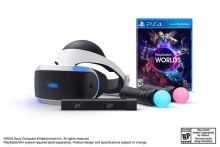 PlayStation VR with camera, Move controllers and VR Worlds, in a 2016 launch-bundle image.

References
- ↑ 1.0 1.1 1.2 1.3 1.4 1.5 1.6 1.7 "Backward compatibility: PS4 games playable on PS5 consoles". PlayStation Support. https://www.playstation.com/en-us/support/games/ps5-backward-compatibility-games/. Retrieved 2026-10-13.
- ↑ 2.0 2.1 2.2 2.3 Shawn Layden (2016-10-13). "PlayStation VR Launches Today Across the United States and Canada". PlayStation.Blog. https://blog.playstation.com/2016/10/13/playstation-vr-launches-today-across-the-united-states-and-canada/. Retrieved 2026-10-13.
- ↑ 3.0 3.1 3.2 Sony Computer Entertainment Inc. (2014-03-18). "Sony Computer Entertainment Announces "Project Morpheus" - A Virtual Reality System That Expands The World Of Playstation®4 (PS4™)". Sony News Releases. https://sony.mediaroom.com/2014-03-18-Sony-Computer-Entertainment-Announces-Project-Morpheus-A-Virtual-Reality-System-That-Expands-The-World-Of-Playstation-4-PS4. Retrieved 2026-10-13.
- ↑ 4.0 4.1 4.2 4.3 John Koller (2016-03-18). "PlayStation VR Launch Bundle Pre-Orders Start Tuesday". PlayStation.Blog. https://blog.playstation.com/2016/03/18/playstation-vr-launch-bundle-pre-orders-start-tuesday/. Retrieved 2026-10-13.
- ↑ 5.00 5.01 5.02 5.03 5.04 5.05 5.06 5.07 5.08 5.09 5.10 5.11 5.12 5.13 5.14 5.15 5.16 5.17 5.18 5.19 5.20 5.21 5.22 5.23 5.24 5.25 5.26 5.27 5.28 Sid Shuman (2017-10-02). "PlayStation VR: The Ultimate FAQ". PlayStation.Blog. https://blog.playstation.com/2017/10/02/playstation-vr-the-ultimate-faq/. Retrieved 2026-10-13.
- ↑ 6.0 6.1 6.2 6.3 6.4 6.5 6.6 6.7 6.8 "How to get the most from PS VR". PlayStation Support. https://www.playstation.com/en-ca/support/hardware/ps-vr-improve-set-up/. Retrieved 2026-10-13.
- ↑ 7.0 7.1 7.2 7.3 Sid Shuman (2023-02-06). "PlayStation VR2: The ultimate FAQ". PlayStation.Blog. https://blog.playstation.com/2023/02/06/playstation-vr2-the-ultimate-faq/. Retrieved 2026-10-13.
- ↑ 8.00 8.01 8.02 8.03 8.04 8.05 8.06 8.07 8.08 8.09 8.10 8.11 8.12 8.13 8.14 Sony Computer Entertainment Inc. (2016-03-15). "PlayStation®VR Launches October 2016 Available Globally At 44,980 Yen, $399 USD, €399 And £349". Sony News Releases. https://sony.mediaroom.com/2016-03-15-PlayStation-VR-Launches-October-2016-Available-Globally-At-44-980-Yen-399-USD-399-And-349. Retrieved 2026-10-13.
- ↑ 9.0 9.1 9.2 9.3 9.4 "PlayStation VR". PlayStation 4 User's Guide. https://manuals.playstation.net/document/en/ps4/settings/psvr.html. Retrieved 2026-10-13.
- ↑ 10.00 10.01 10.02 10.03 10.04 10.05 10.06 10.07 10.08 10.09 10.10 10.11 10.12 10.13 10.14 10.15 10.16 Sony Computer Entertainment. "PlayStation VR CUH-ZVR1 Instruction Manual" (PDF). PlayStation. pp. 2, 8, 10-15. https://www.playstation.com/content/dam/global_pdc/en/corporate/support/manuals/psvr-docs/cuh-zvr1/EN_MEA_PSVR_CUH-ZVR1_Instruction_Manual_Web.pdf. Retrieved 2026-10-13.
- ↑ 11.0 11.1 11.2 11.3 11.4 11.5 11.6 11.7 "Tech Specs (US)". PlayStation. https://www.playstation.com/en-us/ps-vr/tech-specs/. Retrieved 2026-10-13.
- ↑ 12.0 12.1 "Important notices regarding PlayStation® products and services". PlayStation Support. PlayStation Camera adaptor. https://www.playstation.com/en-us/support/important-notice/. Retrieved 2026-10-13.
- ↑ Shu Yoshida (2015-03-03). "GDC 2015 – Project Morpheus Update". PlayStation.Blog. https://blog.playstation.com/archive/2015/03/03/gdc-2015-project-morpheus-update/feed/. Retrieved 2026-10-13.
- ↑ Fred Dutton (2015-09-15). "PlayStation VR is the official name for the PS4 virtual reality system". PlayStation.Blog. https://blog.playstation.com/archive/2015/09/15/playstation-vr-is-the-official-name-for-the-ps4-virtual-reality-system/. Retrieved 2026-10-13.
- ↑ Shawn Layden (2016-06-13). "PlayStation E3 2016 Recap". PlayStation.Blog. https://blog.playstation.com/2016/06/13/playstation-e3-2016-press-conference-recap/. Retrieved 2026-10-13.
- ↑ 16.0 16.1 Sid Shuman (2016-10-05). "PlayStation VR: Launch Lineup and Beyond". PlayStation.Blog. https://blog.playstation.com/2016/10/05/playstation-vr-launch-lineup-and-beyond/. Retrieved 2026-10-13.
- ↑ 17.0 17.1 17.2 Pekka Laiho and Tommi Nikula (2020-01-20). "Comparing VR headsets’ tracking performance". OptoFidelity. https://www.optofidelity.com/insights/blogs/comparing-vr-headsets-tracking-performance. Retrieved 2026-10-13.
- ↑ 18.0 18.1 18.2 18.3 18.4 18.5 18.6 18.7 "PS VR: Quick start guide". PlayStation Support. https://www.playstation.com/en-us/support/hardware/psvr-quick-start-guide/. Retrieved 2026-10-13.
- ↑ "PlayStation VR CUH-ZVR2 Quick Start Guide" (PDF). PlayStation. pp. 3-5. https://manuals.playstation.net/document/pdf/CUH-ZVR2U_1.pdf. Retrieved 2026-10-13.
- ↑ Isabelle Tomatis (2021-10-13). "Celebrating five years of PlayStation VR". PlayStation.Blog. https://blog.playstation.com/2021/10/13/celebrating-five-years-of-playstation-vr/. Retrieved 2026-10-13.
- ↑ Brett Elston (2021-02-05). "PlayStation Store: January 2021’s top downloads". PlayStation.Blog. https://blog.playstation.com/2021/02/05/playstation-store-january-2021s-top-downloads/. Retrieved 2026-10-13.
- ↑ Sean Murray (2019-08-02). "No Man’s Sky: Beyond Out August 14, Adds PS VR Support". PlayStation.Blog. https://blog.playstation.com/2019/08/02/no-mans-sky-beyond-out-august-14-adds-ps-vr-support/. Retrieved 2026-10-13.
- ↑ Sean Murray (2019-08-14). "No Man’s Sky Beyond Release". No Man's Sky. https://www.nomanssky.com/2019/08/no-mans-sky-beyond-release/. Retrieved 2026-10-13.
- ↑ 24.0 24.1 24.2 M. P. Jacob Habgood; David Wilson; David Moore; Sergio Alapont (2017). "HCI Lessons From PlayStation VR". CHI PLAY '17 Extended Abstracts: 125-135. doi:10.1145/3130859.3131437. Retrieved 2026-10-13.
- ↑ "PlayStation Camera Adaptor CFI-ZAA1 Instruction Manual" (PDF). PlayStation. 2020. pp. 2-3. https://www.playstation.com/content/dam/global_pdc/en/corporate/support/manuals/accessories/ps5-accessories/playstation-camera-adaptor-cfi-zaa1/EN_PSCameraAdaptor_CFI-ZAA1_Instruction_Man_Web.pdf. Retrieved 2026-10-13.
- ↑ 26.0 26.1 "Expanded Company Timeline". Sony Interactive Entertainment. https://sonyinteractive.com/en/our-company/expanded-company-timeline/. Retrieved 2026-10-13.