

Daydream
More actions
| Daydream | |
|---|---|

| |
| Information | |
| Type | Virtual Reality |
| Subtype | Mobile VR |
| Creator | |
| Developer | |
| Operating System | Android (historical platform using Nougat VR mode) |
| Devices | Google Daydream View, Lenovo Mirage Solo |
| Accessories | Daydream Controller |
| Release Date | November 10, 2016 (first Daydream View) |
| Price | US$79 (Daydream View, 2016 launch) |
| Website | Archived Google VR documentation |
Daydream (also Google Daydream) was a mobile virtual reality platform developed by Google. It combined software, certified "Daydream-ready" smartphones, head-mounted viewers, and a motion controller into a single system. Google announced it on May 18, 2016 at Google I/O 2016; its head of VR, Clay Bavor, presented the platform during the opening keynote. Daydream used the VR mode introduced in Android Nougat, while Google Cardboard remained a separate smartphone VR option.[1][2][3]
The Daydream View viewer used a compatible phone for its display and processing. The later Lenovo Mirage Solo ran Daydream on built-in hardware and added positional head tracking. Google stopped selling Daydream View in October 2019; its service notice says Daydream software receives no further software or security updates and may not work properly on some Android 11 or later devices. The archived developer site also records that new users could no longer download and install Google VR Services on previously supported devices from November 2023.[4][5][6]
Platform and software
Daydream combined Android's VR facilities with Google VR Services, the Daydream app and applications built for the platform. Android 7.0's Compatibility Definition distinguished VR mode from the higher-performance VR hardware feature. The latter required sustained performance mode, OpenGL ES 3.2, Vulkan Hardware Level 0 and a display of at least 1080p updating at 60 Hz in VR mode. These were requirements for devices declaring that Android feature, rather than a specification for every Android phone or a measurement of every Daydream app.[7]
In the I/O 2016 keynote, Bavor said Google had reduced latency to under 20 milliseconds through Android N optimizations such as single-buffer rendering. This was Google's launch claim, rather than an independent latency measurement for every phone or application.[8]
The Daydream Home environment was the launcher and app-discovery space. Google announced versions of YouTube VR, Google Street View, Google Play Movies & TV and Google Photos for Daydream. Developers could begin building with the Google VR SDK in May 2016, including a C++ NDK and a Nexus 6P development configuration. January 2017 reporting described the opening of app publishing to all Android developers, rather than the beginning of all third-party development. Google's distribution documentation required developers to opt in and pass review for discovery in Daydream; that review was separate from an app's availability in the ordinary 2D Google Play store.[2][9][10]
Google previewed Daydream 2.0, called Euphrates, in May 2017 with capture and casting features. Its support instructions document casting the VR view to a television through a Cast device on the same Wi-Fi network, and sharing screenshots or screen recordings. These are documented historical functions; the instructions do not establish that discontinued services work on a particular current phone.[11][12]
Daydream used asynchronous reprojection to adjust an already rendered frame for recent head rotation. Google's documentation says it was automatically enabled for Daydream and Daydream Standalone apps. It did not correct translational head movement in 6DoF applications, so rendering a scene at a low frame rate could still produce positional errors. A high display update rate therefore did not establish an equally high application rendering rate.[13]
App requirements
Google published separate design, functionality, performance and publishing criteria for Daydream discovery. The archived rules included the following requirements and recommendations.[9]
| Area | Historical requirement or recommendation |
|---|---|
| Rendering performance | The 2018 qualifying examples targeted at least 60 fps for 3DoF on the 2016 Pixel XL, or 75 fps for 6DoF on Mirage Solo, without relying on reprojection, with two-sigma confidence over a 30-minute session. Apps also had to avoid thermal warnings during 30 minutes of use.[14] |
| Loading | Provide feedback in VR if loading takes more than three seconds; a static, untracked splash screen was prohibited.[14] |
| 2D transitions | Do not switch unexpectedly to a monoscopic interface. Permitted exceptional transitions, such as a permission or web login flow, required prompting the user to remove the phone and restoring the VR state afterward.[15] |
| Orientation | Run VR activities in landscape orientation and disallow orientation changes.[16] |
| System interface | Hide Android's status and navigation bars while in VR.[16] |
| Readability | Place content at a distance and size that users can focus on and read. Google recommended starting beyond 0.5 m with text occupying at least 1.5 degrees of visual angle.[15] |
| Head tracking | Maintain head tracking and world-relative virtual objects, including during transitions.[15][16] |
| Horizon and movement | Keep the horizon stable and make camera movement user-initiated. The design rules allowed a reviewed artistic exception with an Intense Motion rating.[15] |
| Controller | The design rules required full playability with the standard controller, consistent system buttons, handedness and touchpad scrolling. Later SDK release v1.170.0 added a manifest option allowing an app to launch without a connected controller.[15][17] |
| Listing and assets | Match the store description, supply a VR icon and provide a stereo 360-degree photosphere for the Play VR details environment.[18] |
Hardware
Daydream View
The first Daydream View is a slide-on viewer into which a user drops a Daydream-ready phone, which acts as the display and processor; the headset's lenses split the phone screen into a stereoscopic image. Google announced it on October 4, 2016 alongside the Pixel phones. Its November 1 announcement scheduled sales for November 10, 2016 at US$79 in the United States, C$99 in Canada, £69 in the United Kingdom, €69 in Germany and A$119 in Australia. These were launch prices for the viewer and controller, with the phone separate.[19][20]
Unlike Cardboard's broader phone-viewer approach, the Daydream system required certified phones. The View was made from soft, breathable fabric and designed to fit over eyeglasses. Google described it as 30% lighter than similar devices without identifying a comparison model in the announcement. Slate was the initial color; Crimson and Snow became available online in the United States, United Kingdom and Australia on December 8, 2016.[19][21]
Google announced a second-generation View on October 4, 2017 in Charcoal, Fog and Coral, with new lenses and a wider field of view. An October 19 report documented that the Google Store was taking US$99 orders; it distinguished that ordering date from expected shipment by October 22 for Charcoal and Coral and a two-to-three-week delay for Fog. The headset added a removable top strap and moved controller storage to a loop at the back of the headstrap. A contemporary hands-on comparison also documented a metal heat sink in the front cover.[22][23][24][25]
| Feature | Daydream View (2016) | Daydream View (2017) |
|---|---|---|
| Display and processing | Provided by a Daydream-ready phone | Provided by a Daydream-ready phone[4] |
| Head and standard controller tracking | 3DoF rotation | 3DoF rotation[26] |
| Controller storage | Tray inside the viewer | Loop on the rear headstrap[24] |
| Support strap | Rear headstrap | Rear headstrap plus removable top strap[24][25] |
| Launch colors | Slate; Crimson and Snow followed | Charcoal, Fog and Coral[19][21][22] |
| United States launch price | US$79 | US$99[20][23] |
Both View generations used the phone's screen, so the viewer itself did not have a fixed panel resolution or an independent application processor. Google documented NFC-based viewer detection and automatic screen alignment. Its tracking documentation classifies View as a 3DoF headset with a 3DoF controller: it tracked rotation, rather than the wearer's physical translation around a room.[4][24][26]
Daydream Controller
The Daydream Controller is a small handheld remote with a clickable touchpad, a Daydream button, an app button, volume controls, and a status light. It tracks orientation only, giving three degrees of freedom (3DoF), so it can sense the way it is pointed and tilted but not its position in space. It recharges over USB-C. Google's hardware diagrams distinguish the first View's internal storage tray from the 2017 viewer's rear storage loop.[27][24][26]
The touchpad supported touching, swiping and clicking. Apps could assign the app button, while the Daydream and volume buttons were reserved for system functions. Pressing the Daydream button opened the Dashboard; holding it recentered the view and controller. The developer design rules used an arm model for general pointing and required the cursor to appear at the same depth as, or closer than, its target. A displayed virtual hand or arm position derived from such a model did not make the remote a position-tracked 6DoF controller.[27][15][26]
Daydream-ready phones
Daydream-ready phones were Android handsets certified by Google with the display, sensors and processing needed by the platform. Google's launch announcement identified the Google Pixel and Google Pixel XL as the first Daydream-ready phones. Its retained support list names the following models; the list is historical and does not override later operating-system or service restrictions.[4][19][28]
| Manufacturer | Models in Google's retained support list |
|---|---|
| Pixel, Pixel XL, Pixel 2, Pixel 2 XL, Pixel 3 and Pixel 3 XL | |
| Samsung | Samsung Galaxy S8, Galaxy S8+, Galaxy Note 8, Galaxy S9 and Galaxy S9+ |
| Huawei | Mate 9 Pro and Porsche Design Mate 9 |
| ZTE | Axon 7 |
| LG | V30 and V35 |
| Asus | ZenFone AR |
That retained list does not include every earlier announcement. Google's December 2016 update separately confirmed that the Motorola Moto Z and Moto Z Force had joined the Daydream-ready family in the preceding month. Hardware certification did not guarantee that Daydream remained available after a phone's software updates or the end of platform support.[21][6]
Google said eight manufacturers had committed to building Daydream-ready phones: Samsung, HTC, LG, Xiaomi, Huawei, ZTE, Asus, and Alcatel. The I/O 2016 statement described planned hardware support, rather than a list of released phones.[8]
Lenovo Mirage Solo
The Lenovo Mirage Solo was the first standalone Daydream headset, meaning it ran the platform on built-in hardware with no phone required. Lenovo announced it at CES on January 9, 2018; Google confirmed retail availability on May 4, 2018, and a contemporary review reported a US$399 selling price. Its manufacturer datasheet specifies a Qualcomm Snapdragon 835 processor, 4 GB of RAM, 64 GB of storage, a 2560 x 1440 LCD panel at 75 Hz and a 4,000 mAh battery rated for 2.5 hours of general use. Lenovo qualified battery life as dependent on settings and use. It shipped with the standard 3DoF Daydream Controller.[29][5][30][31]
The Mirage Solo used Google WorldSense, Google's inside-out positional tracking system, with two tracking cameras. WorldSense drew on Google's Project Tango technology and gave the headset 6DoF tracking, allowing physical leaning and stepping as well as looking around. This did not change the bundled controller's 3DoF tracking. Google's experimental 6DoF controller kit was a separate configuration for Mirage Solo: it required a USB-connected tracking faceplate, used optical controller tracking and added trigger and grip buttons. The archived kit page says applications for developer kits were closed.[31][11][26][32]
Research uses
A CHI 2020 extended-abstract paper by Pascal Knierim and colleagues investigated portable text entry using a modified second-generation Daydream View, a Pixel 2 XL and an Apple Magic Keyboard. The researchers cut an opening in the viewer's heat sink for the phone camera and used Vuforia 7.5 with a printed keyboard marker to track the head and keyboard and display a cropped live view of the hands. This was a custom mixed-reality apparatus, rather than a retail Daydream passthrough or positional-tracking feature.[33]
The within-participant study involved 24 adults aged 19-38 and compared the modified headset setup with a phone soft keyboard and a physical keyboard used with the phone's display. In counterbalanced typing and copy-editing tasks, the headset condition produced faster typing than the soft keyboard but slower typing than the physical keyboard with the phone display. Copy editing took longer in the headset than in either comparison condition. The authors discussed restricted cursor navigation and field of view; the experiment did not establish equivalent performance for ordinary Daydream applications or long-term office work.[33]
Reception and decline
Contemporary reviews treated the 2017 View as an improvement to the earlier viewer's fit and optics. Sherri L. Smith's review described comfortable use with the added top strap but also noted the smaller software selection compared with Samsung's Gear VR. Kevin Carbotte's comparison found that the revised front cover helped with phone heat during his tests. These were observations with the reviewers' phones and sessions, rather than guarantees for every compatible phone. The platform also faced competition from standalone headsets such as the Oculus Go and Oculus Quest, which did not require placing a personal phone inside a viewer.[34][25][35]
Content support eroded through 2019. Variety's contemporary account reported that HBO had discontinued its Daydream apps, Hulu had dropped support over the summer and Google had ended Play Movies for Daydream in June. On October 15, 2019 Google confirmed that Pixel 4 would not support Daydream and that it was ending View sales, while saying the app and store would remain available for existing users. In its statement to the publication, Google attributed the decision to lower-than-hoped consumer and developer adoption, declining use and the inconvenience of losing access to a phone's ordinary apps while it was in a headset.[36][37]
The subsequent milestones were separate. Google's Android SDK repository was archived on November 8, 2019. In October 2020 its service notice stated that Daydream VR software was no longer supported, with no further software or security updates, and warned of problems on some devices running Android 11 or later. This was an end of support, rather than a guarantee that every existing app stopped working on the same day.[37][38][6]
In February 2021, 9to5Google documented errors in the Daydream Play Store and in-VR discovery interface. Its February 15 update reported that discovery had been restored; the original report also said apps could still be installed through the phone's ordinary Play Store. The incident therefore was not a documented permanent closure of all Daydream downloads. Google's later developer-site banner records a further restriction from November 2023: new users could no longer download and install Google VR Services on previously supported devices. Google's service notice retains a general statement that compatible viewers and controllers can show VR content, but it does not promise universal Cardboard controller compatibility or the availability of each old service.[39][4][6]
History
| Date | Event |
|---|---|
| May 18, 2016 | Daydream platform announced at Google I/O[1][3] |
| May 19, 2016 | Google documented developer access to the VR SDK and a Nexus 6P development configuration[2] |
| October 4, 2016 | Daydream View (1st generation) announced with Pixel and Pixel XL[19] |
| November 10, 2016 | First View launch date announced for five markets, including the United States at US$79[20] |
| January 25, 2017 | Contemporary reporting described Daydream app publishing opening to all Android developers[10] |
| May 2017 | Standalone Daydream and WorldSense announced; Euphrates previewed[40][11] |
| October 4, 2017 | Second View announced in Charcoal, Fog and Coral[22] |
| October 19, 2017 | Google Store orders for the second View reported at US$99; shipping schedules varied by color[23] |
| January 9, 2018 | Mirage Solo announced at CES[29] |
| May 4, 2018 | Google confirmed Mirage Solo retail availability[5] |
| October 15, 2019 | Daydream View sales ended; Pixel 4 would not support Daydream[36][4] |
| November 8, 2019 | Google VR SDK for Android repository archived[37] |
| October 2020 | Google announced the end of Daydream software support and Android 11 compatibility warning[38][6] |
| February 2021 | In-VR discovery failed; a February 15 report said it had been restored[39] |
| November 2023 | Google VR Services download and installation ended for new users on previously supported devices[4] |
See also
Gallery
-
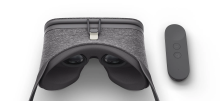 Rear view of the 2016 Google Daydream View viewer with its controller.

References
- ↑ 1.0 1.1 Sundar Pichai (2016-05-18). "I/O: Building the next evolution of Google". Google Blog. https://blog.google/products-and-platforms/products/assistant/io-building-next-evolution-of-google/. Retrieved 2026-10-14.
- ↑ 2.0 2.1 2.2 Nathan Martz (2016-05-19). "VR at Google - Jump, Expeditions, and Daydream". Google Developers Blog. https://developers.googleblog.com/en/vr-at-google-jump-expeditions-and-daydream/. Retrieved 2026-10-14.
- ↑ 3.0 3.1 Jamie Feltham (2016-05-18). "Google's Mobile VR Platform is Daydream And It Comes With A Motion Controller". UploadVR. https://www.uploadvr.com/google-daydream/. Retrieved 2026-10-14.
- ↑ 4.0 4.1 4.2 4.3 4.4 4.5 4.6 "Daydream View". Google for Developers. https://developers.google.com/vr/discover/daydream-view. Retrieved 2026-10-14.
- ↑ 5.0 5.1 5.2 Clay Bavor (2018-05-04). "Introducing the first Daydream standalone VR headset and new ways to capture memories". Google Blog. https://blog.google/products-and-platforms/products/google-ar-vr/new-daydream-headset-and-vr180-camera-now-available/. Retrieved 2026-10-14.
- ↑ 6.0 6.1 6.2 6.3 6.4 "Daydream service update". Google Daydream Help. https://support.google.com/daydream/answer/7185096?hl=en. Retrieved 2026-10-14.
- ↑ "Android 7.0, (N) Compatibility Definition, section 7.9". Android Open Source Project. https://source.android.com/docs/compatibility/7.0/android-7.0-cdd. Retrieved 2026-10-14.
- ↑ 8.0 8.1 "Google I/O 2016 - Keynote 360". Google for Developers (YouTube). 2016-05-18. https://www.youtube.com/watch?v=lFm4s50PnmY. Retrieved 2026-10-14.
- ↑ 9.0 9.1 "Publishing Daydream Apps". Google for Developers. https://developers.google.com/vr/distribute/daydream. Retrieved 2026-10-14.
- ↑ 10.0 10.1 Tim (2017-01-25). "Google Opens Up Daydream App Development to All". Droid Life. https://www.droid-life.com/2017/01/25/google-opens-daydream-development/. Retrieved 2026-10-14.
- ↑ 11.0 11.1 11.2 Clay Bavor (2017-05-18). "More on Daydream and Developer tools for VR and AR". Google Blog. https://blog.google/products-and-platforms/products/google-ar-vr/more-daydream-tango-and-developer-tools-vr-and-ar/. Retrieved 2026-10-14.
- ↑ "Asynchronous Reprojection". Google for Developers. https://developers.google.com/vr/discover/async-reprojection. Retrieved 2026-10-14.
- ↑ 14.0 14.1 "Daydream App Quality Requirements - Performance and Stability". Google for Developers. https://developers.google.com/vr/distribute/daydream/performance-requirements. Retrieved 2026-10-14.
- ↑ 15.0 15.1 15.2 15.3 15.4 15.5 "Daydream App Quality Requirements - Design". Google for Developers. https://developers.google.com/vr/distribute/daydream/design-requirements. Retrieved 2026-10-14.
- ↑ 16.0 16.1 16.2 "Daydream App Quality Requirements - Functionality". Google for Developers. https://developers.google.com/vr/distribute/daydream/functionality-requirements. Retrieved 2026-10-14.
- ↑ "Releases: googlevr/gvr-android-sdk". Google on GitHub. https://github.com/googlevr/gvr-android-sdk/releases. Retrieved 2026-10-14.
- ↑ "Daydream App Quality Requirements - Publishing". Google for Developers. https://developers.google.com/vr/distribute/daydream/publishing-requirements. Retrieved 2026-10-14.
- ↑ 19.0 19.1 19.2 19.3 19.4 Clay Bavor (2016-10-04). "Daydream: Bringing high-quality VR to everyone". Google Blog. https://blog.google/products-and-platforms/products/google-ar-vr/daydream-bringing-high-quality-vr-everyone/. Retrieved 2026-10-14.
- ↑ 20.0 20.1 20.2 Mike Jazayeri (2016-11-01). "Daydream View coming to stores November 10th". Google Blog. https://blog.google/products-and-platforms/products/google-ar-vr/daydream-view-coming-stores-november-10th/. Retrieved 2026-10-14.
- ↑ 21.0 21.1 21.2 Mike Jazayeri (2016-12-08). "More phones, new colors and the latest apps on Daydream". Google Blog. https://blog.google/products-and-platforms/products/google-ar-vr/more-phones-new-colors-and-latest-apps-daydream/. Retrieved 2026-10-14.
- ↑ 22.0 22.1 22.2 Clay Bavor (2017-10-04). "Pixel 2 and Daydream View: new experiences in AR and VR". Google Blog. https://blog.google/products-and-platforms/products/google-ar-vr/pixel-2-and-daydream-view-new-experiences-ar-and-vr/. Retrieved 2026-10-14.
- ↑ 23.0 23.1 23.2 Matt Adams (2017-10-19). "You can now grab the Daydream View VR headset from the Google Store". Android Authority. https://www.androidauthority.com/daydream-view-vr-available-808645/. Retrieved 2026-10-14.
- ↑ 24.0 24.1 24.2 24.3 24.4 "Daydream View hardware". Google Daydream Help. https://support.google.com/daydream/answer/7185269?hl=en. Retrieved 2026-10-14.
- ↑ 25.0 25.1 25.2 Kevin Carbotte (2017-10-17). "Google's Second-Gen Daydream View VR HMD Is A Bigger Improvement Than It First Appears". Tom's Hardware. https://www.tomshardware.com/news/google-daydream-view-vr-headset-refresh,35690.html. Retrieved 2026-10-14.
- ↑ 26.0 26.1 26.2 26.3 26.4 "Degrees of freedom". Google for Developers. https://developers.google.com/vr/discover/degrees-of-freedom. Retrieved 2026-10-14.
- ↑ 27.0 27.1 "Daydream Controller". Google for Developers. https://developers.google.com/vr/discover/controllers. Retrieved 2026-10-14.
- ↑ 28.0 28.1 "Use your phone with Daydream". Google Daydream Help. https://support.google.com/daydream/answer/9232592?hl=en. Retrieved 2026-10-14.
- ↑ 29.0 29.1 "From Pocket to PC to Home: Lenovo's CES 2018 Lineup Makes Reality Better". Lenovo StoryHub. 2018-01-09. https://news.lenovo.com/pressroom/press-releases/from-pocket-to-pc-to-home-lenovos-ces-2018-lineup-makes-reality-better/. Retrieved 2026-10-14.
- ↑ Lucas Matney (2018-05-04). "Review: Lenovo Mirage Solo headset with Google WorldSense tracking". TechCrunch. https://techcrunch.com/2018/05/04/review-lenovo-mirage-solo-headset-with-google-worldsense-tracking/. Retrieved 2026-10-14.
- ↑ 31.0 31.1 "Lenovo Mirage Solo with Daydream: specifications". Lenovo (manufacturer datasheet hosted by Best Buy). 2018. https://files.bbystatic.com/L1a7ZsXy66ahUVNSGNHnpA%3D%3D/0f336a49-41b5-4cdd-9d78-891b7c52d129.pdf. Retrieved 2026-10-14.
- ↑ "Experimental Daydream 6DoF controllers". Google for Developers. https://developers.google.com/vr/experimental/6dof-controllers. Retrieved 2026-10-14.
- ↑ 33.0 33.1 Pascal Knierim; Thomas Kosch; Johannes Groschopp; Albrecht Schmidt (2020-04-25). "Opportunities and Challenges of Text Input in Portable Virtual Reality". Extended Abstracts of the 2020 CHI Conference on Human Factors in Computing Systems: 1-8. Association for Computing Machinery. doi:10.1145/3334480.3382920. Retrieved 2026-10-14.
- ↑ Sherri L. Smith (2017-12-08). "Google Daydream View (2017) Review: Small Changes Make a Big Impact". Tom's Guide. https://www.tomsguide.com/us/google-daydream-view,review-4960.html. Retrieved 2026-10-14.
- ↑ Ben Lang (2019-10-15). "Google Discontinues Daydream View Headset, the Final Nail in the Coffin for its Android VR Ambitions". Road to VR. https://www.roadtovr.com/google-puts-final-nail-daydream-coffin-discontinues-view-headset/. Retrieved 2026-10-14.
- ↑ 36.0 36.1 Janko Roettgers (2019-10-15). "Google Ships Pixel 4 Without Daydream VR Support, Stops Selling Daydream Viewer". Variety. https://variety.com/2019/digital/news/pixel-4-google-daydream-vr-1203371182/. Retrieved 2026-10-14.
- ↑ 37.0 37.1 37.2 "googlevr/gvr-android-sdk". Google on GitHub. https://github.com/googlevr/gvr-android-sdk. Retrieved 2026-10-14.
- ↑ 38.0 38.1 Abner Li (2020-10-02). "Google officially drops support for Daydream VR with Android 11". 9to5Google. https://9to5google.com/2020/10/02/google-daydream-vr/. Retrieved 2026-10-14.
- ↑ 39.0 39.1 Abner Li (2021-02-15). "[Update: Restored] Daydream Play Store, VR app discovery shuts down". 9to5Google. https://9to5google.com/2021/02/15/google-daydream-play-store/. Retrieved 2026-10-14.
- ↑ Clay Bavor (2017-05-17). "The latest on VR and AR at Google I/O". Google Blog. https://blog.google/products-and-platforms/products/google-ar-vr/latest-vr-and-ar-google-io/. Retrieved 2026-10-14.