

Google Daydream View
More actions
| Google Daydream View | |
|---|---|

| |
| Basic Info | |
| VR/AR | Virtual Reality |
| Type | Head-mounted display |
| Subtype | Mobile VR |
| Platform | Daydream |
| Creator | |
| Developer | |
| Manufacturer | |
| Announcement Date | 4 October 2016 (first generation); 4 October 2017 (second generation) |
| Release Date | 10 November 2016 (first generation); 19 October 2017 (second generation, United States) |
| Price | US$79 (first generation, launch); US$99 (second generation, launch) |
| Website | https://vr.google.com/daydream/ (archived) |
| Versions | First generation (2016); second generation (2017) |
| Requires | Daydream-ready smartphone |
| Predecessor | Google Cardboard |
| System | |
| Operating System | Android (runs on the inserted phone) |
| Display | |
| Display | Provided by the inserted phone |
| Refresh Rate | At least 60 Hz in VR mode (Android requirement for Daydream-ready phones) |
| Image | |
| Field of View | 90 degrees (Google figure for the first generation, may vary by phone); wider on the second generation |
| Optics | |
| Optics | Two lenses (first generation); hybrid Fresnel lenses (second generation) |
| Ocularity | Binocular |
| Adjustable Diopter | No (fits over most eyeglasses) |
| Passthrough | No |
| Tracking | |
| Tracking | 3DoF rotational tracking by the phone's sensors; 3DoF controller |
| Eye Tracking | No |
| Hand Tracking | No |
| Audio | |
| Audio | Phone speaker or headphones connected to the phone |
| Connectivity | |
| Connectivity | NFC tag for automatic phone detection; controller over Bluetooth Low Energy |
| Power | None (the headset has no battery) |
| Battery Capacity | Controller: 220 mAh (2017 specification) |
| Battery Life | Controller: up to 12 hours (Google figure) |
| Device | |
| Dimensions | 166.8 x 106.2 x 98.6 mm (first generation); 167.8 x 117.1 x 100.2 mm (second generation) |
| Weight | 220 g (first generation); 261 g (second generation), without phone |
| Material | Fabric over a plastic frame, removable foam facepad |
| Color | Slate, Snow, Crimson (2016); Charcoal, Fog, Coral (2017) |
| Sensors | NFC tag and capacitive alignment pads in the headset; 9-axis IMU in the controller |
| Input | Daydream Controller (3DoF): clickable touchpad, app button, home button, volume buttons |
The Google Daydream View (sold as Daydream View) is a discontinued mobile virtual reality head-mounted display made by Google for its Daydream platform. The user drops a Daydream-ready Android phone into the fabric-covered headset; the phone supplies the display, the processing and the head tracking, while a small wireless Daydream Controller tracks hand orientation in three degrees of freedom.[1][2] Google designed the headset itself and called it the first Daydream-ready headset and controller.[3]
Google announced the first-generation Daydream View on 4 October 2016 alongside its Pixel phones and released it on 10 November 2016 for US$79 in five countries.[3][4] A second-generation model with new lenses, a top strap and a heat sink in the front cover followed on 19 October 2017 at US$99.[5][6] Google stopped selling the headset on 15 October 2019, saying that "there hasn't been the broad consumer or developer adoption we had hoped", and it ended Daydream software support with Android 11 in 2020.[7][8]
Announcement and release
Background
Google introduced the Daydream platform at the opening keynote of Google I/O on 18 May 2016, where its head of VR, Clay Bavor, presented it as a VR mode for the next version of Android. UploadVR described it as a large extension of the groundwork laid by Google Cardboard.[9] Google showed a reference design for a Daydream headset, which it said was not a finished product, and a small two-button controller with orientation sensors. Bavor said the platform would have latency "under 20 milliseconds", and Google said Daydream would launch that autumn.[10]
First generation (2016)
Google unveiled Daydream View at its Pixel event on 4 October 2016. In a post on Google's blog the same day, Bavor said the headset was "designed and developed by Google", was made of soft, breathable fabric, was "30% lighter than similar devices" and was designed to fit over eyeglasses. The post also said the headset would fit any Daydream-ready phone, big or small, and that the Pixel and Pixel XL were the first such phones. United States pre-orders opened on 20 October at Verizon and the Google Store. Slate was available at launch in every country, with Snow and Crimson following later in the United States, United Kingdom and Australia.[3]
On announcement day the Google Store said that customers who pre-ordered a Pixel phone would get a promotional code for a free Daydream View, Hypergrid Business reported.[11] 9to5Google reported in mid-November 2016 that the codes, announced for United States customers, were being emailed to people who had pre-ordered a Pixel or Pixel XL.[12]
On 1 November 2016 Google confirmed a 10 November release on the Google Store and at retailers in five countries.[13] The headset went on sale that day; in Australia, Telstra followed on 22 November.[4]
| Country | Price | Retailers besides the Google Store |
|---|---|---|
| United States | US$79 | Verizon, Best Buy |
| Canada | CA$99 | Bell, Rogers, Telus, Best Buy |
| United Kingdom | 69 pounds | EE, Carphone Warehouse |
| Germany | 69 euros | Deutsche Telekom |
| Australia | A$119 | JB Hi-Fi, Telstra (from 22 November) |
Source: Google's launch announcements.[13][4]
Second generation (2017)
Google announced a revised Daydream View on 4 October 2017, at the event where it introduced the Pixel 2. It was available for pre-order at US$99, with release on 19 October, in Charcoal, Fog and Coral.[5] In Canada, pre-orders opened at CA$139 for delivery by 19 October.[14] The new model kept the name Daydream View; Android Central noted that it looked, felt and worked much like the original, so owners did not need a new phone to use it.[15]
Design and hardware
Headset
The headset hides a simple plastic frame holding two lenses inside a fabric shell. Road to VR noted that, unlike the Samsung Gear VR with its on-board IMU, touchpad, fan and micro-USB port, the View contains almost nothing besides plastic and lenses apart from an NFC tag in the front cover. It has no battery and does not plug into the phone.[1] When a Daydream-ready phone is placed in the headset, the NFC sensor lets the phone detect it automatically.[2] Google's launch post described this as an auto-alignment system that needs no cables or connectors.[3]
To accept phones of different sizes, the front cover is largely open. A spring-loaded hinge at the bottom and an elastic hook at the top press the phone against high-friction pads, and the open top and sides leave room for phones of different heights and widths. Two black capacitive pads touch the phone's screen; the phone uses them to line up the image with the lenses, so the phone does not have to be placed exactly.[1] Google's product page said the fabric design was "inspired by what you wear" and that the facepad was removable for hand washing.[16]
The first model has a single elastic strap around the back of the head, adjusted by two sliding plastic loops instead of Velcro, and no top strap.[1] The controller was stored inside the front flap when not in use.[3][17] Google listed the headset at 220 g and 166.8 x 106.2 x 98.6 mm, made of "lightweight stretch fabric".[18] The outer cover is solid, with no opening for the phone's camera.[11] Audio comes from the phone's own speaker or from headphones connected to the phone.[17]
Display and optics
The View has no screen of its own. The phone's display is split into a stereoscopic image by the lenses.[1] Google gave the first model's field of view as 90 degrees and said it may vary by phone; Road to VR's Ben Lang estimated it at 80 to 85 degrees in use, slightly less than the first two Gear VR models.[1] Tom's Guide reported that Google would only say the field of view was more than 90 degrees.[17]
With a Pixel phone, Road to VR reported a 60 Hz refresh rate in VR mode, latency under the 20 ms threshold and a screen door effect less pronounced than on the Oculus Rift or HTC Vive. It also noted that low persistence seemed less effective than on other headsets, and that the OLED panel showed black smear, where dark areas smear across lighter ones during head movement.[1]
Daydream controller
Each headset ships with the Daydream controller, which provides 3DoF input; Google requires every Daydream app to work with it.[2] It has a clickable touchpad, an app button, a home button and volume buttons, plus a status light and a USB-C charging port.[19] Holding the home button recenters the headset and controller.[17] The controller measures 105 x 35 x 17 mm, weighs 40 g, uses 9-axis IMUs for tracking and connects over Bluetooth Low Energy.[18] Google rated it at up to 12 hours of use per charge.[18] The 2017 specification sheet lists a 220 mAh battery and notes that a USB-C charger and cable come with Pixel phones but not with Daydream View.[19] Tom's Guide reported that Google quoted about two hours to recharge it.[17]
The controller tracks rotation only. Road to VR wrote that point-and-click selection was simpler than the Gear VR's side-mounted touchpad, but that a remote-style pointer forces the wrist into an awkward angle over long sessions.[1]
Second-generation changes
The 2017 model kept the fabric design but used a smoother material with more texture. It added a removable top strap, moved controller storage to the rear strap, and placed a magnesium heat sink in the front cover to move heat away from the phone. Google designed new lenses for a wider field of view, and a new injection-molding technique made the face mask contour better to the face.[6] Google's store page called the field of view "our widest yet".[19]
Android Central's Russell Holly described the new optics as hybrid Fresnel lenses replacing the small lenses of the first model. The wider lenses made it easier to find a clear viewing position, but text at the edges of the view looked blurry or showed slight chromatic aberration. He found that the reshaped face mask let in far less light from behind the wearer.[15] Tom's Guide reported that Google widened the field of view from 90 to 100 degrees.[20]
Specifications
| Specification | First generation (2016) | Second generation (2017) |
|---|---|---|
| Launch price (United States) | US$79[3] | US$99[5] |
| Headset dimensions | 166.8 x 106.2 x 98.6 mm[18] | 167.8 x 117.1 x 100.2 mm[19] |
| Headset weight (without phone) | 220 g[18] | 261 g[19] |
| Material | Lightweight stretch fabric[18] | Lightweight fabric[19] |
| Colors | Slate, Snow, Crimson[3] | Charcoal, Fog, Coral[5] |
| Lenses | Two lenses, 90-degree field of view (Google figure)[1] | Hybrid Fresnel lenses[15], "our widest yet" (Google)[19] |
| Top strap | None[1] | Removable[6] |
| Controller storage | Inside the front flap[3] | On the rear strap[6] |
| Heat sink | None | Magnesium heat sink in the front cover (new in 2017)[6] |
| Controller | 105 x 35 x 17 mm, 40 g, 9-axis IMU, Bluetooth LE, up to 12 hours[18] | 105 x 35 x 17 mm, 40 g, 9-axis IMU, Bluetooth LE, 220 mAh[19] |
| In the box | Headset, controller, wrist strap, quick start guide[18] | Headset, controller, removable top strap, quick start guide[19] |
Daydream-ready phones
The headset works only with phones that Google has certified for Daydream. Google described these as phones with high-resolution, low-persistence displays, processors that can run VR at 60 frames per second and high-fidelity sensors for head tracking.[2] In November 2016, Road to VR reported that the Android 7.0 Compatibility Definition Document had added a section setting out what a Daydream-ready phone must meet.[21] That section ("Virtual Reality High Performance") includes the following requirements:[22]
| Area | Requirement (Android 7.0 CDD, section 7.9.2) |
|---|---|
| Processor | At least 2 physical cores; must support sustained performance mode |
| Graphics | Must support OpenGL ES 3.2 and Vulkan Hardware Level 0; should support Vulkan Hardware Level 1 |
| Video decoding | H.264 at 3840x2160 at 30 fps (40 Mbps) at minimum; HEVC and VP9 at 1920x1080 at 30 fps (10 Mbps) at minimum, and should handle 3840x2160 at 30 fps (20 Mbps) |
| Sensors | Must meet the gyroscope, accelerometer and magnetometer requirements for high-fidelity sensors; must report accurate skin temperature |
| Display resolution | At least 1080p; 1440p or higher strongly recommended |
| Display size | Between 4.7 and 6 inches diagonal |
| Refresh rate | At least 60 Hz in VR mode |
| Pixel switching | Gray-to-gray, white-to-black and black-to-white switching time of 3 ms or less |
| Persistence | A low-persistence mode with 5 ms persistence or less |
| Bluetooth | Bluetooth 4.2 with LE Data Length Extension |
Google's own list of Daydream-ready phones, as archived in early October 2019, contained the following models.[23] The Pixel 4 was never supported.[7]
| Maker | Daydream-ready models |
|---|---|
| Pixel, Pixel 2 and Pixel 2 XL, Pixel 3 and Pixel 3 XL | |
| Samsung | Galaxy S8 and S8+, Galaxy Note8, Galaxy S9 and S9+ |
| Motorola | Moto Z, Moto Z Force, Moto Z2 Force |
| Huawei | Mate 9 Pro, Porsche Design Mate 9 |
| ZTE | Axon 7 |
| ASUS | ZenFone AR |
| LG | V30 |
Software and features
The headset runs the Daydream software on the phone. Road to VR described the setup with a Pixel XL: the pre-installed Daydream app installed updates, paired the controller and updated its firmware; after that, placing the phone in the headset and closing the latch launched Daydream.[24] First-time users go through a calibration tutorial for the headset and controller, which Tom's Guide timed at four to five minutes.[17]
The home space, Daydream Home, is the hub from which VR apps are downloaded.[9] Road to VR described it as an app launcher set in a cartoon forest with a distant waterfall.[24] Apps are bought and installed from a VR version of the Google Play Store, which surrounds the user with a 3D photosphere of the app being browsed.[25]
At launch Google offered its own YouTube VR, Google Street View, Google Play Movies, Google Photos and a preview of Google Arts & Culture VR. Launch partners and titles named by Google included Hulu, HBO, Netflix, The New York Times, The Wall Street Journal, a Fantastic Beasts experience from Warner Bros., MLB, NBA, Wonderglade, Gunjack 2: End of Shift, Mekorama, Need for Speed: No Limits VR, Danger Goat, Hunters Gate, Star Chart VR, Home Run Derby and Keep Talking and Nobody Explodes.[3][13][4] For the second-generation launch, Google said 250 high-quality VR titles would be available, against 25 apps when the original launched. It also announced casting of the VR view to a TV and free IMAX short films for Pixel 2 owners through Google Play Movies.[14][5]
Reception
First generation
Road to VR's Ben Lang called the View "cleverly designed to be inexpensive without feeling cheap" and judged that it matched the Gear VR in many ways, including visual sharpness. His main criticisms were light leaking in from the phone side of the lenses, glare and a halo around the lenses in high-contrast scenes, a slightly narrower field of view than the Gear VR, and comfort: without a top strap, a large phone such as the Pixel XL concentrated weight around the eyes.[24][1]
UploadVR's Ian Hamilton found the fit "finicky". Light was visible through the bottom of the headset, a ring around the lenses caught the light, the phone got "very hot" in VR, and the controller had to be reoriented from time to time. He suggested waiting until more apps were available.[26]
Tom's Guide's Sherri L. Smith rated it 4 out of 5. She praised the fabric design and comfort over glasses, and noted it was lighter and smaller than the Gear VR (7.8 ounces against 12.2 ounces). She saw more motion blur and slightly rougher graphics than on the Gear VR, and reported that after about 15 minutes the Pixel XL's rear panel measured "about 110" (the review does not state the unit).[17] Chris Martin of Tech Advisor praised the NFC setup and found the headset worked with glasses, but noted light getting in at the sides because the headset is wide.[27]
Second generation
Tom's Guide rated the 2017 model 4.5 out of 5 and called it "the most comfortable VR headset on the market", crediting the thicker foam and the top strap. The reviewer measured a Pixel 2 XL at 114 degrees Fahrenheit after 15 minutes of play, and noted that Daydream's library had grown to more than 200 apps, games and experiences, still behind the Gear VR's more than 600.[20] Android Central's Russell Holly called it a "mostly successful refinement". He found that the heat sink kept phones cooler in direct sunlight, but that the smaller side straps could press on the eyebrows of people with larger heads.[15]
Discontinuation and end of support
On 15 October 2019 Google confirmed that it had stopped selling Daydream View and that its new Pixel 4 would not support Daydream. In a statement to Variety, quoted by Road to VR, Google said: "There hasn't been the broad consumer or developer adoption we had hoped, and we've seen decreasing usage over time of the Daydream View headset." It added that asking people to put their phone in a headset and lose access to their apps "causes immense friction". The Daydream app and store remained available for existing users.[7] Road to VR noted that the standalone Lenovo Mirage Solo, the 2018 Daydream headset, had drawn little attention, and that standalone headsets such as the Oculus Quest offered many of the same benefits without a phone.[7]
In October 2020 Google updated its support page to say that Daydream VR software was no longer supported and that the Daydream app might not work properly on devices running Android 11 or later. The headset and controller could still be used as a generic viewer, like Google Cardboard.[8] In February 2021 the Play Store and VR app discovery inside Daydream stopped working; on 15 February 9to5Google reported that Google had quietly restored them.[28] Google's archived developer site states that, as of November 2023, previously supported devices can no longer download and install Google VR Services for new users.[2]
Gallery
-
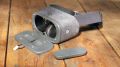 First-generation Daydream View with the front cover open and the controller
 -
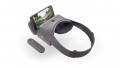 First-generation Daydream View with a phone in the open front cover
 -
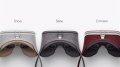 The three 2016 colors: Snow, Slate and Crimson
 -
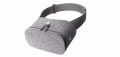 First-generation Daydream View in Slate


See also
References
- ↑ 1.00 1.01 1.02 1.03 1.04 1.05 1.06 1.07 1.08 1.09 1.10 Ben Lang (2016-11-10). "Google Daydream Review: Casual VR Closes the Gap (page 2)". Road to VR. https://www.roadtovr.com/google-daydream-review-view-casual-vr-closes-the-gap/2/. Retrieved 2026-10-12.
- ↑ 2.0 2.1 2.2 2.3 2.4 "Daydream View". Google VR (Google for Developers). Google. https://developers.google.com/vr/discover/daydream-view. Retrieved 2026-10-12.
- ↑ 3.0 3.1 3.2 3.3 3.4 3.5 3.6 3.7 3.8 Clay Bavor (2016-10-04). "Daydream: Bringing high-quality VR to everyone". The Keyword (Google blog). Google. https://blog.google/products/daydream/daydream-bringing-high-quality-vr-everyone/. Retrieved 2026-10-12.
- ↑ 4.0 4.1 4.2 4.3 Andrey Doronichev (2016-11-10). "Experience Daydream today". The Keyword (Google blog). Google. https://blog.google/products/daydream/experience-daydream-today/. Retrieved 2026-10-12.
- ↑ 5.0 5.1 5.2 5.3 5.4 Rachel Kaser (2017-10-04). "Google debuts the updated Daydream View VR headset". The Next Web. https://thenextweb.com/news/google-debuts-updated-daydream-vr-headset. Retrieved 2026-10-12.
- ↑ 6.0 6.1 6.2 6.3 6.4 Abner Li (2017-10-04). "Daydream View: Improved design w/ new colors and wider field of view". 9to5Google. https://9to5google.com/2017/10/04/daydream-view-announce-features-price/. Retrieved 2026-10-12.
- ↑ 7.0 7.1 7.2 7.3 Ben Lang (2019-10-15). "Google Discontinues Daydream View Headset, the Final Nail in the Coffin for its Android VR Ambitions". Road to VR. https://www.roadtovr.com/google-puts-final-nail-daydream-coffin-discontinues-view-headset/. Retrieved 2026-10-12.
- ↑ 8.0 8.1 Abner Li (2020-10-02). "Google officially drops support for Daydream VR with Android 11". 9to5Google. https://9to5google.com/2020/10/02/google-daydream-vr/. Retrieved 2026-10-12.
- ↑ 9.0 9.1 Jamie Feltham (2016-05-18). "Google's Mobile VR Platform is Daydream And It Comes With A Motion Controller". UploadVR. https://www.uploadvr.com/google-daydream/. Retrieved 2026-10-12.
- ↑ Joseph Bernstein (2016-05-18). "Google's New Virtual Reality Platform Is Called Daydream". BuzzFeed News. https://www.buzzfeednews.com/article/josephbernstein/googles-new-virtual-reality-platform-is-called-daydream. Retrieved 2026-10-12.
- ↑ 11.0 11.1 Maria Korolov (2016-10-04). "Google launches Pixel phone and Daydream View VR headset". Hypergrid Business. https://www.hypergridbusiness.com/2016/10/google-launches-pixel-phone-and-daydream-view-vr-headset/. Retrieved 2026-10-12.
- ↑ Justin Duino (2016-11-14). "PSA: Daydream View promos code are now going out for Pixel pre-orders". 9to5Google. https://9to5google.com/2016/11/14/daydream-view-vr-pixel-promo-codes/. Retrieved 2026-10-12.
- ↑ 13.0 13.1 13.2 Mike Jazayeri (2016-11-01). "Daydream View coming to stores November 10th". The Keyword (Google blog). Google. https://blog.google/products/daydream/daydream-view-coming-stores-november-10th/. Retrieved 2026-10-12.
- ↑ 14.0 14.1 Bradly Shankar (2017-10-04). "Google announces new Daydream View virtual reality headset". MobileSyrup. https://mobilesyrup.com/2017/10/04/google-announces-new-daydream-view-virtual-reality-headset/. Retrieved 2026-10-12.
- ↑ 15.0 15.1 15.2 15.3 Russell Holly (2017-10-17). "Daydream View 2017 review: Mostly successful refinement". Android Central. https://www.androidcentral.com/daydream-view-2017-review. Retrieved 2026-10-12.
- ↑ "Daydream View - Headset". Google VR. Google. 2016-11-07. https://web.archive.org/web/20161107165635/https://vr.google.com/daydream/headset/. Retrieved 2026-10-12.
- ↑ 17.0 17.1 17.2 17.3 17.4 17.5 17.6 Sherri L. Smith (2016-11-10). "Google Daydream View Review". Tom's Guide. https://www.tomsguide.com/us/google-daydream-view,review-4026.html. Retrieved 2026-10-12.
- ↑ 18.0 18.1 18.2 18.3 18.4 18.5 18.6 18.7 "Daydream View - Google VR headset". Google Store. Google. 2017-01-06. https://web.archive.org/web/20170106210155/https://store.google.com/product/daydream_view. Retrieved 2026-10-12.
- ↑ 19.0 19.1 19.2 19.3 19.4 19.5 19.6 19.7 19.8 "Google Daydream View Tech Specs". Google Store. Google. 2018-10-10. https://web.archive.org/web/20181010060121/https://store.google.com/product/google_daydream_view_specs. Retrieved 2026-10-12.
- ↑ 20.0 20.1 Sherri L. Smith (2017-12-08). "Google Daydream View (2017) Review: Small Changes Make a Big Impact". Tom's Guide. https://www.tomsguide.com/us/google-daydream-view,review-4960.html. Retrieved 2026-10-12.
- ↑ Dominic Brennan (2016-11-23). "Daydream-ready Phone Minimum Requirements Detailed in Android Documentation". Road to VR. https://www.roadtovr.com/daydream-ready-phone-requirements-detailed-android-documentation/. Retrieved 2026-10-12.
- ↑ "Android 7.0 Compatibility Definition". Android Open Source Project. Google. https://source.android.com/docs/compatibility/7.0/android-7.0-cdd.pdf. Retrieved 2026-10-12.
- ↑ "Daydream-ready phones". Google VR. Google. 2019-10-05. https://web.archive.org/web/20191005062335/https://vr.google.com/daydream/smartphonevr/phones/. Retrieved 2026-10-12.
- ↑ 24.0 24.1 24.2 Ben Lang (2016-11-10). "Google Daydream Review: Casual VR Closes the Gap". Road to VR. https://www.roadtovr.com/google-daydream-review-view-casual-vr-closes-the-gap/. Retrieved 2026-10-12.
- ↑ Ben Lang (2016-11-10). "Google Daydream Review: Casual VR Closes the Gap (page 3)". Road to VR. https://www.roadtovr.com/google-daydream-review-view-casual-vr-closes-the-gap/3/. Retrieved 2026-10-12.
- ↑ Ian Hamilton (2016-11-09). "Review: Daydream View Puts The Best Of Google In a Finicky Fit". UploadVR. https://www.uploadvr.com/review-daydream-view-google/. Retrieved 2026-10-12.
- ↑ Chris Martin (2016-11-11). "Google Daydream View review". Tech Advisor. https://www.techadvisor.com/article/717309/google-daydream-view-review.html. Retrieved 2026-10-12.
- ↑ Abner Li (2021-02-15). "Daydream Play Store, VR app discovery shuts down". 9to5Google. https://9to5google.com/2021/02/15/google-daydream-play-store/. Retrieved 2026-10-12.