

Oculus Go
More actions
| Oculus Go | |
|---|---|

| |
| Basic Info | |
| VR/AR | Virtual Reality |
| Type | Head-mounted display |
| Subtype | Standalone VR |
| Platform | Oculus Platform |
| Creator | Oculus VR |
| Developer | Oculus VR |
| Manufacturer | Xiaomi (hardware partner)[1] |
| Announcement Date | October 11, 2017 (Oculus Connect keynote)[2] |
| Release Date | May 1, 2018[3] |
| Price | US$199 (32GB), US$249 (64GB), at launch[3] |
| Website | https://www.meta.com/ (discontinued) |
| Versions | 32GB, 64GB[3] |
| Requires | Phone-assisted initial setup[4]; Meta account for continued use[5] |
| System | |
| Operating System | Android-based Oculus system software[6] |
| Chipset | Qualcomm Snapdragon 821[3] |
| CPU | Quad-core 64-bit Qualcomm Kryo[7] |
| GPU | Qualcomm Adreno 530[7] |
| Storage | |
| Storage | 32GB or 64GB[3] |
| Display | |
| Display | Single 5.5-inch fast-switch LCD[3] |
| Resolution | 2560 × 1440 total; 1280 × 1440 allocated per eye[3] |
| Refresh Rate | 60Hz; optional 72Hz[8] |
| Image | |
| Foveated Rendering | Fixed foveated rendering[8] |
| Optics | |
| Optics | Fresnel lenses[9] |
| Ocularity | Binocular |
| Passthrough | No camera passthrough[10] |
| Tracking | |
| Tracking | 3DoF (rotational only)[2] |
| Eye Tracking | No; foveation is fixed[8] |
| Rotational Tracking | Yes[2] |
| Positional Tracking | No[8] |
| Play Space | Stationary[8] |
| Audio | |
| Audio | Integrated spatial speakers[11] |
| Microphone | Integrated[11] |
| 3.5mm Audio Jack | Yes[9] |
| Camera | No[10] |
| Connectivity | |
| Connectivity | Wi-Fi[4] |
| Ports | Micro-USB; 3.5mm audio[4][9] |
| Power | Internal lithium-ion battery[3] |
| Battery Life | About 2 hours of gaming or up to 2.5 hours of video (Oculus estimate)[3] |
| Device | |
| Material | Aluminum front face; foam facial interface; fabric straps[9] |
| Headstrap | Soft adjustable fabric straps[9] |
| Haptics | Not supported[12] |
| Sensors | Proximity sensor[4] |
| Input | Oculus Go controller (3DoF); one AA battery[10][4] |
The Oculus Go is a discontinued standalone virtual reality head-mounted display developed by Oculus VR with Xiaomi as its hardware partner. It was announced at the Oculus Connect keynote on October 11, 2017, and released on May 1, 2018 at US$199 for the 32GB model and US$249 for the 64GB model.[2][3] It was Oculus's first standalone VR headset.[13] Its display and computing hardware are built into the headset, so a phone or PC does not power the VR experience. The original setup process used a mobile app on a separate phone.[9][4]
Go tracks head rotation and comes with a single orientation-tracked controller. Its three degrees of freedom cover pitch, yaw and roll; leaning or walking does not produce positionally tracked movement. Its software library combined games, media viewing and social experiences.[2][8][11] Oculus announced the end of Go sales during 2020 and a shift toward six-degree-of-freedom products such as Oculus Quest.[14]
History and development
Announcement and hardware partnership
The October 2017 announcement introduced Go as an all-in-one headset at a planned US$199 price. Oculus also described compatibility with the Mobile SDK and the Unity and Unreal integrations used for Samsung Gear VR, allowing developers to target both devices with many of the same application binaries.[2]
Xiaomi's hardware partnership was announced at Qualcomm's CES press conference in January 2018. Hugo Barra identified the Snapdragon 821 as Go's processor and Xiaomi as the hardware partner for its global launch. Xiaomi's Thomas Tang separately announced Mi VR standalone for China, with shared core hardware and Xiaomi's VR platform. The China-specific product was a related regional device with a different platform, rather than a separate storage edition of Oculus Go.[1]
May 2018 launch
Oculus made Go available in 23 countries on May 1, 2018. The two launch editions differed in built-in storage, at 32GB and 64GB. Its announced launch library included more than 1,000 apps, games and experiences.[3][13]
| Date | Event |
|---|---|
| October 11, 2017 | Oculus announced Go at the Oculus Connect keynote.[2] |
| January 2018 | Qualcomm's CES conference identified the Xiaomi partnership and Snapdragon 821 processor, and introduced the related China-specific Mi VR device.[1] |
| May 1, 2018 | Go became available in 23 countries, with 32GB and 64GB editions.[3] |
| June 23, 2020 | Oculus announced that Go sales would end during 2020, with system bug fixes and security patches planned through 2022.[14] |
| December 4, 2020 | Announced deadline for accepting new Go apps and app updates for store submission.[15] |
| December 18, 2020 | Announced deadline for publishing additional Go apps in the store.[15] |
| October 21, 2021 | Oculus released an unlocked OS build and its software unlock guide.[16] |
Design philosophy
Go combined the display, processor, battery and audio system in a portable headset. The industrial design team's account describes soft, collapsible straps secured by hook-and-loop tabs and a removable top strap. Its anodized aluminum front face doubles as a heat spreader; the facial interface uses injection-molded foam. A supplied glasses spacer creates room between the facial interface and the lenses.[9]
The device supported entertainment uses such as virtual cinema, panoramic media and social applications as well as games. This was a stationary viewing and interaction system: the headset and controller did not track their position in a room.[11][8][10] The difference from phone-powered Gear VR was the integrated display and processor, while much of the mobile software platform remained shared.[2]
Display technology
The built-in 5.5-inch fast-switch LCD has 2560 × 1440 pixels across the whole panel. The stereo allocation is 1280 × 1440 pixels per eye. Oculus specified 538 pixels per inch for the physical panel, a measurement that differs from angular resolution through the lenses.[3]
Go normally operates at 60Hz and offers an optional 72Hz mode selected by the application. Oculus's engineering guidance explains that 24-frame-per-second video can divide evenly into 72Hz, whereas 30- or 60-frame-per-second video fits a 60Hz presentation more evenly. A game's ability to use the higher refresh rate depends on its rendering workload.[8]
Panel resolution and rendering resolution
The physical display specification is separate from the eye textures that an application renders. Oculus's April 2018 development guide gave a default eye-buffer size of 1024 × 1024 and allowed developers to change the buffer dimensions when tuning applications. Rendering a larger eye texture does not change the panel's pixel count.[10]
Optical system
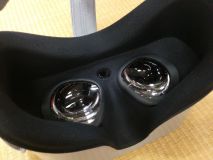
Go uses custom Fresnel lenses. The design team's description identifies them as its second generation of Rift lenses. The supplied glasses spacer and the removable facial interface were part of the fit system; prescription lens inserts were also described as an alternative to wearing glasses inside the headset.[9]
Processing power
The headset runs its applications locally on a Qualcomm Snapdragon 821 system-on-chip and has either 32GB or 64GB of built-in storage.[3] The processor integrates a quad-core 64-bit Kryo CPU and Adreno 530 GPU, manufactured on a 14nm FinFET process.[7] Oculus introduced rendering and power-management features for this hardware.[8]
Fixed foveated rendering
Fixed foveated rendering reduces the rendering resolution at the edges of an eye texture while retaining more detail in its center. Go's implementation is fixed within the texture and does not follow the user's eyes. Its benefit depends on the workload, and the lower-resolution regions can introduce visible artifacts in high-contrast text or detailed textures. Developers could tune the level or disable it for a particular scene.[8]
Dynamic throttling
Dynamic throttling uses the developer's CPU and GPU level selections as minimum levels and can raise clocks in response to workload. Oculus's engineering account describes utilization and missed-frame information as inputs to this system.[8]
Tracking system
The headset provides rotational head tracking, with no positional tracking. The view can respond to turning the head but does not reproduce a change in viewpoint caused by moving the head sideways or walking. The controller likewise supplies orientation rather than a measured location in space.[2][8][10] Applications can still move a viewpoint through software, but Go's tracking does not provide room-scale movement.[8]
Oculus Go controller
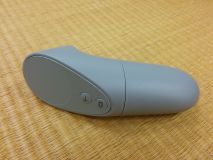
The single handheld controller has a clickable touchpad and index-finger trigger. These input types match those of the Gear VR controller, although the physical designs differ. The headset itself has no touchpad, so applications that relied on Gear VR's headset touchpad needed an alternative input path.[10]
| Control | Documented function |
|---|---|
| Trigger | Select a pointed-at item. |
| Touchpad | Click to select; use the touch surface to browse. |
| Back button | Return to the previous screen or menu. |
| Oculus/Home button | Return to Oculus Home; holding the button recenters the controller orientation and view. |
These are the historical controls documented in the TACTICS VR Go manual. The controller can be configured for either hand and uses one replaceable AA battery.[4] Oculus's documentation explicitly excludes Go from the haptics support provided for Quest and Rift.[12]
Audio system
Go has integrated speakers and a microphone. Its audio design channels sound from the headset housing through the strap arms to ports near the ears. A 3.5mm audio jack supports separate headphones.[11][9] This open-ear arrangement leaves the ears uncovered rather than sealing them inside headphone cups.[9]
Physical design and battery
The fabric straps allow fit adjustments at the sides and top of the head. The foam facial interface can be removed for the supplied glasses spacer. A proximity sensor inside the headset detects whether it is being worn.[9][4]
The built-in lithium-ion battery was advertised by Oculus for about two hours of gaming or up to 2.5 hours of streaming media and video, depending on content. These are manufacturer estimates, not a guarantee for an aged battery.[3] The historical charging specification calls for a USB 2.0 Micro-B cable and a 10W (5V, 2A) adapter; the controller's AA battery is separate from the headset battery.[4]
Software platform
Gear VR compatibility and development
Go uses Wi-Fi for its network connection. Its historical setup guide described choosing a network in the phone app or headset settings, and noted that networks with captive portals were not supported for initial setup.[4]
Go used the Android-based Oculus software platform. Most Gear VR applications could run as the same binary, but compatibility was conditional: Go lacked Google Play Services, a headset camera and the Gear VR headset touchpad, and did not support very old pre-1.0 Mobile SDK applications. Oculus scanned submitted builds for these incompatibilities.[10] Go shipped with Android API level 25; Oculus's compatibility guide explained that a build requiring a higher minimum API level would not appear on the device.[17]
The April 2018 guide specified Unity 5.6.5p2 or 2017.4.1 with Oculus Utils 1.24.1 or later, Oculus's Unreal 4.18 integration, or Mobile SDK 1.14 or later for native development. It also described developer-mode access to ADB and the OVR Metrics Tool for performance inspection.[10] The August 2021 Mobile SDK release notes still listed Go among the Android devices supported for native C/C++ app development.[6]
Media and social software
The May 2018 launch account described Oculus Rooms for shared activities, Oculus Gallery for personal photos and video, and the forthcoming Oculus Venues and Oculus TV applications for events and entertainment. Gallery supported panoramic and 360-degree photos and a virtual home theater. Hulu and SHOWTIME were named as individual entertainment apps that Oculus TV would help launch.[11] YouTube VR was released for Go on November 12, 2018, with conventional videos as well as 3D 360-degree and VR180 content.[18]
Business and research use
Oculus announced Go business-bundle preorders in May 2018, including a commercial license, additional facial interfaces, a worldwide power adapter and dedicated support. The launch announcement planned shipping for later that summer.[11]
An original input-method study by Ziming Li and Roshan Peiris used a Go headset and its 3DoF controller with a Unity demo. Five participants tested three controller-rolling text-entry methods and a raycasting baseline on the same QWERTY layout, without autocomplete or autocorrection. The remote, within-subject experiment found no overall advantage for the proposed techniques over raycasting. The authors identified the small sample and unequal familiarity with the methods as limitations.[19]
Discontinuation and legacy access
Sales and software support
The June 23, 2020 announcement said Oculus would end Go sales during that year and stop shipping additional 3DoF VR products. It promised bug fixes and security patches through 2022 but no new Go features. The store deadlines concerned new app submissions, app updates and publication. Oculus said owners could continue using their headsets after sales ended.[14][15]
Meta's legacy-device account documentation, checked on October 14, 2026, states that a Meta account is required to continue using Go. It describes account migration using the mobile app or web setup and distinguishes an existing account from creating a new one.[5]
Unlocked operating-system build
On October 21, 2021, Oculus made an unlocked Go OS build available for low-level access and hardware repurposing. Its guide describes disabling boot-image signature checks and dm-verity verification so an owner can replace boot and system images. Unlocking erases user data and stops over-the-air updates. The guide also describes returning to a locked state, which again erases data and requires signed images to boot.[16]
This release provides access to the device software. It does not promise ongoing store operation, restoration of purchases or continued access to third-party online applications.[16][14]
Technical specifications summary
| Specification | Verified description |
|---|---|
| Display | 5.5-inch fast-switch LCD, 2560 × 1440 total.[3] |
| Refresh rate | 60Hz, with optional 72Hz application mode.[8] |
| Optics | Fresnel lenses.[9] |
| Processor | Qualcomm Snapdragon 821.[3] |
| Storage editions | 32GB and 64GB.[3] |
| Tracking | Head and controller orientation, without positional tracking.[2][8] |
| Controller | Clickable touchpad, index trigger and two face buttons; one AA battery.[10][4] |
| Audio | Integrated spatial audio and microphone; 3.5mm headphone jack.[11][9] |
| Headset battery life | About 2 hours for games or up to 2.5 hours for streaming video, according to Oculus.[3] |
| Launch price | US$199 (32GB) or US$249 (64GB).[3] |
| Status | Discontinued; sales ending during 2020 announced June 23, 2020.[14] |
Comparison with Gear VR
| Feature | Oculus Go | Samsung Gear VR |
|---|---|---|
| Hardware running the experience | Integrated display and processor.[9] | A compatible Samsung Galaxy phone.[10] |
| Display | Built-in LCD.[3] | The inserted phone's display.[10] |
| Head tracking | Rotational, without positional tracking.[8] | The rotational mobile-VR platform with which Go shared application compatibility.[2][19] |
| Controller input model | Orientation-tracked controller with a clickable trackpad and index-finger trigger.[10] | Gear VR controller inputs matched by Go; applications still needed the correct device-specific model.[10] |
See Also
Gallery
-
 Oculus Go lenses.
-
 Oculus Go controller.


References
- ↑ 1.0 1.1 1.2 "CES 2018 press conference transcript, included in Qualcomm Schedule 14A materials". Qualcomm. 2018-01-16. https://d18rn0p25nwr6d.cloudfront.net/CIK-0000804328/0a12649c-6061-4590-9337-7e8e1c49d541.pdf. Retrieved 2026-10-14.
- ↑ 2.00 2.01 2.02 2.03 2.04 2.05 2.06 2.07 2.08 2.09 2.10 "Introducing Oculus Go". Meta Horizon OS Developers. 2017-10-11. https://developers.meta.com/vr/blog/introducing-oculus-go/. Retrieved 2026-10-14.
- ↑ 3.00 3.01 3.02 3.03 3.04 3.05 3.06 3.07 3.08 3.09 3.10 3.11 3.12 3.13 3.14 3.15 3.16 3.17 3.18 3.19 3.20 "Oculus Developer News from F8 2018". Meta Horizon OS Developers. 2018-05-01. https://developers.meta.com/vr/blog/oculus-developer-news-from-f8-2018/. Retrieved 2026-10-14.
- ↑ 4.00 4.01 4.02 4.03 4.04 4.05 4.06 4.07 4.08 4.09 4.10 "Oculus User Guide". TACTICS VR. https://trial.tacticsvr.com.au/wp-content/uploads/sites/2/2020/02/Oculus-Go-User-Manual-v1.3_TACTICS.pdf. Retrieved 2026-10-14.
- ↑ 5.0 5.1 "Learn about Meta accounts on Samsung Gear VR and Oculus Go". Meta Help Center. https://www.meta.com/help/quest/1076174626443423/. Retrieved 2026-10-14.
- ↑ 6.0 6.1 "Oculus Developer Release Notes: v31". Meta Horizon OS Developers. 2021-08-13. https://developers.meta.com/vr/blog/oculus-developer-release-notes-v31/. Retrieved 2026-10-14.
- ↑ 7.0 7.1 7.2 "Qualcomm Snapdragon 821 Processor". Qualcomm. https://www.qualcomm.com/content/dam/qcomm-martech/dm-assets/documents/snapdragon-821-processor-product-brief.pdf. Retrieved 2026-10-14.
- ↑ 8.00 8.01 8.02 8.03 8.04 8.05 8.06 8.07 8.08 8.09 8.10 8.11 8.12 8.13 8.14 8.15 "Optimizing Oculus Go for Performance". Meta Horizon OS Developers. 2018-03-22. https://developers.meta.com/vr/blog/optimizing-oculus-go-for-performance/. Retrieved 2026-10-14.
- ↑ 9.00 9.01 9.02 9.03 9.04 9.05 9.06 9.07 9.08 9.09 9.10 9.11 9.12 9.13 "Oculus Go". Core77 Design Awards 2019. 2019. https://designawards.core77.com/consumer-technology/87578/Oculus-Go.html. Retrieved 2026-10-14.
- ↑ 10.00 10.01 10.02 10.03 10.04 10.05 10.06 10.07 10.08 10.09 10.10 10.11 10.12 10.13 "Everything You Need to Know To Develop for Oculus Go". Meta Horizon OS Developers. 2018-04-20. https://developers.meta.com/vr/blog/everything-you-need-to-know-to-develop-for-oculus-go/. Retrieved 2026-10-14.
- ↑ 11.0 11.1 11.2 11.3 11.4 11.5 11.6 11.7 "Oculus Go Available Now: Our Best VR Optics in Our First Standalone VR Headset". Meta Quest Blog. 2018-05-01. https://www.meta.com/blog/oculus-go-available-now-our-best-vr-optics-in-our-first-standalone-vr-headset/. Retrieved 2026-10-14.
- ↑ 12.0 12.1 "Oculus Developer Center Update: Device-centric Documentation Architecture". Meta Horizon OS Developers. 2020-01-13. https://developers.meta.com/vr/blog/oculus-developer-center-update-device-centric-documentation-architecture/. Retrieved 2026-10-14.
- ↑ 13.0 13.1 "F8 2018: Oculus Go Available Now for $199". Meta Newsroom. 2018-05-01. https://about.fb.com/news/2018/05/oculus-go/. Retrieved 2026-10-14.
- ↑ 14.0 14.1 14.2 14.3 14.4 "An Update on the Evolution of the Oculus Platform". Meta Quest Blog. 2020-06-23. https://www.meta.com/blog/an-update-on-the-evolution-of-the-oculus-platform-/. Retrieved 2026-10-14.
- ↑ 15.0 15.1 15.2 "The Next Chapter of Oculus Development and a New Quest Distribution Path, Coming in 2021". Meta Horizon OS Developers. 2020-06-23. https://developers.meta.com/vr/blog/the-next-chapter-of-oculus-development-and-a-new-quest-distribution-path-coming-in-2021/. Retrieved 2026-10-14.
- ↑ 16.0 16.1 16.2 "Unlocking Oculus Go". Meta Horizon OS Developers. 2021-10-21. https://developers.meta.com/vr/blog/unlocking-oculus-go/. Retrieved 2026-10-14.
- ↑ "Best Practices: Ensuring Compatibility of Your Gear VR Application for Oculus Go". Meta Horizon OS Developers. 2018-07-17. https://developers.meta.com/vr/blog/best-practices-ensuring-compatibility-of-your-gear-vr-application-for-oculus-go/. Retrieved 2026-10-14.
- ↑ "Press Play: 'YouTube VR' Available Now on Oculus Go". Meta Quest Blog. 2018-11-12. https://www.meta.com/blog/press-play-youtube-vr-available-now-on-oculus-go-/. Retrieved 2026-10-14.
- ↑ 19.0 19.1 Li, Ziming; Peiris, Roshan (July 15, 2021). "RotateEntry: Controller-rolling-style Text Entry for Three Degrees of Freedom Virtual Reality Devices". Frameless 3 (1): Article 21. Retrieved 2026-10-14.