

HTC Vive Cosmos
More actions
| HTC Vive Cosmos | |
|---|---|

| |
| Basic Info | |
| VR/AR | Virtual Reality |
| Type | Head-mounted display |
| Subtype | PC VR |
| Platform | SteamVR, Viveport |
| Creator | HTC |
| Developer | HTC |
| Manufacturer | HTC |
| Announcement Date | January 7, 2019 (CES 2019) |
| Release Date | October 3, 2019 |
| Price | US$699 / €799 (launch); £699 / AU$1,299 |
| Website | https://www.vive.com/ |
| Versions | Vive Cosmos, Vive Cosmos Play, Vive Cosmos Elite, Vive Cosmos XR (developer kit announced) |
| Requires | Windows 10 PC with DisplayPort 1.2 and USB 3.0 (HTC minimum: Intel Core i5-4590 or AMD FX 8350, NVIDIA GeForce GTX 970 4GB or AMD Radeon R9 290 4GB, 4 GB RAM) |
| Predecessor | HTC Vive |
| System | |
| Operating System | Windows |
| Display | |
| Display | Dual 3.4-inch LCD (RGB subpixels) |
| Resolution | 1440 x 1700 per eye (2880 x 1700 combined) |
| Refresh Rate | 90 Hz |
| Image | |
| Field of View | Maximum 110 degrees |
| Optics | |
| Optics | Fresnel lenses |
| Ocularity | Binocular |
| IPD Range | Hardware IPD adjustment (Eye Comfort Setting) |
| Passthrough | Yes (front cameras) |
| Tracking | |
| Tracking | 6DoF inside-out (six cameras); SteamVR Tracking with the External Tracking Faceplate |
| Eye Tracking | No |
| Hand Tracking | No |
| Audio | |
| Audio | Integrated stereo on-ear headphones (removable) |
| Microphone | Integrated microphones |
| Camera | Six tracking cameras (four on the display unit, two on the faceplate) |
| Connectivity | |
| Connectivity | USB 3.0 and DisplayPort 1.2 to the PC through a converter box; optional Vive Wireless Adapter |
| Ports | USB-C 3.0, DisplayPort 1.2, proprietary faceplate connection |
| Device | |
| Weight | 645 g (HTC figure) |
| Material | Plastic |
| Color | Dark blue and black |
| Sensors | G-sensor, gyroscope, Eye Comfort Setting (IPD) |
| Input | Vive Cosmos controllers (2x AA batteries each) |
The HTC Vive Cosmos is a tethered PC VR head-mounted display made by HTC. HTC unveiled it at CES 2019 on January 7, 2019, opened pre-orders on September 12, 2019, and shipped it worldwide on October 3, 2019 at US$699.[1][2] It was HTC's first consumer headset since the original HTC Vive. Unlike that headset, it uses inside-out tracking: six cameras on the headset track the head and the controllers, so no external base stations are needed.[3][4]
The headset has two 3.4-inch LCD panels at 1440 x 1700 pixels per eye (2880 x 1700 combined), a 90 Hz refresh rate, a maximum 110-degree field of view, a flip-up visor and built-in on-ear headphones.[2] Its front faceplate is removable. In February 2020 HTC used that modular design to turn the Cosmos into a product family: the four-camera Cosmos Play, the Cosmos Elite with a SteamVR Tracking faceplate, and the Cosmos XR passthrough developer kit.[5]
Launch reviews criticized the tracking, which failed in dim rooms before HTC patched it, and the price, which sat US$300 above the Oculus Rift S.[6][7] HTC confirmed in July 2023 that the Vive Cosmos had been discontinued in the United States.[3]
Announcement and release
HTC announced the Vive Cosmos at its CES 2019 press conference in Las Vegas on January 7, 2019, alongside the HTC Vive Pro Eye.[1][8] HTC's release described a headset focused on comfort and easy setup that needed no external base stations, could be used "whether at home or on the go", and had "the capability to be powered by more than a traditional gaming PC". It said developer kits would ship in early 2019, with price and availability to follow later in the year. Daniel O'Brien, HTC Vive's general manager for the Americas, said HTC had found that "over 85% of VR intenders believe that ease of use and set up is the most important factor to consider while purchasing a headset".[1] HTC also said that the Vive Reality System, a redesigned user interface from its Creative Labs team, would debut on the Cosmos later in 2019.[1] UploadVR noted that HTC had trademarked the Cosmos name in November 2018.[8]
HTC released further details through 2019. In June it confirmed the 1440 x 1700 per-eye resolution, the 90 Hz refresh rate and RGB LCD panels, and claimed "40% improved lens clarity over the original Vive".[9] In August HTC called the Cosmos its "lightest VIVE yet" at 645 g. UploadVR questioned the claim, since its own weighing of the 2016 Vive with strap and without cable came to about 566 g; HTC replied that "the total package of functionality is the lightest we've ever produced."[10]
On September 12, 2019 HTC set the price at US$699 and opened pre-orders on vive.com and at retailers including Amazon, B&H Photo, GameStop, Newegg and Walmart, with worldwide availability from October 3, 2019. Customers who pre-ordered by October 2 received a 12-month Viveport Infinity subscription code, and later buyers six months.[2] The Ghost Howls listed the European launch price as €799.[11] TechRadar gave the British and Australian prices as £699 and AU$1,299.[12]
Design and hardware
Display and optics
The Cosmos uses two 3.4-inch (diagonal) LCD panels with a resolution of 1440 x 1700 pixels per eye, 2880 x 1700 combined. HTC describes this as an 88% increase in pixel count over the original Vive.[2][13] Unlike the OLED screens of the original Vive, the panels have full red, green and blue subpixels, which Road to VR noted improves subpixel resolution and fill factor; it also noted that LCDs generally handle dark scenes less well than OLEDs.[9] The headset runs at 90 Hz, the same as the original Vive, and HTC lists a maximum field of view of 110 degrees.[9][13]
The optics are Fresnel lenses with a hardware IPD adjustment that HTC calls the Eye Comfort Setting.[13][9] In its review, Road to VR found the field of view clearly wider than the Rift S but narrower than the Valve Index, and the screen door effect and pixel density roughly in the same class as those two headsets. It reported somewhat less glare and fewer god rays than the Vive and Vive Pro, but a "frustratingly small sweet spot".[4] TechRadar noted that the lenses cannot be moved toward or away from the eyes, as they can on the Valve Index, so black edges are visible when the wearer looks to the side.[12]
Tracking and cameras
The standard Cosmos tracks the headset and controllers with six cameras: four on the display unit and two on the front faceplate, which HTC called the Vive Motion Mod at launch.[2][11] HTC specifies no minimum space for standing or seated use and a minimum area of 2 m x 1.5 m for room-scale use.[13] The front cameras also provide a passthrough view, which is used when tracing the play-area boundary with a controller and can be opened in any app by pressing the Vive button twice.[4][12]
Road to VR's Ben Lang suspected that the cameras' poor performance in low light came from using RGB cameras, which he thought were less sensitive than the monochrome infrared cameras on other inside-out headsets, while noting that a fault such as incorrect exposure was also possible.[6]
Faceplates
The faceplate attaches through a proprietary connector, which lets the tracking hardware be swapped.[13] At launch HTC announced the Vive Cosmos External Tracking Mod, to be sold separately, a faceplate for SteamVR Tracking that works with existing Lighthouse base stations and Vive Trackers.[2] By February 2020 HTC called it the External Tracking Faceplate and priced it at US$199. It works with base stations 1.0 or 2.0 and with original Vive or Vive Pro controllers.[5]
Ergonomics and audio
The display unit sits on a halo-style headband with a rear tightening wheel, and it flips up so the wearer can see the room without removing the headset.[12][13] HTC lists the weight as 645 g.[10] Road to VR and TechRadar both described the headset as front-heavy. Road to VR's reviewer reported strong forehead pressure after about 30 minutes, while praising the light-blocking facial interface and calling the flip-up visor a "very welcomed addition".[4][12]
Integrated on-ear stereo headphones and microphones are built in.[13] The headphones can be removed without tools, and a 3.5 mm jack takes the user's own headphones. Road to VR said the headphones "sound good" but criticized their spring-flip mechanism and flimsy band.[4]
Controllers
The Cosmos controllers replaced the wand controllers of the original Vive.[4] Each has a system button, two application buttons, a trigger, a bumper, a joystick and a grip button, along with a gyroscope, G-sensor, Hall sensor and touch sensors, and runs on two AA batteries.[13] Each controller has a light-up ring around its face buttons.[12] Road to VR called the controllers "decidedly chunky" with a poor center of gravity, though it preferred them to the original wands. It found their tracking good enough to play Beat Saber on Expert+ but noted dead zones near the headset.[4]
PC connection and requirements
The headset connects by cable to a converter box, which links to the PC with DisplayPort and USB 3.0 cables and needs its own power adapter.[13] On the headset side HTC lists USB-C 3.0, DisplayPort 1.2 and the proprietary faceplate connection.[13] The Cosmos works with the Vive Wireless Adapter, sold separately, which also needs an attach kit and a free PCIe slot in the PC.[2]
| Component | Requirement |
|---|---|
| Processor | Intel Core i5-4590 or AMD FX 8350 equivalent or better |
| Graphics | NVIDIA GeForce GTX 970 4GB or AMD Radeon R9 290 4GB equivalent or better |
| Memory | 4 GB RAM or more |
| Video output | DisplayPort 1.2 or newer |
| USB | 1x USB 3.0 or newer |
| Operating system | Windows 10 |
The box contained the headset, two controllers, a headset cable, the converter with DisplayPort and USB 3.0 cables, the converter power adapter, a Mini DisplayPort to DisplayPort adapter, four AA batteries, a cleaning cloth, documentation and a Viveport redemption code.[13]
Specifications
| Specification | Vive Cosmos |
|---|---|
| Display | Dual 3.4-inch LCD[13] |
| Resolution | 1440 x 1700 per eye (2880 x 1700 combined)[13] |
| Refresh rate | 90 Hz[13] |
| Field of view | Maximum 110 degrees[13] |
| Lenses | Fresnel, hardware IPD adjustment[9] |
| Tracking | Inside-out, six cameras[2] |
| Audio | Integrated stereo headphones, integrated microphones[13] |
| Headset sensors | G-sensor, gyroscope, Eye Comfort Setting (IPD)[13] |
| Connections | USB-C 3.0, DisplayPort 1.2, proprietary faceplate connection[13] |
| Weight | 645 g (HTC figure)[10] |
| Launch price | US$699[2] |
Software and features
The Cosmos is a SteamVR headset and also uses HTC's own software. At launch HTC introduced the Vive Reality System on the Cosmos, with a redesigned interface called Lens and a home space called Origin.[2] The CES 2019 announcement had also described a deal with Mozilla for a Vive-dedicated VR browser.[1] Engadget found the Lens menus slow and clunky; Lens showed Viveport titles alongside games bought on Steam and the Vive store.[7] Road to VR wrote that Lens did little beyond browsing and launching the library, that the planned social features were not yet available, and that key settings still lived in SteamVR.[4]
Tracking updates
Road to VR postponed its review on October 3, 2019 after the headset repeatedly refused to start tracking after sunset, warning that the room was too dark, a problem that four other inside-out headsets (Oculus Rift S, Oculus Quest, HP Reverb and Lenovo Mirage Solo) did not have in the same room. HTC confirmed the problem was not unique to the review unit and released a patch that made the headset more tolerant of low light, followed by a firmware update that let users bypass the warning.[6]
Software version 1.0.5 improved room setup in low light and fixed a USB audio driver issue. HTC released version 1.0.7 in beta on October 25, 2019. HTC said the update improved low-light tracking, prediction during fast movement and when a controller leaves the cameras' view, near-field tracking for uses such as archery, and controller stability in low-light and bright conditions. HTC announced official Vive Wireless Adapter support at the same time.[14] Writing in 2021, TechRadar said the Cosmos was "a far better headset" after significant software and firmware updates and the Elite faceplate.[12]
Cosmos family
On February 20, 2020 HTC presented the "complete VIVE Cosmos Series". All models share the same display unit, Fresnel lenses, flip-up mount and hardware IPD adjustment, and differ in their faceplates.[5][15] HTC CEO Yves Maître called the Cosmos "truly the most versatile headset yet."[5] At the same time HTC said the six-camera faceplate would be sold separately for US$199 in the second quarter of 2020, as an upgrade that adds vertical and waist-level tracking coverage.[5]
| Model | Tracking | Announced price | Notes |
|---|---|---|---|
| Vive Cosmos Play | Inside-out, four cameras | US$499 quoted to press, later withdrawn | Entry model with two controllers and no side-mounted headphones (sold as an accessory); upgradable with other faceplates[16][5] |
| Vive Cosmos | Inside-out, six cameras | US$699 | The original 2019 model[5] |
| Vive Cosmos Elite | SteamVR Tracking (External Tracking Faceplate) | US$899 | Bundled with two SteamVR base stations and two Vive controllers; pre-orders from February 24, 2020[5][16] |
| Vive Cosmos XR | Inside-out, four cameras, plus two passthrough cameras | Not announced | Developer kit and faceplate for passthrough mixed reality, up to 100-degree passthrough field of view; developer kit planned for the second quarter of 2020[5][17] |
HTC first told reporters the Cosmos Play would cost US$499, then removed the price from its press release, saying it "may be updated".[16] The Elite bundle included SteamVR 1.0 base stations and the original Vive wand controllers, although the faceplate also works with 2.0 base stations.[16] Road to VR reported a March 18, 2020 launch date for the Elite.[15] For the Cosmos XR, Dan O'Brien told UploadVR that the faceplate was intended eventually for enterprise and professional users but needed a developer phase first; HTC's own internal demos supported hand tracking and a single Cosmos controller.[17] Road to VR noted that the XR's passthrough cameras sit below eye level.[15]
TechRadar gave the Elite's prices as US$899, £899 and AU$1,699, with the External Tracking Faceplate alone at US$199 or £199.[12] Road to VR later reported that the Elite kit was cut to about US$750 and that the headset alone sold for as little as about US$550.[3]
Reception
Reviews in October 2019 judged the Cosmos a capable headset that was hard to justify at US$699 against the roughly US$400 Oculus Rift S and US$1,000 Valve Index.[4][7]
Road to VR's Ben Lang put the tracking under normal lighting "somewhere between PSVR and Rift S (leaning closer to Rift S)" and found it noticeably less precise in dim rooms, which would make precision work such as VR painting frustrating. He said the Cosmos won on field of view and audio but that the Rift S offered "a generally better experience for $300 less", and concluded that the headset "doesn't feel like it lives up to its $700 price point."[4]
Engadget's Devindra Hardawar titled his review "Too late, too expensive". He found tracking in Raw Data and SUPERHOT VR held up well, but could not get it working at night until every light was on. He also reported buggy setup software and called the controllers "serviceable yet unremarkable". Hardawar judged the Cosmos a better experience than the Rift S but "not $300 better", and wrote: "If HTC released the Cosmos a year ago, I would have sang its praises."[7]
TechRadar's later review of the Cosmos and Cosmos Elite listed the high-resolution LCD, the upgrade path to the Elite and the Viveport Infinity offer as strengths, and the tracking issues of the inside-out model, the bulky controllers and the Elite's use of older accessories as weaknesses. It concluded that "even the high-end HTC Vive Cosmos Elite isn't better than the Valve Index".[12] In its 2023 retrospective, Road to VR said the Elite faceplate had been the only real way to get consistently good tracking from the headset, and that the Cosmos never seriously competed with Oculus or Valve.[3]
| Feature | Vive Cosmos | Oculus Rift S | Valve Index |
|---|---|---|---|
| Price (US) | US$699[2] | US$399[12] | US$999.99[12] |
| Resolution per eye | 1440 x 1700[2] | 1280 x 1440[9] | 1440 x 1600[4] |
| Refresh rate | 90 Hz | 80 Hz[9] | 120 Hz (144 Hz mode)[4] |
| Tracking | Inside-out (six cameras)[2] | Inside-out[6] | SteamVR Tracking[4] |
Discontinuation
In July 2023 HTC removed the US product page for the Vive Cosmos after the headset had been out of stock for months. An HTC service representative told Road to VR that "the VIVE Cosmos headset has been discontinued in the US", while new units were still sold directly by HTC in some markets, including Europe, Australia, Taiwan and Japan.[3] MIXED reported at the time that the standard model had also disappeared from HTC's German store, while the Cosmos Elite was still sold there for 649 euros, down from 999 euros.[18] As of October 2026, the Cosmos product URLs on HTC's US site redirect to a general product listing that covers the Vive Focus, Vive XR Elite, Vive Pro, Vive Flow and Vive Eagle lines, with no Cosmos model.[19]
See also
- HTC Vive Cosmos Elite
- HTC Vive
- HTC Vive Pro
- HTC Vive Pro 2
- HTC Vive XR Elite
- Oculus Rift S
- Valve Index
- Inside-out tracking
- SteamVR
Gallery
-
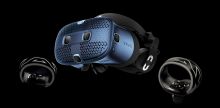 HTC Vive Cosmos headset and controllers.
 -
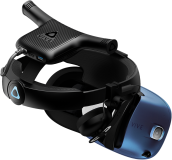 HTC Vive Cosmos with a VIVE Wireless Adapter.


References
- ↑ 1.0 1.1 1.2 1.3 1.4 "HTC VIVE Evolves Premium VR Portfolio With New Hardware, Unlimited Software Subscription, And Content Partnerships". HTC VIVE Newsroom. HTC. 2019-01-07. https://www.vive.com/us/newsroom/2019-01-07/. Retrieved 2026-10-12.
- ↑ 2.00 2.01 2.02 2.03 2.04 2.05 2.06 2.07 2.08 2.09 2.10 2.11 2.12 "HTC VIVE Announces Price and Availability of VIVE Cosmos; Pre-Orders Begin This Week". HTC VIVE Newsroom. HTC. 2019-09-12. https://www.vive.com/us/newsroom/2019-09-12/. Retrieved 2026-10-12.
- ↑ 3.0 3.1 3.2 3.3 3.4 Scott Hayden (2023-07-06). "HTC Quietly Retires Vive Cosmos in the US". Road to VR. https://roadtovr.com/htc-discontinues-cosmos-elite-us/. Retrieved 2026-10-12.
- ↑ 4.00 4.01 4.02 4.03 4.04 4.05 4.06 4.07 4.08 4.09 4.10 4.11 4.12 Ben Lang (2019-10-07). "Vive Cosmos Review - A Decent Headset Up Against Stiff Competition". Road to VR. https://roadtovr.com/htc-vive-cosmos-review/. Retrieved 2026-10-12.
- ↑ 5.0 5.1 5.2 5.3 5.4 5.5 5.6 5.7 5.8 "HTC VIVE Unveils Complete VIVE Cosmos Series". HTC VIVE Newsroom. HTC. 2020-02-20. https://www.vive.com/us/newsroom/2020-02-20/. Retrieved 2026-10-12.
- ↑ 6.0 6.1 6.2 6.3 Ben Lang (2019-10-03). "Our Vive Cosmos Review is Postponed Until HTC Shines Light on a Potentially Glaring Issue". Road to VR. https://www.roadtovr.com/htc-vive-cosmos-review-postponed/. Retrieved 2026-10-12.
- ↑ 7.0 7.1 7.2 7.3 Devindra Hardawar (2019-10-17). "HTC Vive Cosmos review: Too late, too expensive". Engadget. https://www.engadget.com/2019-10-17-htc-vive-cosmos-review.html. Retrieved 2026-10-12.
- ↑ 8.0 8.1 Jamie Feltham (2019-01-07). "CES 2019: HTC Vive Cosmos Inside-Out Tracked VR Headset Revealed". UploadVR. https://uploadvr.com/htc-vive-cosmos-revealed-ces. Retrieved 2026-10-12.
- ↑ 9.0 9.1 9.2 9.3 9.4 9.5 9.6 Ben Lang (2019-06-25). "HTC Reveals Vive Cosmos Resolution, Refresh Rate, & Lens Details". Road to VR. https://roadtovr.com/htc-vive-cosmos-resolution-refresh-rate-lens/. Retrieved 2026-10-12.
- ↑ 10.0 10.1 10.2 Jamie Feltham (2019-08-16). "Fact Check: Is Cosmos HTC's 'Lightest Vive Yet'?". UploadVR. https://uploadvr.com/vive-cosmos-weight. Retrieved 2026-10-12.
- ↑ 11.0 11.1 Skarredghost (2019-09-12). "HTC Vive Cosmos, maybe the most versatile PC VR headset, launches at $699". The Ghost Howls. https://skarredghost.com/2019/09/12/htc-vive-cosmos-price-specifications-availability/. Retrieved 2026-10-12.
- ↑ 12.00 12.01 12.02 12.03 12.04 12.05 12.06 12.07 12.08 12.09 12.10 Nick Pino (2021-03-09). "HTC Vive Cosmos and Cosmos Elite review". TechRadar. https://www.techradar.com/reviews/htc-vive-cosmos-and-cosmos-elite. Retrieved 2026-10-12.
- ↑ 13.00 13.01 13.02 13.03 13.04 13.05 13.06 13.07 13.08 13.09 13.10 13.11 13.12 13.13 13.14 13.15 13.16 13.17 13.18 "VIVE Cosmos Specs". HTC VIVE. HTC. 2020-04-19. https://web.archive.org/web/20200419185820/https://www.vive.com/us/product/vive-cosmos/specs/. Retrieved 2026-10-12.
- ↑ Scott Hayden (2019-10-21). "HTC Aims to Fix Vive Cosmos with Tracking Software Update, Beta Now Live". Road to VR. https://roadtovr.com/htc-update-vive-cosmos-tracking-october/. Retrieved 2026-10-12.
- ↑ 15.0 15.1 15.2 Ben Lang (2020-02-20). "HTC Unveils Three New Vive Cosmos Headsets: Elite, Play, and XR". Road to VR. https://roadtovr.com/htc-vive-cosmos-series-cosmos-elite-cosmos-play-cosmos-xr/. Retrieved 2026-10-12.
- ↑ 16.0 16.1 16.2 16.3 Jamie Feltham (2020-02-19). "HTC Plans Cheaper Vive Cosmos Model, $900 SteamVR Tracking Model". UploadVR. https://uploadvr.com/vive-cosmos-price-cut/. Retrieved 2026-10-12.
- ↑ 17.0 17.1 Jamie Feltham (2020-02-19). "HTC Reveals Passthrough AR Faceplate For Vive Cosmos". UploadVR. https://www.uploadvr.com/vive-cosmos-ar-faceplate/. Retrieved 2026-10-12.
- ↑ Jan Wöbbeking (2023-07-07). "HTC stops selling its VR headset Vive Cosmos". MIXED. https://mixed-news.com/en/htc-stops-selling-its-vr-headset-vive-cosmos/. Retrieved 2026-10-12.
- ↑ "VIVE Products - VR Headsets and Goggles". HTC VIVE. HTC. https://www.vive.com/us/product/. Retrieved 2026-10-12.