

DPVR E4
More actions
| DPVR E4 | |
|---|---|
 
| |
| Basic Info | |
| VR/AR | Virtual Reality |
| Type | Head-mounted display |
| Subtype | PC VR |
| Platform | SteamVR |
| Creator | DPVR |
| Developer | DPVR |
| Manufacturer | DPVR |
| Announcement Date | November 28, 2022[1] |
| Release Date | April 14, 2023 (Japan)[2][3] |
| Price | US$549 announced standard price; US$499 introductory offer[1] |
| Website | https://www.dpvr.com/en/product/dpvr-e4-pc-virtual-reality-headset/ |
| Versions | Original E4; revised E4 / E4 Black (see history) |
| Requires | Compatible Windows PC, DisplayPort and USB connections, external power adapter, DPVR Assistant 4[4] |
| System | |
| Operating System | Windows 10/11 on the host PC[5] |
| Display | |
| Display | Fast LCD[5] |
| Resolution | 3664 × 1920 total; 1832 × 1920 per eye[6] |
| Refresh Rate | 72 Hz / 90 Hz / 120 Hz[6] |
| Image | |
| Field of View | 116° advertised; axis not specified[6] |
| Optics | |
| Optics | Fresnel lenses[1] |
| Ocularity | Binocular[4] |
| IPD Range | Fixed lenses; software adjustment (see optics)[6] |
| Passthrough | Full and partial modes documented for VR Player in Assistant 4.3.4.121[7] |
| Tracking | |
| Tracking | 6DoF inside-out tracking with four cameras[6] |
| Base Stations | None required[6] |
| Rotational Tracking | Yes[5] |
| Positional Tracking | Yes[5] |
| Audio | |
| Audio | Built-in speakers and 3.5mm headphone connection[5] |
| Microphone | Built-in[5] |
| 3.5mm Audio Jack | Yes[5] |
| Camera | Four tracking cameras[6] |
| Connectivity | |
| Connectivity | DisplayPort 1.4 and USB 3.2[4] |
| Wired Video | DisplayPort[4] |
| Power | External power adapter through the connection cable[4] |
| Device | |
| Dimensions | 192 × 281 × 124.5 mm[4] |
| Weight | 280 g in original announcement; current specification 285 g, both excluding headstrap[1][6] |
| Headstrap | Adjustable headband with rear knob and top strap[4] |
| Haptics | Controller vibration[4] |
| Color | White, Black[6] |
| Sensors | Tracking cameras; gyroscope and G-sensor[6] |
| Input | Two tracked 6DoF motion controllers[5] |
The DPVR E4 is a PC-powered Virtual Reality head-mounted display made by Shanghai-based DPVR. It connects to a Windows computer for SteamVR content and uses four cameras for inside-out headset and controller tracking. DPVR announced the E4 in November 2022; its Japanese distributor began sales in April 2023. The original E4 and the later Black revision share the display resolution and flip-up visor design, while the revision changes cooling, audio, cabling and fit.[6][1][2][3][8]
History and development
DPVR announced the E4 on November 28, 2022, with orders scheduled to open on November 30. The company set an announced standard price of US$549 and an introductory price of US$499 for the first 2,000 units ordered through December 31. It said shipments would begin before January 15, 2023. These were the announcement's ordering and shipping plans, rather than evidence of the date the first customer received a headset.[1]
In Japan, authorized distributor aiuto announced sales from April 14, 2023 at an expected retail price of ¥79,800 including tax. Its launch account compared the E4's inside-out tracking with the base-station setup of the earlier E3-4K Gaming Combo. On April 17 it corrected the Japanese package manual: the listed AA batteries were not included and had to be purchased separately.[2][3]
Revised E4 and Black edition
A DPVR announcement dated March 1, 2024, with a February 29 dateline, described a hardware revision developed in response to reports of heat during longer sessions. The changes included side vents, a revised vapor chamber and fan control, updated speakers, a reinforced 6-meter cable with a detachable end, a redesigned headphone connection and a magnetic face liner. DPVR claimed a 20°C reduction in core temperature while running Half-Life: Alyx for two hours. This is a manufacturer-reported result for that stated workload, rather than an independently established temperature reduction for every application or room.[9]
Aiuto introduced the DPVR E4 Black Limited Edition in Japan on June 7, 2024. Its comparison with the earlier E4 documents a cable-length change from 5 to 6 meters, a head-circumference range change from 55-66 to 53-66 cm, a magnetic face liner and included wired earphones. The headset was black, while the supplied controllers were white.[10][8]
| Feature | Earlier E4 in aiuto's documentation | E4 Black Limited Edition |
|---|---|---|
| Display and tracking | 3664 × 1920 Fast LCD; up to 120 Hz; inside-out 6DoF | Same stated resolution, maximum refresh rate and tracking method |
| Headset-body mass | 280 g, excluding headstrap | 285 g, excluding headstrap |
| PC cable | 5 meters | 6 meters; revised cable durability |
| Head-circumference range | 55-66 cm | 53-66 cm |
| Audio | Built-in speakers and headphone jack | Revised speakers and supplied wired earphones |
| Face liner | Earlier liner | Magnetic liner |
The comparison describes the documented versions, rather than every subsequent production unit.[5][8]
Aiuto subsequently announced changes to the standard E4 on November 21, 2024: a lower-noise fan, revised cooling, speakers and cable, and the expanded 53-66 cm fit range. It said revised units would enter shipments successively. The improvements therefore should not be treated as exclusive to every black unit or as present in every earlier white unit.[11]
The separately named E4 Arc integrates an Ultraleap Leap Motion Controller 2 camera for hand input. DPVR's April 2024 announcement identifies it as an E4 variant intended for commercial uses. Its added hand-tracking camera is distinct from the original E4's four headset-tracking cameras.[12]
On October 14, 2026, DPVR's international E4 product page displayed US$599 and white/black color choices. Aiuto's Black Limited Edition page was marked discontinued. The Japanese listing status does not establish worldwide discontinuation of the E4.[6][8]
Physical design
The front visor flips upward through 90°, allowing the wearer to see the room while leaving the headband on. The manual shows a rear tightening knob, an adjustable top strap, front and rear padding, speakers and microphones. It also describes replacement of the head-contact pads, face liner and top strap.[6][4]
The 280 g figure in the original announcement excluded the headstrap. DPVR's current product specification instead lists 285 g without the headstrap. Neither is a complete worn-system mass including the strap and cable.[1][6]
Optics and eye alignment
The E4 uses Fresnel lenses. Its lenses are fixed in position: IPD adjustment takes place in DPVR Assistant 4 rather than by moving the lenses. DPVR's international page lists 54-74 mm for software adjustment. Aiuto distinguishes a 54-74 mm applicable range from a 50-80 mm software setting range. These are the suppliers' stated ranges; the software control does not physically alter lens separation.[1][6][5]
Both the manual and the product pages describe space for glasses. DPVR's advertised field of view is 116°; the inspected specification does not label it as horizontal, vertical or diagonal.[4][6]
Display technology
DPVR specifies a total display resolution of 3664 × 1920, with 1832 × 1920 pixels per eye, and selectable 72, 90 and 120 Hz modes. Aiuto describes a Sharp Fast LCD display and Fresnel optics. A refresh-rate setting describes display operation, rather than a guarantee that the host computer renders every application at that frame rate.[6][5]
Tracking system and controllers
The headset uses inside-out tracking with four cameras and provides six degrees of freedom for the headset and controllers without external base stations. DPVR's troubleshooting guidance recommends evenly distributed room lighting and adding visible features such as posters to plain white walls when positioning is lost. [6]
Each controller has a tracking ring, a joystick, trigger and side button. The left controller has X/Y and menu buttons; the right has A/B and a DPVR button. The manual documents vibration feedback, battery-cover removal, controller re-pairing and firmware updates through Assistant 4.[4]
Aiuto specifies one AA alkaline battery per controller, 2.4 GHz ISM-band wireless communication, and an estimated five to six hours of operation depending on use. Its Japanese-package correction specifically concerns batteries being omitted from the box, not a different controller battery type.[5][8][3]
DPVR Assistant 4 provides controller operation modes for different games. Its product FAQ directs users to select the recommended mode in the controller settings. The release notes also document later controller-binding and tracking changes, so SteamVR compatibility should not be read as a promise that every game's controls work without configuration.[6][7]
Connectivity and PC requirements
The production manual specifies a two-in-one connection cable, DisplayPort 1.4 and USB 3.2 interfaces, and a separate power adapter. Its connection diagram routes video to the computer's discrete graphics card, USB to the computer and power to a wall outlet through the adapter. The usage instructions accept USB 3.0 or above. This is a tethered PC headset; the required computer and external power connection remain part of its setup.[4]
The November 2022 announcement described HDMI, but the inspected production manual and product specification identify DisplayPort. The announcement's interface description should not replace the production connection requirements.[1][4][6]
| Component | DPVR's published minimum-PC guidance |
|---|---|
| Operating system | Windows 10 or higher |
| Processor | Intel Core i5/i7, Intel Xeon E3-1240 V5, or AMD Ryzen 5 equivalent or greater |
| Graphics | NVIDIA GeForce GTX 1060 equivalent or greater |
| Memory | At least 8 GB RAM |
| Connections | One USB connection and one DisplayPort 1.4 output |
These are the manufacturer's general headset requirements, rather than application-specific recommendations.[6]
Graphics support is version-dependent. DPVR's product FAQ documents AMD operation at 4K 72 or 90 Hz with Assistant 4.1.3.5 or later, while aiuto's Japanese product guidance excludes AMD graphics cards. DPVR's April 2025 release notes separately document added NVIDIA GeForce RTX 50-series support. The FAQ's older AMD instructions and the distributor's restriction are retained as distinct source statements rather than combined into an unconditional graphics-card compatibility claim.[6][5][7]
Platform and software
DPVR Assistant 4 handles E4 setup and settings and integrates the device with SteamVR. DPVR also provides a Smart Checker utility for assessing PC compatibility. The official download page inspected on October 14, 2026 listed Assistant version 4.3.8.21, with release notes dated August 6, 2025.[7]
Selected published changes show the separation between headset firmware, controller firmware and PC software:
| Component and version | Date | Documented change |
|---|---|---|
| Headset firmware 1.3.30.19 | April 4, 2023 | Changes addressing tracking loss in dark or visually simple environments and sleep/wake behavior |
| Controller firmware 1.4.22 | May 31, 2023 | Vibration-feedback changes |
| Headset firmware 1.7.33.22 | August 19, 2023 | Image-noise and tracking changes |
| Assistant 4.2.9.212 | October 12, 2024 | Controller hand-skeleton input and a fix for tracking failure beyond a 3-meter headset/controller distance |
| Assistant 4.2.11.151 | November 28, 2024 | VRChat bindings, a SteamVR 2.8.6 menu-flicker fix and changes to drawing play areas |
| Assistant 4.3.4.121 | April 17, 2025 | RTX 50-series graphics support; full and partial passthrough modes in VR Player |
| Assistant 4.3.8.21 | August 6, 2025 | Video-player changes and detection of mismatched E4 driver/SteamVR versions |
These are DPVR's release-note descriptions, rather than independent measurements of improvements.[7]
The documented hand-skeleton input appears under controller tracking in the PC software notes. It does not establish that an original E4 has the separate Ultraleap camera integrated into E4 Arc. Likewise, the April 2025 passthrough entry is specifically a VR Player feature, rather than a specification of a general-purpose mixed-reality system.[7][12]
Research use
A 2026 Safety Science study used DPVR E4 for prerecorded pedestrian/cyclist scenes made in Unity 2022. The paper names E4 without specifying a hardware revision. It compared the same scenarios in VR and on a monitor, using a 100° field of view in the VR experiment, eight 60-second scenes per format, subjective ratings and EEG. Participants were students aged 21-24; the reported EEG subgroup analysis retained 18 with previous bicycle-related injury and 22 without, after five exclusions. The authors reported stronger theta-band responses to close-passing bicycles in VR, with no corresponding significant close/far difference in the monitor condition. The experiment used passive viewing, restricted movement and no sound, and its young-adult sample limits generalization. It investigated pedestrian perception, rather than E4 tracking accuracy, display latency or a comparison between headset models.[13]
Technical specifications summary
| Specification | Documented value or scope |
|---|---|
| Display | Fast LCD; 3664 × 1920 total, 1832 × 1920 per eye |
| Display modes | 72 / 90 / 120 Hz |
| Optics and IPD | Fresnel; fixed lens positions and software IPD setting |
| Advertised field of view | 116°, without an axis specified in the inspected international table |
| Tracking | Four-camera inside-out 6DoF headset/controller tracking |
| Audio | Built-in speakers and microphones; 3.5mm headphone connection |
| PC connection | DisplayPort 1.4, USB and an external power adapter |
| Visor | 90° flip-up design |
| Headset-body mass | 280 g original announcement; 285 g current international specification, excluding headstrap |
Display, tracking and current advertised figures follow DPVR's international specifications; the connection and audio details also appear in the manual and aiuto documentation.[6][1][4][5]
See Also
Gallery
-
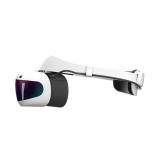 Side view of DPVR E4.

References
- ↑ 1.00 1.01 1.02 1.03 1.04 1.05 1.06 1.07 1.08 1.09 "DPVR E4 Announced with November Launch, Aims to dominating the consumer market for tethered PC VR headsets". DPVR / PR Newswire. 2022-11-28. https://www.prnewswire.com/news-releases/dpvr-e4-announced-with-november-launch-aims-to-dominating-the-consumer-market-for-tethered-pc-vr-headsets-301687567.html. Retrieved 2026-10-14.
- ↑ 2.0 2.1 2.2 "視野角116度・超軽量280g、PC接続型VRヘッドマウントディスプレイ「DPVR E4」取り扱い開始". aiuto. 2023-04-07. https://www.aiuto-jp.co.jp/information/entry_1800.php. Retrieved 2026-10-14.
- ↑ 3.0 3.1 3.2 3.3 "DPVR E4 同梱マニュアル表記の誤りについてお詫びと訂正". aiuto. 2023-04-17. https://www.aiuto-jp.co.jp/information/entry_1830.php. Retrieved 2026-10-14.
- ↑ 4.00 4.01 4.02 4.03 4.04 4.05 4.06 4.07 4.08 4.09 4.10 4.11 4.12 4.13 "DPVR E4 User Manual, Version 2.0". DPVR. https://m.media-amazon.com/images/I/B1q2DM15aaL.pdf. Retrieved 2026-10-14.
- ↑ 5.00 5.01 5.02 5.03 5.04 5.05 5.06 5.07 5.08 5.09 5.10 5.11 5.12 5.13 "DPVR E4". aiuto. https://www.aiuto-jp.co.jp/products/product_4375.php. Retrieved 2026-10-14.
- ↑ 6.00 6.01 6.02 6.03 6.04 6.05 6.06 6.07 6.08 6.09 6.10 6.11 6.12 6.13 6.14 6.15 6.16 6.17 6.18 6.19 6.20 6.21 6.22 "DPVR E4: Gaming PC VR Headset". DPVR. https://www.dpvr.com/en/product/dpvr-e4-pc-virtual-reality-headset/. Retrieved 2026-10-14.
- ↑ 7.0 7.1 7.2 7.3 7.4 7.5 "DPVR Assistant 4 and release notes". DPVR. https://product.dpvr.com/assistant4/download.html. Retrieved 2026-10-14.
- ↑ 8.0 8.1 8.2 8.3 8.4 "DPVR E4 Black Limited Edition ※終息品". aiuto. https://www.aiuto-jp.co.jp/products/product_5130.php. Retrieved 2026-10-14.
- ↑ "DPVR Refines E4 Headset for Commercial and Consumer Excellence–Hardware Updates". DPVR. 2024-03-01. https://www.dpvr.com/en/dpvr-refines-e4-headset-for-commercial-and-consumer-excellence-hardware-updates/. Retrieved 2026-10-14.
- ↑ "PC接続型VR HMD「DPVR E4」のBlackモデルが限定発売!「DPVR E4 Black Limited Edition」取り扱い開始". aiuto. 2024-06-07. https://www.aiuto-jp.co.jp/information/entry_2141.php. Retrieved 2026-10-14.
- ↑ "「DPVR E4」製品仕様変更のお知らせ". aiuto. 2024-11-21. https://www.aiuto-jp.co.jp/information/entry_2263.php. Retrieved 2026-10-14.
- ↑ 12.0 12.1 "DPVR Unveils New Hand-Tracking Supported Headset E4 Arc in Collaboration with Ultraleap". DPVR. 2024-04-23. https://www.dpvr.com/en/e4-arc-new-launch/. Retrieved 2026-10-14.
- ↑ Vladimir Maksimenko; Liting Yuan; Khashayar Kazemzadeh; Prateek Bansal (2026). "Using brain response to measure pedestrian safety perception: evidence from video and VR experiments". Safety Science 199: 107202. doi:10.1016/j.ssci.2026.107202. Retrieved 2026-10-14.