

RayNeo Air 2
More actions
| RayNeo Air 2 | |
|---|---|

| |
| Basic Info | |
| VR/AR | Augmented Reality |
| Type | AR Glasses |
| Subtype | Display Glasses, XR Glasses |
| Platform | External display over USB-C DisplayPort[1] |
| Creator | RayNeo, with TCL backing[2] |
| Developer | RayNeo[2] |
| Manufacturer | RayNeo Co., Ltd.[1] |
| Release Date | November 8, 2023 (US availability reported)[2] |
| Price | US$379 (US recommended retail price, November 2023)[2] |
| Website | https://www.rayneo.com/products/rayneo-air-2-xr-glasses |
| Requires | Compatible DisplayPort source; adapters for other outputs[3] |
| Predecessor | TCL NXTWEAR S (identified in the launch announcement)[2] |
| Successor | RayNeo Air 2s[4] |
| Display | |
| Display | Sony 0.55-inch Micro-OLED[2] |
| Resolution | 1920 x 1080 in 2D; 3840 x 1080 combined input in 3D[5] |
| Pixel Density | Advertised 49 PPD[5] |
| Refresh Rate | 60 Hz / 120 Hz[5] |
| Image | |
| Field of View | Advertised 46 degrees (axis unspecified)[5] |
| Optics | |
| Optics | Birdbath optics[5] |
| Ocularity | Binocular (dual displays)[2] |
| Adjustable Diopter | Correction through magnetic prescription-lens inserts[1] |
| Tracking | |
| Tracking | Accelerometer and gyroscope; software-dependent head tracking[5][6] |
| Audio | |
| Audio | Two super-linear speakers; Whisper Mode[5] |
| Connectivity | |
| Connectivity | USB-C with DisplayPort[5] |
| Ports | USB-C[1] |
| Wired Video | DisplayPort over USB-C[1] |
| Power | Supplied by the connected source or powered adapter[3][7] |
| Device | |
| Dimensions | 174.1 x 154 x 47.4 mm in use; 54.6 x 150.8 x 47.4 mm folded (distributor figures)[5] |
| Weight | Advertised 76 g, including nose pad[5] |
| Sensors | Accelerometer, gyroscope, forehead proximity sensor[5] |
| Input | Source-device controls; volume and display buttons on temples[1] |
| Compliance | Manual: FCC Part 15 Class B statement; EU Directive 2014/30/EU declaration[1] |
The RayNeo Air 2 is a pair of display glasses developed by RayNeo, a company incubated by TCL Electronics. RayNeo reported US availability on November 8, 2023, at a recommended retail price of US$379.[2] The glasses use Sony Micro-OLED displays and birdbath optics to show video from a connected phone, computer or game system. They support 60 Hz and 120 Hz display modes, with a distributor-specified weight of 76 g including the nose pad.[5]
Air 2 has a basic external-display mode and additional software-dependent modes. Its manual describes an XR mode for selected Android devices and a Windows multi-window mode using Mirror Studio. These require a host device and software; the glasses are not a standalone computer.[1] RayNeo Air 2s, introduced in August 2024, is a separate successor model.[4]
History and development
RayNeo's November 2023 announcement identified the TCL NXTWEAR S as the Air 2's predecessor. It described a change to Sony's 0.55-inch Micro-OLED displays and stated that Air 2 was around 15 percent lighter. The company was founded in 2021 and described itself as incubated by TCL Electronics.[2]
| Date | Documented event |
|---|---|
| November 8, 2023 | RayNeo announced that Air 2 was available through its US Amazon store for US$379. Distribution through other regional channels during the fourth quarter of 2023 was a stated plan, rather than proof that every market had received stock that day.[2] |
| February 8, 2024 | Japanese distributor CFD Sales announced the start of handling Air 2, with a scheduled release that day and an expected tax-inclusive retail price of approximately JPY59,800.[8] |
| May 9, 2024 | RayNeo and SEI Robotics announced Pocket TV, a separate Google TV streaming device explicitly compatible with Air 2.[7] |
| August 15, 2024 | RayNeo reported US availability of Air 2s, naming Air 2 as its predecessor. The successor has a four-speaker system and a revised optical engine; those changes do not describe the original Air 2.[4] |
On October 14, 2026, RayNeo's US product page marked Air 2 as out of stock. This is a dated store observation, not confirmation of permanent discontinuation or of availability in other markets.[9]
Display technology
Air 2 combines Sony Micro-OLED displays with a birdbath optical system. CFD Sales specifies a 16:9 image, 1920 x 1080 input in 2D mode and 3840 x 1080 input in 3D mode. The launch announcement describes dual Full HD displays; the 3840 x 1080 3D figure is the combined format rather than the resolution of each display.[5][2] The glasses support switching between ordinary 2D video and stereoscopic 3D video in projection mode.[1][3]
| Item | Published specification and scope |
|---|---|
| Display | Sony low-power Micro-OLED; the launch announcement identifies 0.55-inch panels.[5][2] |
| Resolution | 1920 x 1080 in 2D; 3840 x 1080 in 3D, as listed by CFD Sales.[5] |
| Refresh rate | 60 Hz or 120 Hz. The manual describes a physical button operation for choosing the mode.[5][1] |
| Field of view | 46 degrees. The cited product specification does not label this as horizontal or vertical.[5] |
| Angular pixel density | Advertised 49 pixels per degree. The distributor does not identify this as an average or peak measurement.[5] |
| Virtual-screen comparison | Marketed as equivalent to a 201-inch screen at a distance of 6 m. This is a screen-size analogy tied to viewing distance.[5] |
| Brightness | Advertised 600 nits. CFD Sales labels this as brightness without specifying a measurement plane or laboratory procedure.[5] |
| Contrast and color | Advertised 100,000:1 contrast ratio and 108% sRGB color gamut.[5] |
| Optical measurements | The distributor lists MTF >80%@30lp/[email protected] and TV distortion of 1.2%. These are distributor-listed optical figures.[5] |
RayNeo's Air 2s announcement separates a 5,000-nit screen-brightness claim from a maximum 600-nit to-eye-brightness claim. Comparing the original Air 2's 600-nit specification directly with the successor's 5,000-nit panel figure would mix brightness descriptions.[4]
Physical design and fit
Air 2 has adjustable temples and nose pads. Each temple has three vertical positions, while the nose-pad support can move between three fore-and-aft positions. The pads can also be spread or pinched to change how the frame sits. The manual explains these adjustments as ways to align the image when its top or bottom is difficult to see.[1]
| Item | Documented detail |
|---|---|
| Weight | 76 g including the nose pad, according to CFD Sales.[5] |
| Dimensions in use | 174.1 x 154 x 47.4 mm, as listed by the distributor.[5] |
| Folded dimensions | 54.6 x 150.8 x 47.4 mm, as listed by the distributor.[5] |
| Prescription correction | A prescription-lens frame is supplied. Custom lenses attach magnetically to the inside of the glasses and must be obtained separately.[1] |
| Package contents | Glasses, data cable, portable bag, cleaning cloth, user manual and prescription-lens frame.[1] |
| Sensors | Accelerometer, gyroscope and a forehead proximity sensor.[5] |
The fitting adjustments position the frame and optical image; the manual does not describe them as an adjustable interpupillary-distance mechanism. Prescription inserts provide the documented correction method for nearsighted and farsighted wearers.[1]
Audio and controls
Air 2 has two super-linear speakers. Its Whisper Mode is intended to reduce sound leakage using acoustic phase cancellation.[5] This describes the manufacturer's audio design; it does not guarantee that nearby people cannot hear the output.
The left temple controls volume and audio mode. The right temple controls brightness and refresh rate. The manual documents the following operations; its disclaimer notes that operation can differ with phone or glasses software releases.[1]
| Control | Operation in the Air 2 manual |
|---|---|
| Left front / rear buttons | Increase / decrease volume with a short press. |
| Left front button, held for 2 seconds | Select standard audio mode. |
| Left rear button, held for 2 seconds | Select the quieter mode called "light voice mode" in the English manual. |
| Right front / rear buttons | Increase / decrease brightness with a short press. |
| Right front button, held for 2 seconds | Select 120 Hz. |
| Right rear button, held for 2 seconds | Select 60 Hz. |
| A left and a right button pressed together | Switch 2D / 3D in projection mode; the manual says either front or rear button can be used on each side. |
Connectivity and accessories
The supplied USB-C cable plugs into a temple and a source with DisplayPort video output. A USB-C connector alone does not establish video compatibility. RayNeo's Air 2 FAQ says devices without DP output require an adapter and identifies a powered converter for other video outputs, as well as an adapter for Lightning iPhones and Android phones without DP.[1][3]
RayNeo's product listing names iPhone 15/16, Steam Deck, ROG Ally, MacBook, iPad, Switch, PlayStation and Xbox examples, but also warns that some devices need additional accessories. The type of connection and available software modes depend on the source device.[9][3]
| Connection or accessory | Role and limitations |
|---|---|
| Direct USB-C DisplayPort | External-display connection for supported phones, computers and handhelds. The FAQ requires a direct connection for its documented 3D-video mode.[3] |
| Powered video converter | An option for sources without the required DP connection. The Air 2 FAQ describes supplying 5 V externally and warns that its adapter-based connection is limited to 2D mirroring.[3] |
| JoyDock | A separate Nintendo Switch accessory announced with Air 2. RayNeo described a 10,000 mAh battery for powering the console and glasses; its November 2023 announcement forecast US sales in December rather than proving that later sales date.[2] |
| Pocket TV | A separate Google TV streaming box co-developed with SEI Robotics, with a 6,500 mAh battery, 64 GB of storage and microSD expansion up to 2 TB in the May 2024 announcement. Air 2 is explicitly supported, and Pocket TV supplies power to the glasses. Those components belong to the accessory.[7][10] |
Pocket TV gives Air 2 a portable streaming source. It does not turn the glasses' USB-C link into a wireless video connection or place the streaming box's battery and storage inside the glasses.[7][1]
Software modes and head tracking
The original manual distinguishes projection mode from XR mode. Projection mode displays content from the connected source. XR mode needs the RayNeo XR app on selected Android phones with DP output. The manual also describes Mirror Studio for a Windows multi-window workspace.[1]
| Software or mode | Documented scope |
|---|---|
| Projection mode | Basic video from the source; 2D / 3D switching is available in this mode.[1] |
| RayNeo XR app | RayNeo's download page specifies Android 8.0 or above with 3D and DP functionality for Air-series glasses. Its Air 2 FAQ says the app does not work properly on iPhones or Android phones without DP, and directs Samsung users to disable DeX mode while using it.[11][3] |
| Mirror Studio | A Windows multi-window application described in the Air 2 manual. This is documented historical functionality, rather than a claim that every current Windows version or GPU is compatible.[1] |
| XR Linux Driver | The project's current supported-device table includes Air 2. The driver translates glasses movement into mouse movement or data for applications; it explicitly says it does not provide a 3DoF virtual display by itself.[6] |
| Breezy Desktop | Host software for a virtual workspace using the XR Linux Driver. Documentation checked on October 14, 2026 describes KDE Plasma 6 and GNOME 45-51, with Wayland required for creating virtual displays. The project has trial and paid access conditions for workspace features.[12] |
| XR Gaming | A Steam Deck plugin that uses the supported-device driver and can hold a virtual display in an orientation as the head turns. Its documentation distinguishes this from ordinary mirroring and identifies firmware, plugin mode, rendering latency and calibration as relevant conditions.[13] |
Air 2 therefore has motion sensors and documented host-dependent head-tracking uses. This differs from an independently operating headset with built-in spatial applications. In the Linux software described above, a 3DoF display uses orientation; the driver and workspace application are separate parts of the system.[6][12]
Use cases and limitations
RayNeo markets Air 2 for movies, gaming and use as a portable external display. Its manual also documents a multi-window office mode. A compatible video source, appropriate adapters where needed and model-compatible software determine which of these functions is available.[5][1][3]
In an original review published on November 9, 2023, Nadeem Sarwar reported sharp central imagery but ghosting or blurred text at the vertical edges and corners, especially while reading or using several virtual windows. The review describes informal trials with nearly a dozen people, including prescription-glasses wearers, and reports that fit adjustments improved but did not eliminate the issue. These are observations from that review, not a controlled optical study or a measured defect rate for all Air 2 units.[14]
The same review found that calls switched to the phone's speakers in the tested setup and that Whisper Mode reduced loudness and sound leakage. These results are bounded to the review's devices and launch-era software; they do not establish universal behavior for later firmware.[14]
The manual reports TÜV Rheinland certification for low blue light, flicker-free operation and eye comfort, while also warning that extended display use can cause eye strain. It says the glasses are not waterproof and lists an operating range of 0-50 degrees C. Certification and manufacturer precautions do not establish a clinical benefit or comfort for every wearer.[1]
The manual includes an FCC Part 15 Class B compliance statement. It also records Falcon Innovations Technology (Shenzhen) Co., Ltd.'s declaration that the RayNeo Air 2 product type complies with EU Directive 2014/30/EU.[1]
Product variants
The original Air 2 and Air 2s are separate models. Air 2s was introduced in August 2024 at a US recommended retail price of US$399, with four speakers, a revised optical engine and a stated weight of 78 g. Its advertised screen-brightness and to-eye-brightness figures refer to different parts of the optical system. These successor specifications should not be assigned to Air 2.[4]
See Also
Gallery
-
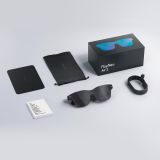 RayNeo Air 2 and its accessories.

References
- ↑ 1.00 1.01 1.02 1.03 1.04 1.05 1.06 1.07 1.08 1.09 1.10 1.11 1.12 1.13 1.14 1.15 1.16 1.17 1.18 1.19 1.20 1.21 1.22 "RayNeo Air 2 User Manual". RayNeo. https://cdn.shopify.com/s/files/1/0688/8642/9983/files/Air_2_Manual_compressed.pdf?v=1719554149. Retrieved 2026-10-14.
- ↑ 2.00 2.01 2.02 2.03 2.04 2.05 2.06 2.07 2.08 2.09 2.10 2.11 2.12 "RayNeo Air 2 XR Glasses Revolutionize Wearable Display User Experience, Launched on Amazon US". RayNeo, distributed by PR Newswire. 2023-11-08. https://www.prnewswire.com/news-releases/rayneo-air-2-xr-glasses-revolutionize-wearable-display-user-experience-launched-on-amazon-us-301982514.html. Retrieved 2026-10-14.
- ↑ 3.0 3.1 3.2 3.3 3.4 3.5 3.6 3.7 3.8 "Air 2 FAQs". RayNeo. https://www.rayneo.com/pages/faq-air-2. Retrieved 2026-10-14.
- ↑ 4.0 4.1 4.2 4.3 4.4 "RayNeo Launches Air 2s: Redefining XR Industry with Symmetric Audio, Visual Brilliance and Ergonomic Comfort". RayNeo, distributed by PR Newswire. 2024-08-15. https://www.prnewswire.com/news-releases/rayneo-launches-air-2s-redefining-xr-industry-with-symmetric-audio-visual-brilliance-and-ergonomic-comfort-302222387.html. Retrieved 2026-10-14.
- ↑ 5.00 5.01 5.02 5.03 5.04 5.05 5.06 5.07 5.08 5.09 5.10 5.11 5.12 5.13 5.14 5.15 5.16 5.17 5.18 5.19 5.20 5.21 5.22 5.23 5.24 5.25 5.26 5.27 "RayNeo Air 2: product specifications". CFD Sales. https://www.cfd.co.jp/consumer/product/detail/rayneo-air-2.html. Retrieved 2026-10-14.
- ↑ 6.0 6.1 6.2 "XR Linux Driver: supported devices and driver documentation". Wayne Heaney on GitHub. https://github.com/wheaney/XRLinuxDriver. Retrieved 2026-10-14.
- ↑ 7.0 7.1 7.2 7.3 "RayNeo and SEI Robotics co-launch Pocket TV, offering a portable Google TV experience for XR glasses". RayNeo, distributed by PR Newswire. 2024-05-09. https://www.prnewswire.com/news-releases/rayneo-and-sei-robotics-co-launch-pocket-tv-offering-a-portable-google-tv-experience-for-xr-glasses-302140621.html. Retrieved 2026-10-14.
- ↑ "TCL RayNeo consumer wearable smart glasses RayNeo Air 2: distribution announcement". CFD Sales. 2024-02-08. https://www.cfd.co.jp/consumer/product/release/rayneo-air-2.html. Retrieved 2026-10-14.
- ↑ 9.0 9.1 "RayNeo Air 2 AR Glasses". RayNeo. https://www.rayneo.com/products/rayneo-air-2-xr-glasses. Retrieved 2026-10-14.
- ↑ "Pocket TV FAQs". RayNeo. https://www.rayneo.com/pages/faq-pocket-tv. Retrieved 2026-10-14.
- ↑ "Download: RayNeo XR APP". RayNeo. https://www.rayneo.com/pages/download. Retrieved 2026-10-14.
- ↑ 12.0 12.1 "Breezy Desktop: virtual workspace documentation". Wayne Heaney on GitHub. https://github.com/wheaney/breezy-desktop. Retrieved 2026-10-14.
- ↑ "XR Gaming: virtual display documentation". Wayne Heaney on GitHub. https://github.com/wheaney/decky-XRGaming. Retrieved 2026-10-14.
- ↑ 14.0 14.1 "RayNeo Air 2 Review: XR Smart Glasses Look Great, But What's Missing?". SlashGear. 2023-11-09. https://www.slashgear.com/1442042/rayneo-air-2-review-xr-smart-glasses-look-price/. Retrieved 2026-10-14.