

Microsoft HoloLens 2
More actions
| Microsoft HoloLens 2 | |
|---|---|
 
| |
| Basic Info | |
| VR/AR | Mixed Reality |
| Type | AR Glasses |
| Subtype | Enterprise AR |
| Platform | Windows Holographic |
| Developer | Microsoft |
| Manufacturer | Microsoft |
| Announcement Date | February 24, 2019 (Mobile World Congress 2019)[1] |
| Release Date | November 7, 2019 (first deliveries to preorder customers)[2] |
| Price | US$3,500 at launch; Dynamics 365 Remote Assist bundles from US$125 per month[1] |
| Website | https://www.microsoft.com/hololens |
| Versions | HoloLens 2, HoloLens 2 Development Edition, HoloLens 2 Industrial Edition, Trimble XR10 (Trimble hard-hat version) |
| Requires | A user account (Microsoft Entra ID, Microsoft account or local account) |
| Predecessor | Microsoft HoloLens |
| System | |
| Operating System | Windows Holographic (Windows 10 based; Windows 11 based from version 23H1) |
| Chipset | Qualcomm Snapdragon 850 Compute Platform[3] |
| HPU | Second-generation custom Holographic Processing Unit (HPU 2.0) |
| Storage | |
| Storage | 64 GB UFS 2.1 |
| Memory | 4 GB LPDDR4x |
| Display | |
| Display | Laser light scanned by MEMS mirrors into see-through waveguides |
| Resolution | "2k 3:2 light engines" (Microsoft); default render target 1440 x 936[4] |
| Pixel Density | More than 2.5k radiants (light points per radian); Microsoft cited 47 pixels per degree |
| Refresh Rate | Applications target 60 frames per second |
| Image | |
| Field of View | 52 degrees diagonal (3:2 aspect ratio)[5] |
| Optics | |
| Optics | See-through holographic lenses (waveguides); fixed focal distance of about 2.0 m |
| Ocularity | Binocular |
| Passthrough | Optical see-through |
| Tracking | |
| Tracking | 6DoF world-scale inside-out tracking |
| Eye Tracking | Yes (two infrared cameras) |
| Hand Tracking | Yes (two-handed, fully articulated) |
| Audio | |
| Audio | Built-in spatial sound speakers |
| Microphone | 5-channel microphone array |
| Camera | 8 MP stills, 1080p30 video |
| Connectivity | |
| Ports | USB Type-C (DRP) |
| WiFi | 802.11ac 2x2 |
| Bluetooth | 5.0 |
| Power | Internal lithium battery; 18 W (9 V, 2 A) USB-C charger included |
| Battery Life | 2-3 hours of active use; up to two weeks standby |
| Device | |
| Weight | 566 g |
| Material | Carbon fiber |
| Sensors | 4 visible-light head-tracking cameras, 2 infrared eye-tracking cameras, 1 MP time-of-flight depth sensor, accelerometer, gyroscope, magnetometer |
| Input | Articulated hand tracking, eye gaze, voice |
The Microsoft HoloLens 2 is a standalone mixed reality head-mounted display developed by Microsoft for business and industrial users. Microsoft announced it at Mobile World Congress in Barcelona on February 24, 2019, at a price of US$3,500, and began delivering it to preorder customers on November 7, 2019.[1][2] It succeeded the original Microsoft HoloLens and runs Windows Holographic on a Qualcomm Snapdragon 850 Compute Platform, with a second-generation Holographic Processing Unit handling sensor processing and tracking.[3]
Compared with the first model, HoloLens 2 has a larger field of view (52 degrees diagonally against 34 degrees), fully articulated hand tracking, eye tracking with iris sign-in, a visor that flips up, and a redesigned headband that moves the processor and battery to the back of the head.[1][5][6] Its display uses lasers and scanning mirrors feeding waveguides, a design whose sharpness Microsoft and independent display analysts have described very differently.[6][7] The headset was also the technical basis for the US Army's Integrated Visual Augmentation System.[8]
Microsoft confirmed on October 1, 2024 that it had stopped producing HoloLens 2, had signaled a last time to buy, and would end support, including security updates, on December 31, 2027. No successor was announced.[9] As of October 2026 the device still receives monthly security updates; the most recent listed release is the September 2026 Update (build 22621.1560).[10]
Announcement and release
Mobile World Congress 2019
Microsoft unveiled HoloLens 2 at a press event at Mobile World Congress on February 24, 2019. In the company's announcement post, Microsoft Azure corporate vice president Julia White gave the price as US$3,500, opened preorders the same day, and named ten initial markets: the United States, Japan, China, Germany, Canada, the United Kingdom, Ireland, France, Australia and New Zealand. Customers could also buy it in a bundle with Microsoft's Dynamics 365 Remote Assist software starting at US$125 per month.[1] White wrote that Microsoft had "more than doubled the field of view" while keeping 47 pixels per degree, and that it had "more than tripled the measured comfort and ergonomics of the device."[1]
Alex Kipman, the Microsoft technical fellow in charge of the HoloLens project, presented the device on stage.[5][6] A Microsoft feature story published the same day quoted him saying, "For the first time, you're going to feel what it feels like to touch a hologram," and described early work with customers and partners including PACCAR, Alaska Airlines, PTC and Bentley Systems.[11] The Verge reported that Microsoft would sell the headset only to enterprise customers and had not announced a developer kit at that point; Kipman described the target users as "first-line workers", such as people in auto shops, on factory floors, in operating rooms and in field repair.[6]
Microsoft announced several related products at the same event: the Azure Kinect DK developer kit (US$399 preorder), a preview of the Dynamics 365 Guides work-instruction app, a public preview of Azure Spatial Anchors, a private preview of Azure Remote Rendering, and a HoloLens Customization Program for partners who wanted to adapt the hardware. Mozilla said it would bring a Firefox Reality browser prototype to the headset, and Epic Games announced Unreal Engine 4 support for HoloLens.[1]
The launch came days after more than 200 Microsoft employees signed a letter asking the company to drop a US$479 million US Army contract for HoloLens technology, writing, "We did not sign up to develop weapons, and we demand a say in how our work is used." Microsoft chief executive Satya Nadella defended the contract in an interview with CNN, saying, "We made a principled decision that we're not going to withhold technology from institutions that we have elected in democracies to protect the freedoms we enjoy."[12]
Development Edition and shipping
On May 2, 2019, Microsoft announced the HoloLens 2 Development Edition at US$3,500 or US$99 per month. It used the same hardware as the standard model and added US$500 in Azure credits and three-month trials of Unity Pro and the Unity PiXYZ plugin for importing CAD data; buyers had to be members of Microsoft's Mixed Reality Developer Program.[13]
HoloLens 2 began shipping on November 7, 2019. The Verge reported that the first deliveries went to preorder customers in the United States, France, Germany, Ireland, New Zealand, Australia and the United Kingdom, and that the product was aimed only at business customers, especially in manufacturing and repair. Microsoft communications director Greg Sullivan told the publication that preorder customers were a mix of new buyers and owners replacing first-generation devices.[2] The first operating system release for the headset, Windows Holographic version 1903, is dated November 2019.[10]
Industrial Edition and partner versions
In early February 2021, Microsoft introduced the HoloLens 2 Industrial Edition for regulated environments at US$4,950, with shipments from spring 2021. It is rated for clean rooms (ISO 14644-1 Class 5-8) and for hazardous locations (UL Class I, Division 2), and carries a two-year warranty and a Rapid Replacement Program.[14]
The Trimble XR10 with HoloLens 2, announced alongside the headset, integrates it into a hard hat for safety-controlled work sites. It was the first device built through the HoloLens Customization Program and was offered for preorder at a manufacturer's suggested retail price of US$4,750.[1][15]
| Version | Announced | Price at launch | Notes |
|---|---|---|---|
| HoloLens 2 | February 24, 2019 | US$3,500 | Shipped from November 7, 2019; sold to business customers[1][2] |
| HoloLens 2 Development Edition | May 2, 2019 | US$3,500 or US$99 per month | Same hardware; Azure credits and Unity software trials[13] |
| HoloLens 2 Industrial Edition | February 2021 | US$4,950 | Clean room and hazardous location ratings, two-year warranty[14] |
| Trimble XR10 with HoloLens 2 | February 24, 2019 | US$4,750 (MSRP) | Hard-hat version made by Trimble[15] |
Design and hardware
Display and optics
HoloLens 2 replaced the display system of the first HoloLens with a laser scanning design. In The Verge's description, lasers shine into mirrors that oscillate up to 54,000 times per second to paint the image, forming a microelectromechanical system (MEMS) display. The light then enters waveguides, which on HoloLens 2 use two sandwiched glass plates instead of three. The Verge wrote that the waveguide needs no individual fitting and sits far enough from the eyes for the wearer to keep prescription glasses on; Zulfi Alam, Microsoft's general manager for optics engineering, said the company simulated the path of every photon from the lasers, work that The Verge wrote required custom silicon. The pre-release units The Verge tried had their displays set to 500 nits; according to the publication, Microsoft thought the final version could be much brighter, depending on power draw.[6]
Microsoft's specification lists see-through holographic lenses (waveguides), "2k 3:2 light engines", a holographic density of more than 2.5k radiants (light points per radian), and eye-based rendering that optimizes the display for each user's 3D eye position.[3] Microsoft does not publish a native panel resolution in pixels. Its developer documentation gives a default and maximum render target size of 1440 x 936, which applications can scale down to a minimum viewport of 634 x 412; the system then upscales the image to fill the displays.[4] Developers are told to maintain a constant 60 frames per second, since lower rates cause judder.[16]
Microsoft's comfort guidance states that HoloLens displays are fixed at an optical distance of about 2.0 m, so the wearer's eyes always focus at that distance. To limit discomfort from the vergence-accommodation conflict, the guidance recommends keeping content that users converge on as close to 2.0 m as possible.[17]
Field of view
On stage, Microsoft described the field of view only as "more than double" that of the original HoloLens. Road to VR later reported that the figure referred to area, and that Kipman had given the diagonal values to Wired before the reveal: 34 degrees (16:9) for the first HoloLens and 52 degrees (3:2) for HoloLens 2. The publication also found that a comparison graphic shown at the presentation implied a 5.2-fold area increase; Microsoft called it an "illustration".[5] UploadVR calculated approximate per-axis values of 43 degrees horizontal and 29 degrees vertical from the 52-degree diagonal and the 3:2 aspect ratio. Those numbers are the publication's estimate, not figures Microsoft published.[18]
Resolution dispute
Microsoft presented HoloLens 2 as keeping the 47 pixels per degree of its predecessor, and The Verge wrote that this density was high enough to read 8-point text.[1][6] Display analyst Karl Guttag disputed the figure after testing the headset. He counted about 854 scan lines at the center of the image but estimated the effective resolution at roughly 600 lines, or about 20 pixels per degree, and wrote that in side-by-side photographs the first HoloLens, which uses LCOS microdisplays, was "dramatically sharper". He also reported temporal artifacts such as flickering edges from the scanning pattern.[7]
Processing
The main processor is a Qualcomm Snapdragon 850 Compute Platform with 4 GB of LPDDR4x memory and 64 GB of UFS 2.1 storage.[3] The first HoloLens used an Intel processor; Kipman told The Verge that "ARM rules in battery-operated devices" and that Intel had no suitable system on chip for such a product.[6]
The second-generation Holographic Processing Unit (HPU 2.0) is a custom Microsoft chip. At the Hot Chips 31 conference in August 2019, Microsoft described it as a 79 mm2 die built on TSMC's 16FF+ process with 2 billion transistors, 125 Mb of SRAM and more than 1 TOPS of programmable compute spread across 13 statically assigned compute cores. It connects to the Snapdragon 850 over a PCIe 2.0 x1 link at 100 MB/s, receives the rendered images over MIPI, and applies several pose updates per frame for hologram stability, with a hardened block that decouples the render resolution from the display resolution.[19] According to a Microsoft technical report, the HPU sits at the front of the headset next to the sensors, runs all of the on-device computer vision (head, hand and eye tracking, spatial mapping) and hosts a deep neural network core, leaving the Snapdragon's CPU fully available to applications. The Snapdragon sits at the rear.[20]
Sensors and tracking
HoloLens 2 uses markerless inside-out tracking for world-scale six degrees of freedom tracking, builds a real-time mesh of the environment, and supports mixed reality capture of combined hologram and camera photos and videos.[3] Microsoft's Research Mode report describes how the sensors are used: four grayscale cameras run visual-inertial SLAM, while the time-of-flight depth camera works in two modes, a 45 fps near-depth mode for hand tracking (hands are supported up to 1 m from the device) and a 1-5 fps long-range mode for spatial mapping.[20]
| Sensor | Specification | Use |
|---|---|---|
| Visible-light cameras | 4; focal length 1.08 mm, 96.1 degrees diagonal field of view, 98.6 mm stereo baseline for the forward pair[3] | Head tracking; grayscale at 30 fps[20] |
| Infrared cameras | 2[3] | Eye tracking and iris sign-in |
| Depth sensor | 1 MP time-of-flight[3] | Hand tracking (45 fps) and spatial mapping (1-5 fps)[20] |
| Inertial measurement unit | Accelerometer, gyroscope, magnetometer[3] | Motion, gravity and absolute orientation[20] |
| Photo/video camera | 8 MP stills, 1080p30 video[3] | Capture and video calls |
| Microphones | 5-channel array[3] | Voice commands and calls |
Ergonomics and build
The headset consists of a visor holding the sensors and displays, and a headband tightened with an adjustment wheel at the back. The visor can be rotated up while the headset is worn. Brightness buttons sit on the left of the visor and volume buttons on the right; the power button and USB-C port are on the rear cover. The box includes a removable brow pad, an optional overhead strap, a USB-C charger and cable, and a cleaning cloth. Microsoft lists a single size that fits over eyeglasses and a weight of 566 grams.[3] UploadVR's hands-on at the launch event put it at 13 g lighter than the first HoloLens.[21]
Microsoft's device design team told The Verge that it tested many materials before choosing carbon fiber to save weight, used a database of about 600 head shapes, and measured neck muscle strain to place the center of gravity. The main processor and battery moved to a module at the back of the head, which put the balance point behind the ears. The headset is not much lighter than the original but feels lighter because of that balance.[6] The device is passively cooled without fans, and Microsoft states that it meets the basic impact protection requirements of the ANSI Z87.1, CSA Z94.3 and EN 166 eye-protection standards.[3]
Power
Microsoft rates the battery at 2-3 hours of active use and up to two weeks of standby. At the reveal, Road to VR noted that the active-use figure was roughly in line with the original HoloLens.[22] The included 18 W charger supplies 9 V at 2 A; the device stays fully functional while charging, but it needs at least a 15 W charger to hold or raise its battery level while switched on.[3] In UploadVR's 2021 review, intermittent use gave about three hours, while heavy use in Microsoft Mesh reduced that to around two hours or less.[23]
Software and features
Operating system
HoloLens 2 runs Windows Holographic, a version of Windows built for the device. It was originally based on Windows 10;[3] with version 23H1 in June 2023 the headset moved to Windows 11, and upgrading requires a device on build 20346.1002 (21H1) or newer.[10] Preinstalled apps include Microsoft Edge, the Microsoft Store, 3D Viewer, OneDrive, Dynamics 365 Guides and Dynamics 365 Remote Assist.[3]
| Version | Date | Build |
|---|---|---|
| 1903 | November 2019 | 18362.1039 |
| 2004 | May 2020 | 19041.1103 |
| 20H2 | November 2020 | 19041.1128 |
| 21H1 | May 2021 | 20346.1002 |
| 21H2 | October 2021 | 20348.1432 |
| 22H1 | April 2022 | 20348.1501 |
| 22H2 | November 2022 | 20348.1528 |
| 23H1 (first Windows 11 based release) | June 2023 | 22621.1113 |
| 23H2 | October 2023 | 22621.1244 |
| 24H1 | May 2024 | 22621.1376 |
| 24H1 November 2024 Update (final feature release) | November 2024 | 22621.1409 |
Source for table: Microsoft's HoloLens 2 release notes.[10]
Input, eye tracking and identity
Input is controller-free. Microsoft lists a two-handed, fully articulated hand model with direct manipulation of holograms, real-time eye tracking, and voice commands that work on the device, with Cortana natural-language requests when connected to the internet.[3] The eye tracking API gives applications a combined gaze ray at about 30 Hz, accurate to roughly 1.5 degrees of visual angle around the target; an extended API adds separate left and right eye vectors and frame rates of 30, 60 or 90 fps.[24]
Each user calibrates by following a set of targets. The system uses the measured eye positions for hologram alignment and display quality, so there is no manual interpupillary distance setting on HoloLens 2. Up to 50 calibration profiles are stored on the device, and since Windows Holographic 20H2 an "Auto Eye Position" feature estimates eye positions for uncalibrated users within 20 to 30 seconds.[25]
The eye cameras also support Windows Hello iris sign-in. Microsoft states that the biometric data is stored only on the device and never sent to servers, and that iris authentication reaches a false acceptance rate of 1 in 100,000. A device joined to Microsoft Entra ID supports up to 63 accounts, of which Microsoft recommends no more than 10 enroll for iris sign-in.[26]
Development
Applications can be built with Unity, Unreal Engine or native code through OpenXR. Microsoft's OpenXR runtime exposes HoloLens 2 features such as articulated hand tracking, eye gaze, spatial anchors and scene understanding through vendor and cross-vendor extensions; from Unity 2021.3 LTS, OpenXR is the only supported Unity backend for the device, and Unreal Engine 4.26 added built-in OpenXR support for it. The Mixed Reality Toolkit supports OpenXR from version 2.7.[27] In an August 2020 technical report, Microsoft researchers described Research Mode, an API and tool set that gives access to the raw camera, depth and IMU streams for computer vision and robotics research.[20]
Enterprise software
Microsoft's own business apps for the headset were Dynamics 365 Remote Assist, for video calls with remote experts who can annotate the wearer's view, and Dynamics 365 Guides, for step-by-step holographic work instructions.[1][3] Microsoft has announced that both apps will no longer be available after December 31, 2026; the Remote Assist mobile app was deprecated on March 25, 2025.[28]
Military use
The Integrated Visual Augmentation System (IVAS), a soldier headset developed for the US Army, was based on HoloLens. When the Army moved IVAS from prototyping to production in March 2021, Kipman described the headset as "based on HoloLens and augmented by Microsoft Azure cloud services".[8] The Verge reported that the Army had planned to spend up to US$21.9 billion over the ten-year contract, and Microsoft's 2024 discontinuation statement said it remained "fully committed to the IVAS program".[9] In February 2025 Microsoft and Anduril Industries announced that Anduril would take over IVAS as prime contractor, pending Department of Defense approval, with Microsoft staying on as cloud provider.[29] Breaking Defense reported in April 2025 that, according to Anduril, the Army had signed off on the contract novation on April 10, and that Microsoft confirmed the transfer.[30] The later history of the program is covered in the Integrated Visual Augmentation System article.
Discontinuation and support
On October 1, 2024, Microsoft confirmed to The Verge that it was no longer producing HoloLens 2. In an emailed statement, Microsoft general manager Craig Cincotta said the company had "signaled a last time to buy for customers and partners", that support including security updates would end on December 31, 2027, and that Microsoft would continue in mixed reality through first-party software and services while partnering with phone and mixed reality hardware makers. The Verge noted that former HoloLens head Alex Kipman had left Microsoft in 2022, that layoffs in January 2023 had hit Microsoft's devices teams and further layoffs earlier in 2024 had affected HoloLens 2 staff, and that Microsoft had reportedly dropped plans for a HoloLens 3.[9] Road to VR reported that remaining units were sold subject to availability, that updates would cover critical security issues and major regressions, and that the warranty terms were unchanged.[31]
Microsoft's release notes call the November 2024 Update (build 22621.1409) the final feature release for HoloLens 2, with monthly security servicing continuing through December 2027. For the United Kingdom's Product Security and Telecommunications Infrastructure (PSTI) Act, Microsoft gives a minimum security update period of February 28, 2028 for units bought up to February 28, 2025, and states that "As of December 2024, HoloLens devices are no longer manufactured."[10] Monthly security updates continued through 2025 and 2026, with the September 2026 Update listed as the current release.[10]
Reception
Early hands-on reports at Mobile World Congress were mostly positive about comfort and interaction. The Verge's Dieter Bohn wrote that the headset was "better in nearly every important way" than the first HoloLens and that it had moved from a short demo to something people might use "for a few hours if the software was really useful", although he saw small halos around some holograms on pre-release hardware.[6] Road to VR's Scott Hayden found the fit secure even without the top strap and called the eye-tracked text scrolling "simple, but extremely effective", while noting that bright lighting washed out some image detail.[32] UploadVR's Jamie Feltham called the larger field of view "a welcome step up" but "not a revelation", and wrote that the hand-tracking sensor's field of view was larger than the display's, although gestures outside it still caused problems.[21]
In a full review in April 2021, Feltham called HoloLens 2 "far more comfortable than almost any VR headset I've used" and described its depth-sensor hand tracking as "incredibly solid", but named the field of view as its main flaw and called the US$3,500 price "insanely expensive". He described it as a proof-of-concept device that did not feel ready for mass adoption, mainly because of its field of view.[23] Karl Guttag's display measurements, discussed above, disputed Microsoft's resolution claims.[7]
Researchers have also measured the headset's tracking. A 2021 study in Multimodal Technologies and Interaction that used an OptiTrack motion-capture system as ground truth found HoloLens 2 hand-tracking measurements accurate to around 2 cm, against millimetre-range results for the HTC Vive's tracked controller; the authors attributed much of the gap to tracking a bare hand instead of a controller.[33]
See also
- Microsoft HoloLens
- HoloLens 2 Industrial Edition
- Trimble XR10
- Integrated Visual Augmentation System
- Windows Mixed Reality
- Holographic Processing Unit
- Magic Leap 2
- Magic Leap One
- Lenovo ThinkReality A3
- Varjo XR-4
Gallery
-
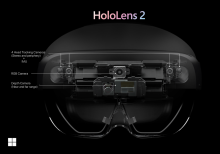 HoloLens 2 sensor layout.

References
- ↑ 1.00 1.01 1.02 1.03 1.04 1.05 1.06 1.07 1.08 1.09 1.10 Julia White (2019-02-24). "Microsoft at MWC Barcelona: Introducing Microsoft HoloLens 2". The Official Microsoft Blog. Microsoft. https://blogs.microsoft.com/blog/2019/02/24/microsoft-at-mwc-barcelona-introducing-microsoft-hololens-2/. Retrieved 2026-10-12.
- ↑ 2.0 2.1 2.2 2.3 Adi Robertson (2019-11-07). "The Microsoft HoloLens 2 ships today for $3,500". The Verge. https://www.theverge.com/2019/11/7/20946589/microsoft-hololens-2-mixed-reality-headset-preorder-shipping-price-upgrade. Retrieved 2026-10-12.
- ↑ 3.00 3.01 3.02 3.03 3.04 3.05 3.06 3.07 3.08 3.09 3.10 3.11 3.12 3.13 3.14 3.15 3.16 3.17 "HoloLens 2 hardware". Microsoft Learn. Microsoft. https://learn.microsoft.com/en-us/hololens/hololens2-hardware. Retrieved 2026-10-12.
- ↑ 4.0 4.1 "Rendering - Mixed Reality". Microsoft Learn. Microsoft. https://learn.microsoft.com/en-us/windows/mixed-reality/develop/advanced-concepts/rendering-overview. Retrieved 2026-10-12.
- ↑ 5.0 5.1 5.2 5.3 Ben Lang (2019-02-27). "Microsoft Significantly Misrepresented HoloLens 2's Field of View at Reveal". Road to VR. https://roadtovr.com/microsoft-significantly-misrepresented-hololens-2s-field-of-view-at-reveal/. Retrieved 2026-10-12.
- ↑ 6.0 6.1 6.2 6.3 6.4 6.5 6.6 6.7 6.8 Dieter Bohn (2019-02-24). "Microsoft's HoloLens 2: a $3,500 mixed reality headset for the factory, not the living room". The Verge. https://www.theverge.com/2019/2/24/18235460/microsoft-hololens-2-price-specs-mixed-reality-ar-vr-business-work-features-mwc-2019. Retrieved 2026-10-12.
- ↑ 7.0 7.1 7.2 Karl Guttag (2020-07-08). "Hololens 2 Display Evaluation (Part 2: Comparison to Hololens 1)". KGOnTech. https://kguttag.com/2020/07/08/hololens-2-display-evaluation-part-2-comparison-to-hololens-1/. Retrieved 2026-10-12.
- ↑ 8.0 8.1 Alex Kipman (2021-03-31). "Army moves Microsoft HoloLens-based headset from prototyping to production phase". The Official Microsoft Blog. Microsoft. https://blogs.microsoft.com/blog/2021/03/31/army-moves-microsoft-hololens-based-headset-from-prototyping-to-production-phase/. Retrieved 2026-10-12.
- ↑ 9.0 9.1 9.2 Tom Warren (2024-10-01). "Microsoft is discontinuing its HoloLens headsets". The Verge. https://www.theverge.com/2024/10/1/24259369/microsoft-hololens-2-discontinuation-support. Retrieved 2026-10-12.
- ↑ 10.0 10.1 10.2 10.3 10.4 10.5 "HoloLens 2 release notes". Microsoft Learn. Microsoft. https://learn.microsoft.com/en-us/hololens/hololens-release-notes. Retrieved 2026-10-12.
- ↑ Jennifer Langston (2019-02-24). "New HoloLens 2 gives Microsoft the edge in the next generation of computing". Microsoft Source. Microsoft. https://news.microsoft.com/innovation-stories/hololens-2/. Retrieved 2026-10-12.
- ↑ Lucas Matney (2019-02-25). "Microsoft CEO defends work on half-billion-dollar HoloLens military contract". TechCrunch. https://techcrunch.com/2019/02/25/microsoft-ceo-says-company-isnt-walking-away-from-half-billion-dollar-military-contract. Retrieved 2026-10-12.
- ↑ 13.0 13.1 Frederic Lardinois (2019-05-02). "Microsoft announces the $3,500 HoloLens 2 Development Edition". TechCrunch. https://techcrunch.com/?p=1821279. Retrieved 2026-10-12.
- ↑ 14.0 14.1 Harry Baker (2021-02-03). "Microsoft Introduces New HoloLens 2 Industrial Edition". UploadVR. https://uploadvr.com/hololens-2-industrial-edition/. Retrieved 2026-10-12.
- ↑ 15.0 15.1 David Malone (2019-03-07). "Trimble unveils new mixed-reality device with Microsoft HoloLens 2 technology". Building Design + Construction. https://www.bdcnetwork.com/home/news/55162350/trimble-unveils-new-mixed-reality-device-with-microsoft-hololens-2-technology. Retrieved 2026-10-12.
- ↑ "Hologram stability - Mixed Reality". Microsoft Learn. Microsoft. https://learn.microsoft.com/en-us/windows/mixed-reality/develop/advanced-concepts/hologram-stability. Retrieved 2026-10-12.
- ↑ "Comfort - Mixed Reality". Microsoft Learn. Microsoft. https://learn.microsoft.com/en-us/windows/mixed-reality/design/comfort. Retrieved 2026-10-12.
- ↑ David Heaney (2019-02-25). "HoloLens 2's Field of View Revealed". UploadVR. https://uploadvr.com/hololens-2-field-of-view/. Retrieved 2026-10-12.
- ↑ Ian Cutress (2019-08-20). "Hot Chips 31 Live Blogs: Microsoft Hololens 2.0 Silicon". AnandTech. https://web.archive.org/web/20190821043257/https://www.anandtech.com/show/14775/hot-chips-31-live-blogs-microsoft-hololens-20-silicon. Retrieved 2026-10-12.
- ↑ 20.0 20.1 20.2 20.3 20.4 20.5 Dorin Ungureanu, Federica Bogo, Silvano Galliani, Pooja Sama, Xin Duan, Casey Meekhof, Jan Stühmer, Thomas J. Cashman, Bugra Tekin, Johannes L. Schönberger, Pawel Olszta, Marc Pollefeys (2020-08-25). "HoloLens 2 Research Mode as a Tool for Computer Vision Research". arXiv (Microsoft technical report). https://arxiv.org/abs/2008.11239. Retrieved 2026-10-12.
- ↑ 21.0 21.1 Jamie Feltham (2019-02-25). "MWC 2019: HoloLens 2 Is An AR Headset I'd Actually Use". UploadVR. https://uploadvr.com/mwc-2019-hololens-2/. Retrieved 2026-10-12.
- ↑ Ben Lang (2019-02-24). "HoloLens 2 Specs Reveal 2-3 Hour 'Active' Battery Life, Optional Top Strap, & More". Road to VR. https://www.roadtovr.com/hololens-2-specs-resolution-field-of-view-battery-life/. Retrieved 2026-10-12.
- ↑ 23.0 23.1 Jamie Feltham (2021-04-09). "HoloLens 2 Review: Ahead Of Its Time, For Better And Worse". UploadVR. https://uploadvr.com/hololens-2-review/. Retrieved 2026-10-12.
- ↑ "Eye tracking overview - Mixed Reality". Microsoft Learn. Microsoft. https://learn.microsoft.com/en-us/windows/mixed-reality/design/eye-tracking. Retrieved 2026-10-12.
- ↑ "Improve visual quality and comfort". Microsoft Learn. Microsoft. https://learn.microsoft.com/en-us/hololens/hololens-calibration. Retrieved 2026-10-12.
- ↑ "Manage user identity and login for HoloLens". Microsoft Learn. Microsoft. https://learn.microsoft.com/en-us/hololens/hololens-identity. Retrieved 2026-10-12.
- ↑ "OpenXR - Mixed Reality". Microsoft Learn. Microsoft. https://learn.microsoft.com/en-us/windows/mixed-reality/develop/native/openxr. Retrieved 2026-10-12.
- ↑ "Welcome to Dynamics 365 Remote Assist". Microsoft Learn. Microsoft. https://learn.microsoft.com/en-us/dynamics365/mixed-reality/remote-assist/ra-overview. Retrieved 2026-10-12.
- ↑ Julie Bort (2025-02-11). "Anduril takes control of Microsoft's $22B VR military headset program". TechCrunch. https://techcrunch.com/2025/02/11/anduril-takes-control-of-microsofts-22b-vr-military-headset-program/. Retrieved 2026-10-12.
- ↑ Ashley Roque (2025-04-15). "Anduril gets green light from Army to take over Microsoft's IVAS project: Exec". Breaking Defense. https://breakingdefense.com/2025/04/anduril-gets-green-light-from-army-to-take-over-microsofts-ivas-project-exec/. Retrieved 2026-10-12.
- ↑ Scott Hayden (2024-10-01). "Microsoft Discontinues HoloLens 2, Support to End in 2027 with No Successor in Sight". Road to VR. https://www.roadtovr.com/microsoft-hololens-2-discontinued-support-2027-hololens-3/. Retrieved 2026-10-12.
- ↑ Scott Hayden (2019-02-26). "Hands-on: HoloLens 2 is a More Than Just a Larger Field of View". Road to VR. https://www.roadtovr.com/hololens-2-hands-on-preview-mwc-2019/. Retrieved 2026-10-12.
- ↑ Inês Soares, Ricardo B. Sousa, Marcelo Petry, António Paulo Moreira (2021-08-23). "Accuracy and Repeatability Tests on HoloLens 2 and HTC Vive". Multimodal Technologies and Interaction, vol. 5, no. 8. https://doi.org/10.3390/mti5080047. Retrieved 2026-10-12.