

Lenovo ThinkReality A3
More actions
| Lenovo ThinkReality A3 | |
|---|---|

| |
| Basic Info | |
| VR/AR | Augmented Reality |
| Type | AR Glasses |
| Subtype | Enterprise AR |
| Platform | Windows PCs (PC Edition), Android Motorola smartphones (Industrial Edition) |
| Creator | Lenovo |
| Developer | Lenovo |
| Manufacturer | Lenovo |
| Announcement Date | 10 January 2021 (CES 2021) |
| Release Date | Mid-2021 (select markets, Lenovo's announced window); April 2022 (Japan) |
| Price | US$1,499.99 (PC Edition, Lenovo US store, 2023); 192,500 yen (PC Edition) and 544,500 yen (Industrial Edition bundle), Japan, 2022, tax included |
| Website | https://www.lenovo.com/us/en/thinkrealitya3 |
| Versions | ThinkReality A3 PC Edition (part number 20V7Z9AKXX), ThinkReality A3 Industrial Edition |
| Requires | Compatible Windows PC with USB-C DisplayPort output (PC Edition) or select Motorola smartphone (Industrial Edition) |
| System | |
| Chipset | Qualcomm Snapdragon XR1 (Lenovo: "Qualcomm XR-1 SmartViewer") |
| GPU | Integrated Adreno |
| Display | |
| Display | Two 1080p displays, 200 nits (Lenovo figure) |
| Resolution | 1920 x 1080 per eye (1080p), 45 pixels per degree (Lenovo figure) |
| Refresh Rate | 60Hz |
| Optics | |
| Optics | Birdbath optics |
| Ocularity | Binocular |
| Adjustable Diopter | No (prescription inserts available) |
| Passthrough | Optical see-through |
| Tracking | |
| Tracking | 6DoF room-scale tracking with dual fisheye cameras |
| Audio | |
| Audio | Integrated stereo speakers |
| Microphone | Three noise-suppressing microphones |
| Camera | 8MP RGB camera (1080p video); dual fisheye tracking cameras |
| Connectivity | |
| Connectivity | USB-C 3.2 Gen 1 (Lenovo store listing; the 2020 product sheet says USB 3.1), DisplayPort 1.4 |
| Ports | USB-C (removable cable) |
| Power | Powered by the host device over USB-C |
| Device | |
| Weight | 130 g (Lenovo figure; the 2020 product sheet says under 130 g) |
| Color | Black |
| Sensors | Dual fisheye tracking cameras, 8MP RGB camera |
| Input | Host device controls; head and gaze tracking; voice recognition |
The Lenovo ThinkReality A3 is a pair of tethered augmented reality smart glasses made by Lenovo for business use. The glasses tether over a single USB-C cable to a host that runs the applications: a Windows laptop in the PC Edition, or a select Motorola smartphone in the Industrial Edition. The frame contains a Qualcomm Snapdragon XR1 chip, two 1080p displays, an 8-megapixel camera and two fisheye cameras for six-degrees-of-freedom tracking.[1] Lenovo marketed the PC Edition as a private multi-monitor workspace that can place up to five virtual displays around the wearer, and the Industrial Edition for remote assistance, guided workflows and 3D visualization in settings from factory floors and laboratories to retail and hospitality spaces.[1]
Lenovo announced the A3 at the online CES 2021 on 10 January 2021 and said it would reach select markets worldwide from mid-2021; it gave no price at announcement.[1][2] Lenovo's US store later listed the PC Edition at US$1,499.99.[3] From November 2021 the A3 was also the first hardware supported by Qualcomm's Snapdragon Spaces developer platform, and in June 2022 it went on sale, paired with a Motorola edge+ (2022), as the platform's hardware development kit.[4][5] In July 2026 Lenovo said it was moving away from its business-first XR strategy under the ThinkReality brand.[6]
Background
The A3 belonged to Lenovo's ThinkReality enterprise line. XDA Developers compared it with the ThinkReality A6 AR headset that Lenovo had shown in 2019 and described the A3 as more compact and lightweight.[7] In its CES 2021 release Lenovo listed the A3 alongside its other XR offerings for business customers: the ThinkReality A6, the Lenovo Mirage VR S3 standalone headset, and Varjo headsets, which Lenovo resold.[1] The ThinkReality software platform, which Lenovo described as a way for commercial customers to build, deploy and manage mixed reality applications and content, underpinned the Industrial Edition.[1]
Announcement and release
Lenovo announced the ThinkReality A3 in a press release dated 10 January 2021, during the all-digital CES 2021. Jon Pershke, Lenovo's vice president of strategy and emerging business in its Intelligent Device Group, described the A3 as "light, powerful and versatile."[1] The release said the glasses would be available in select markets worldwide starting in mid-2021; Windows Central and TechRadar both noted that Lenovo had not given a price.[1][2][8] XDA Developers reported that the product was aimed at enterprise customers rather than retail buyers.[7]
OnMSFT, whose review was later republished by Windows Report, wrote that Lenovo rolled out the A3 in mid-2021 and listed a starting price of US$1,349.99.[9] Lenovo's US online store, as archived on 1 October 2023, sold the PC Edition (part number 20V7Z9AKXX) for US$1,499.99.[3] When The Ghost Howls tried the glasses at Laval Virtual in April 2022, it reported a starting price of US$1,500 on Lenovo's website.[10]
Lenovo Japan released both editions in April 2022. Impress Watch reported prices of 192,500 yen for the PC Edition and 544,500 yen for the Industrial Edition, and GetNavi stated that these prices include tax.[11][12] In Japan the Industrial Edition was sold as a package with a motorola edge 30 Pro smartphone, an Industrial Kit and Industrial Frame, the ThinkReality Cloud Portal for central management of devices and users, holo one's sphere software for creating work procedures and displaying PDF and 3D model files, and online support. Its software was licensed annually, with renewal required from the second year.[11][13]
Design and hardware
The A3 is a glasses-style headset with folding frames, which Lenovo said "fit like sunglasses." Its 2020 product sheet lists a weight under 130 g, while the Lenovo store gives 130 g (0.3 lb).[14][3] Processing inside the glasses is handled by a Qualcomm Snapdragon XR1, which Lenovo's materials call the "Qualcomm XR-1 SmartViewer"; applications run on the tethered PC or phone.[1][14]
Each eye has a 1080p display. Lenovo's product sheet gives a sharpness of 45 pixels per degree, and the store listing gives a brightness of 200 nits.[14][3] Lenovo confirmed to Road to VR that the glasses use birdbath optics, similar to those of the Nreal Light, rather than waveguides. Road to VR's Scott Hayden noted that birdbath designs are cheaper to manufacture than waveguides but less bright.[15] Lenovo did not publish a field of view figure. The Ghost Howls estimated it at around 50-something degrees diagonal, with a very limited vertical field of view.[10]
Two fisheye cameras provide room-scale tracking in six degrees of freedom, and an 8-megapixel RGB camera records 1080p video for remote expert sessions.[1][14] The frame holds integrated speakers and three microphones.[14] The glasses connect through a removable USB Type-C cable and are DisplayPort 1.4 compliant. The product sheet gives the USB standard as USB 3.1, and the later store listing as USB-C 3.2 Gen 1.[14][16]
Lenovo designed the frame for tool-free changes, with swappable nosepieces and ear-horn extensions. The safety lenses meet the ANSI Z87.1 eye-protection standard, and customers can swap the front frames and lenses to change tint level and add side shields. Prescription lenses can be mounted to the nosepiece as a single assembly and removed when another person uses the same glasses.[16] The product sheet lists an IP54 rating, cosmetic and industrial frame options, an ergonomic fit kit, a protective carrying case and available prescription inserts (see Prescription lens inserts).[14]
| Component | Specification |
|---|---|
| Processor | Qualcomm Snapdragon XR1 ("Qualcomm XR-1 SmartViewer")[14] |
| Displays | Binocular 1080p, 45 pixels per degree[14] |
| Brightness | 200 nits[3] |
| Optics | Birdbath[15] |
| Tracking | Dual fisheye cameras, room-scale six-degrees-of-freedom tracking[14] |
| Camera | 8MP RGB, 1080p video[1] |
| Audio | Integrated speakers and three microphones[14] |
| Connection | Removable USB Type-C cable, USB 3.1 (product sheet) or USB-C 3.2 Gen 1 (store listing); DisplayPort 1.4 compliant[14][16] |
| Durability and safety | IP54; conforms to ANSI Z87.1[14] |
| Weight | Under 130 g (product sheet); 130 g / 0.3 lb (store listing)[14][3] |
Editions
PC Edition
The PC Edition tethers to a laptop or mobile workstation and places several large virtual monitors in the wearer's view, on which existing Windows software runs.[1] Lenovo's product sheet called this use "Workspace" and said it was optimized for Lenovo workstations and PCs with dual-channel memory and discrete GPUs.[14] The virtual monitors are set up with Lenovo's Virtual Display Manager, a free download from the ThinkReality support site that controls the size, position, distance, angle and brightness of each screen.[11] Lenovo's ThinkReality A3 web page described monitor formats from single to triple to curved widescreen, and its store page said the wearer can place the virtual displays, then tilt, swivel and lock them in place.[17][16]
At launch Lenovo said the virtual displays were optimized for its ThinkPad laptops and mobile workstations with Intel and AMD Ryzen processors.[15] The 2023 store listing said the PC Edition "works only with compatible ThinkPad products" and named the ThinkPad P1 Gens 2, 3 and 4, P15 Gen 1, P17 Gens 1 and 2, P53, X1 Gen 4 and T15g Gens 1 and 2.[3] OnMSFT's review listed minimum requirements of an Intel Core i5 or better, 8 GB of dual-channel memory, an NVIDIA Quadro T1000 or GeForce RTX 3000 GPU or better, and a USB 3.1 Type-C Gen 1 port with DisplayPort 1.2, and noted that the glasses were not supported with Lenovo and ThinkPad docks.[9] Serious Insights reported that compatibility was first limited to laptops with discrete graphics and was later extended to many higher-end models, and by February 2025 Lenovo's store page said the multi-monitor feature also worked with mainstream computers that met the published requirements.[18][16]
Industrial Edition
The Industrial Edition tethers to select Motorola smartphones. Lenovo's announcement specified Motorola phones with a Qualcomm Snapdragon 800-series processor or better and DisplayPort output.[1] It is built around the ThinkReality software platform: Lenovo's product sheet says the solutions require a ThinkReality software user license and include certified turnkey applications for remote assistance, workflow support, training and 3D visualization in manufacturing, logistics, architecture, engineering and construction, and energy and utilities.[14] Lenovo also offered industrial frame options for more durable use.[1] OnMSFT tested the glasses with a Moto G100, which came with Lenovo's A3 Companion, A3 Model Viewer and AR Cast apps preinstalled.[9]
Software and features
Lenovo's product sheet lists voice recognition, object recognition, image recognition, head and gaze tracking, a barcode reader and HDCP support for protected content as software features.[14] Serious Insights reported that the phone-based apps used gaze navigation.[18]
Snapdragon Spaces development kit
When Qualcomm launched its Snapdragon Spaces XR developer platform for head-worn AR on 9 November 2021, TechCrunch reported that the ThinkReality A3 paired with a Motorola phone was the only supported hardware, with devices from Oppo and Xiaomi expected in the first half of 2022.[4] On 1 June 2022 Qualcomm opened the platform to all developers and began taking orders for a hardware development kit that combined the A3 with a Motorola edge+ (2022) running a Snapdragon 8 Gen 1.[5][19] MIXED reported that Qualcomm did not name a price and that the kit was sold through selected retailers in many countries.[20] Qualcomm's kit page listed the box contents as the A3 glasses, the Motorola edge+ smartphone, a USB-C cable, an ergonomic fit kit, a sample prescription insert to take to a local provider and a carrying case, and said the kit was sold through authorized Lenovo resellers.[21]
Reception
Announcement coverage focused on the size and the PC use case. TechRadar's Joel Khalili wrote that press images suggested the frame was "slightly heftier" than Lenovo's "fit like sunglasses" description.[2] Road to VR's Hayden called Lenovo's "smart glasses" label confusing, writing that the room-scale tracking and immersive displays put the A3 "decidedly more on the augmented reality end of the spectrum."[15]
OnMSFT's Kareem Anderson tested the A3 with a ThinkPad P15 workstation and a Moto G100. He found the experience more polished and comfortable than the Microsoft HoloLens 2 and reported negligible latency on the P15, but saw dropouts when using the phone. He did not recommend the glasses for most people, calling a wired quasi-desktop setup "still is not very practical."[9]
The Ghost Howls, trying the glasses with a laptop at Laval Virtual in April 2022, found the glasses light and comfortable with readable text and bright colors, but said only one virtual screen fit in view at a time and called the positional tracking "still subpar" compared with HoloLens and Quest, with content that wobbled when the head moved. The writer described the A3 as an enterprise version of Nreal.[10]
In a December 2022 review, Daniel W. Rasmus of Serious Insights called the A3 "excellent but pricy." He wrote that the glasses work out of the box to create multiple displays on laptops and desktops, but that they "prove power-hungry, even when off," draining a phone battery quickly, and that software remained a hindrance to wider adoption.[18]
Current status
By February 2025 Lenovo's US store page for the PC Edition gave the product's status as "End Of Life" and stated that it did not include a Motorola phone, access to the ThinkReality Cloud Platform or Lenovo Integrated Solution Support.[16] On 13 July 2026 The Ghost Howls, followed by Road to VR, reported that Lenovo had shut down its US-based XR business unit. Lenovo said in a statement that it was "transitioning from a business-first XR strategy under our ThinkReality brand" to a consumer-focused approach within Motorola, centered on AI-enabled wearables.[6] The Ghost Howls described Lenovo as having been a major partner for Qualcomm's Snapdragon Spaces.[22] Neither report said what would happen to support for existing ThinkReality hardware.[6][22]
See also
- Lenovo
- Lenovo ThinkReality VRX
- Enterprise AR
- AR Glasses
- Qualcomm Snapdragon XR1
- Snapdragon Spaces
- Birdbath optics
- Nreal Light
Gallery
-
 ThinkReality A3 worn while using a laptop.
 -
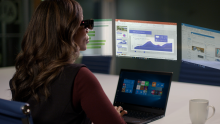 Illustration of virtual displays with ThinkReality A3.


References
- ↑ 1.00 1.01 1.02 1.03 1.04 1.05 1.06 1.07 1.08 1.09 1.10 1.11 1.12 "Lenovo Introduces the ThinkReality A3 - The Most Versatile Smart Glasses Ever Designed for the Enterprise". Lenovo StoryHub. Lenovo. 2021-01-10. https://news.lenovo.com/pressroom/press-releases/thinkreality-a3-most-versatile-smart-glasses-ever-designed-for-the-enterprise/. Retrieved 2026-10-12.
- ↑ 2.0 2.1 2.2 Joel Khalili (2021-01-11). "Lenovo may have finally cracked smart glasses for the workplace". TechRadar. https://www.techradar.com/news/lenovo-may-have-finally-cracked-smart-glasses-for-the-workplace. Retrieved 2026-10-12.
- ↑ 3.0 3.1 3.2 3.3 3.4 3.5 3.6 "ThinkReality A3 Smart Glasses (PC Edition), product page as archived on 1 October 2023". Lenovo. https://web.archive.org/web/20231001092539/https://www.lenovo.com/us/en/p/smart-devices/virtual-reality/thinkreality-a3-pc-edition/wmd00000500. Retrieved 2026-10-12.
- ↑ 4.0 4.1 Frederic Lardinois (2021-11-09). "Qualcomm launches new AR dev kit, acquires Clay AIR". TechCrunch. https://techcrunch.com/2021/11/09/qualcomm-launches-new-ar-dev-kit-acquires-clay-air. Retrieved 2026-10-12.
- ↑ 5.0 5.1 Dean Takahashi (2022-06-01). "Qualcomm launches Snapdragon Spaces XR platform for AR devs". VentureBeat. https://venturebeat.com/business/qualcomm-launches-snapdragon-spaces-xr-platform-for-ar-devs. Retrieved 2026-10-12.
- ↑ 6.0 6.1 6.2 Scott Hayden (2026-07-13). "Lenovo Reportedly Shutters US-based XR Business Unit Amid Shift to AI Wearables". Road to VR. https://roadtovr.com/lenovo-shutters-xr-business-unit-report/. Retrieved 2026-10-12.
- ↑ 7.0 7.1 Kunal Khullar (2021-01-10). "Lenovo ThinkReality A3 are AR smart glasses made for enterprises". XDA Developers. https://www.xda-developers.com/lenovo-thinkreality-a3-ar-smart-glasses-enterprise-launch-ces-2021/. Retrieved 2026-10-12.
- ↑ Sean Endicott (2021-01-10). "Lenovo's ThinkReality A3 smart glasses are built to get work done". Windows Central. https://www.windowscentral.com/lenovo-thinkreality-a3-smart-glasses. Retrieved 2026-10-12.
- ↑ 9.0 9.1 9.2 9.3 Kareem Anderson. "Lenovo ThinkReality A3 Smart Glasses Review: Enterprise AR is outperforming consumer AR". Windows Report (originally published by OnMSFT). https://web.archive.org/web/20250518225752/https://windowsreport.com/lenovo-thinkreality-a3-smart-glasses-review-enterprise-ar-is-outperforming-consumer-ar/. Retrieved 2026-10-12.
- ↑ 10.0 10.1 10.2 Skarredghost (2022-04-16). "Laval Virtual: Hands-on with Lenovo ThinkReality A3 and Actronika Skinetic!". The Ghost Howls. https://skarredghost.com/2022/04/16/hands-on-lenovo-thinkreality-a3-actronika-skinetic/. Retrieved 2026-10-12.
- ↑ 11.0 11.1 11.2 Shinji Seimiya (2022-04-13). "レノボ、5画面表示可能なスマートグラス「ThinkReality A3」". Impress Watch. https://www.watch.impress.co.jp/docs/news/1402477.html. Retrieved 2026-10-12.
- ↑ Kento Kitagawa (2022-04-14). "レノボ、作業支援や業務サポート用のスマートグラス「ThinkReality A3」". Keitai Watch. https://k-tai.watch.impress.co.jp/docs/news/1402808.html. Retrieved 2026-10-12.
- ↑ 14.00 14.01 14.02 14.03 14.04 14.05 14.06 14.07 14.08 14.09 14.10 14.11 14.12 14.13 14.14 14.15 14.16 "ThinkReality A3 product sheet". Lenovo. 2020. https://static.lenovo.com/ww/campaigns/2021/thinkreality/Lenovo_A3%20Data%20sheet.pdf. Retrieved 2026-10-12.
- ↑ 15.0 15.1 15.2 15.3 Scott Hayden (2021-01-11). "Lenovo Reveals ThinkReality A3 Lightweight AR Glasses for Enterprise". Road to VR. https://www.roadtovr.com/lenovo-thinkreality-a3-ar-smart-glasses/. Retrieved 2026-10-12.
- ↑ 16.0 16.1 16.2 16.3 16.4 16.5 "ThinkReality A3 Smart Glasses (PC Edition), product page as archived on 21 February 2025". Lenovo. https://web.archive.org/web/20250221201916/https://www.lenovo.com/us/en/p/smart-devices/virtual-reality/thinkreality-a3-pc-edition/wmd00000500. Retrieved 2026-10-12.
- ↑ "ThinkReality A3, product web page as archived on 29 January 2021". Lenovo. https://web.archive.org/web/20210129234201/https://www.lenovo.com/us/en/thinkrealitya3. Retrieved 2026-10-12.
- ↑ 18.0 18.1 18.2 Daniel W. Rasmus (2022-12-14). "Lenovo ThinkReality A3 Glasses Review: An Enticing Platform for Enterprise AR". Serious Insights. https://www.seriousinsights.net/lenovo-thinkreality-a3-glasses-review/. Retrieved 2026-10-12.
- ↑ "Qualcomm announces global availability of its Snapdragon Spaces XR Developer Platform". Auganix. 2022-06-01. https://www.auganix.org/qualcomm-announces-global-availability-of-its-snapdragon-spaces-xr-developer-platform/. Retrieved 2026-10-12.
- ↑ Matthias Bastian (2022-06-02). "Qualcomm announces AR developer kit, Snapdragon Spaces available worldwide". MIXED. https://mixed-news.com/en/qualcomm-announces-ar-developer-kit-snapdragon-spaces-available-worldwide/. Retrieved 2026-10-12.
- ↑ "ThinkReality A3 developer kit, page as archived on 15 June 2023". Snapdragon Spaces. Qualcomm. https://web.archive.org/web/20230615033742/https://spaces.qualcomm.com/devices/lenovo-thinkreality-a3/developer-kit/. Retrieved 2026-10-12.
- ↑ 22.0 22.1 Skarredghost (2026-07-13). "Lenovo laid off its XR business unit to focus on AI and wearables". The Ghost Howls. https://skarredghost.com/2026/07/13/lenovo-vr-layoffs/. Retrieved 2026-10-12.