

Nreal Light
More actions
| Nreal Light | |
|---|---|

| |
| Basic Info | |
| VR/AR | Augmented Reality |
| Type | AR Glasses |
| Subtype | Consumer AR |
| Platform | Nebula / NRSDK (historical software) |
| Creator | Nreal (now Xreal) |
| Developer | Nreal |
| Manufacturer | Nreal |
| Announcement Date | 7 January 2019[1] |
| Release Date | South Korean consumer rollout: August 2020[2]; later markets below |
| Price | Historical regional prices and announced kit prices below |
| Website | https://www.xreal.com/ |
| Versions | Consumer Kit; Developer Kit with external computing pack and controller[3] |
| Requires | Compatible Android smartphone and software; Developer Kit uses external computing pack[4] |
| Successor | Related later model: Xreal Air (different tracking features) |
| System | |
| Operating System | Android host; historical Nebula and NRSDK[4] |
| Chipset | External host processing; CES 2019 pack used Qualcomm Snapdragon 845[1] |
| CPU | External host |
| GPU | External host |
| Display | |
| Display | Micro-OLED according to a September 2021 tested-unit review; see discussion[5] |
| Resolution | 1920 × 1080 per eye[4] |
| Refresh Rate | 60 Hz in MR Space (NRSDK 1.10.2 specifications)[4] |
| Image | |
| Field of View | 52 degrees (axis unspecified in cited manufacturer table)[4] |
| Optics | |
| Optics | Birdbath optics[6] |
| Ocularity | Binocular[4] |
| Adjustable Diopter | Prescription-lens frame supplied; no verified built-in diopter specification[7] |
| Passthrough | Optical see-through |
| Tracking | |
| Tracking | 6DoF inside-out tracking using SLAM[8] |
| Hand Tracking | Supported in compatible NRSDK applications; device/software limits apply[9] |
| Rotational Tracking | Yes, as part of 6DoF[9] |
| Positional Tracking | Yes, as part of 6DoF[9] |
| Play Space | Scene-dependent spatial AR; manufacturer meshing guidance below |
| Audio | |
| Audio | Two built-in speakers[4] |
| Microphone | Two microphones[10] |
| Camera | RGB capture camera and two spatial tracking cameras (three total)[8][11] |
| Connectivity | |
| Connectivity | Wired USB-C connection to external host[4] |
| Ports | USB-C host cable |
| Wired Video | USB-C host connection |
| Power | Host-powered[12] |
| Battery Capacity | No battery in the glasses[12] |
| Battery Life | Uses connected phone battery; no fixed standalone duration[12] |
| Device | |
| Dimensions | 156 × 52 × 44 mm, folded (NRSDK 1.10.2 table)[4] |
| Weight | 106 g excluding cable in KDDI and NRSDK documentation; Korea launch claimed 88 g[4][7] |
| Headstrap | Glasses temples; foldable design[3] |
| Color | Dark gray at Korean consumer launch[7] |
| Sensors | Spatial tracking cameras, RGB camera and IMU[4] |
| Input | Phone pointer/touchscreen; physical 3DoF controller or hand input in compatible software[13][9] |
Nreal Light is a pair of phone-powered augmented reality glasses developed by Nreal, which adopted the XREAL name in 2023. Its consumer version connects to an Android smartphone, while the Developer Kit uses an external computing pack. The glasses support six degrees of freedom (6DoF) head tracking and spatial applications through the company's historical software platform.[4][9][14]
Nreal announced Light at CES on 7 January 2019. Consumer shipping and retail sales began in South Korea in August 2020 through LG Uplus. Later carrier rollouts included Japan, Germany, Spain and the United States. Announcement dates, preorder dates and actual shipping evidence differ between markets; the chronology below distinguishes them.[1][2][15]
History and development
Nreal was founded in January 2017 by Chi Xu and Bing Xiao.[1] KDDI's 2020 launch release identified the company as headquartered in Beijing.[8] Its CES 2019 announcement described an 85 g prototype, a companion Snapdragon 845 computing pack, two cameras for simultaneous localization and mapping (SLAM), speakers, microphones and a wireless controller. The announcement also advertised USB-C content connections to laptops and desktops. These were claims for the announced design, rather than confirmation of current Nebula support on PCs or a complete description of every later retail package.[1]
At AWE on 30 May 2019, Nreal announced a US$499 Consumer Kit containing the glasses and a US$1,199 Developer Kit containing glasses, an external computing pack and a 3DoF controller. It forecast limited consumer quantities later in 2019, mass availability in 2020 and developer shipments starting in September 2019. Those schedules were announcements. The same release described foldable temples and planned support for Android Native and Unity development.[3]
Nreal's January 2021 retrospective described its 2020 Developer Kit as a bundle for creating MR content or adapting Android applications, with Spatial collaboration software preinstalled. The company also described introducing Nebula at CES 2020. This record is useful for the software and kit history without treating every proposal in the 2019 announcement as a delivered feature.[2]
Regional availability and prices
The prices below belong to the cited market and period. They do not establish current sales, stock, warranty or phone compatibility.
| Market / edition | Documented date | Price and conditions | Context |
|---|---|---|---|
| 2019 proposed Consumer Kit / Developer Kit | Announced 30 May 2019 | US$499 / US$1,199 | Glasses-only consumer proposal versus pack-and-controller developer bundle; shipment schedules were forecasts.[3] |
| South Korea, U+ Real Glass | Carrier announced retail for 21 August 2020; Nreal later confirmed shipping and sales during August | 699,000 won including VAT; carrier-plan discounts were offered | The launch service required U+5G membership. Galaxy Note20 support was described at launch, with LG Velvet and other phones planned.[7][2] |
| Japan, KDDI/au NrealLight | 11 November 2020 preorders; 1 December retail date in KDDI's announcement | 69,799 yen including tax | Original supported phones were Xperia 5 II and Galaxy Note20 Ultra 5G, with required software updates.[8] |
| Germany, Deutsche Telekom | 17 March 2021 preorders; online-shop availability announced for April | 799 euros for glasses; phone priced separately | Initially paired with OPPO Find X3 Pro. The March announcement is a preorder record.[10] |
| Spain, Vodafone | 1 June 2021 retail date announced on 31 May | Glasses offered at 16 euros per month for 36 months | Vodafone 5G Reality AR ran through Nebula; phone bundles had separate pricing.[11] |
| United States, Verizon | Nreal's November 2021 announcement specified 30 November for 20 stores and 2 December online; a March 2022 company retrospective confirmed 2021 retail sales | Approximately US$600 in the contemporary announcement report | Selected Samsung 5G phones and OnePlus 8 5G UW were identified for full spatial AR; the report's publication date is not the retail date.[16][15] |
Nreal's retrospective described the Japanese launch as November 2020, while KDDI distinguished November preorders from the planned 1 December sale date. The carrier's more specific chronology is retained here.[2][8] XREAL's current company history dates the Nreal-to-XREAL rebranding to 2023; its older developer documentation consequently calls the device XREAL Light.[14][4]
Design and optical system
Light has a glasses frame with foldable temples. KDDI described its consumer version as a smartphone-connected device rather than a self-contained headset. The connected host supplies processing, and the consumer quickstart states that the glasses run from the phone's battery.[8][12]
Its optics use a birdbath combiner. In a 2021 technical article, optical researcher Soon-gi Park specifically described Nreal Light's use of a concave half-mirror and illustrated the arrangement in Figure 1d. This architecture combines a view of the physical surroundings with display light reflected toward the eyes. It should be distinguished from waveguide architectures that guide light through a substrate by total internal reflection.[6]
A September 2021 original hands-on review described the tested display as micro-OLED. The manufacturer's versioned specifications independently list a resolution of 1920 × 1080 per eye. The review's exact supplier identification and its other optical estimates are not treated as verified specifications for every unit.[5][4]
Documented hardware
| Property | Model-specific documentation | Qualification |
|---|---|---|
| Display resolution | 1920 × 1080 per eye | Resolution of each eye's display, as listed for Light in NRSDK 1.10.2.[4] |
| Field of view | 52 degrees | The cited manufacturer table does not identify a horizontal, vertical or diagonal axis.[4] |
| MR Space frame rate | 60 Hz | Versioned specification for MR Space; not a tracking-sensor sampling rate or latency measurement.[4] |
| Cameras and inertial sensing | RGB camera, grayscale tracking cameras and IMU; KDDI lists three cameras in total | Vodafone distinguishes two spatial cameras. Capture access and tracking are separate software functions.[4][8][11] |
| Audio | Two speakers and microphones | Deutsche Telekom specified dual speakers and dual microphones and described the microphones as supporting voice control; sound quality and privacy are not measured by these counts.[10] |
| Host connection | USB-C cable | External host needed; connector presence alone does not establish full Nebula/NRSDK compatibility.[4][9] |
| Folded dimensions | 156 × 52 × 44 mm | NRSDK 1.10.2 table; these are folded dimensions.[4] |
| Weight | 106 g excluding cable in KDDI and NRSDK documentation | LG Uplus's August 2020 announcement instead states 88 g; the January 2019 prototype announcement states 85 g. The sources do not establish why these figures differ.[4][8][7][1] |
The quickstart lists four nose pads, a prescription-lens frame, VR Cover, clip, glasses case and cleaning cloth. The frame accepts lenses supplied by an optician. It also identifies a brightness button. The cover blocks the physical surroundings; the manufacturer tells users not to walk while it is attached.[12]
Tracking and input
Light's camera-based SLAM supports both rotational and positional head tracking. Applications can use detected planes and tracked images to relate digital content to the surroundings. These are software capabilities, rather than a promise that tracking is reliable in every room or outdoor condition.[8][9]
Phone and physical controller
The smartphone can serve as a 3DoF pointer, with touch input for selection and manipulation. The separate Light controller also tracks three degrees of freedom and has a touchpad, App and Home buttons. NRSDK 1.10.2 documents Bluetooth pairing to a computing pack or phone. Its charging pins connect to the computing pack, which shares battery power with the controller. These functions belong to the controller, not to a radio or battery inside the glasses.[13]
XREAL's design guide describes touchscreen taps, holds and swipes for pointing and moving objects, along with phone vibration as possible feedback. It also describes gaze interaction using head position and direction, including dwell selection. This is head-directed targeting; it does not document pupil-based eye tracking. Applications choose which interaction techniques to implement.[17]
Hand tracking
Hand tracking is supported in Light applications using compatible versions of NRSDK. The 1.10.2 documentation describes 23 hand key points, positions and orientations, left/right hand identification, recognized poses and pinch selection. Its compatibility guidance lists specific tested phones and warns that performance on other devices is not guaranteed.[18][9]
The SDK uses onboard cameras to observe the hands. Its guidance recommends visible hands and suitable lighting, and identifies complex backgrounds, backlighting, low or unbalanced light, interlaced fingers and fast movement as potential problems. Hand-input availability and reliability depend on the application, host and software version.[18]
Depth mesh and scene limits
NRSDK 1.10.2 documents triangle-based environmental meshes for Light. Applications can use them for occlusion, collision detection and placement of digital objects on surfaces that are not necessarily planar. The same version distinguishes these features from the original Xreal Air, whose compatibility table lists 3DoF head tracking and lacks Light's camera-based environment features.[19][9]
The meshing guide recommends uniform illumination, textured surfaces, slow smooth movement and distances of 0.5-3 m. It identifies moving objects, darkness, reflective or transparent surfaces, thin structures and textureless surfaces as difficult cases. These are operating guidelines for that SDK feature, not a measured tracking volume or guaranteed accuracy specification.[19]
Phone connectivity and software
Nebula display modes
The quickstart distinguishes Air Casting, which presents the phone's screen, from MR Space, which opens applications in a spatial interface. The phone's pointer and touchscreen operate that interface. It describes initial activation using Nebula and a compatible smartphone.[12] At the Korean launch, LG Uplus described positioning up to three app windows, for example video beside web browsing or messaging. Those examples describe the carrier's launch software rather than universal support for every Android application.[7]
Full spatial features depend on the combination of phone model, operating-system version, Nebula and NRSDK. The historical compatibility table includes model numbers and separate notes for RGB capture, hand tracking and depth mesh. It is more specific than a general requirement that a phone have a USB-C connector. Historical launch lists also varied between carrier markets.[9][8][10]
Development and camera access
The Developer Kit's external pack and controller are separate from the consumer phone-based package. The 1.10.2 FAQ describes Normal, Experimental and Enterprise SDK editions; Enterprise APIs provide access to raw grayscale camera and IMU data. It recommends Unity LTS releases and describes historical Android/API/Nebula combinations. These older requirements should be read with their version context.[4][20]
The RGB camera can supply a texture and record video in supported applications. The 1.10.2 guide includes capture samples, options for blending camera imagery with application content, and audio recording. It separately lists tested phones and warns that reliability is not guaranteed on other phones. Capture capability does not make the glasses' optical see-through view into mandatory camera passthrough.[21]
Later software status
As checked on 14 October 2026, XREAL's SDK download page states that Nebula will no longer be maintained. Its NRSDK 2.1.0 notes ended support for the Developer Kit and advised users of that kit to remain on older SDK versions or use supported hardware. Its 2.3.0 and 2.3.1 known-issue lists say that XREAL Light is not compatible with Samsung S23 and Beam Pro. The continued availability of older documentation does not establish support for newer hosts or software.[22]
Earlier releases also changed capabilities. NRSDK 1.6.0 introduced beta hand tracking, with an expiry restriction for applications using that version's feature; 1.7.0 expanded device support. Later notes added mesh and capture functions. These dated software generations explain why a feature described in later documentation should not be assumed present in the original consumer launch configuration.[22]
Documented applications
Launch material described entertainment, games and spatial app windows. KDDI demonstrated YouTube and Chrome windows and Space Channel 5 AR, while Deutsche Telekom described messaging alongside video, using the smartphone's voice input to compose text, and dedicated 3D applications. Vodafone Spain's 5G Reality AR, developed with Virtual Voyagers and Optiva Media, supplied 2D/3D widgets and browser windows through Nebula.[8][10][11]
Nreal's March 2022 retrospective described a U.S. Cinedigm video partnership for Light, with a large virtual video screen and up to two additional virtual screens. It explicitly excluded that service from Japan. Such region-specific examples are evidence of particular services and software; they do not verify current availability or establish a general replacement for desktop monitors or office equipment.[15]
Research using Nreal Light
Acoustic touch prototype
A 2023 PLOS ONE study used Nreal Light and an OPPO Find X3 Pro in a custom Foveated Audio Device (FAD). The prototype used Unity 2022.1.0b2 and YOLOv5m object recognition to associate sounds with a book, bottle, bowl and cup. Reflective markers and motion capture measured head and hand behavior during the seated task. This was a research application using Light's camera and audio capabilities, rather than a stock accessibility feature.[23]
The study recruited 17 people and analyzed 14 after three blind/low-vision participants were excluded. The analyzed groups contained seven blind or low-vision participants and seven blindfolded sighted participants. The seated task had 60 trials comparing FAD, spoken clock-face descriptions and sounds from external speakers; the standing task had three object-finding trials. The blind/low-vision group's reported seated success rates were 81.66% for FAD, 90.71% for clock-face descriptions and 85% for speakers. The authors described that group's performance across the three conditions as comparable.[23]
The authors limited recognition to four selected object classes for reliability. They reported phone heating and power-consumption problems and concluded that object recognition needed substantial improvement before real-world reliance. The small, trained laboratory sample and custom application do not establish general navigation safety, clinical effectiveness or performance of ordinary Light software.[23]
Preliminary outdoor running assessment
A 2025 Computer Graphics Forum paper explored mixed-reality pacing displays. During preliminary hardware selection, its authors tested Light, HoloLens 2 and Quest Pro. They reported that Light's sensors and cameras obstructed the upper view and that tracking was unstable and lagged during movement, making it unsuitable for their running visualization. This was a qualitative device-selection observation, with no reported Light-specific phone/software configuration or numerical tracking-accuracy benchmark.[24]
The subsequent controlled running study used Quest Pro and analyzed 16 participants. Its pace, workload and preference results therefore concern that apparatus and visualizations, rather than Light. The preliminary Light observation also should not be generalized to every stationary or indoor application.[24]
See Also
Gallery
-
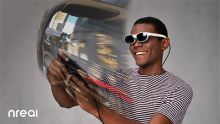 Nreal Light as shown in a 2019 product announcement.

References
- ↑ 1.0 1.1 1.2 1.3 1.4 1.5 "nreal Announces nreal light, Ready-to-Wear Mixed Reality Smart Glasses". Nreal via PR Newswire. 2019-01-07. https://www.prnewswire.com/news-releases/nreal-announces-nreal-light-ready-to-wear-mixed-reality-smart-glasses-300773544.html. Retrieved 2026-10-14.
- ↑ 2.0 2.1 2.2 2.3 2.4 "Nreal 2020 Milestone Press Release (Japan)". Nreal via PR TIMES. 2021-01-07. https://prtimes.jp/main/html/rd/p/000000006.000070978.html. Retrieved 2026-10-14.
- ↑ 3.0 3.1 3.2 3.3 "nreal Announces Highly Anticipated Consumer Availability of nreal light for $499 USD". Nreal via PR Newswire. 2019-05-30. https://www.prnewswire.com/news-releases/nreal-announces-highly-anticipated-consumer-availability-of-nreal-light-for-499-usd-300858781.html. Retrieved 2026-10-14.
- ↑ 4.00 4.01 4.02 4.03 4.04 4.05 4.06 4.07 4.08 4.09 4.10 4.11 4.12 4.13 4.14 4.15 4.16 4.17 4.18 4.19 4.20 4.21 "XREAL Glasses (NRSDK 1.10.2)". XREAL. https://xreal.gitbook.io/nrsdk/v1.10.2/nrsdk-fundamentals/xreal-devices/readme. Retrieved 2026-10-14.
- ↑ 5.0 5.1 "Nreal Light: ANÁLISIS". Real o Virtual. 2021-09-17. https://www.realovirtual.com/articulos/5860/nreal-light-analisis. Retrieved 2026-10-14.
- ↑ 6.0 6.1 Soon-gi Park (2021-07-19). "Augmented and Mixed Reality Optical See-Through Combiners Based on Plastic Optics". Information Display 37 (4): 6-11. doi:10.1002/msid.1226. Retrieved 2026-10-14.
- ↑ 7.0 7.1 7.2 7.3 7.4 7.5 "LG유플러스, 세계 최초 5G AR글래스 상용화". LG Uplus. 2020-08-11. https://www.lg.co.kr/media/release/22263. Retrieved 2026-10-14.
- ↑ 8.00 8.01 8.02 8.03 8.04 8.05 8.06 8.07 8.08 8.09 8.10 "スマートグラス「NrealLight」を12月1日から販売開始". KDDI. 2020-11-10. https://news.kddi.com/kddi/corporate/newsrelease/2020/11/10/4778.html. Retrieved 2026-10-14.
- ↑ 9.00 9.01 9.02 9.03 9.04 9.05 9.06 9.07 9.08 9.09 "Compatibility (NRSDK 1.10.2)". XREAL. https://xreal.gitbook.io/nrsdk/v1.10.2/nrsdk-fundamentals/xreal-devices/compatibility. Retrieved 2026-10-14.
- ↑ 10.0 10.1 10.2 10.3 10.4 "Fokus auf Innovation: Telekom launcht erste Mixed-Reality-Brille Nreal Light". Deutsche Telekom. 2021-03-17. https://www.telekom.com/de/newsroom/aktuelles/medieninformationen/2021/03/fokus-auf-innovation-telekom-launcht-erste-mixed-reality-brille. Retrieved 2026-10-14.
- ↑ 11.0 11.1 11.2 11.3 "Vodafone crea la primera experiencia de realidad aumentada para particulares con las gafas Nreal Light y su app, Vodafone 5G Reality AR". Vodafone Spain. 2021-05-31. https://www.saladeprensa.vodafone.es/c/notas-prensa/np_nreal_ya_disponibles/. Retrieved 2026-10-14.
- ↑ 12.0 12.1 12.2 12.3 12.4 12.5 "Nreal Light Quickstart Guide". Nreal. https://device.report/m/cb7d84c52771a2ce445bee85f5fca07fcf89497e357f73aade6fb34b053dc62f_optim.pdf. Retrieved 2026-10-14.
- ↑ 13.0 13.1 "Controller (NRSDK 1.10.2)". XREAL. https://xreal.gitbook.io/nrsdk/v1.10.2/nrsdk-fundamentals/xreal-devices/controller. Retrieved 2026-10-14.
- ↑ 14.0 14.1 "XREAL About Us". XREAL. https://www.xreal.com/us/about. Retrieved 2026-10-14.
- ↑ 15.0 15.1 15.2 "AR技術開発企業のNreal、シリーズC+で6000万ドル調達". Nreal via PR TIMES. 2022-03-30. https://prtimes.jp/main/html/rd/p/000000026.000070978.html. Retrieved 2026-10-14.
- ↑ "Nreal Light AR glasses hit U.S Verizon stores on November 30". GamesBeat. 2021-11-18. https://gamesbeat.com/nreal-light-ar-glasses-hit-u-s-verizon-stores-on-november-30. Retrieved 2026-10-14.
- ↑ "Controlling (NRSDK design guide)". XREAL. https://xreal.gitbook.io/nrsdk/design-guide/controlling. Retrieved 2026-10-14.
- ↑ 18.0 18.1 "Hand Tracking (NRSDK 1.10.2)". XREAL. https://xreal.gitbook.io/nrsdk/v1.10.2/development/hand-tracking. Retrieved 2026-10-14.
- ↑ 19.0 19.1 "Depth Mesh (NRSDK 1.10.2)". XREAL. https://xreal.gitbook.io/nrsdk/v1.10.2/development/depth-mesh. Retrieved 2026-10-14.
- ↑ "Frequently Asked Questions (NRSDK 1.10.2)". XREAL. https://xreal.gitbook.io/nrsdk/v1.10.2/frequently-asked-questions. Retrieved 2026-10-14.
- ↑ "Access RGB Camera (NRSDK 1.10.2)". XREAL. https://xreal.gitbook.io/nrsdk/v1.10.2/advanced/recording. Retrieved 2026-10-14.
- ↑ 22.0 22.1 "SDK Download and release notes". XREAL. https://developer.xreal.com/download/. Retrieved 2026-10-14.
- ↑ 23.0 23.1 23.2 Howe Yuan Zhu; Shayikh Nadim Hossain; Craig Jin; Avinash K. Singh; Minh Tran Duc Nguyen; Lil Deverell; Vincent Nguyen; Felicity S. Gates; Ibai Gorordo Fernandez; Marx Vergel Melencio; Julee-anne Renee Bell; Chin-Teng Lin (2023-10-25). "An investigation into the effectiveness of using acoustic touch to assist people who are blind". PLOS ONE 18 (10). doi:10.1371/journal.pone.0290431. Retrieved 2026-10-14.
- ↑ 24.0 24.1 A. Li; C. Perin; J. Knibbe; G. Demartini; S. Viller; M. Cordeil (2025-05-23). "Embedded and Situated Visualisation in Mixed Reality to Support Interval Running". Computer Graphics Forum 44 (3). doi:10.1111/cgf.70133. Retrieved 2026-10-14.