

ThirdEye X2
More actions
| ThirdEye X2 | |
|---|---|

| |
| Basic Info | |
| VR/AR | Augmented Reality, Mixed Reality |
| Type | Smart Glasses |
| Subtype | Enterprise AR |
| Platform | Android |
| Creator | ThirdEye Gen |
| Developer | ThirdEye Gen |
| Manufacturer | ThirdEye Gen |
| Announcement Date | January 7, 2019 (CES unveiling announcement) [1] |
| Release Date | September 17, 2019 (availability announcement); January 6, 2020 (worldwide mass-shipping announcement) [2] [3] |
| Price | US$1,950 in 2019/2020 announcements; US$2,450 listed October 2026 [2] [4] |
| Website | https://www.thirdeyegen.com/x2-smart-glasses |
| Versions | X2 MR Glasses |
| Requires | Standalone headset; application/module requirements vary |
| Predecessor | ThirdEye X1 [5] |
| System | |
| Operating System | Android; documented Unity configuration targets Android 9.0 [6] |
| Chipset | Qualcomm Snapdragon XR1 [4] |
| Storage | |
| Storage | 64 GB flash [4] |
| Memory | 4 GB RAM [4] |
| Display | |
| Display | Dual optical see-through displays; cloning and stereo modes [7] |
| Peak Brightness | 500 nits display brightness reported in January 2024 market survey; peak measurement unspecified [8] |
| Resolution | 1280 × 720 per eye [7] |
| Refresh Rate | Two 720p, 60 fps displays described in September 2019 reporting [9] |
| Image | |
| Field of View | 42° (manufacturer figure; axis unspecified) [3] |
| Optics | |
| Optics | Waveguide [4] |
| Ocularity | Binocular; stereoscopic mode [7] |
| Passthrough | Optical see-through [10] |
| Tracking | |
| Tracking | VisionEye SLAM; documented inside-out 6DoF and plane detection [7] |
| Hand Tracking | ManoMotion gesture-control update announced January 2020 [3] |
| Audio | |
| Audio | Built-in speaker; wired and Bluetooth earphones [7] |
| Microphone | Three built-in microphones; active noise cancellation described in manual [7] |
| Camera | 13 MP RGB; two wide-angle global-shutter cameras; 8 × 8 thermal sensor [7] [11] |
| Connectivity | |
| Connectivity | Wi-Fi, Bluetooth, USB-C [8] [11] |
| WiFi | 802.11a/b/g/n/ac, as listed in the manual [7] |
| Power | Internal battery; USB-C charging [7] |
| Battery Capacity | 1750 mAh single battery, as described in 2019/2020 announcements [2] [3] |
| Battery Life | Approximately 150 hours standby while turned off (manufacturer FAQ); active use depends on configuration [11] |
| Device | |
| Weight | 300 g in January 2020 announcement; 11 ounces on current product page [3] [4] |
| Headstrap | Supplied head strap; glasses-style temples [7] [11] |
| Haptics | Manual describes a "Haptic Buzzer" at startup/shutdown [7] |
| Color | Black frame shown in the January 2024 market survey [8] |
| Sensors | Gyroscope, accelerometer, magnetometer; ambient light and thermal sensors; GPS [3] [11] |
| Input | Head-motion cursor, voice commands, physical buttons; versioned hand gestures [7] [12] [3] |
| Compliance | FCC Part 15 Class B (manufacturer manual statement) [7] |
The ThirdEye X2, marketed as the X2 MR Glasses, is a standalone enterprise augmented reality headset made by ThirdEye Gen. Its optical see-through displays place digital content over the wearer's view of the surroundings. ThirdEye announced its CES unveiling in January 2019, announced availability that September, and reported worldwide mass shipping in January 2020. Those events distinguish the original reveal from the later production announcement.[1] [2] [3]
The X2 combines onboard Android computing, cameras and VisionEye SLAM software. Its applications include document viewing, remote assistance and spatial content. The hardware, application subscriptions and VisionEye development configuration have separate requirements; later software descriptions should not be assumed to describe every early X2 package.[4] [6] [8]
History and availability
In a February 2019 interview, ThirdEye founder Nick Cherukuri described the company as a Princeton, New Jersey smart-glasses provider and said that the X1 had launched at CES 2018 before the X2's CES 2019 unveiling. He identified enterprise use and integration with customers' existing systems as the product's focus. This is the company's account of its early product sequence.[5]
Hatch Duo, the industrial-design firm that worked on the X2, describes redesigning an existing prototype, revising ergonomics and interaction, and working with the manufacturing partner on parts and tooling over four months. Its account documents a design and manufacturing project, rather than a measured comfort or durability result.[13]
| Record | Documented event or offer | Qualification |
|---|---|---|
| January 7, 2019 | ThirdEye announced that the X2 would be demonstrated at CES on January 8-11. The release described Android 8.0 and a 6-ounce headset. [1] | An unveiling announcement; it does not establish the final production weight or date of delivery. |
| September 17, 2019 | The company announced availability at US$1,950, with bulk pricing, and described approximately 9 ounces. It said the remaining mass-production units would be delivered in October. [2] | October delivery was a forecast in this announcement. |
| January 6, 2020 | ThirdEye announced worldwide mass shipping, stated a weight of 300 grams and retained the US$1,950 price. It also announced its ManoMotion gesture-control update. [3] | A manufacturer shipping report, rather than an independently audited shipment total. |
| Product page checked October 14, 2026 | ThirdEye listed US$2,450, Snapdragon XR1, 4 GB RAM and 64 GB flash, and described the headset as 11 ounces. [4] | A dated listing; it does not establish stock, delivery time or identical hardware in every earlier unit. |
The published weights differ. The sources do not explain the difference through accessory inclusion, measurement method or a particular hardware revision, so their figures remain attached to their respective records.[1] [2] [3] [4]
Design and displays
The X2 has two see-through displays in a glasses-style frame. ThirdEye's manual describes a flexible nosepiece and a supplied head strap. The manufacturer's FAQ recommends placing the strap over the top of the head and offers prescription lenses and frames; the manual notes that wearing ordinary eyeglasses underneath depends on the user's head shape and glasses.[7] [11]
ThirdEye identifies the optics as waveguide technology. Optical supplier Lumus named the X2 MR Glasses among products using its reflective-waveguide technology in April 2022. That supplier statement establishes the optical relationship; the specifications of Lumus's newer Maximus engines in the same release are not X2 specifications.[4] [14]
The manual specifies 1280 × 720 pixels for each eye. In its default cloning mode, both eyes show the same image. Stereo mode uses a 2560 × 720 Android buffer, with separate 1280-pixel-wide regions for the left and right displays. This makes the mode and rendering buffer distinct from a single eye's resolution.[7]
ThirdEye advertises a 42-degree field of view without identifying its axis in the cited production announcement. Its FAQ compares the image to a 90-inch high-definition screen at 10 feet. The manual advertises display viewability in bright sunlight, and the January 2024 DHS market survey reports 500-nit display brightness for the X2. These are published product descriptions, rather than independent optical measurements.[3] [11] [7] [8]
A contemporary September 2019 report described ThirdEye's claim of two 720p, 60 fps displays. The reporter had not tested the X2 and was seeking clarification of its field-of-view axis. The same report compared the announced US$1,950 X2 price with HoloLens 2's US$3,500 and cited a HoloLens 2 weight of 566 g. These were contemporary published descriptions, rather than an independently measured comparison of display quality, comfort or tracking.[9]
Cameras and spatial tracking
The device has a central 13-megapixel RGB camera and two additional wide-angle global-shutter cameras. The manual describes the latter as providing raw image feeds; the production announcement calls them grey-scale cameras. They should not be conflated with the built-in thermal sensor or a separately attached thermal camera.[7] [3]
The integrated thermal sensor is an 8 × 8, 64-pixel sensor. Higher-resolution thermal sensors can connect through USB-C, according to ThirdEye's product page. This distinction matters when describing thermal images produced by an accessory-equipped X2.[11] [4]
The manual also documents an ambient-light sensor that adjusts display brightness, an integrated flashlight and GPS. The 2020 announcement lists three-axis gyroscope, accelerometer and magnetometer sensors. ThirdEye's FAQ gives a GPS accuracy claim of within 16 feet depending on environmental conditions; it is a manufacturer estimate rather than an independently measured positioning result.[7] [3] [11]
VisionEye software provides inside-out 6DoF tracking and plane detection in the manual's examples. ThirdEye's Unity instructions specifically require an X2 with a VisionEye SLAM Module. The linked API documentation distinguishes computation on the glasses' CPU from edge computation on the VisionEye hardware component, which it describes as using a Movidius Myriad X vision-processing unit. That module description does not replace the Snapdragon XR1 listed for the headset itself.[7] [6] [15] [4]
The API describes pose and orientation callbacks, map loading/saving and stereo or time-of-flight plane callbacks. These are documented development interfaces; they do not establish a measured tracking latency, unlimited tracking area or equal performance in all lighting conditions.[15]
Controls and audio
The manual's "gaze" interface is a head-motion cursor. Turning the head moves it, and selection can use dwell or the physical Select button. It also names Power and Home/Back buttons. This head-directed interface is not evidence of eye tracking.[7]
ThirdEye's voice service uses the wake phrase "Okay ThirdEye" and Android broadcasts for application commands. Developers register their commands and remove them when the application is inactive. System commands are reserved; using one in an application's command list causes the recognizer to refuse that list. The guidance recommends clear, short phrases and notes difficulties with some acronyms and specialist terminology.[12]
In January 2020 ThirdEye announced a ManoMotion update for hand-controlled cursor motion, pinch selection/dragging and an open/closed-hand back command. The announcement describes a software feature update, so hand gestures should not be treated as an undocumented capability of every original firmware version.[3]
The manual lists an internal speaker, an auxiliary wired-earphone jack, Bluetooth audio and three microphones with active noise cancellation. It describes a haptic buzzer activating at startup and shutdown. Its supplied-accessory list includes earphones, the head strap, a carrying case, cleaning cloth, power adapter and USB cable.[7]
Audio capture has a software constraint: ThirdEye's developer guidance says the speech recognizer occupies the microphone while listening. An application recording audio or initiating a WebRTC call must interrupt that service and resume it afterward. The WebRTC notes also describe explicit routing to the built-in speaker and changes to echo-cancellation/noise-suppression settings for that integration.[10] [16]
Software and development
Android applications
The original CES announcement described Android 8.0. ThirdEye's later Android Studio instructions use minimum API level 27 and compile/target level 28, while its Unity instructions specify Android 9.0. These are versioned documentation examples rather than a promise that every X2 runs the same current OS image.[1] [17] [6]
The Android Studio guide explicitly states that the X2 is incompatible with Google Play and associated Google Mobile Services, including ARCore, Firebase and Google's speech services. Android compatibility therefore does not establish compatibility with every Android application or service dependency.[17]
ThirdEye provides its own app store. Its manual allows developers to submit free or paid applications and identifies UI SDKs and VisionEye Unity/Unreal Engine plugins. It does not provide an audited current app count, so a count of software developers should not be read as a count of available applications.[7]
The manual describes file transfers between the X2 and a computer over the supplied USB-C cable. Captured photos and videos are saved in the device's media gallery.[7]
Display and input integration
ThirdEye's GUI guidance specifies landscape orientation, black backgrounds for optical see-through and bright text larger than 25 sp. It recommends reserving the central view for content that needs attention and placing menus toward the edges. Fullscreen layouts can make some edge controls inaccessible to the motion/gesture cursor. Applications using the RGB camera can address Camera ID 0; the guidance discusses covering the camera-preview view with a black layer to retain a clear optical view.[10]
The separate torch-control page records an issue with flashlight enable/disable-state reporting during camera operation and describes a supplied Android library as a workaround. This is a documented integration issue, rather than evidence that the flashlight cannot operate during capture.[18]
VisionEye and updates
The Unity example uses Unity 2019.4, ThirdEye's Unity package and an X2 with its VisionEye module. It builds an Android APK with Android 9.0 as the minimum API configuration and ARM64 selected instead of ARMv7. The example contains a camera rig and a cube; the instructions warn against moving the individual eye cameras separately from the rig.[6]
ThirdEye documents an OTA updater that checks for a newer system image, downloads it and applies it after confirmation and a restart. Its FAQ also describes offline updates through USB-C. The presence of these procedures does not establish a guaranteed update schedule, security-support end date or an available update for every device today.[19] [11]
Enterprise software and documented uses
ThirdEye's product page describes remote collaboration in which a field worker streams a view to a remote expert and receives feedback. It also describes document/checklist workflows, RealEye AI software and proprietary mobile device management with device enrollment. These are application and deployment services around the headset; they are not substitutes for hardware specifications.[4]
The January 2020 announcement described ThirdEye Workspace applications for live AR remote help and 3D SLAM-based CAD modeling and overlay.[3]
The company's September 2019 announcement identified field service, healthcare, manufacturing, airlines, architecture, education and insurance as target industries. Its statements about productivity improvements were promotional claims; the release did not report a controlled study or methods that would establish a general performance improvement.[2]
Emergency-response market survey
The DHS National Urban Security Technology Laboratory's January 2024 SAVER market survey describes the X2 with BANC3/ThirdEye RespondEye software for emergency-response training and remote guidance. It lists photos/video, annotations, conference calls and optional FLIR One Pro thermal integration. Its price description separates a US$2,450 headset, US$799 SLAM tracking module and US$49.99 monthly RespondEye subscription per headset. Those were the reported package costs, not a current universal offer.[8]
The survey gathered vendor/manufacturer information, industry publications and responses to a government information request between January and May 2023. It is a market survey of available systems, not a controlled X2 clinical or training-effectiveness experiment. Its product coverage does not constitute government endorsement or establish medical diagnostic accuracy.[8]
Published development experience
In a December 2025 Information paper, Tsinakos, Teazi and Tsinakou reported that an educational AI-assistant project initially considered the X2 but switched to Meta Quest 2. They cited lack of Google Play support and difficulties finding development material for their project. This is an account of that project's platform choice, rather than a quantitative X2 usability comparison. The implemented system used Quest 2; the paper's proposed 52-student study does not supply X2 learning-outcome results.[20]
Operating limits
The manual describes an IP40 rating and a claimed two-metre concrete-drop resistance. It also gives storage temperatures of -20°C to 60°C and an operating range of 10°C to 27°C in its safety text. Storage and operation are different limits. These manufacturer descriptions do not establish a military environmental qualification.[7]
There is also a conflict in intended-use language: the manual's safety text excludes machinery, medical and industrial applications, while ThirdEye markets the X2 to enterprise industries including healthcare and manufacturing. The same manual's EU declaration names model T1100G, without explaining its applicability to the X2. These inconsistencies in the document prevent treating its general safety and regulatory wording as an X2-specific approval for safety-critical work or clinical use.[7] [2]
Technical specifications summary
| Specification | Documented value and scope |
|---|---|
| Display and rendering | 1280 × 720 per eye; cloned or separate stereo content [7] |
| Optical field of view | Advertised 42°; axis unspecified in the cited production release [3] |
| Compute | Snapdragon XR1, 4 GB RAM, 64 GB flash on ThirdEye's product listing [4] |
| Built-in camera and thermal sensing | 13 MP RGB; two wide-angle cameras; 8 × 8 thermal sensor [7] [11] |
| Spatial software | VisionEye SLAM; documented Unity configuration requires VisionEye module [6] |
| Battery | 1750 mAh single battery in September 2019 and January 2020 announcements; FAQ's approximately 150-hour figure is standby with the device turned off [2] [3] [11] |
| Weight | 300 g in January 2020 announcement; current listing says 11 ounces [3] [4] |
| Pricing | US$1,950 in the availability/mass-shipping announcements; US$2,450 listed in October 2026; application/module costs can be separate [2] [4] [8] |
See Also
Gallery
-
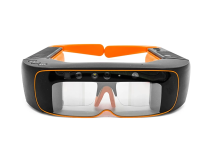 X2 headset viewed from the front.

References
- ↑ 1.0 1.1 1.2 1.3 1.4 "ThirdEye Releases X2- the World's Smallest Mixed Reality Glasses at CES 2019". ThirdEye Gen / PR Newswire. 2019-01-07. https://www.prnewswire.com/news-releases/thirdeye-releases-x2---the-worlds-smallest-mixed-reality-glasses-at-ces-2019-300774275.html. Retrieved 2026-10-14.
- ↑ 2.00 2.01 2.02 2.03 2.04 2.05 2.06 2.07 2.08 2.09 "ThirdEye Gen Announces Shipments of its X2 Mixed Reality Glasses". ThirdEye Gen / PR Newswire. 2019-09-17. https://www.prnewswire.com/news-releases/thirdeye-gen-announces-shipments-of-its-x2-mixed-reality-glasses-300919487.html. Retrieved 2026-10-14.
- ↑ 3.00 3.01 3.02 3.03 3.04 3.05 3.06 3.07 3.08 3.09 3.10 3.11 3.12 3.13 3.14 3.15 3.16 3.17 "ThirdEye Announces Mass Shipping of X2 Mixed Reality Glasses". ThirdEye Gen / GlobeNewswire. 2020-01-06. https://www.globenewswire.com/news-release/2020/01/06/1966527/0/en/ThirdEye-Announces-Mass-Shipping-of-X2-Mixed-Reality-Glasses.html. Retrieved 2026-10-14.
- ↑ 4.00 4.01 4.02 4.03 4.04 4.05 4.06 4.07 4.08 4.09 4.10 4.11 4.12 4.13 4.14 4.15 "X2 MR Smart Glasses". ThirdEye Gen. https://www.thirdeyegen.com/x2-smart-glasses. Retrieved 2026-10-14.
- ↑ 5.0 5.1 "ThirdEye Gen: The company behind the world's smallest Mixed Reality smart glasses". AR for Enterprise Alliance. 2019-02-14. https://thearea.org/thirdeye-gen-the-company-behind-the-worlds-smallest-mixed-reality-smart-glasses/. Retrieved 2026-10-14.
- ↑ 6.0 6.1 6.2 6.3 6.4 6.5 "Getting Started in Unity". ThirdEye Gen Developer Portal. https://thirdeyegen.gitbook.io/developer-portal/visioneye-slam-developement/getting-started-in-unity. Retrieved 2026-10-14.
- ↑ 7.00 7.01 7.02 7.03 7.04 7.05 7.06 7.07 7.08 7.09 7.10 7.11 7.12 7.13 7.14 7.15 7.16 7.17 7.18 7.19 7.20 7.21 7.22 7.23 7.24 7.25 7.26 "ThirdEye X2 User Guide, part 7002, marked Rev 2.5 June 2019". ThirdEye Gen, reproduced by Manuals+. https://manuals.plus/m/d4e228849036ff01576eaa27a9b2a2d2bbb448d32e2d653e3cc3747152f37716. Retrieved 2026-10-14.
- ↑ 8.0 8.1 8.2 8.3 8.4 8.5 8.6 8.7 "Augmented Reality (AR) Training Systems for First Responders: Market Survey Report, SAVER-T-MSR-45". U.S. Department of Homeland Security, NUSTL / DAGER Technology. 2024-01. https://www.dhs.gov/sites/default/files/2024-02/24_02_16_st_artrainingsystemsmsr_0.pdf. Retrieved 2026-10-14.
- ↑ 9.0 9.1 "ThirdEye Launches Lightweight Enterprise AR Headset For $1950". UploadVR. 2019-09-15. https://uploadvr.com/thirdeye-x2-launched/. Retrieved 2026-10-14.
- ↑ 10.0 10.1 10.2 "Developer Guidelines". ThirdEye Gen Developer Portal. https://thirdeyegen.gitbook.io/developer-portal/android-development/developer-guidelines. Retrieved 2026-10-14.
- ↑ 11.00 11.01 11.02 11.03 11.04 11.05 11.06 11.07 11.08 11.09 11.10 11.11 "Frequently Asked Questions". ThirdEye Gen. https://www.thirdeyegen.com/faq. Retrieved 2026-10-14.
- ↑ 12.0 12.1 "Integrating Voice Commands". ThirdEye Gen Developer Portal. https://thirdeyegen.gitbook.io/developer-portal/android-development/integrating-voice-commands. Retrieved 2026-10-14.
- ↑ "ThirdEye Gen". Hatch Duo. https://hatchduo.com/works/thirdeye-gen. Retrieved 2026-10-14.
- ↑ "Spurred by Customer Demand, Lumus Announces Two New Products Based on Unique 2D Reflective Waveguide Architecture". Lumus / PR Newswire. 2022-04-06. https://www.prnewswire.com/il/news-releases/spurred-by-customer-demand-lumus-announces-two-new-products-based-on-unique-2d-reflective-waveguide-architecture-301518452.html. Retrieved 2026-10-14.
- ↑ 15.0 15.1 "VisionEye SLAM Intro". ThirdEye Gen. https://thirdeyegen.gitbook.io/visioneye-slam-api-documentation/. Retrieved 2026-10-14.
- ↑ "Configuring audio with WebRTC". ThirdEye Gen Developer Portal. https://thirdeyegen.gitbook.io/developer-portal/android-development/configuring-audio-with-webrtc. Retrieved 2026-10-14.
- ↑ 17.0 17.1 "Getting Started In Android Studio". ThirdEye Gen Developer Portal. https://thirdeyegen.gitbook.io/developer-portal/android-development/getting-started-in-android-studio. Retrieved 2026-10-14.
- ↑ "Flashlight/torch control during video capture". ThirdEye Gen Developer Portal. https://thirdeyegen.gitbook.io/developer-portal/android-development/flashlight-torch-control-during-video-capture. Retrieved 2026-10-14.
- ↑ "OTA Update Instructions". ThirdEye Gen Developer Portal. https://thirdeyegen.gitbook.io/developer-portal/general/ota-update-instructions. Retrieved 2026-10-14.
- ↑ "The Psychological Effects of AI Learning Assistants in Immersive Virtual Reality Environments". Information. 2025-12-03. https://www.mdpi.com/2078-2489/16/12/1062. Retrieved 2026-10-14.