

StarVR One
More actions
| StarVR One | |
|---|---|

| |
| Basic Info | |
| VR/AR | Virtual Reality |
| Type | Head-mounted display |
| Subtype | Enterprise VR |
| Platform | SteamVR, StarVR SDK[1] |
| Creator | StarVR Corporation |
| Developer | StarVR Corporation |
| Manufacturer | StarVR Corporation |
| Announcement Date | August 14, 2018[2] |
| Release Date | November 2018 (developer program announced); 2020 (enterprise availability reported)[3][4] |
| Price | US$3,200 (2018 developer-program price, headset only)[3] |
| Website | https://www.starvr.com/ (historical) |
| Versions | StarVR One; StarVR One XT (alternative optical tracking)[2] |
| Requires | Windows PC; external tracking hardware and controllers[1] |
| Predecessor | StarVR (original)[5] |
| System | |
| Operating System | Windows 10 x64 (documented 2018 requirements)[1] |
| Chipset | PC-powered |
| CPU | Host PC |
| GPU | Host PC |
| Display | |
| Display | Two 4.77-inch AMOLED panels; full RGB per pixel[6][2] |
| Subpixel Layout | Full RGB per pixel (manufacturer description)[2] |
| Resolution | 1830 × 1464 per eye[6] |
| Refresh Rate | 90 Hz[6] |
| Persistence | Low persistence (published specification)[6] |
| Image | |
| Field of View | 210° horizontal × 130° vertical (manufacturer specification)[2] |
| Horizontal FoV | 210° (manufacturer specification)[2] |
| Vertical FoV | 130° (manufacturer specification)[2] |
| Foveated Rendering | Eye-tracked, in supported applications[2][7] |
| Optics | |
| Optics | Custom Fresnel lenses; canted displays[2][8] |
| Ocularity | Binocular[6] |
| Tracking | |
| Tracking | SteamVR Tracking 2.0 (StarVR One); active optical markers (One XT)[2] |
| Base Stations | External SteamVR stations; not included in developer package[1] |
| Eye Tracking | Integrated Tobii eye tracking[2] |
| Rotational Tracking | Yes (SteamVR tracking)[2] |
| Positional Tracking | Yes (external SteamVR stations)[1] |
| Play Space | Room-scale, with external tracking[9] |
| Audio | |
| Audio | 3.5 mm stereo headset socket with microphone support[6] |
| Microphone | External headset microphone support through 3.5 mm socket[6] |
| 3.5mm Audio Jack | Yes[6] |
| Connectivity | |
| Connectivity | Two 0.9 m Type-C cables and two 5 m Type-C extensions[6] |
| Ports | Headset: 3.5 mm audio socket; adapter box: two DisplayPort and two USB 2.0 connections[1][6] |
| Wired Video | Two DisplayPort connections through adapter box[1] |
| Power | Tethered; distributor FAQ states no charging is required[6] |
| Device | |
| Weight | One: 450 g excluding headband and cables; One XT: 430 g (2018 report, inclusion convention unspecified)[6][10] |
| Headstrap | Adjustable semi-rigid headband; replaceable face cushion[6] |
| Color | Black (2018 manufacturer illustrations)[1] |
| Sensors | Accelerometer, gyroscope; integrated Tobii eye tracking[1] |
| Input | External SteamVR controllers[1] |
The StarVR One is an enterprise-focused ultra-wide field of view virtual reality head-mounted display developed by StarVR Corporation. The company announced it at SIGGRAPH in Vancouver on August 14, 2018, for commercial visualization, simulation and location-based entertainment. Its principal features are a manufacturer-specified 210° horizontal by 130° vertical field of view, full-RGB AMOLED displays, integrated Tobii eye tracking and external SteamVR tracking. The separately announced One XT uses active optical markers for other tracking systems. [2]
The US$3,200 developer program opened for applications in November 2018 and was put on hold in December. Reports of enterprise availability followed in 2020. The initial offering required selection through a developer program. [3] [11] [4]
History and development
Origins and the earlier StarVR
Starbreeze introduced the earlier StarVR at E3 in June 2015 after acquiring the French company Infinite Eye. Acer and Starbreeze announced their intention to form a joint venture in May 2016, then announced board approval of the agreement in June. The planned venture covered design, manufacturing, promotion, sales and marketing for professional and location-based VR. The earlier headset had a published combined display resolution of 5120 × 1440 pixels and a 210° horizontal field of view. Those figures describe the predecessor, rather than the One's later display panels. [12] [13]
Acer and Starbreeze announced on August 31, 2016 that they had begun shipping earlier StarVR units to IMAX for its planned VR centers. The IMAX partnership formed part of the earlier StarVR location-based entertainment business. [5]
StarVR One and developer distribution
The 2018 One announcement introduced custom AMOLED displays, Tobii eye tracking, software IPD measurement and a SteamVR Tracking 2.0 configuration. It also described an SDK, a native Unreal Engine plugin and an optional dual-input VR SLI mode. [2]
On November 19, 2018, Road to VR reported the company's announcement that initial production units were ready for selected developer-program applicants. The reported US$3,200 price covered the headset without tracking stations or controllers; the program was initially limited to selected regions in North America, Europe and Asia. This was a restricted developer offering, rather than unrestricted retail availability. [3]
ELSA Japan announced its appointment as a domestic authorized distributor on November 20, 2018. It listed the StarVR One for Developer, model EHD-SV1LD, at ¥445,000 before consumption tax, with early December 2018 as the planned Japanese release period. Applicants selected for the developer program were to receive the SDK and access to a support forum and dedicated community. The dated announcement describes the planned schedule; it does not establish that every applicant received a unit on that date. [9]
In December, a StarVR spokesperson told UploadVR that the developer program was on hold while the company faced uncertainty involving its overseas shareholder and was going private. The statement concerned the program and its operations; it did not say that all headset development had permanently ended. [11]
Road to VR's April 2020 report described distributor availability in Japan and Taiwan, and its May 4 update reported US$3,200 or €2,800 for qualified enterprise purchasers, including shipping but excluding local taxes. The update also described a selection process for customers. Its explanation of OpenVR compatibility cautioned that the headset's viewport requirements could require application changes. [4]
Later corporate and software records
Starbreeze's 2024 annual report states that it sold its 33% stake in the StarVR joint venture to Acer during that year. Acer's audited statements for 2025, authorized in March 2026, list StarVR Corporation as not in operation and show a 100% holding at December 31, 2025. These corporate records establish a later business status, without providing a precise date on which every headset or application stopped operating. [14] [15]
Software support is also version-specific. Autodesk added StarVR One support to VRED 2019.2, but its VRED Professional 2024.2 release notes, dated November 17, 2023, record the removal of the native StarVR and XTAL VR modes. Historical integration documentation should therefore be read with its software version. [7] [16]
Design and display technology
AMOLED panels and optics
The published specification describes two 4.77-inch AMOLED panels with 1830 × 1464 pixels per eye, running at 90 Hz in a low-persistence mode. StarVR described full RGB at each pixel and approximately 16 million subpixels across both displays. The pixel grid and subpixel total are different measures of resolution. The combined side-by-side pixel count is 3660 × 1464, calculated from the two published panel dimensions. [6]
StarVR's release identifies custom Fresnel lenses, and the original field-of-view study describes the displays as canted. The optical design extends the visible region toward the sides of the head. The display resolution does not establish a uniform pixels-per-degree figure throughout the lenses, and the manufacturer's wide-field specification is distinct from an independently measured visible field. [2] [8]
The manufacturer described the headband as a way to distribute the weight during extended use. The published 450 g figure excludes the headband and cables. The distributor's specification describes an adjustable semi-rigid headband and a removable, replaceable facial cushion. These are design and specification statements, rather than a measured guarantee of comfort for all users. [6] [2]
Field of view and fit
StarVR specified 210° horizontally and 130° vertically. It marketed this as covering almost all natural human vision; that description is a manufacturer claim. Both field axes matter, and they should not be compared directly with another headset's unspecified or diagonal figure. [2]
A 2022 original study by Sauer and colleagues measured six headsets with a calibrated fisheye camera and measured headset-to-eye distances in 21 adults, aged 22-40. For StarVR One, the mean eye relief was 18.2 mm. The study calculated a 182° binocular horizontal field and a maximum 99° vertical extent; the central vertical meridian was 92°. The 99° figure accounts for the headset's irregular outline. The calculations assumed a mirrored right-eye view and correct IPD alignment. [8]
| Figure | Meaning |
|---|---|
| 210° horizontal × 130° vertical | Manufacturer specification. [2] |
| 182° horizontal; 92° central vertical | Camera-based values at the study's mean eye relief. [8] |
| 99° maximum vertical extent | Greatest upper-to-lower extent of the measured outline, including its peripheral shape. [8] |
The researchers found that eye relief changes the visible field. A six-person subset underwent VR kinetic perimetry and a conventional perimeter comparison. The study's luminance limits prevented reproduction of all standard peripheral clinical test settings. Its results describe the tested setup and fit, rather than universal visible angles, clinical certification or an independently demonstrated improvement in presence. [8]
Eye tracking and rendering
IPD measurement
The integrated Tobii system automatically measures interpupillary distance and applies a software adjustment to the image. This does not move the lenses. The original field-of-view study distinguishes fixed lens positions and projection-matrix adjustments from physical lens adjustment, and identifies StarVR One as a canted-display device without physical IPD adjustment. [2] [8]
The company also proposed gaze analysis, interactivity and heat maps as uses of the eye-tracking data. Such applications depend on the software that consumes the gaze information. The announcement did not provide a general measured accuracy or reliability figure for every use case. [2]
Foveated rendering
Foveated rendering allocates higher image quality to the area around the user's gaze and lower detail to the surrounding image. On StarVR One, this is an application and rendering feature supported by eye tracking, rather than a promise that every SteamVR application automatically uses it. Autodesk's 2019.2 announcement explicitly describes eye-tracked foveated rendering support and adjustable HMD render settings. [7]
ZeroLight documented an implementation for the 2018 StarVR One demonstration. It rendered lower-resolution wide views and higher-resolution gaze-centered views, with a blend region between them. Intel GPA captures in its account showed approximately 14 ms for equally dense wide-field viewports and approximately 11 ms for its foveated viewports. ZeroLight also reported that eye-tracking latency required a larger transition region to avoid visible changes in pixel density. These figures are developer-reported rendering results for that demonstration, rather than the headset's measured motion-to-photon latency or a guaranteed performance gain in other applications. [17]
Tracking and product variants
| Configuration | Announced tracking system | Scope |
|---|---|---|
| StarVR One | SteamVR Tracking 2.0 | External SteamVR stations track the headset; the developer package did not include stations or controllers. [2] [1] |
| StarVR One XT | Active optical markers | Announced as an alternative configuration for optical tracking systems, with plugins and customization tools. The announcement does not describe XT as a mandatory SteamVR-plus-optical combination or give a universal warehouse-scale tracking volume. [2] |
PC Watch's August 15, 2018 announcement coverage listed 430 g for One XT. The report did not state whether its weight included the headband or cables. [10]
The SteamVR configuration provides positional and rotational headset tracking within an externally tracked installation. ELSA's developer catalog lists an accelerometer and a gyroscope, and its package note requires controllers and Lighthouse hardware to be obtained separately. Its documentation is evidence for the specified ecosystem and package, without establishing full compatibility with every later controller or tracking accessory. [1]
The original 2018 announcement mentions tracking-system and device-input integration through the SDK. The XT's external optical infrastructure must be chosen for the installation; a headset variant name by itself does not specify an installation's dimensions or accuracy. [2] [1]
Connectivity, audio and physical setup
The connection specification lists two 0.9 m Type-C cables and two 5 m Type-C extension cables, making a documented cable path of 5.9 m. The cable adapter box connects to two DisplayPort outputs and two USB 2.0 ports on the computer. ELSA's 2018 catalog also listed NVIDIA VirtualLink support. These are documented configurations from that period, rather than a statement that any USB-C socket supplies the required display streams. [6] [1]
The headset has a 3.5 mm stereo socket with microphone support for an external audio headset. This microphone-capable socket should not be counted as proof of a built-in microphone. The distributor's FAQ identifies StarVR as a PC device, states that Mac operation was unsupported in that documentation, and says that charging is not required. [6]
System requirements and software
ELSA's November 2018 developer catalog documented the following PC requirements and package. These dated values describe that developer offering and its SDK environment; they do not promise compatibility with current operating systems, drivers or application versions. [1]
| Item | Documented 2018 developer configuration |
|---|---|
| Operating system | Windows 10 x64 April 2018 Update, version 1803 or later. |
| Processor | Intel Core i7-7700. |
| Memory | 16 GB RAM. |
| Graphics | NVIDIA GeForce GTX 1080 Ti or higher as the stated minimum; Quadro P6000 or GV100 recommended. |
| PC connections | Two DisplayPort and two USB 2.0 connections through the adapter box. |
| Development environment | Windows 10 SDK 17134; catalog lists OpenGL, DirectX 11, DirectX 12 and Vulkan support. |
| Included connection equipment | Two 5 m Type-C extensions and cable adapter box. |
| Separately required | SteamVR controllers and Lighthouse hardware. |
The catalog described a runtime that could be integrated with third-party applications, Unreal and Unity plugins, an OpenVR application driver, SDK eye-tracking calibration and plugin APIs for tracking and device input. The original reveal also described optional dual-input VR SLI rendering. These documented interfaces explain the enterprise development focus; they do not establish that all existing applications could use the full field of view or eye tracking without adaptation. [1] [2]
Autodesk's VRED 2022 Python API exposed gaze origin and target, foveated rendering controls and separate resolution scales for front and side viewports. It also documented a single-texture option for non-foveated rendering instead of the front-and-side pair. The later removal of native StarVR mode from VRED Professional 2024.2 limits the period to which that API description applies. [18] [16]
A complete installation also needed the PC, tracking stations and controllers. Their cost depended on the chosen configuration and was additional to the quoted headset price. [3] [1]
Applications and original research
Documented enterprise applications
The manufacturer proposed driving and flight simulation and engineering design review as uses of the One's wide field of view. ELSA's catalog also described automotive mockups and virtual apartment showrooms. These are intended applications, rather than evidence of adoption by a particular military, medical school or industrial customer. [2] [1]
A documented implementation is ZeroLight's SIGGRAPH 2018 Porsche showroom demonstration. Participants could configure a full-scale Porsche Cayenne Turbo in a virtual Ginza environment, open its doors and boot, and change options. ZeroLight used gaze information in its Wisdom analytics system to visualize gaze duration as heat maps and used eye tracking for foveated rendering. This account establishes the demonstration and its software integration; it is not a controlled measurement of greater engagement or training effectiveness. [19]
AKTIO announced a highway work-safety training system on May 10, 2021, with rental beginning that day. Its equipment specification identifies StarVR One, SteamVR base stations, HTC controllers, a Virtuix Omni treadmill, a Leap Motion controller and a notebook PC. The five scenario groups cover lane-control collisions, falls from elevated work platforms, truck-mounted crane accidents, incidents involving construction machinery and hazardous grass-cutting work. This dated implementation documents industrial training use; the announcement does not provide a controlled assessment of accident prevention or learning outcomes. [20]
Simulated lens-distortion experiment
García García and colleagues used StarVR One in a 2024 pilot study of simulated progressive-addition-lens distortions. Eighteen participants, aged 19-30 and without relevant refractive errors, moved virtual cubes in a 3 × 3 m space. The setup used four Lighthouse v2 stations, a Vive controller, Unity 2019.4.25.f1, a Windows 10 PC and modified Tobii Pro SDK 1.10 recording. Each participant completed 25 trials across four simulated lens conditions and an undistorted baseline, rating discomfort on a 0-7 scale. [21]
Ratings differed across conditions, with the +2 D spherical / +2 D addition simulation rated worst. The study also fitted a gradient boosting regression model. Its interpretation was limited by the small young sample, few high-discomfort ratings, possible confusion between headset discomfort and simulated-lens discomfort, and static distortion shaders that did not update with gaze. Frame rates were not recorded. The experiment demonstrates a custom vision-research setup, rather than prescription-lens adaptation in older users or clinical performance of the headset. [21]
Technical specifications summary
| Specification | Details and qualification |
|---|---|
| Display | Two 4.77-inch AMOLED panels, 1830 × 1464 pixels per eye; full RGB per pixel. [6] [2] |
| Combined resolution | 3660 × 1464 pixels, calculated from the panel specification; approximately 16 million RGB subpixels across both panels. [6] |
| Manufacturer field of view | 210° horizontal × 130° vertical. [2] |
| Refresh rate | 90 Hz, low persistence. [6] |
| Eye tracking | Integrated Tobii system; automatic software IPD measurement and application-dependent foveated rendering. [2] [7] |
| Tracking | SteamVR Tracking 2.0 for One; alternative active optical-marker tracking for One XT. [2] |
| Audio | External 3.5 mm stereo headset connection with microphone support. [6] |
| Weight | Published 450 g excluding headband and cables for One; One XT was reported at 430 g in August 2018, with the inclusion convention unspecified. [6][10] |
| Developer-program price | Reported US$3,200 in November 2018, without tracking stations or controllers. [3] |
See Also
Gallery
-
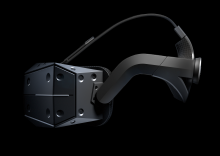 Side view of StarVR One, in a manufacturer rendering published in 2018.
 -
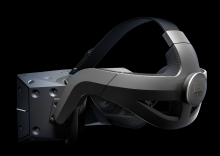 StarVR One rear three-quarter view, in a manufacturer rendering published in 2018.
 -
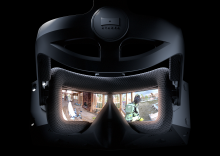 Manufacturer illustration of StarVR One's face cushion and lenses, published in 2018.


References
- ↑ 1.00 1.01 1.02 1.03 1.04 1.05 1.06 1.07 1.08 1.09 1.10 1.11 1.12 1.13 1.14 1.15 1.16 1.17 "StarVR One for Developers". ELSA Japan. 2018-11. https://www.elsa-jp.co.jp/wp-content/uploads/2014/09/catalog-StarVR-One-for-Developers1.pdf. Retrieved 2026-10-14.
- ↑ 2.00 2.01 2.02 2.03 2.04 2.05 2.06 2.07 2.08 2.09 2.10 2.11 2.12 2.13 2.14 2.15 2.16 2.17 2.18 2.19 2.20 2.21 2.22 2.23 2.24 2.25 2.26 2.27 2.28 "StarVR Unveils the World’s Most Advanced Virtual Reality Headset with Integrated Eye Tracking". StarVR Corporation via Cision. 2018-08-14. https://news.cision.com/starvr/r/starvr-unveils-the-world-s-most-advanced-virtual-reality-headset-with-integrated-eye-tracking,c2592432. Retrieved 2026-10-14.
- ↑ 3.0 3.1 3.2 3.3 3.4 3.5 Ben Lang (2018-11-19). "StarVR One Priced at $3,200 for Developers, Now Accepting Applications". Road to VR. https://www.roadtovr.com/starvr-one-priced-at-3200-for-developers-now-accepting-applications/. Retrieved 2026-10-14.
- ↑ 4.0 4.1 4.2 Scott Hayden (2020-05-04). "Ultra-wide FOV Headset StarVR One Priced at $3,200, Selling to Enterprise Only". Road to VR. https://www.roadtovr.com/starvr-one-launch-acer-starbreeze/. Retrieved 2026-10-14.
- ↑ 5.0 5.1 "Acer and Starbreeze Announce First Shipment of StarVR Head-Mounted Displays". Acer. 2016-08-31. https://news.acer.com/acer-and-starbreeze-announce-first-shipment-of-starvr-head-mounted-displays. Retrieved 2026-10-14.
- ↑ 6.00 6.01 6.02 6.03 6.04 6.05 6.06 6.07 6.08 6.09 6.10 6.11 6.12 6.13 6.14 6.15 6.16 6.17 6.18 6.19 6.20 6.21 "StarVR One". Condata International / Abico Enterprise Solution. https://condata-ai.com/starvr/. Retrieved 2026-10-14.
- ↑ 7.0 7.1 7.2 7.3 "What´s New - VRED 2019.2 Design & Professional". Autodesk Community. 2018-10-23. https://forums.autodesk.com/t5/vred-forum/what-s-new-vred-2019-2-design-amp-professional/m-p/8365342/highlight/true. Retrieved 2026-10-14.
- ↑ 8.0 8.1 8.2 8.3 8.4 8.5 8.6 Yannick Sauer; Alexandra Sipatchin; Siegfried Wahl; Miguel García García (2022-01-15). "Assessment of consumer VR-headsets’ objective and subjective field of view (FoV) and its feasibility for visual field testing". Virtual Reality 26: 1089-1101. Retrieved 2026-10-14.
- ↑ 9.0 9.1 "StarVR Corporationとの国内正規代理店契約締結 および「StarVR One」の開発者向け先行販売開始のご案内". ELSA Japan. 2018-11-20. https://www.elsa-jp.co.jp/newsrelease/20181120/. Retrieved 2026-10-14.
- ↑ 10.0 10.1 10.2 中村 真司 (2018-08-15). "人の視野をほぼ100%カバーする視線追跡対応VR HMD「StarVR One」". PC Watch. https://pc.watch.impress.co.jp/docs/news/1138089.html. Retrieved 2026-10-14.
- ↑ 11.0 11.1 Jamie Feltham (2018-12-07). "StarVR Developer Program 'On Hold' Due To 'Uncertainties With Shareholder'". UploadVR. https://www.uploadvr.com/starvr-developer-program-on-hold-due-to-uncertainties-with-shareholder/. Retrieved 2026-10-14.
- ↑ "Starbreeze and Acer to Form Joint Venture for the StarVR Headset". Acer. 2016-05-17. https://news.acer.com/starbreeze-and-acer-to-form-joint-venture-for-the-starvr-headset. Retrieved 2026-10-14.
- ↑ "Acer and Starbreeze Boards Approve Definitive Agreement to form Joint Venture for StarVR". Acer. 2016-06-27. https://news.acer.com/acer-and-starbreeze-boards-approve-definitive-agreement-to-form-joint-venture-for-starvr. Retrieved 2026-10-14.
- ↑ "Annual Report 2024". Starbreeze. 2025. https://storage.mfn.se/a/starbreeze/55f20a55-cdd9-46e0-98cd-7e3b8170b233/starbreeze-annual-report-2024.pdf. Retrieved 2026-10-14.
- ↑ "Consolidated Financial Statements with Independent Auditors’ Report for the Years Ended December 31, 2025 and 2024". Acer. 2026-03-12. https://images.acer.com/is/content/acer/2025-Q4-Consolidated-Financial-Statements-enpdf. Retrieved 2026-10-14.
- ↑ 16.0 16.1 "VREDPro 2024.2 changes". Autodesk. 2023-11-17. https://up1.autodesk.com/prd/2026/VRDPRO/45F9214A-687C-5957-9EEA-89BBB9C9F41F/VREDProChanges_ENU.html. Retrieved 2026-10-14.
- ↑ "Foveated Rendering on StarVR One". ZeroLight. 2018-08-12. https://zerolight.com/news/foveated-rendering-on-starvr-one-2. Retrieved 2026-10-14.
- ↑ "Module vrStarVR". Autodesk VRED 2022 documentation. 2022. https://help.autodesk.com/cloudhelp/2022/ENU/VRED/files/Python-Documentation/Python-API-V1/VRED_Python_Documentation_Python_API_V1_vrStarVR_module_html.html. Retrieved 2026-10-14.
- ↑ "ZeroLight & StarVR State-of-the-Art VR Experience". ZeroLight. 2018-08-24. https://zerolight.com/customers/zerolight-starvr-state-of-the-art-vr-experience. Retrieved 2026-10-14.
- ↑ "アクティオの安全教育システム「Safety Training System VR of AKTIO 高速道路安全教育VR」を開発". AKTIO. 2021-05-10. https://www.aktio.co.jp/news/2021/file/NewsRelease_20210510.pdf. Retrieved 2026-10-14.
- ↑ 21.0 21.1 Miguel García García; Yannick Sauer; Tamara Watson; Siegfried Wahl (2024-01-30). "Virtual reality (VR) as a testing bench for consumer optical solutions: a machine learning approach (GBR) to visual comfort under simulated progressive addition lenses (PALs) distortions". Virtual Reality 28. Article 36. Retrieved 2026-10-14.