

Nintendo Labo
More actions
| Nintendo Labo | |
|---|---|

| |
| Information | |
| VR/AR | Virtual Reality |
| Developer | Nintendo |
| Publisher | Nintendo |
| Platform | Nintendo Switch |
| Device | Nintendo Switch |
| Type | Game |
| Input Device | Joy-Con controllers, cardboard Toy-Con accessories |
| Game Mode | Single-player, Multiplayer |
| Release Date | April 20, 2018 (Variety Kit, Robot Kit); April 12, 2019 (VR Kit) |
| Price | US$69.99 to US$79.99 per kit (US MSRP at launch); VR Kit Starter Set US$39.99 |
Nintendo Labo is a toy-videogame product created by Nintendo for the Nintendo Switch based on creating cardboard kits to interface with the Nintendo Switch. Each kit combines sheets of cardboard with Nintendo Switch software; players fold the sheets into creations that Nintendo calls "Toy-Con", insert the console and its Joy-Con controllers, and then play games with them. Nintendo introduced the line on 17 January 2018 as "a new line of interactive build-and-play experiences designed to inspire kids and those who are kids-at-heart", organized around three activities it called Make, Play and Discover.[1]
One of the Labo products is a VR kit that turns the console into a VR headset. Nintendo Labo Toy-Con 04: VR Kit, released on 12 April 2019, includes cardboard VR Goggles fitted with lenses, into which the Switch console is inserted, along with other Toy-Con accessories used in its virtual reality games.[2][3] The goggles have no head strap and are meant to be held up to the face, a design Nintendo chose so that players can pass them around a room.[4][5][6] Road to VR noted that Nintendo had previously released the Virtual Boy, a console headset, in 1995.[3] The VR Goggles also work with VR modes that Nintendo later added to The Legend of Zelda: Breath of the Wild, Super Mario Odyssey and Super Smash Bros. Ultimate.[7]
Concept and development
In Nintendo's developer interview, the team is introduced as Mr. Sakaguchi (Nintendo Labo director and software lead), Mr. Kawamoto (Nintendo Switch director and Nintendo Labo producer) and Mr. Ogasawara (Nintendo Labo hardware lead).[8] Sakaguchi said the idea came from asking what made Joy-Con different from other controllers, and concluded that "the Joy-Con are sensors before they're controllers."[8] By attaching two Joy-Con to different moving parts of one cardboard model, such as the handle and reel of the Toy-Con Fishing Rod, the software can compare their readings to detect how the model is being moved.[8] Sakaguchi named the three technologies that Nintendo Labo uses most as "the dual gyro sensors, the IR Motion Camera, and the HD rumble function."[8]
The developers decided early in the process that no tools should be needed to build the kits. Ogasawara said that "the more we thought about it, the more we realised that we wanted to design the product so that you wouldn't need any tools at all," and Sakaguchi said the idea "is what caused the design to take shape."[8] Nintendo states that all parts pop out of the sheets and fold together without scissors, glue or tape, and that the software on each kit's cartridge provides interactive step-by-step instructions that can be zoomed, rotated and rewound.[4][9] According to Nintendo, some Toy-Con take 10 to 20 minutes to build and others take several hours.[4]
How it works
Each Toy-Con uses the sensors in the Switch console and Joy-Con. In the Toy-Con Piano from the Variety Kit, a 13-key cardboard keyboard, the IR Motion Camera in the right Joy-Con detects which keys are pressed and the console plays the matching notes. The Toy-Con RC Car moves by using the vibration of the Joy-Con's HD Rumble feature, and the Toy-Con House identifies differently shaped cardboard blocks with the IR Motion Camera.[1]
Every kit also includes Toy-Con Garage, a programming tool with a visual interface that Nintendo says introduces "basic principles of programming". According to Nintendo, players can use it to experiment with the Toy-Con they have built or to make their own designs from household items such as paper cups, stickers and ribbon.[9][10]
Kits
Nintendo released four main kits. Each one includes the cardboard materials and its own Nintendo Switch software; the Switch console is sold separately.[1][9][2]
| Kit | North American release | US launch price (MSRP) | Toy-Con projects |
|---|---|---|---|
| Toy-Con 01: Variety Kit | April 20, 2018[1] | $69.99[1] | Two RC Cars, Fishing Rod, House, Motorbike, Piano[1] |
| Toy-Con 02: Robot Kit | April 20, 2018[1] | $79.99[1] | Wearable robot suit with visor, backpack and hand and foot straps[1] |
| Toy-Con 03: Vehicle Kit | September 14, 2018[11] | $69.99[9] | Car, Submarine, Plane, Pedal, two Keys[9] |
| Toy-Con 04: VR Kit | April 12, 2019[2] | $79.99 (full kit); $39.99 (Starter Set + Blaster)[2] | VR Goggles, Blaster, Camera, Bird, Wind Pedal, Elephant[2] |
A Customization Set with stencils, stickers and colored tape was sold alongside the first two kits for $9.99.[1] In the Robot Kit, the player wears the cardboard suit to control a giant robot in the game.[1] In the Vehicle Kit, the player moves an assembled Key between the Car, Submarine and Plane to switch vehicles, and a second Key lets another player join as co-pilot.[9]
VR Kit
Announcement and release
Nintendo announced Nintendo Labo Toy-Con 04: VR Kit in March 2019 and released it on 12 April 2019.[6][2] Nintendo said the kit was designed to "combine the innovative physical and digital gameplay of Nintendo Labo with basic VR technology to create a simple and shareable virtual reality experience for kids and families."[3] At launch, Doug Bowser, Nintendo of America's Senior Vice President of Sales and Marketing, said that many of the company's young fans had not yet tried virtual reality and called the kit "an approachable way for kids and families to get introduced to this new world."[2]
It was sold in two main configurations in the United States:[2]
| Configuration | US MSRP | Contents |
|---|---|---|
| Nintendo Labo: VR Kit | $79.99 | Software; materials for all six Toy-Con (VR Goggles, Blaster, Camera, Bird, Wind Pedal, Elephant); Screen Holder and other accessories |
| Nintendo Labo: VR Kit - Starter Set + Blaster | $39.99 | Software; VR Goggles and Blaster; Screen Holder and other accessories |
| Expansion Set 1 | $19.99 | Elephant and Camera (no software or goggles) |
| Expansion Set 2 | $19.99 | Wind Pedal and Bird (no software or goggles) |
The two expansion sets were sold only through Nintendo's online store.[2] According to Nintendo, the full kit contains 32 cardboard sheets, VR lenses, reflective, sponge and red sticker sheets, two grommet washer sets and rubber bands.[7]
Design and hardware
The Toy-Con VR Goggles are a cardboard holder for the Switch console with a pair of lenses. Each lens sees one half of the screen, which produces a stereoscopic image.[3] The console's screen is 1280 x 720, so Road to VR calculated that each eye sees at most 640 x 720 pixels, which it compared with the 2013 Oculus Rift DK1 development kit.[3] In its review, Pocket-lint wrote that "the 720p resolution on the Switch display is halved the moment you turn on VR" and that there is "no way to change the focal sharpness."[12]
Tracking is limited to head rotation (three degrees of freedom). UploadVR noted that players can tilt their heads and point and tilt the controllers, but cannot move their head or hands through space.[13] Nintendo calls the Toy-Con VR Goggles "handheld goggles" that "should not be secured to the head."[4] Engadget reported Nintendo's claim that leaving out the head strap and having players hold the devices up to their faces "will make for a more social experience."[6] Several of the other Toy-Con add physical feedback: the Wind Pedal blows a puff of air at the player, and the Blaster gives a "click" when fired.[2]
All VR Kit games can also be played without VR by placing the console in the included Screen Holder, which shows them as ordinary 2D images.[2][3]
Software
Nintendo lists games that include battling an alien invasion with the Blaster, feeding hippos, taking photos in an ocean with the Camera, painting as an elephant and creating 3D art, flying on the back of a bird, and hopping as a frog.[2][7] Some games involve people who are not looking into the goggles. For example, while one player takes photos of the ocean with the Toy-Con Camera, another person can wear the Toy-Con Snorkel and step in front of the Camera to make a fish swim toward the player.[2]
The VR Kit includes two programming tools. Toy-Con Garage returns from the earlier kits, and the new Toy-Con Garage VR lets players make their own small VR games and experiences. Nintendo used Toy-Con Garage VR to build VR Plaza, a collection of more than 60 short games that players can open and edit.[2][7]
Age guidance and safety
Nintendo sets the target age for VR mode at seven and above, a figure it says it chose after consulting an expert in the field. Parents can block VR mode for children aged six and under through a goggles icon in the software's settings. The software reminds players to take a break after set periods of play, and Nintendo advises that differences in eyesight or pupil distance can make the 3D image hard to see for some people.[4][14] Nintendo also warns that some players may experience motion sickness, fatigue or discomfort.[4]
Support in other games
Nintendo added optional VR Goggles support to three existing Switch games through free updates:
| Game | Update | Date | VR content |
|---|---|---|---|
| The Legend of Zelda: Breath of the Wild | Ver. 1.6.0 | April 25, 2019[15] | Optional VR view of the normal game, switched on in the Options menu; head movement controls the camera[16] |
| Super Mario Odyssey | Free update | April 25, 2019[2] | Three mini-missions in the Cap, Seaside and Luncheon Kingdoms[7] |
| Super Smash Bros. Ultimate | Ver. 3.1.0 | May 30, 2019[17] | Single-player VR mode in the Games & More menu[17] |
Takuhiro Dohta, technical director of Breath of the Wild, said of that game's VR option: "The controls and overall game content are the same as normal, but you'll be able to get a new perspective on Hyrule."[16]
Hardware compatibility
The VR Goggles were made for the original Nintendo Switch. Nintendo says that "the Toy-Con VR Goggles accessory is not compatible with Nintendo Switch 2 or Nintendo Switch Lite." On the Nintendo Switch OLED Model, whose screen is 7 inches, the image is shrunk in VR mode to keep the effect, and the automatic switch to VR mode does not work, so the "VR Mode Auto-Switch" setting has to be turned off.[14] Road to VR reported in April 2025 that the Nintendo Switch 2, with its 7.9-inch screen, cannot physically fit into the goggles, so the VR modes of the Labo software and the three updated games cannot be played on it.[18]
In early 2026 a Nintendo staff member told press at a preview event that the Labo VR Goggles would work with the Virtual Boy - Nintendo Classics library. On 5 February 2026 Nintendo issued a correction saying that "the Nintendo Labo VR Goggles are not officially supported for the Virtual Boy - Nintendo Classics library" and pointed players to its own Virtual Boy accessories for Switch, a headset priced at $99.99 and a cardboard model at $24.99.[19][20]
Sales
Nintendo reported that sales of the Nintendo Labo series reached 1.39 million units by 30 June 2018; at that point the Variety Kit and Robot Kit were the only kits on sale.[9][21] In the question-and-answer session of Nintendo's October 2018 financial results briefing, company president Shuntaro Furukawa said the company "knew from the start that the sales trend for Nintendo Labo would be different from that of games like Mario or Zelda" and wanted it to be "a product that continues to sell for a long time as a new way to play on Nintendo Switch."[22]
Education
On 23 October 2018, Nintendo and the Institute of Play, a nonprofit organization, announced a program to bring Nintendo Labo into elementary school classrooms in the United States, combining it with science, technology, engineering, art and mathematics (STEAM) teaching. Nintendo supplied Variety Kits and Nintendo Switch systems, and the program aimed to reach about 2,000 students aged 8 to 11 during the 2018-2019 school year, starting with a pilot in the New York area and a Nintendo Labo Teacher Guide.[10] In April 2019 Nintendo said that "Nintendo Labo is even being used in schools".[23]
Reception
| Kit | Metacritic score (Switch) |
|---|---|
| Toy-Con 01: Variety Kit | 77/100[24] |
| Toy-Con 02: Robot Kit | 68/100[25] |
| Toy-Con 03: Vehicle Kit | 69/100[11] |
| Toy-Con 04: VR Kit | 71/100[26] |
On OpenCritic the VR Kit has a Top Critic Average of 78, with 89% of critics recommending it.[27] UploadVR's Jamie Feltham criticized the image quality, writing that the lines between pixels "are bold and distort the picture" and that small head movements produced motion blur, and he said he would welcome an optional head strap for solo play to spare his arms. He wrote that a VR enthusiast looking for a high-end experience should look elsewhere, but that "Labo turns VR into something it's never really been before: a toy."[13] Pocket-lint called the full kit "incredibly creative, imaginative and great fun while it lasts", but wrote that "you can't play for too long before your eyes start to hurt" and that its testers needed a break after an hour.[12]
According to Nintendo, the three kits released in 2018 won an Innovation Award at the Game Developers Conference in March 2019, and the BAFTA Family award and Game Innovation award at the British Academy Games Awards in April 2019.[23]
See also
Gallery
-
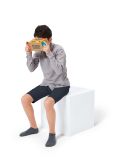 Toy-Con VR Goggles held to the face, as shown in Nintendo’s 2019 VR Kit announcement.
 -
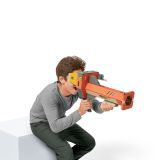 The Nintendo Labo VR Kit’s Toy-Con Blaster with VR Goggles.
 -
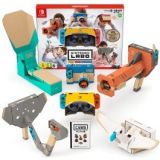 Nintendo Labo VR Kit with its Toy-Con accessories and packaging.


References
- ↑ 1.00 1.01 1.02 1.03 1.04 1.05 1.06 1.07 1.08 1.09 1.10 "Nintendo Labo Combines the Magic of Nintendo Switch with the Fun of DIY Creations". Business Wire. Nintendo of America. 2018-01-17. https://www.businesswire.com/news/home/20180117006511/en/. Retrieved 2026-09-27.
- ↑ 2.00 2.01 2.02 2.03 2.04 2.05 2.06 2.07 2.08 2.09 2.10 2.11 2.12 2.13 2.14 "Enter the Family-Friendly World of Nintendo Labo: VR Kit, Now Available". Business Wire. Nintendo of America. 2019-04-12. https://www.businesswire.com/news/home/20190412005099/en/Enter-the-Family-Friendly-World-of-Nintendo-Labo-VR-Kit-Now-Available. Retrieved 2026-09-27.
- ↑ 3.0 3.1 3.2 3.3 3.4 3.5 Ben Lang (2019-03-07). "Nintendo Jumps into VR (Again) With Switch VR 'Labo' Kit Coming in April". Road to VR. https://roadtovr.com/nintendo-switch-vr-labo-kit-announcement-april-release/. Retrieved 2026-09-27.
- ↑ 4.0 4.1 4.2 4.3 4.4 4.5 "FAQ". Nintendo Labo Official Site. Nintendo of America. https://web.archive.org/web/20201113194750/https://labo.nintendo.com/faq/. Retrieved 2026-09-27.
- ↑ Lisa Marie Segarra (2019-03-21). "Nintendo Sets Its Sights on Virtual Reality". Fortune. https://fortune.com/2019/03/21/nintendo-switch-labo-vr/. Retrieved 2026-09-27.
- ↑ 6.0 6.1 6.2 Richard Lawler (2019-03-06). "Nintendo's next Labo kit brings VR to Switch on April 12th". Engadget. https://www.engadget.com/2019-03-06-nintendo-labo-vr.html. Retrieved 2026-09-27.
- ↑ 7.0 7.1 7.2 7.3 7.4 "Nintendo Labo: VR Kit". Nintendo Labo Official Site. Nintendo of America. https://web.archive.org/web/20190618011654/https://labo.nintendo.com/kits/vr-kit/. Retrieved 2026-09-27.
- ↑ 8.0 8.1 8.2 8.3 8.4 "Nintendo Labo developer interview - Part 1: The Concept". Nintendo UK. Nintendo. 2018-04-13. https://www.nintendo.com/en-gb/News/2018/April/Nintendo-Labo-developer-interview-Part-1-The-Concept-1363026.html. Retrieved 2026-09-27.
- ↑ 9.0 9.1 9.2 9.3 9.4 9.5 9.6 "Drive, Dive and Fly with the New Nintendo Labo Vehicle Kit". Business Wire. Nintendo of America. 2018-07-26. https://www.businesswire.com/news/home/20180726006047/en. Retrieved 2026-09-27.
- ↑ 10.0 10.1 "Nintendo Partners with Institute of Play to Bring Nintendo Labo to Schools Across U.S.". Business Wire. Nintendo of America. 2018-10-23. https://www.businesswire.com/news/home/20181023005406/en/. Retrieved 2026-09-27.
- ↑ 11.0 11.1 "Nintendo Labo: Toycon 03 Vehicle Kit". Metacritic. https://www.metacritic.com/game/nintendo-labo-toycon-03-vehicle-kit/. Retrieved 2026-09-27.
- ↑ 12.0 12.1 Stuart Miles (2019-04-10). "Nintendo Labo VR review: Fun way to try out VR on Switch". Pocket-lint. https://www.pocket-lint.com/ar-vr/reviews/nintendo/147739-nintendo-labo-vr-review/. Retrieved 2026-09-27.
- ↑ 13.0 13.1 Jamie Feltham (2019-04-15). "Nintendo Labo VR Is A Creaky Headset That May Have Cracked VR For Kids". UploadVR. https://www.uploadvr.com/nintendo-labo-vr-impressions/. Retrieved 2026-09-27.
- ↑ 14.0 14.1 "Information About the VR Mode of Nintendo Labo Toy-Con 04: VR Kit". Nintendo Support. Nintendo of America. https://en-americas-support.nintendo.com/app/answers/detail/a_id/43723/~/information-about-the-vr-mode-of-nintendo-labo-toy-con-04:-vr-kit. Retrieved 2026-09-27.
- ↑ "How to Update The Legend of Zelda: Breath of the Wild". Nintendo Support. Nintendo of America. https://en-americas-support.nintendo.com/app/answers/detail/a_id/25568/~/how-to-update-the-legend-of-zelda:-breath-of-the-wild. Retrieved 2026-09-27.
- ↑ 16.0 16.1 "Discover how The Legend of Zelda: Breath of the Wild works in VR with Nintendo Labo!". Nintendo UK. Nintendo. 2019-04-16. https://www.nintendo.com/en-gb/News/2019/April/Discover-how-The-Legend-of-Zelda-Breath-of-the-Wild-works-in-VR-with-Nintendo-Labo--1547803.html. Retrieved 2026-09-27.
- ↑ 17.0 17.1 "Super Smash Bros. Ultimate Update History". Nintendo Support. Nintendo of America. https://en-americas-support.nintendo.com/app/answers/detail/a_id/45074/~/super-smash-bros.-ultimate-update-history. Retrieved 2026-09-27.
- ↑ Scott Hayden (2025-04-03). "Nintendo Switch 2 Won't Support the Original 'Labo VR' Kit". Road to VR. https://roadtovr.com/nintendo-switch-2-labo-vr-kit-not-supported/. Retrieved 2026-09-27.
- ↑ "Virtual Boy - Nintendo Classics can be played with Nintendo Labo VR kit [update: conflicting Nintendo statement"]. Nintendo Everything. 2026-02-05. https://nintendoeverything.com/virtual-boy-nintendo-classics-can-be-played-with-nintendo-labo-vr-kit/. Retrieved 2026-09-27.
- ↑ "Labo VR won't work with Nintendo Classics Virtual Boy games". My Nintendo News. 2026-02-07. https://mynintendonews.com/2026/02/07/labo-vr-wont-work-with-nintendo-classics-virtual-boy-games/. Retrieved 2026-09-27.
- ↑ "Consolidated Financial Highlights (Three Months Ended June 30, 2018)". Nintendo Co., Ltd.. 2018-07-31. https://www.nintendo.co.jp/ir/pdf/2018/180731e.pdf. Retrieved 2026-09-27.
- ↑ "Six Months Financial Results Briefing for Fiscal Year Ending March 2019: Q and A Summary". Nintendo Co., Ltd.. 2018-11. https://www.nintendo.co.jp/ir/pdf/2018/181109e.pdf. Retrieved 2026-09-27.
- ↑ 23.0 23.1 "Financial Results Briefing for Fiscal Year Ended March 2019". Nintendo Co., Ltd.. 2019-04-26. https://www.nintendo.co.jp/ir/pdf/2019/190426_3e.pdf. Retrieved 2026-09-27.
- ↑ "Nintendo Labo: Toycon 01 Variety Kit". Metacritic. https://www.metacritic.com/game/nintendo-labo-toycon-01-variety-kit/. Retrieved 2026-09-27.
- ↑ "Nintendo Labo: Toycon 02 Robot Kit". Metacritic. https://www.metacritic.com/game/nintendo-labo-toycon-02-robot-kit/. Retrieved 2026-09-27.
- ↑ "Nintendo Labo: Toycon 04 VR Kit". Metacritic. https://www.metacritic.com/game/nintendo-labo-toycon-04-vr-kit/. Retrieved 2026-09-27.
- ↑ "Nintendo Labo VR Kit Reviews". OpenCritic. https://opencritic.com/game/7512/nintendo-labo-vr-kit. Retrieved 2026-09-27.