

VPL EyePhone
More actions
| VPL EyePhone | |
|---|---|

| |
| Basic Info | |
| VR/AR | Virtual Reality |
| Type | Head-mounted display |
| Subtype | PC-Powered VR, Vintage VR |
| Platform | Silicon Graphics IRIS workstations (RB2)[1] |
| Creator | VPL Research[2] |
| Developer | VPL Research |
| Manufacturer | VPL Research |
| Announcement Date | June 7, 1989 (RB2 presentation)[1] |
| Release Date | 1989 (commercially documented)[3] |
| Price | LX US$9,150; HRX US$49,000 (1993 survey)[4] |
| Versions | Original EyePhone, LX, HRX[4][3] |
| Requires | External video source; configured tracker for head tracking[5] |
| Display | |
| Display | Dual LCD screens; HRX uses active-matrix TFT[6] |
| Resolution | 442 × 238 (LX); 720 × 480 (HRX), primary-colored elements per eye[4] |
| Image | |
| Field of View | 108° (LX), 106° (HRX), both-eye horizontal[4] |
| Horizontal FoV | 86° per eye / 108° both eyes (LX)[5] |
| Vertical FoV | 76° (LX); 75° (HRX)[4] |
| Optics | |
| Optics | FMT Fresnel lenses (LX)[5] |
| Ocularity | Binocular |
| Tracking | |
| Tracking | 6 DoF electromagnetic, with configured Polhemus tracker[1] |
| Tracking Frequency | 60 acquisitions/s (LX tracker)[5] |
| Base Stations | Fixed magnetic source (RB2)[1] |
| Hand Tracking | Yes (with DataGlove)[1] |
| Body Tracking | Yes (with DataSuit)[1] |
| Rotational Tracking | Yes[1] |
| Positional Tracking | Yes, with tracker[1] |
| Update Rate | 30 or 60 transfers/s (LX tracker)[5] |
| Audio | |
| Audio | Stereo headphones[6] |
| Connectivity | |
| Connectivity | RS-170A RGB or NTSC (HRX)[6] |
| Wired Video | Yes[5] |
| Power | External; HRX domestic brochure: 110 VAC, 50 W[6] |
| Device | |
| Weight | 2.5 lb (HRX goggles and headmount)[6] |
| Material | Plastic (HRX headmount)[6] |
| Sensors | External Polhemus magnetic tracking sensor[1] |
| Input | DataGlove, (sold separately)[3] |
The EyePhone was a virtual reality head-mounted display (HMD) developed by VPL Research. It was part of Reality Built for Two (RB2), a shared virtual environment system presented on June 7, 1989.[1]
VPL advertised two EyePhone models, including the new HRX, in 1991.[2]
History
Company Background
VPL's 1990 exhibitor description names Jaron Lanier and Jean-Jacques Grimaud as its founders and gives 1985 as the founding year. A later Virtual Reality Society account dates the company to 1984 and places its beginnings in a corner of Lanier's cottage in Palo Alto, California.[2][7]
The company name "VPL" stood for "Virtual Programming Languages."[3]
VPL Research became one of the first companies to develop and sell virtual reality products. Lanier helped popularize the term "virtual reality".[7]
Development and Release
The 1990 RB2 paper dates its first presentation to June 7, 1989.[1]
Dataquest's September 1989 report identifies EyePhone as a recent commercial product and describes RB2 demonstrations in San Francisco and at SIGGRAPH in Boston.[3]
Commercial Models
Period specifications count individual LCD color elements; these records describe different generations and historical prices.[4]
| Model | Horizontal FoV | Resolution (per eye) | List Price | Notes |
|---|---|---|---|---|
| Model 1 (1989 EyePhone; number not given in source) | Not established here | 84,000 pixels reported in 1989; geometry unspecified | $9,400 (September 1989) | Sony color LCDs, Pop-Optix lenses and Polhemus positioning[3] |
| LX | 86° per eye; 108° both eyes | 442 × 238 primary-colored elements | US$9,150 (1993 survey) | VPL brochure specifies 76° vertical[5][4] |
| Model HRX | 86° per eye; 106° both eyes | 720 × 480 primary-colored elements | US$49,000 (1993 survey) | VPL brochure specifies 75° vertical[6][4] |
The HRX brochure mentions an earlier EyePhone Model 2 without identifying it as the LX.[6]
The complete "Reality Built for Two" (RB2) system, including the computers required to run it, cost around $250,000 in former employee Mitch Altman's later recollection.[8]
Dataquest separately listed an approximately $70,000 two-person development package in 1989, explicitly excluding the IRIS computers.[3]
Technical Specifications
Display Technology
- Display Type: Dual LCD panels that provided slightly different images to each eye to create stereoscopic 3D[6]
The LX and HRX brochures call their Fresnel lens system FMT Optics.[6][5]
The survey counts red, green and blue LCD elements separately; these matrix dimensions differ from modern full-color pixel specifications.[4]
The 1989 report identifies Pop-Optix lenses.[3]
Physical Design
VPL's goggles-and-headmount figures were 2.5 lb for both LX and HRX.[6][5]
The LX headmount had an adjustable fit. Its control unit provided separate brightness, color and tint adjustments for the left and right displays.[5]
Tracking Capabilities
The RB2 description identifies a head-mounted Polhemus sensor that measured position and orientation relative to a fixed magnetic source in the room. Movement changed the view.[1]
The LX's Polhemus 3Space Isotrak tracker acquired data 60 times/s, with 30 or 60 transfers/s. These tracking rates do not specify LCD refresh or application frame rate.[5]
VPL cautioned against using the magnetic tracking system near metal objects or strong electromagnetic fields. HRX head tracking was an optional configuration.[6]
Platform Requirements
The EyePhone required an external image source. The 1990 RB2 configuration used Silicon Graphics IRIS rendering engines, one for each eye.[1]
- Authoring Station: Macintosh-based system networked via Ethernet[1]
The LX accepted separate left and right NTSC video inputs, with serial connections for tracking.[5]
The HRX could be ordered for RS-170A RGB and sync with NTSC timing, or composite NTSC inputs.[6]
VPL Ecosystem
The EyePhone was part of a larger ecosystem of VR products developed by VPL Research:
| Product | Function | Price |
|---|---|---|
| DataGlove | Hand tracking and interaction device with fiber-optic sensors and 6502-based electronics[8][1] | $8,800 (September 1989)[3] |
| DataSuit | Full-body tracking suit with sensors for arms, legs, and trunk[1] | N/A |
| AudioSphere | 3D spatial audio system[2] | N/A |
| Isaac | Real-time 3D visual rendering engine[1] | N/A |
| Body Electric | Visual programming language for VR[1] | N/A |
| RB2 (Reality Built for Two) | Complete multi-user VR system | Around $250,000 including computers (Altman recollection)[8] |
The DataGlove was developed by Thomas G. Zimmerman and L. Young Harvill.[9]
VPL later licensed the DataGlove technology to Mattel, which used it to create the Power Glove for the Nintendo Entertainment System.[10]
Software and Applications
Programming Environment
VPL Research developed several software components for the EyePhone system:
- Body Electric - A visual programming language and scripting system used to control and program all VR components[7]
- Isaac - A real-time 3D visual rendering engine that worked with Body Electric to create virtual environments[1]
- Swivel 3D - A 3D modeling application created by Young Harvill that allowed users to generate virtual worlds on Macintosh computers[11][1]
VPL also described a separate Convolvotron for spatial sound.[1]
Demonstrated Applications
Reality Built for Two (RB2) provided shared virtual reality experiences where multiple users could interact in the same virtual space. Its demonstrations included objects with programmed behavior, such as a ceiling fan controlled by a virtual switch.[3]
A NASA Marshall report from the 1995 summer fellowship program describes an LX EyePhone in its RB2 laboratory. The team integrated Fastrak tracking and Spaceball controls with WorldToolKit to review imported CAD models, including airlock geometry. This was a particular laboratory configuration, rather than the headset's original tracking specification.[12]
Head and hand control
Pausch, Shackelford and Proffitt studied 28 introductory computer-science students (14 women and 14 men) with a VPL EyePhone, Polhemus 3Space tracker and two SGI VGX machines. Participants found and read aloud 20 two-digit visual targets per trial. In one condition, head motion controlled the camera; in the other, helpers held the same display stationary while participants manipulated the tracker by hand. Gender-balanced groups tried both conditions in opposite orders, with ten trials per condition and the first three excluded. Rendering was about 10 frames/s. Mean search time was 1.5 seconds/target with head control versus 2.6 with hand control, a reported 42% reduction; prior head-control experience improved later hand-control performance by 23%. The authors limited their conclusion to this search task, rather than claiming VR generally outperformed desktop interfaces. The paper does not identify an LX or HRX variant.[13]
Cultural Impact
Media Appearances
The EyePhone and other VPL Research products gained media attention. Philip Elmer-DeWitt described trying a VPL system at SIGGRAPH in Dallas in a September 3, 1990 TIME report. He reported difficulty with glove control and noticeable view-update delay.[14]
Featured in the 1992 science fiction film "The Lawnmower Man," the EyePhone belonged to the real VR equipment used in the production. The film credits acknowledge VPL Research for data-gloves and eye-phones.[15]
The October 1987 cover of Scientific American showed a data glove alongside its computer-generated counterpart.[9]
Legacy
The device survives as a historical artifact. In September 2026, the Computer History Museum announced a prototype EyePhone among the exhibits planned for "Extended Reality: Visions of the Future," scheduled for October 1, 2026 to March 28, 2027.[16]
Company Closure
VPL Research entered Chapter 11 proceedings on March 15, 1993, as recorded in a European Patent Office appeal decision concerning one of its patent applications. The decision describes continued activity and court-approved financing during the proceedings.[17]
The company's patents were eventually sold to Sun Microsystems in 1998. Sun's announcement, preserved on Lanier's website, describes acquiring more than a dozen patents and other technical assets from Thomson CSF and Greenleaf Medical. It announced plans to use the technology in Java 3D and other graphics products.[18]
Reception and Limitations
Technical Limitations
Frame rate depended on the computer, software and scene. The NASA report describes a detailed airlock model falling below one frame/s on an SGI 4D/310 with 24 MB RAM, and recommends partitioning the scene or using faster hardware. This measures that rendering workload, rather than the LCD's refresh rate.[12]
The 1993 survey says VPL was not selling the HRX in April 1993 because of LCD supply difficulties.[4]
Market Barriers
- Cost: The total system cost of around $250,000 restricted access chiefly to large companies and universities, according to Altman's account.[8]
- Computing Requirements: RB2 used SGI workstations.[1]
- Software constraints: NASA's report identifies RB2 Swivel's 1,020-object file limit and lack of advanced texture mapping, alongside limited sensor and C-language extensibility. The laboratory's later WorldToolKit integration addressed its CAD workflow.[12]
Comparison to Other Devices
| Device | Release Year / dated record | Resolution (per eye) | FoV (measurement) | Tracking | Price |
|---|---|---|---|---|---|
| VPL EyePhone (LX) | 1993 survey | 442 × 238 colored elements | 108° horizontal, both eyes | 6 DoF with external tracker | US$9,150 (survey)[4][5] |
| NVisor (NVIS; SX datasheet) | 2003 datasheet | 1280×1024 | 60° diagonal | Tracker dependent; IS-900 6 DoF supported | Not specified in datasheet[19] |
| Virtuality Visette | 1993 survey | 376 × 276 colored elements | 90°-120° binocular (survey) | Not specified in cited survey | Bundled with arcade system; no separate price in survey[4] |
| Oculus Rift | 2016 launch offer | 1080×1200 | Not specified here | 6 DoF, infrared Constellation | US$599 launch offer, excluding PC[20][21][22] |
Its documented configuration combined:[1]
See Also
- Virtual reality
- Head-mounted display
- VPL Research
- Jaron Lanier
- Thomas G. Zimmerman
- DataGlove
- The Lawnmower Man
- History of virtual reality
- List of virtual reality headsets
Gallery
-
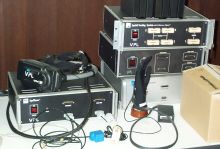 VPL EyePhone and DataGlove on display in Tokyo, photographed in 1999.

References
- ↑ 1.00 1.01 1.02 1.03 1.04 1.05 1.06 1.07 1.08 1.09 1.10 1.11 1.12 1.13 1.14 1.15 1.16 1.17 1.18 1.19 1.20 1.21 1.22 1.23 1.24 1.25 1.26 Chuck Blanchard; Ann Lasko-Harvill; Lou Ellyn Jones (1990). "What's New in Reality Built for Two". Ars Electronica. Retrieved 2026-10-16.
- ↑ 2.0 2.1 2.2 2.3 "VPL Research Inc. (1990 and 1991 exhibitor descriptions)". ACM SIGGRAPH History Archives. https://history.siggraph.org/exhibitor/vpl-research-inc/. Retrieved 2026-10-16.
- ↑ 3.00 3.01 3.02 3.03 3.04 3.05 3.06 3.07 3.08 3.09 (1989-09). "Virtual Reality: The Next User Interface". Dataquest Research Newsletter, CCIS 1989-5, document 0004939. Retrieved 2026-10-16.
- ↑ 4.00 4.01 4.02 4.03 4.04 4.05 4.06 4.07 4.08 4.09 4.10 4.11 Richard Holloway; Anselmo Lastra (1993-09). "Virtual Environments: A Survey of the Technology, TR93-033". University of North Carolina at Chapel Hill. Retrieved 2026-10-16.
- ↑ 5.00 5.01 5.02 5.03 5.04 5.05 5.06 5.07 5.08 5.09 5.10 5.11 5.12 "EyePhone LX (domestic brochure)". VPL Research. https://archive.org/download/VPL_promo_material_EyePhone_LX/eyephone_lx_text.pdf. Retrieved 2026-10-16.
- ↑ 6.00 6.01 6.02 6.03 6.04 6.05 6.06 6.07 6.08 6.09 6.10 6.11 6.12 "EyePhone HRX (domestic brochure)". VPL Research. 1991. https://archive.org/download/VPL_promo_material_EyePhone_HRX/eyephone_hrx_text.pdf. Retrieved 2026-10-16.
- ↑ 7.0 7.1 7.2 "VPL Research Jaron Lanier". Virtual Reality Society. https://www.vrs.org.uk/virtual-reality-profiles/vpl-research.html. Retrieved 2026-10-16.
- ↑ 8.0 8.1 8.2 8.3 Matthew Terndrup (2015-02-05). "Flashback: An Interview with Mitch Altman (A Virtual Reality Pioneer from the late 1980's)". UploadVR. https://www.uploadvr.com/flashback-an-interview-with-mitch-altman-a-virtual-reality-pioneer-from-the-late-1980s/. Retrieved 2026-10-16.
- ↑ 9.0 9.1 "Scientific American, October 1987". Scientific American, cover and page 130. 1987-10. https://wkbpic.com/wkbx/SA/1987/1987-10-01.pdf. Retrieved 2026-10-16.
- ↑ Shann Nix (1989-08-07). "Welcome to the World of Hyper-Reality". San Francisco Chronicle. https://archive.computerhistory.org/resources/access/text/2024/05/102734504-05-0001-acc.pdf. Retrieved 2026-10-16.
- ↑ John Perry Barlow (2015-04-30). "Virtual Reality and the Pioneers of Cyberspace (Being in Nothingness, 1990 essay reprint)". WIRED. https://www.wired.com/2015/04/virtual-reality-and-the-pioneers-of-cyberspace/. Retrieved 2026-10-16.
- ↑ 12.0 12.1 12.2 Peter Hor-Ching Wang (1996-02-01). "A Convertor and User Interface to Import CAD Files into WorldToolKit Virtual Reality Systems". NASA/ASEE Summer Faculty Fellowship Program, 1995; NTRS 19960025483. Retrieved 2026-10-16.
- ↑ Randy Pausch; M. Anne Shackelford; Dennis Proffitt (1993). "A User Study Comparing Head-Mounted and Stationary Displays". IEEE Symposium on Research Frontiers in Virtual Reality. Retrieved 2026-10-16.
- ↑ Philip Elmer-DeWitt (1990-09-03). "Technology: (Mis)Adventures In Cyberspace". TIME. https://time.com/archive/6715769/technology-misadventures-in-cyberspace/. Retrieved 2026-10-16.
- ↑ "The Lawnmower Man (1992), production credits". AFI Catalog of Feature Films. https://catalog.afi.com/Catalog/moviedetails/59296. Retrieved 2026-10-16.
- ↑ "Computer History Museum Announces Extended Reality: Visions of the Future Exhibit". Computer History Museum. 2026-09-10. https://computerhistory.org/press-releases/computer-history-museum-announces-extended-reality-visions-of-the-future-exhibit/. Retrieved 2026-10-16.
- ↑ "Decision of the Legal Board of Appeal dated 13 October 1998, J 26/95". Official Journal EPO 1999, pages 668-686. 1999-11-23. https://www.epo.org/en/legal/official-journal/1999/11/p668. Retrieved 2026-10-16.
- ↑ "Sun Acquires Virtual Reality and Networked 3D Graphics Patent Portfolio from Industry Pioneer". Sun Microsystems announcement, preserved by Jaron Lanier. 1998-02. https://www.jaronlanier.com/sun.html. Retrieved 2026-10-16.
- ↑ "nVisor SX: High-Resolution, Wide Field-of-View Head-Mounted Display". NVIS. 2003. https://snebulos.mit.edu/projects/voila/docs/datasheets/nvisor-sx.pdf. Retrieved 2026-10-16.
- ↑ "Oculus Rift Pre-Orders Now Open, First Shipments March 28". Oculus Blog. 2016-01-06. https://www.meta.com/blog/oculus-rift-pre-orders-now-open-first-shipments-march-28/. Retrieved 2026-10-16.
- ↑ Atman Binstock (2015-05-15). "Powering the Rift". Oculus Blog. https://www.meta.com/blog/powering-the-rift/. Retrieved 2026-10-16.
- ↑ "The Oculus Rift, Oculus Touch, and VR Games at E3". Oculus Blog. 2015-06-11. https://www.meta.com/blog/the-oculus-rift-oculus-touch-and-vr-games-at-e3/. Retrieved 2026-10-16.