

DAQRI Smart Helmet
More actions
| DAQRI Smart Helmet | |
|---|---|

| |
| Basic Info | |
| VR/AR | Augmented Reality |
| Type | AR headset |
| Subtype | Enterprise AR, Industrial AR |
| Platform | DAQRI Visual Operating System (Vos)[1] |
| Creator | DAQRI |
| Developer | DAQRI |
| Manufacturer | DAQRI |
| Announcement Date | September 2014; Intel redesign at CES 2016[2][3] |
| Release Date | Late 2016 (Developer Edition)[4] |
| Price | US$15,000 (2017 early adopter package)[5] |
| Website | Archived product page |
| Versions | Prototype; Smart Helmet Developer Edition[6][5] |
| Requires | Custom industrial applications and data integration[7] |
| Predecessor | 2014 Android prototype[2] |
| Successor | DAQRI Smart Glasses[8] |
| System | |
| Operating System | DAQRI Vos; Linux base reported for 2016 development[1][9] |
| Chipset | Sixth-generation Intel Core m7[7] |
| CPU | Intel Core m7-6Y75 (2017 hardware account)[4] |
| GPU | Intel HD Graphics 515 (2017 account)[4] |
| Storage | |
| Storage | 64 GB SSD (2017 account)[4] |
| Display | |
| Display | Binocular optical see-through; LCoS (2017 account)[4] |
| Resolution | 1366 × 768 pixels (2017 account)[4] |
| Image | |
| Field of View | 44° diagonal (2017 account)[4] |
| Optics | |
| Optics | Optical see-through[7] |
| Ocularity | Binocular[4] |
| Passthrough | Direct optical view through transparent displays[7] |
| Tracking | |
| Tracking | Intellitrack visual-inertial navigation; application-specific registration[10] |
| Audio | |
| Audio | Speakers, microphone array and audio output[4][11] |
| Microphone | Array; 2016 demo described four microphones[11] |
| Camera | Tracking camera, RGB camera, RealSense depth sensor and thermal camera[7] |
| Connectivity | |
| Connectivity | Wi-Fi and Bluetooth[4] |
| Ports | USB expansion; USB-C hub supplied in 2017 guide[11][12] |
| WiFi | Integrated (2017 account)[4] |
| Bluetooth | Bluetooth Low Energy (2017 account)[4] |
| Power | Removable rechargeable lithium-ion battery[12] |
| Device | |
| Weight | 1500 g including battery (2018 study apparatus)[13] |
| Material | 2016 description: molded plastic outer shell; cast aluminum and carbon fiber composite inner shell[14] |
| Headstrap | Harness with horizontal and vertical adjustment and fit dial[12] |
| Sensors | Motion, depth and thermal sensors[7][4] |
| Input | Head-directed cursor with dwell selection; physical buttons; supplied keyboard/trackpad[15][12] |
| Compliance | 2017 safety notice: not yet mechanical-impact certified or PPE approved; manufacturer Part 15 statement[16] |
The DAQRI Smart Helmet was an industrial augmented reality headset developed by DAQRI in a helmet form. It combined transparent displays, onboard computing, tracking and depth cameras, and thermal imaging for industrial work. DAQRI presented an early prototype in September 2014 and an Intel-based redesign at CES 2016. The later Developer Edition was offered through a US$15,000 early adopter package that included software and applications.[7][2][3][5]
The helmet was intended for work instructions, equipment data, model visualization and remote assistance in construction, manufacturing, aerospace, and oil and gas. Its protective appearance should be distinguished from certification: DAQRI's March 2017 safety notice said the product had not yet been approved as personal protective equipment or certified against mechanical impact hazards.[7][3][16]
History and development
Prototypes and Intel redesign
DAQRI began in 2010 as a mobile AR company based in Los Angeles.[9] Its early helmet concept was already public in September 2014. Contemporary reporting described an Android system using two Qualcomm Snapdragon processors. In an interview that month, president Andy Lowery expected a prototype by the end of October and industrial pilot programs in December. Those statements described development plans, rather than evidence of a general commercial release.[2][6]
Intel's CES 2016 backgrounder introduced an Intel Core M and RealSense version, initially for key partners, with broader availability planned for later that year. American Megatrends announced its BIOS development collaboration on January 20, 2016 and identified a sixth-generation Intel Core m7 processor. These records describe a later design than the Android prototype.[3][17]
Developer Edition and later direction
The US$15,000 early adopter package included the Developer Edition and software. An April 2017 interview with DAQRI marketing director Fabrice Etienne reported availability since late 2016, with hard-hat certification underway and full production forecast for 2017. The forecast does not establish a subsequent production date.[5][4]
The separate DAQRI Smart Glasses became the company's later hardware focus. In December 2017, CEO Roy Ashok described the helmets as a development platform whose customer trials informed the glasses. He discussed the glasses' early-November shipment and broader range of uses. Flex's June 2017 manufacturing agreement likewise concerned Smart Glasses, while its company description named the helmet among products running DAQRI's Visual Operating System, Vos.[8][1]
In September 2019, TechCrunch reported that DAQRI had closed its headquarters and was selling assets. A customer email obtained by the publication said its cloud and smart-glasses hardware platforms would shut down by the end of that month. A later investigation based on former-employee interviews described certification and deployment difficulties with the helmet and the company's shift to the glasses. These reports do not establish that every previously installed offline helmet application stopped working on a particular date.[18][9]
Processing and software
The Intel redesign placed its processor inside the helmet. DAQRI's archived product page specifies a sixth-generation Core m7 and a tracking camera paired with a dedicated processor.[7]
DAQRI marketed the software platform as Vos. In his 2020 investigation, Janko Roettgers reported that development moved from Android to Linux before a planned 2016 shipment. A processor or camera's support for Windows does not by itself identify the helmet's operating system.[1][9]
4D Studio let customers assemble work instructions and data visualizations from models, text, documents, images, audio and video. The January 2017 early adopter package included the authoring software and remote expert, thermal vision, data visualization and guided work-instruction applications. Industrial deployments still needed task content and connections to the customer's equipment or information systems.[5][7]
Display technology
The transparent displays let the wearer view physical equipment directly while reading graphics and instructions.[7]
A CES 2016 description used DAQRI's term "photonic display" and attributed to the company a lensing design intended to synchronize physical and displayed focal distances. This was a product claim, rather than a measured guarantee of visual comfort. The same description listed an injection-molded plastic exterior and an inner shell made from cast aluminum and carbon fiber composite.[14]
The developer guide explains fit in terms of aligning the displays with the eyes and adjusting the harness. It does not supply a numerical IPD range or establish prescription correction.[12]
Camera system and tracking
The archived DAQRI page identifies a wide-angle tracking camera, a RealSense LR200 depth sensor and a thermal camera as separate components. The LR200 description includes an RGB camera, stereo infrared cameras and an infrared projector. Infrared depth sensing and thermal imaging perform different functions.[7]
Camera specifications reported in April 2017:[4]
| Component | Documented description |
|---|---|
| Depth sensor | Intel RealSense LR200; 480 × 360 depth at 60 frames per second, stated range 0.4-4 m |
| Tracking camera | 640 × 480 at 100 frames per second; 166° diagonal fisheye lens |
| RGB video camera | 1080p at 30 frames per second |
| Thermal camera | FLIR; reported temperature range -20°C to 120°C |
A January 2016 description listed a 13-megapixel camera for photo and video capture and 2D target recognition. It also described two IMUs, one as industrial grade and the other as commercial grade. Early September 2014 descriptions advertised surround-camera coverage. These records should not be combined into a claim that every later helmet contained four additional HD cameras.[14][2][6]
DAQRI called its visual-inertial navigation technology Intellitrack. Industrial applications also used visual markers for registration. The 2016 steel-mill trial used four identified observation points and the helmet's 2D vision camera rather than depth data. The trial used application-specific marker registration.[10]
In Autodesk's 2017 account, Roy Ashok described RealSense sensing that interpreted room geometry, recognized objects such as doors, windows and tables, and recorded room maps for placing virtual content. These were attributed capability descriptions, without a reported independent recognition benchmark.[15]
Thermal vision
DAQRI described thermal vision as an overlay of temperature information for inspecting industrial equipment. The 2017 account said thermal and normal contextual AR views could not run simultaneously. Thermal monitoring was an intended maintenance function, without a demonstrated guarantee of fault detection.[7][4]
Controls and audio
The headset's hands-free menu control used head movement to aim a cursor and a dwell interval to select an item. Autodesk's 2017 account explains that DAQRI adopted this approach after considering the reliability and fatigue problems of hand-signal control. The developer guide also documents a power button, function buttons and an included Bluetooth keyboard and trackpad.[15][12]
A January 2016 description listed integrated power and volume buttons and an audio jack for protective headphones.[14] Intel's April 2016 demonstration brief lists a four-microphone array and an audio output jack. A 2017 report instead describes speakers and four microphones per side. These accounts document different microphone descriptions; they do not establish a universal voice-command interface.[11][4]
Physical design, connectivity and power
The developer guide shows a harness with a rear fit dial and horizontal and vertical adjustment. It instructs users to align the display, tighten the harness and avoid carrying the headset by that harness. It also recommends placing the unworn device upside down on a stable surface and cleaning the lenses and face shield with a soft, dust-free cloth.[12]
The 2017 account lists Intel Wireless-AC 8260 and locally stored CAD data and applications for offline work. Local content differs from remote communication or live networked plant data.[4]
The 2016 product description listed two USB 2.0 expansion ports, with flashlights and gas sensors given as possible peripherals. It described a docking station for stowage, charging and data transfer. The later developer guide documents a supplied USB-C hub, a battery charger and a 60 W USB-C power supply. The guide's charger is for removable batteries; its power rating does not specify headset consumption or battery capacity.[14][12]
| Item in the developer guide | Detail |
|---|---|
| Helmet | One Smart Helmet |
| Batteries | Two rechargeable lithium-ion batteries |
| Charger and supply | Battery charger with a 60 W USB-C power supply |
| Peripheral hub | USB-C hub |
| External input | Bluetooth keyboard and trackpad with a mini USB adapter |
| Regional cords | US, UK and EU cords |
| Printed documents | Welcome note, getting-started guide, and safety and product information |
The package contents and charging arrangement above are recorded in the original guide.[12]
A 2014 prototype account described at least eight hours of battery life. This was an early product description, rather than a measured runtime for the later Developer Edition.[6]
The guide describes a spring-loaded battery cradle and charging either in the supplied charger or with a battery installed in the helmet when connected to power. It does not state a measured runtime or charging duration. Its charging instructions should be read with the safety notice, which tells users not to wear the helmet while charging.[12][16]
Safety and operating limits
DAQRI's safety notice dated March 17, 2017 gives an operating range of 0-37°C. It explicitly says that the product was not yet approved as personal protective equipment or certified against mechanical impact hazards. It also advises against water exposure, extended wearing and using the helmet while charging. This notice prevents treating the helmet form or early promotional descriptions as proof of completed hard-hat or face-shield certification.[16]
The document identifies a Class 1 laser and includes a manufacturer statement of FCC Part 15 compliance and conformity with applicable EU directives. Those statements concern the scopes described in that notice and do not replace workplace impact certification.[16]
Enterprise applications
| Application | Documented use |
|---|---|
| Work instructions | Displaying task information and model-based guidance while the worker keeps their hands available for the task |
| Data visualization | Presenting equipment information at the relevant machine or location |
| Thermal vision | Displaying and recording temperature information for equipment inspection |
| Remote expert | Sharing the wearer's viewpoint and receiving visual assistance from a remote colleague |
DAQRI advertised these four application areas on its product page.[7]
Construction proof of concept
Autodesk documented a joint trial with Mortenson during construction of the Hennepin County Medical Center in Minneapolis. Workers viewed a building information model over the site to inspect proposed mechanical, electrical and plumbing installations. The account describes a proof of concept and imported models aligned with the physical environment. The overlay represented the model, rather than a camera directly detecting actual hidden pipes or wiring.[15]
Steel-mill deployment
A 2016 paper by DAQRI and Intel authors describes a KSP Steel trial in Pavlodar, Kazakhstan. Four visual markers along a roughly 200 m line associated plant information with observation points. The helmet obtained control-system and production-order data over the local wireless network; the trial did not use depth sensing. The authors reported 40% greater wearer productivity and 50% less machine downtime, while acknowledging that larger controlled experiments were needed to separate contributing factors. These company-affiliated case-study figures are not an independently replicated performance guarantee.[10]
Research and limitations
Pringle and colleagues evaluated the Smart Helmet Developer Edition on an eleven-step Siemens wind-turbine yaw-motor servicing task. They recruited 36 male mechanical-engineering students and randomly assigned them to helmet instructions or an iPad manual; four participants were excluded because of language difficulties. The motor sat on a workbench, and the experimenter provided verbal help for four steps. The study describes the helmet as weighing 1500 g with its battery.[13]
The mean weighted error score per step was 0.38 with AR and 0.57 with tablet instructions (p = .02). Completion was not significantly faster: mean step times were 108 and 93 seconds respectively (p = .06). Only air-gap measurement showed significantly fewer errors after correction for comparisons across steps. The authors noted instruction discrepancies, baseline-image quality and the use of students rather than professional technicians. Participants also reported discomfort from the helmet's weight; the findings concern this short procedure.[13]
See Also
Gallery
-
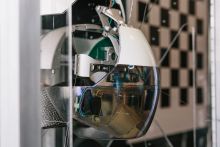 Interior view of the DAQRI Smart Helmet.

References
- ↑ 1.0 1.1 1.2 1.3 "DAQRI Partners with Flex for Production of Augmented Reality Headsets". Flex / PR Newswire. 2017-06-27. https://www.prnewswire.com/news-releases/daqri-partners-with-flex-for-production-of-augmented-reality-headsets-300480078.html. Retrieved 2026-10-14.
- ↑ 2.0 2.1 2.2 2.3 2.4 Tammy Parker (2014-09-07). "Daqri's smart hardhat enables blue-collar augmented reality". Fierce Network. https://www.fierce-network.com/tech/daqri-s-smart-hardhat-enables-blue-collar-augmented-reality. Retrieved 2026-10-14.
- ↑ 3.0 3.1 3.2 3.3 "Intel RealSense Technology Advances Human-Like Senses to Devices". Intel. 2016-01. https://download.intel.com/newsroom/kits/ces/2016/pdfs/PerC_CES_Backgrounder.pdf. Retrieved 2026-10-14.
- ↑ 4.00 4.01 4.02 4.03 4.04 4.05 4.06 4.07 4.08 4.09 4.10 4.11 4.12 4.13 4.14 4.15 4.16 4.17 Julien Happich (2017-04-06). "A hard hat for AR industrialization". eeNews Europe. https://www.eenewseurope.com/en/a-hard-hat-for-ar-industrialization/. Retrieved 2026-10-14.
- ↑ 5.0 5.1 5.2 5.3 5.4 John Hitch (2017-01-04). "Head First: Smart Helmet Redefines Industrial Wearables". IndustryWeek. https://www.industryweek.com/technology-and-iiot/article/21994186/head-first-smart-helmet-redefines-industrial-wearables. Retrieved 2026-10-14.
- ↑ 6.0 6.1 6.2 6.3 Kayla Devon (2014-09-22). "The 21st Century Hardhat". Builder. https://www.builderonline.com/products/tools-equipment/the-21st-century-hardhat_o/. Retrieved 2026-10-14.
- ↑ 7.00 7.01 7.02 7.03 7.04 7.05 7.06 7.07 7.08 7.09 7.10 7.11 7.12 7.13 "Smart Helmet". DAQRI. https://web.archive.org/web/20170130144223/https://daqri.com/products/smart-helmet/. Retrieved 2026-10-14.
- ↑ 8.0 8.1 Matt LaWell (2017-12-08). "New DAQRI Boss Brings AR Bonafides, Perspective". IndustryWeek. https://www.industryweek.com/manufacturing-leader-of-the-week/article/22024706/new-daqri-boss-brings-ar-bonafides-perspective. Retrieved 2026-10-14.
- ↑ 9.0 9.1 9.2 9.3 Janko Roettgers (2020-02-24). "Inside the collapse of Daqri's $300M bet on AR". Lowpass (originally Protocol). https://www.lowpass.cc/p/daqri-snap-ar-failure. Retrieved 2026-10-14.
- ↑ 10.0 10.1 10.2 Philip Greenhalgh; Brian Mullins; Anders Grunnet-Jepsen; Achintya K. Bhowmik (2016). "35-3: Invited Paper: Industrial Deployment of a Full-featured Head-mounted Augmented-reality System and the Incorporation of a 3D-sensing Platform". SID Symposium Digest of Technical Papers 47 (1): 448-451. doi:10.1002/sdtp.10704. Retrieved 2026-10-14.
- ↑ 11.0 11.1 11.2 11.3 "Optimizing Assets, Operations, and the Workforce with Smart Manufacturing". Intel. 2016-04. https://www.intel.com/content/dam/www/public/us/en/documents/brief/optimization-with-smart-manufacturing-brief.pdf. Retrieved 2026-10-14.
- ↑ 12.00 12.01 12.02 12.03 12.04 12.05 12.06 12.07 12.08 12.09 "DAQRI Smart Helmet: Getting Started Guide". DAQRI. https://fccid.io/m/c12f4e840446ca7de009453b8f5f521729e51ccc02ee312a86de3b10d539f754.pdf. Retrieved 2026-10-14.
- ↑ 13.0 13.1 13.2 Andrew Pringle; Abraham G. Campbell; Stefanie Hutka; Alberto Torrasso; Colin Couper; Fabian Strunden; Jan Bajana; Kamil Jastząb; Ralph Croly; Rob Quigley; Ross McKiernan; Paul Sweeney; Mark T. Keane (2018-10-20). "[Poster] Using an Industry-Ready AR HMD on a Real Maintenance Task: AR Benefits Performance on Certain Task Steps More Than Others". 2018 IEEE International Symposium on Mixed and Augmented Reality Adjunct (ISMAR-Adjunct): 236-241. doi:10.1109/ISMAR-Adjunct.2018.00075. Retrieved 2026-10-14.
- ↑ 14.0 14.1 14.2 14.3 14.4 Ian Wright (2016-01-07). "DAQRI Smart Helmet Brings Augmented Reality to Heavy Industry". Engineering.com. https://www.engineering.com/daqri-smart-helmet-brings-augmented-reality-to-heavy-industry/. Retrieved 2026-10-14.
- ↑ 15.0 15.1 15.2 15.3 Zach Mortice (2017-06-21). "建設現場におけるAR活用で壁の向こう側を透視". Autodesk. https://www.autodesk.com/jp/design-make/articles/augmented-reality-in-construction. Retrieved 2026-10-14.
- ↑ 16.0 16.1 16.2 16.3 16.4 "Important Safety and Product Information". DAQRI. 2017-03-17. https://fccid.io/m/96fa1b8acc6f76f21d63451a7e92e2063991e125328ab1ebff110f5752b7e8cf.pdf. Retrieved 2026-10-14.
- ↑ "American Megatrends Collaborates with DAQRI on the Next Generation of DAQRI SMART HELMET™ Augmented Reality HMI". American Megatrends / PR Newswire. 2016-01-20. https://www.prnewswire.com/news-releases/american-megatrends-collaborates-with-daqri-on-the-next-generation-of-daqri-smart-helmet-augmented-reality-hmi-300207187.html. Retrieved 2026-10-14.
- ↑ Lucas Matney (2019-09-12). "Another high-flying, heavily funded AR headset startup is shutting down". TechCrunch. https://techcrunch.com/2019/09/12/another-high-flying-heavily-funded-ar-headset-startup-is-shutting-down/. Retrieved 2026-10-14.