

Tilt Five
More actions
| Tilt Five | |
|---|---|

| |
| Basic Info | |
| VR/AR | Augmented Reality |
| Type | AR Glasses |
| Subtype | Tabletop AR, Gaming AR |
| Platform | Windows PC; Linux and Android development support (see Software)[1] |
| Creator | Jeri Ellsworth[2] |
| Developer | Tilt Five (company)[3] |
| Manufacturer | Tilt Five (company)[4] |
| Announcement Date | 24 September 2019 (Kickstarter campaign)[3] |
| Release Date | 2021 (beta kits); 2022 (production XE shipments)[5][6] |
| Price | US$299 LE / US$359 XE Kickstarter kit pledges (2019); later bundles, see Product kits[7] |
| Website | https://www.tiltfive.com/ |
| Versions | LE and XE kits; Early Beta / XE reward; later one-, two- and three-player bundles[3][7][8] |
| Requires | Compatible USB 3.0 host, supported application and retroreflective gameboard[1] |
| Predecessor | CastAR (technology lineage)[2] |
| System | |
| Operating System | Host-dependent; Windows 10/11 support, experimental Ubuntu drivers and Android beta SDK[1][9] |
| Chipset | Intel Movidius processor for reprojection[4] |
| CPU | Application processing on host[1] |
| GPU | Application graphics on host[1] |
| Storage | |
| Storage | Application storage on host[1] |
| Memory | Application memory on host[1] |
| Display | |
| Display | Dual LCOS pico-projectors[4] |
| Resolution | 1280 × 720 per eye (manufacturer specification)[4] |
| Refresh Rate | 180 Hz color-field projection; applications up to 60 fps (2019 specification)[3] |
| Image | |
| Field of View | 110° diagonal (2019 manufacturer specification)[3] |
| Optics | |
| Optics | Projection onto retroreflective gameboard[10] |
| Ocularity | Binocular stereo[3] |
| Passthrough | Optical see-through[1] |
| Tracking | |
| Tracking | Glasses tracking relative to gameboard; 6DoF wand[10] |
| Base Stations | Gameboard tracking markers[10] |
| Hand Tracking | Application-accessible computer-vision camera; software-dependent[3] |
| Rotational Tracking | Yes (glasses and wand)[11][10] |
| Positional Tracking | Yes (glasses and wand)[11][10] |
| Play Space | Gameboard-centered tabletop display[1] |
| Audio | |
| Audio | Built-in stereo speakers[4] |
| Microphone | Built-in[4] |
| Camera | Two 8 MP infrared cameras: head tracking and tangible tracking[4] |
| Connectivity | |
| Connectivity | USB 3.0 to host; wireless wand-to-glasses link[4] |
| Ports | USB Type-C; included Type-C to Type-A host adapter[4] |
| Wired Video | USB 3.0 data, without DVI/DisplayPort alternate mode[1] |
| WiFi | Host handles networking[1] |
| Bluetooth | Wand-to-glasses connection described as Bluetooth / Bluetooth-like[10][4] |
| Power | Glasses: host USB; wand: two AA batteries[4] |
| Battery Capacity | No onboard glasses battery; wand uses replaceable AA cells[4] |
| Device | |
| Weight | Approximately 100 g, glasses (manufacturer specification)[4] |
| Material | Silicone rubber contact surfaces[4] |
| Haptics | Wand motor; SDK support added in 1.4.0[9] |
| Color | White; Kickstarter-exclusive gray and black variants[12] |
| Sensors | Onboard glasses IMU and infrared cameras; wand IMU[4] |
| Input | 6DoF wand with joystick, trigger and seven buttons; other host input devices where supported[10][1] |
| Compliance | Manufacturer states FCC Part 15 Class B compliance; 2021 announcement also lists CE[13][5] |
The Tilt Five is a tabletop augmented reality gaming system developed by Tilt Five, co-founded by Jeri Ellsworth. Its glasses project separate images for each eye onto a retroreflective gameboard. A USB-connected host runs the application, while a tracked wand provides motion and button input. Multiple users can view a shared scene from their own positions around the board.[3][10] The 2019 crowdfunding campaign preceded beta-kit shipments in 2021 and production XE-kit shipments in 2022.[5][6]
History and development
CastAR origins
In a 2019 interview, Ellsworth traced the projection technology to her hardware research at Valve. She said that after the closure of CastAR, a group of former colleagues bought its technology, including patents and software, as the basis for Tilt Five. She described the newer project as a complete tabletop gaming package rather than hardware sold without prepared content.[2] Tilt Five's own company account dates its founding to November 2017.[14]
Kickstarter and fulfillment
The Kickstarter campaign ran from 24 September to 29 October 2019. It raised US$1,767,301 from 3,345 backers against a US$450,000 goal. These are pledge and backer totals, rather than a count of delivered systems.[3] LE and XE reward tiers included glasses, a wand and a board; the original estimated delivery dates in 2020 were campaign targets.[7]
| Date | Documented milestone |
|---|---|
| 31 August 2021 | The company reported that all beta kits had shipped and that production was moving from design validation into production validation. It did not give firm delivery dates for the remaining reward tiers.[5] |
| 24 May 2022 | Tilt Five reported that the first XE kits had shipped. White kits were first; black and gray units and group packs were still being manufactured or prepared for later fulfillment.[6] |
| 19 September 2022 | Black and gray XE kits and some group-pack cohorts were shipping; white XE kits were ready to ship. The company also opened reservations for two- and three-player bundles.[12] |
| 12 January 2023 | The company said it had shipped pledge rewards for backers who had completed address, tax and shipping confirmation. It separately acknowledged a small number of unresolved backer orders.[15] |
Design and display technology
Retroreflective projection
The glasses' projectors send light toward the board, whose retroreflective surface returns light toward its source. The two projectors provide a stereoscopic view through the glasses, while the wearer can still see the surrounding room. Physical objects between the eyes and the board can obscure the projected imagery.[10][3]
The gameboard defines the display region. An object can appear above or below its surface, but the image must still be viewed against the reflective board. The May 2022 design guide illustrates how tall objects at the far edge can be cut off and explains how the XE kickstand changes the available viewing geometry. This is a board-centered display, rather than unrestricted overlays across the room.[16]
Projectors and image rates
The manufacturer specifies dual 1280 × 720 LCOS pico-projectors. The 2019 campaign identifies a 180 Hz color-field sequential projection engine and hardware stabilization at that rate, while supporting application frames up to 60 fps. The color-field rate and the application's frame rate describe different stages of the image pipeline.[4][3] Its later specification identifies an Intel Movidius chip for 180 fps reprojection.[4]
The campaign specified a 110° diagonal field of view. The later product page repeats 110° without identifying an axis and lists 85% efficiency for the beam-steering lenses and brightness of 0.65 lumens. The page labels the 85% figure as beam-steering lens efficiency; these values are manufacturer specifications.[3][4]
Tilt Five's design guide describes alternating red, green and blue color fields. It cautions that bright primary colors can flicker, fine repeating textures can cause moire patterns, and aliasing can impair text and thin lines. It recommends antialiasing and interfaces positioned and angled for the viewer instead of text laid flat on the board.[16]
Tracking and input
Glasses and gameboard
Infrared cameras track the glasses' position relative to the gameboard and its markers. The product specification lists an 8 MP infrared head-tracking camera, a separate 8 MP programmable camera for tangible tracking, and an onboard IMU.[10][4] The native glasses-pose interface returns position and rotation relative to the display stage.[11] Access to a computer-vision camera enables application-specific object or hand interactions; it does not establish a universal hand-tracking interface for every game.[3]
The January 2026 1.5.0-beta.6 release added automatic gameboard-orientation detection and wide-angle camera-image streaming. Its notes distinguish the board's physical reference frame from a display stage that remains aligned with gravity. They caution against changing the board's orientation during tracking without resetting the tracking state.[17]
Wand controller
The wand combines optical tracking and an IMU for six degrees of freedom. Its controls comprise a joystick, trigger and seven buttons. Seven infrared LEDs support optical tracking, and a wireless link connects it to the glasses.[3][10] The manufacturer lists dimensions of 47 × 320 × 38 mm and a weight of 88 g, without specifying whether that weight includes batteries. It uses two AA batteries and contains a haptic motor.[4]
The wand can be held in a one-handed wand grip or sideways with two hands for conventional button input. It comes paired to the glasses; the Control Panel provides a pairing procedure and the wand's LED indicates its connection state.[16][18][19]
SDK 1.4.0, released on 10 October 2023, exposed the wand's rumble motor to Unity and native applications. The native interface supports an impulse amplitude from 0 to 1 and durations up to 320 ms.[9][20] Games can also use a keyboard, mouse, gamepad or mobile input device if their design does not require tracked wand input.[1]
Hardware and physical design
The glasses contain stereo speakers and a microphone. They appear as a USB audio output device in Windows, with system volume and a Control Panel volume-boost setting. An external audio device is also an option.[4][19]
The current manufacturer specification gives the glasses' weight as approximately 100 g, while the 2019 campaign described pre-production glasses as 85 g. Those dated figures should not be treated as measurements of an identical production unit. The listed contact-surface material is silicone rubber. Tilt Five says the glasses fit over prescription eyewear; kits include nose pieces and a cleaning cloth.[4][3][1]
USB supplies the glasses' power; they have no onboard battery. The safety document gives a nominal 5 V, 800 mA supply for the glasses and a 3 V supply from two AA cells for the wand. It lists an operating range of 0-35 °C and a maximum 90% noncondensing humidity for the system's parts.[4][21]
Connectivity and software
Host connection
The glasses connect through a USB Type-C cable, with a Type-C to Type-A adapter for the host. The supplied cable is listed as 1.5 m long. Tilt Five requires USB 3.0 or faster data and power; its FAQ explicitly states that the cable does not pass DVI or DisplayPort data.[4][1]
Multiple glasses on one computer also depend on USB power and bandwidth. Tilt Five's troubleshooting guide explains that adjacent ports can share a host controller and recommends a powered hub for some configurations. Its driver 1.3 added support for multiple glasses on a Windows PC; individual games still determine how those views and players are used.[19][1]
Host platforms and development
Tilt Five's FAQ documents Windows 10 and Windows 11 support and experimental Ubuntu 20.04 amd64 drivers. Although product pages advertise Android connectivity, the 1.4.2 release notes describe the Android APK as a beta in the developer SDK. These statements distinguish host-development support from a guarantee that every Android device or game works with the glasses.[1][9]
The SDK exposes native C interfaces, with integrations for game engines. The 1.4 series documents Unity 2019.4 LTS as its minimum supported Unity version. Tilt Five also documented an Unreal Engine 4 SDK beta released in October 2022.[9][15]
The public download page lists driver and SDK 1.4.2, whose release notes are dated 28 February 2025. They include a fix for multiple-glasses output on Linux. The separate 1.5.0-beta.6 notes, dated 27 January 2026, describe initial non-conformant OXR API support, WebXR through Chromium-based browsers on Windows, Direct3D 12 support and automatic board-incline detection. The beta also records a camera-streaming incompatibility with applications built using older SDKs.[22][9][17]
Gaming and multiplayer
Games can present a shared board to local players, while showing each wearer a separate perspective or private game information. Online multiplayer runs through the host and application; the glasses do not themselves require a Wi-Fi network connection.[3][1] The January 2023 update described beta SDK support for up to four players' glasses on one computer and two wands per player. This was software support, rather than a guarantee that every title implements four-player local play.[15]
| Example | Documented Tilt Five support |
|---|---|
| QB Planets | The August 2021 update identified the PC version as ready for beta-kit users and supplied keys to Kickstarter backers.[5] |
| Tilt Five Demo Pack | In September 2022, Tilt Five announced a free pack of six demos, including Marbles and Tumbly Towers.[12] |
| Takenoko - Tilt Five AR | The 28 February 2023 announcement documented its Steam launch and local and online play for up to four players.[23] |
| CATAN - Tilt Five AR | Announced on 23 August 2022 with a planned spring 2023 release. The announcement establishes a planned adaptation, not proof of delivery on that schedule.[14] |
Product kits and gameboards
The 2019 campaign's LE kit combined one pair of glasses, one wand and the square board. XE included a larger configurable board, a deluxe box with a carrying handle and access to stretch goals. Early Beta / XE backers received beta hardware as well as the XE reward; group packs included three glasses and three wands.[3][7]
| Board | Manufacturer-listed dimensions | Configuration |
|---|---|---|
| LE | 800 × 800 mm | Square retroreflective gameboard with tracking markers.[10] |
| XE | 800 × 1066.7 mm unfolded; 266.67 × 400 mm folded | Extending board with tracking markers and kickstand. The design guide discusses flat and raised configurations.[4][16] |
The LE pledge was US$299; the regular XE pledge was US$359, with a US$339 early-bird tier. These prices covered kits, rather than glasses alone. Shipping and local taxes were handled separately through the campaign's fulfillment process.[7][3]
On 14 October 2026, the shop listed Ready Player 1, Ready Player 2 and Game Night bundles with one, two and three pairs of glasses and wands respectively, each with an XE board and kickstand set. Displayed prices were US$359, US$499 and US$699. The same page was marked "Out of Stock", so those listings do not establish immediate availability. It also listed separate LE and XE gameboards.[8]
Uses, viewing limits and care
The board and host computer are required for the normal display workflow. Viewing angle, board size, model scale and text layout affect what remains visible. Tilt Five's May 2022 developer guide recommends designing primarily for seated play and testing at different table heights; it does not establish that every wearer will be comfortable for an entire day.[16]
The manufacturer also describes uses outside gaming, including 3D model and data visualization and education. These are possible application areas rather than capabilities automatically supplied by every kit.[1] Its safety document warns against outdoor use, direct sunlight, moisture and obstructing the cooling fan. It also notes that the tether can pull a host device from the table and that heat at the contact points can be uncomfortable.[21]
Original research
The 2024 CardioCoLab study used Tilt Five glasses and a gameboard for a custom embryonic-heart teaching application built in Unity on Windows with Mixed Reality Toolkit 3. An earlier version used an added Ultraleap Stereo IR 170 for the moderator's hand input; the evaluated revision used controllers for all participants. Four simulated seminars included one moderator and two medical students each (12 participants: four moderators and eight students). The researchers limited each seminar to two students to stabilize the system’s performance. Student sessions lasted 60-90 minutes, with additional moderator preparation.[24]
Mean System Usability Scale scores were 76.25 (SD 9.24) for moderators and 83.13 (SD 6.51) for students. Qualitative feedback included ear discomfort, forehead warmth, difficulty reading text and limited space around the board. The authors conducted no further statistical analysis because of the small sample. These findings concern the custom application and seminar setup; the study did not establish comparative learning gains or a general performance rating for the glasses.[24]
Technical specifications summary
| Specification | Details and scope |
|---|---|
| Display | Two 1280 × 720 LCOS pico-projectors; stereo imagery projected onto the board.[4][3] |
| Field of view | 110° diagonal in the 2019 campaign specification.[3] |
| Image rates | 180 Hz color fields and stabilization; applications up to 60 fps in the campaign specification.[3] |
| Glasses weight | Approximately 100 g on the later product page; 85 g for the 2019 pre-production description.[4][3] |
| Tracking and input | Infrared board tracking and IMU in the glasses; optically tracked 6DoF wand with IMU.[10][4] |
| Audio | Stereo speakers and microphone in the glasses.[4] |
| Host connection | USB 3.0 data and power over Type-C; Type-A adapter supplied.[1][4] |
| Required surface | LE or XE retroreflective gameboard.[10] |
| Wand power | Two AA batteries.[18] |
| Compliance | Manufacturer regulatory document states FCC Part 15 Class B and Canadian licence-exempt RSS compliance; the August 2021 update also lists CE, CSA, RCM, MIC and VCCI certification claims.[13][5] |
See Also
Gallery
-
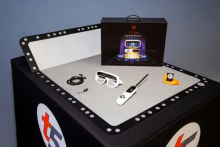 Tilt Five glasses, wand and gameboard.

References
- ↑ 1.00 1.01 1.02 1.03 1.04 1.05 1.06 1.07 1.08 1.09 1.10 1.11 1.12 1.13 1.14 1.15 1.16 1.17 1.18 1.19 "FAQ". Tilt Five. https://www.tiltfive.com/support/faq. Retrieved 2026-10-14.
- ↑ 2.0 2.1 2.2 "Polygamer #94: Jeri Ellsworth of Tilt Five". Polygamer. 2019-10-09. https://www.polygamer.net/2019/10/09/pg94-jeri-ellsworth/. Retrieved 2026-10-14.
- ↑ 3.00 3.01 3.02 3.03 3.04 3.05 3.06 3.07 3.08 3.09 3.10 3.11 3.12 3.13 3.14 3.15 3.16 3.17 3.18 3.19 3.20 3.21 "Tilt Five: Holographic Tabletop Gaming". Tilt Five on Kickstarter. 2019. https://www.kickstarter.com/projects/tiltfive/holographic-tabletop-gaming. Retrieved 2026-10-14.
- ↑ 4.00 4.01 4.02 4.03 4.04 4.05 4.06 4.07 4.08 4.09 4.10 4.11 4.12 4.13 4.14 4.15 4.16 4.17 4.18 4.19 4.20 4.21 4.22 4.23 4.24 4.25 4.26 4.27 4.28 4.29 "The System". Tilt Five. https://www.tiltfive.com/play/the-system. Retrieved 2026-10-14.
- ↑ 5.0 5.1 5.2 5.3 5.4 5.5 "Major Milestone Update! Manufacturing progress, Beta Kits Shipments, Free Keys, Tilt Five Live". Tilt Five. 2021-08-31. https://www.tiltfive.com/updates/major-milestone-update-manufacturing-progress-beta-kits-shipments-free-keys-tilt-five-live. Retrieved 2026-10-14.
- ↑ 6.0 6.1 6.2 "April/May 2022 Update". Tilt Five. 2022-05-24. https://www.tiltfive.com/updates/april-may-2022-update. Retrieved 2026-10-14.
- ↑ 7.0 7.1 7.2 7.3 7.4 "Tilt Five: Holographic Tabletop Gaming: Rewards". Tilt Five on Kickstarter. 2019. https://www.kickstarter.com/projects/tiltfive/holographic-tabletop-gaming/rewards. Retrieved 2026-10-14.
- ↑ 8.0 8.1 "Tilt Five: Shop". Tilt Five. https://www.tiltfive.com/shop. Retrieved 2026-10-14.
- ↑ 9.0 9.1 9.2 9.3 9.4 9.5 "Jousting Jackalope Release Notes". Tilt Five Developer Documentation. 2025-02-28. https://docs.tiltfive.com/t5_release_notes_20jj.html. Retrieved 2026-10-14.
- ↑ 10.00 10.01 10.02 10.03 10.04 10.05 10.06 10.07 10.08 10.09 10.10 10.11 10.12 10.13 "Tech Overview". Tilt Five. https://www.tiltfive.com/make/tech-overview. Retrieved 2026-10-14.
- ↑ 11.0 11.1 11.2 "Tilt Five NDK: T5_GlassesPose Struct Reference". Tilt Five Developer Documentation. https://docs.tiltfive.com/native_sdk/html/structT5__GlassesPose.html. Retrieved 2026-10-14.
- ↑ 12.0 12.1 12.2 "August/September Update". Tilt Five. 2022-09-19. https://www.tiltfive.com/updates/august-september-update. Retrieved 2026-10-14.
- ↑ 13.0 13.1 "Regulatory Information". Tilt Five. https://cdn.prod.website-files.com/64c014cfbff33f53d39bd26f/64c014cfbff33f53d39bd3b1_Regulatory%20Information.docx.pdf. Retrieved 2026-10-14.
- ↑ 14.0 14.1 "Tilt Five to Bring CATAN® to Holographic Life". Tilt Five. 2022-08-23. https://www.tiltfive.com/updates/tilt-five-to-bring-catan-to-holographic-life. Retrieved 2026-10-14.
- ↑ 15.0 15.1 15.2 "December/January 2023 Update". Tilt Five. 2023-01-12. https://www.tiltfive.com/updates/dec-jan-2023. Retrieved 2026-10-14.
- ↑ 16.0 16.1 16.2 16.3 16.4 "Tilt Five Design Tips & Guidelines". Tilt Five (document copy hosted by Hayden Dyar). 2022-05-19. https://prototyping.hdyar.com/assignmentInfo/Tilt_Five_Design_Tips_and_Guidelines_2022_05_19.pdf. Retrieved 2026-10-14.
- ↑ 17.0 17.1 "Kindly Kraken Release Notes". Tilt Five Developer Documentation. 2026-01-27. https://docs.tiltfive.com/t5_release_notes_21kk.html. Retrieved 2026-10-14.
- ↑ 18.0 18.1 "Getting Started". Tilt Five. https://www.tiltfive.com/support/getting-started. Retrieved 2026-10-14.
- ↑ 19.0 19.1 19.2 "Troubleshooting". Tilt Five. https://www.tiltfive.com/support/troubleshooting. Retrieved 2026-10-14.
- ↑ "Tilt Five NDK: Wand related". Tilt Five Developer Documentation. https://docs.tiltfive.com/native_sdk/html/group__wand__functions.html. Retrieved 2026-10-14.
- ↑ 21.0 21.1 "Safety, Care and Warnings". Tilt Five. https://cdn.prod.website-files.com/64c014cfbff33f53d39bd26f/64c014cfbff33f53d39bd3b0_Safety%2C%20Care%20%26%20Warnings.pdf. Retrieved 2026-10-14.
- ↑ "Downloads". Tilt Five. https://www.tiltfive.com/support/downloads. Retrieved 2026-10-14.
- ↑ "Takenoko Lands on Tilt Five". Tilt Five. 2023-02-28. https://www.tiltfive.com/updates/takenoko-lands-on-tilt-five. Retrieved 2026-10-14.
- ↑ 24.0 24.1 D. Schott; F. Heinrich; M. Kunz; J. Mandel; A. Albrecht; R. Braun-Dullaeus; C. Hansen (2024). "CardioCoLab: Collaborative Learning of Embryonic Heart Anatomy in Mixed Reality". Eurographics Workshop on Visual Computing for Biology and Medicine: 1-5. doi:10.2312/vcbm.20241191. Retrieved 2026-10-14.