

Oculus Rift DK1
More actions
| Oculus Rift DK1 (Development Kit 1) | |
|---|---|

| |
| Basic Info | |
| VR/AR | Virtual Reality |
| Type | Head-mounted display |
| Subtype | PC VR |
| Platform | Oculus SDK |
| Creator | Oculus VR |
| Developer | Oculus VR |
| Manufacturer | Oculus VR |
| Announcement Date | August 1, 2012 (crowdfunding campaign)[1] |
| Release Date | March 2013 (initial shipments)[2] |
| Price | US$300 campaign pledge for one assembled developer kit; international shipping extra[1] |
| Website | https://github.com/facebookarchive/RiftDK1 |
| Versions | Oculus Rift DK1 |
| Requires | Host computer with video, USB and external power connections[3] |
| Predecessor | Earlier Rift prototypes |
| Successor | Oculus Rift DK2 |
| System | |
| Operating System | Historical SDK support: Windows, macOS, Linux; version-dependent[4] |
| Chipset | Embedded Tracker V2; host renders applications[5] |
| CPU | STM32F103C8 tracker microcontroller; host CPU runs application logic[5] |
| GPU | Host graphics card[4] |
| Display | |
| Display | 7-inch Innolux HJ070IA-02D LCD[5] |
| Resolution | 640 × 800 per eye (1280 × 800 combined)[4] |
| Refresh Rate | 60 Hz native display mode[4] |
| Image | |
| Field of View | 110° diagonal / 90° horizontal in the 2012 campaign; actual view varies with fit/profile[1][4] |
| Optics | |
| Optics | Three interchangeable lens-cup pairs: A, B and C[3] |
| Ocularity | Binocular |
| IPD Range | Software user profile; eye-relief adjustment is separate[4][3] |
| Adjustable Diopter | Interchangeable eyesight lens cups; no numeric diopter range specified[3] |
| Tracking | |
| Tracking | 3DoF orientation from inertial sensors[5] |
| Tracking Frequency | 1000 Hz gyro/accelerometer reporting; magnetometer up to 220 Hz[6] |
| Rotational Tracking | Yes (pitch, yaw and roll)[5] |
| Positional Tracking | Not provided by the stock orientation tracker[4] |
| Latency | Depends on host, application and synchronization; see measurements below |
| Audio | |
| Audio | Separate audio equipment; headphones not in the documented kit inventory[3] |
| Connectivity | |
| Connectivity | HDMI or DVI video plus USB tracking through the control box[3] |
| Ports | Control box: HDMI, DVI, Mini USB and DC power[3][5] |
| Wired Video | HDMI or DVI (one input at a time)[3] |
| Power | External power adapter[3] |
| Device | |
| Weight | 380 g in a July 2014 hands-on comparison; inclusion of cables unspecified[7] |
| Material | Plastic housing[8] |
| Headstrap | Adjustable side straps and optional over-the-head strap[3] |
| Color | Black[5] |
| Sensors | Gyroscope, Accelerometer and Magnetometer; separate sampling/reporting rates[6] |
| Input | Head orientation; keyboard/mouse or gamepad according to application[4] |
| Compliance | Manufacturer manual states FCC Part 15, Class B digital-device limits[3] |
The Oculus Rift DK1 (Development Kit 1) is the first Oculus Rift developer headset distributed by Oculus VR. The company funded developer kits through a campaign that ran from August 1 to September 1, 2012, and initial shipments followed in March 2013. It was a development product for creating and testing virtual reality content, rather than the later consumer Rift.[1][2][3]
The headset uses a 7-inch LCD shared between the eyes, with a native 1280 × 800 display mode at 60 Hz. Its stock sensor system supplies head orientation, while the host computer renders the scene. Video, sensor data and power pass through an external control box.[5][4][3]
History and development
Prototypes and crowdfunding
Palmer Luckey developed Rift prototypes after collecting and experimenting with earlier headsets. A 2014 interview account describes his purchases of a Vuzix iWear VR920 and an eMagin Z800 3DVisor, followed by a larger collection and garage-built prototypes. John Carmack demonstrated a Luckey prototype at E3 in June 2012. Those prototypes preceded the assembled DK1 shipped to backers.[9]
The Kickstarter campaign sought US$250,000 and recorded US$2,437,429 pledged by 9,522 backers. Its US$300 reward offered one assembled developer kit with Developer Center access; it requested another US$30 for international shipping. The original estimate for that tier was December 2012. A separate US$275 tier offered an unassembled prototype, so the campaign's total number of backers is not a count of identical assembled headsets.[1]
The campaign's specification block was expressly provisional. It listed approximately 0.22 kg and used a six-degree-of-freedom tracking description. These figures should not be substituted for the delivered DK1's heavier housing and orientation-only tracking.[1][5][7]
Manufacturing and initial delivery
In a September 2014 Oculus Connect presentation, engineer Nirav Patel described how the company worked with a manufacturing partner, adapted the housing for production and changed to a 7-inch panel when its intended smaller screen became unavailable. He also described tracker calibration using modified turntables and a gyroscope correction delivered through firmware after kits had shipped. These are accounts of the DK1 production process, rather than specifications for subsequent Rift models.[8]
| Date | Event |
|---|---|
| August 1-September 1, 2012 | Crowdfunding campaign; the assembled-kit reward initially estimated December delivery.[1] |
| March 2013 | Initial shipments. A March 29 contemporary report reproduced an Oculus email confirming that shipping had started that Wednesday and that some kits had already arrived. Its early recipient coverage included the unassembled reward.[2] |
| March 25, 2014 | Facebook announced an agreement to acquire Oculus for approximately US$2 billion, comprising cash and shares, with a further contingent US$300 million earn-out. This was a corporate agreement, not a headset release date.[10] |
| 2014 | Oculus Rift DK2 succeeded DK1. The December 2014 SDK guide describes the new model's higher resolution, OLED display and camera-based positional tracking while retaining DK1 support.[4] |
| September 2014 | Oculus publicly released DK1 firmware, circuit and mechanical design material at Oculus Connect.[8][11] |
| January 13, 2022 | The owner archived the DK1 hardware repository, making that repository read-only.[11] |
Design and display
The DK1 has a plastic headset housing, face padding, adjustable straps and an optional strap over the top of the head. Its headset cord is permanently attached to the control box. A July 2014 hands-on comparison reported a DK1 mass of 380 g, compared with 440 g for DK2; it did not define whether cables were included in those figures.[3][8][7]
iFixit's April 2013 teardown identified an Innolux HJ070IA-02D LCD and its Himax HX8851 timing controller. The landscape display is divided into side-by-side eye images, each nominally 640 × 800 pixels. The SDK identifies the native DK1 display mode as 1280 × 800 at 60 Hz.[5][4]
The low resolution is visible through the magnifying optics. In an original comparison with DK2, reviewer Paul James described the DK1's visible pixel structure and gaps, commonly called the screen door effect, and difficulty resolving small text. He also reported smearing during head movement on its LCD. These observations concern the reviewer's hardware and selected applications.[7][12]
Field of view
The 2012 campaign advertised 110° diagonal and 90° horizontal. Field of view also depends on lens selection, eye relief, face shape and the rendering profile. The December 2014 SDK guide gives an example for its author's left eye on DK1: 53.6° upwards, 58.9° downwards, 50.3° inwards and 58.7° outwards. It explicitly totals that example as 109.0° horizontal and 112.5° vertical. The guide presents these as individual profile angles, rather than a universal measurement of the headset.[1][4]
Optical system
The manual describes three lens-cup pairs with an insert-and-lock mounting arrangement. They accommodate different eyesight needs:[3]
| Lens cups | Manufacturer's intended use |
|---|---|
| A, tallest | Normal 20/20 or farsighted vision; also the specified set when wearing corrective glasses. |
| B, middle | Moderately nearsighted users. |
| C, shortest | Very nearsighted users. |
Coin-operated screws on the sides move the headset assembly relative to the face. The manual requires matching settings on both sides and warns that glasses can reduce the visible field and scratch the lenses. This fit adjustment is separate from interpupillary distance: the SDK uses the user's software profile to set the separation of the virtual eye cameras, rather than treating the physical distance between the lenses as the user's IPD.[3][4]
Applications render separate eye views and compensate for the lens distortion. The SDK guide describes an opposing barrel warp to correct the pincushion distortion seen through the lenses, along with chromatic-aberration correction. Its software calculations use lens and eye-position information. The SDK calculates an intermediate render-target size from field of view and pixel density. This size can exceed the panel's physical resolution without changing its pixel count.[4]
Tracking system
The stock headset measures pitch, yaw and roll using a gyroscope, accelerometer and magnetometer. It provides three rotational degrees of freedom, rather than measured head translation. Leaning or walking does not become position tracking simply because an application moves the virtual camera using a gamepad or a simulated head model.[5][4]
The Tracker V2 board examined in the teardown contained an STM32F103C8 microcontroller, an InvenSense MPU-6000 gyro/accelerometer and a Honeywell HMC5983 digital compass. The presence of this embedded controller distinguishes the headset's sensor electronics from the host CPU and GPU used to run applications.[5]
The February 2013 tracker specification describes a USB HID device. Gyroscope and accelerometer data are reported at 1000 Hz; the target host polling rate is also 1000 Hz. Host or USB bus load can make polling slower, and each report can carry multiple samples. The magnetometer's three axes are sampled together at up to 220 Hz, so consecutive USB reports may repeat its latest reading. The display refresh rate, inertial reporting rate and magnetic sampling rate are separate quantities.[6]
The SDK's sensor-fusion software combines these readings. Its guide describes gravity-based tilt correction, magnetic yaw correction and calibration, as well as prediction of orientation for rendering. The OculusWorldDemo sample has an orientation-reset command. These mechanisms address drift and timing within the software; they do not add a stock positional sensor.[4]
Control box, connections and audio
The control box is connected between the computer and the headset. The documented setup uses one video input at a time, USB for the sensor connection and the supplied power adapter. Its ports and controls are:[3][5]
| Connection or control | Function |
|---|---|
| HDMI and DVI | Alternative video inputs; the kit includes a DVI/HDMI adapter. |
| Mini USB | USB connection to the host computer. |
| DC power | Connection for the external power supply. |
| Contrast buttons | Two display-contrast controls. |
| Brightness buttons | Two display-brightness controls. |
| Power button and blue LED | Power control and indicator. |
The kit inventory includes the headset/control box, power adapter, a 6 ft HDMI cable, a 3 ft USB cable, the video adapter, three pairs of lenses and the top strap. It contains neither headphones nor a microphone. The manufacturer documents four control-box connectors, HDMI, DVI, USB and power, without a 3.5 mm audio input or output. Audio equipment is separate from these headset connections.[3]
PC requirements and software
DK1 applications depend on the host's graphics performance and on compatible versions of the software stack. Historical Oculus packages supplied a native SDK, source samples and integrations for Unity and Unreal Engine. The December 3, 2014 developer guide covers SDK 0.4.4, although its requirements subsection still labels the operating-system list as SDK 0.4.0. It lists Windows 7, 8 and 8.1, Mac OS 10.8/10.9 and 64-bit Linux, with Ubuntu 14.04 LTS in its guideline list.[4]
The same guide offers a 2.0 GHz or faster processor, 2 GB of RAM and a Direct3D 10 or OpenGL 3 compatible graphics card as guidelines. It states that there is no single specific hardware minimum and recommends testing the intended stereo scene at 60 frames per second with vertical synchronization. This is a dated development guideline, not a 2013 launch specification or a current Meta software compatibility promise.[4]
Rendering and demonstrations
The SDK's OculusWorldDemo presents a Tuscany scene, while OculusRoomTiny is a smaller C++ example. The samples demonstrate stereoscopic rendering and sensor integration; WorldDemo provides keyboard, mouse and gamepad controls. The Rift itself supplies head orientation, while movement and other commands come from the application's chosen input device.[4]
Earlier software treated DK1 as an additional monitor, which could be mirrored or used as an extended desktop. The 0.4 guide describes the display driver and DK1 legacy mode. It also describes timewarp, which reprojects rendered imagery using a more recent orientation, and a choice between application-managed distortion and SDK-managed distortion, presentation and timing. These software features are distinct from the panel's 60 Hz refresh and the sensor's reporting rate.[4]
The original 0.4.4 release notes require matched runtime and SDK versions for development while retaining backward compatibility between a newer runtime and older SDKs or integrations. They record fixes for DK1 device identification on Linux and window targeting. They also warn that Unity applications on Mac had higher latency than the C++ WorldDemo and that forcing Unity to use OpenGL on Windows was unsupported in that release. Those qualifications belong to the identified historical package.[13]
Latency measurements
Motion-to-photon latency includes sensing, host processing, rendering, synchronization and display response. It is not established by the 1000 Hz sensor figure or the 60 Hz display mode alone.[6][14]
In 2015, Kjetil Raaen and Ivar Kjellmo tested DK1 on a tripod using a laser, two light sensors and an oscilloscope, comparing rotation with a white-to-black change in a minimal Unity scene. The authors list the host as Windows 7, an Intel "i7-3740 QM" and an NVIDIA Quadro K2000M. They report 5-10 measurements per device:[14]
| Synchronization setting | Mean delay | Minimum | Maximum |
|---|---|---|---|
| V-sync on | 63 ms | 58 ms | 70 ms |
| V-sync off | 14 ms | 2 ms | 22 ms |
The results concern abrupt rotations and a minimal scene, with Unity and Oculus SDK versions unspecified. The authors note visual artifacts with synchronization off and possible detection effects from intermediate rendered frames. These bench trials do not establish a universal DK1 latency or comfort threshold.[14]
Research with modified DK1 hardware
Davies, Miller and Fawcett's 2015 Mirrorshades study used a modified DK1 to compare the current St Salvator's Chapel with a virtual reconstruction. Two externally fitted Logitech C310 cameras supplied video; a Nexus 5 running IndoorAtlas supplied position, while a laptop, external battery and Xbox controller completed the system. Across its evaluation stages, 17 participants took part in 20-30 minute sessions.[15]
The paper reports 52.4 fps for seated VR and 39.2 fps for the camera-based scenario. A separate timer test compared 11 video-frame pairs: seven indicated 181-198 ms and four 198-215 ms. Those figures include cameras, Unity and the display, rather than the stock headset's motion-to-photon delay. Participants reported easier comparison and greater enjoyment, alongside poorer comfort/usability, camera clarity and positioning lag. This small, modified-system study does not demonstrate native DK1 passthrough or position tracking, or objective learning improvement for every user.[15]
Development role and hardware archive
DK1 supplied hardware and software interfaces for developers before Oculus released its consumer headset. Its campaign offered Developer Center documentation, samples and engine integration, and its later hardware archive preserves a record of the tracker firmware, schematic and board designs, and STEP models of the housing, control box and case. The README identifies the historical CooCox and gcc-arm-embedded tools used for the tracker firmware.[1][11]
Oculus' 2017 engineering retrospective describes starting DK2 work in parallel with DK1's 2013 release, reusing parts of the earlier mechanical design and seeking better display and positional-tracking behavior. The retrospective records specific design changes carried from one development kit to the next.[16]
Technical specifications summary
| Specification | Documented detail |
|---|---|
| Display | 7-inch Innolux HJ070IA-02D LCD.[5] |
| Eye image / total resolution | 640 × 800 per eye / 1280 × 800 combined.[4] |
| Native refresh | 60 Hz.[4] |
| Field of view | Campaign: 110° diagonal / 90° horizontal; visible and rendered field varies with fit and profile.[1][4] |
| Optics | A, B and C eyesight lens cups; side screws adjust fit/eye relief.[3] |
| Tracking | Stock orientation tracking; 1000 Hz gyro/accelerometer reports and up to 220 Hz magnetic sampling.[6][5] |
| Latency | Configuration-dependent; the cited 2015 minimal-scene test reports different results with v-sync on and off.[14] |
| Audio | Separate equipment; the manual's control-box connector list has no 3.5 mm audio port.[3] |
| Host connection | HDMI or DVI video plus USB through the control box; external adapter power.[3] |
| Mass | 380 g as reported in the July 2014 comparison; cable inclusion unspecified.[7] |
| Campaign price | US$300 assembled-kit tier; international shipping additional.[1] |
| Product status | Historical development kit, succeeded by DK2; hardware repository archived in 2022.[4][11] |
See Also
Gallery
-
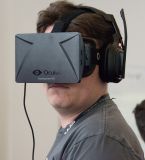 Palmer Luckey wearing Oculus Rift DK1 at SVVR 2014; the headphones are separate.

References
- ↑ 1.00 1.01 1.02 1.03 1.04 1.05 1.06 1.07 1.08 1.09 1.10 "Oculus Rift: Step Into the Game". Oculus. 2012-08-01. https://www.kickstarter.com/projects/1523379957/oculus-rift-step-into-the-game. Retrieved 2026-10-14.
- ↑ 2.0 2.1 2.2 "Oculus Rift Dev Kits begin arriving with early backers!". Road to VR. 2013-03-29. https://roadtovr.com/oculus-rift-dev-kits-begin-arriving-with-early-backers/. Retrieved 2026-10-14.
- ↑ 3.00 3.01 3.02 3.03 3.04 3.05 3.06 3.07 3.08 3.09 3.10 3.11 3.12 3.13 3.14 3.15 3.16 3.17 3.18 3.19 3.20 "Oculus Rift Development Kit, version 1.1". Oculus VR. 2013. https://files.bbystatic.com/j4n9xPt1QKAwgrcmP3aD2g%3D%3D/8148C09C-7EF4-4E09-AC12-1CA3F5F8D12E.pdf. Retrieved 2026-10-14.
- ↑ 4.00 4.01 4.02 4.03 4.04 4.05 4.06 4.07 4.08 4.09 4.10 4.11 4.12 4.13 4.14 4.15 4.16 4.17 4.18 4.19 4.20 4.21 4.22 4.23 "Oculus Developer Guide, SDK version 0.4.4". Oculus VR. 2014-12-03. https://raw.githubusercontent.com/BeAnotherLab/The-Machine-to-be-Another/master/Oculus_Developer_Guide_0.4.4.pdf. Retrieved 2026-10-14.
- ↑ 5.00 5.01 5.02 5.03 5.04 5.05 5.06 5.07 5.08 5.09 5.10 5.11 5.12 5.13 5.14 "Oculus Rift DK1 Teardown". iFixit. 2013-04-09. https://www.ifixit.com/Teardown/Oculus+Rift+DK1+Teardown/13682. Retrieved 2026-10-14.
- ↑ 6.0 6.1 6.2 6.3 6.4 "Tracker Firmware Specification, revision 0.20". Oculus VR. 2013-02-22. https://raw.githubusercontent.com/facebookarchive/RiftDK1/master/TrackerFirmwareSpecification.pdf. Retrieved 2026-10-14.
- ↑ 7.0 7.1 7.2 7.3 7.4 "The Oculus Rift DK2, In-Depth Review and DK1 Comparison". Road to VR. 2014-07-27. https://roadtovr.com/oculus-rift-dk2-review-dk1-comparison-vr-headset/. Retrieved 2026-10-14.
- ↑ 8.0 8.1 8.2 8.3 "Oculus Open-sources Rift DK1: Mechanical Designs, Firmware, and More All Freely Available". Road to VR. 2014-09-22. https://roadtovr.com/oculus-rift-dk1-open-source-manufacturing-the-dk1-nirav-patel/. Retrieved 2026-10-14.
- ↑ "The inside story of the Oculus Rift, VR's singularity moment". WIRED. 2014-07-03. https://www.wired.com/story/inside-oculus/. Retrieved 2026-10-14.
- ↑ "Facebook to Acquire Oculus". Facebook. 2014-03-25. https://about.fb.com/news/2014/03/facebook-to-acquire-oculus/. Retrieved 2026-10-14.
- ↑ 11.0 11.1 11.2 11.3 "Oculus Rift Development Kit 1: archived hardware repository". Oculus VR. https://github.com/facebookarchive/RiftDK1. Retrieved 2026-10-14.
- ↑ "The Oculus Rift DK2, In-Depth Review and DK1 Comparison". Road to VR. 2014-07-27. https://roadtovr.com/oculus-rift-dk2-review-dk1-comparison-vr-headset/3/. Retrieved 2026-10-14.
- ↑ "Oculus SDK 0.4.4 Release Notes, Runtime Rev 1". Oculus VR. https://raw.githubusercontent.com/osrf/oculussdk/master/Release_Notes.txt. Retrieved 2026-10-14.
- ↑ 14.0 14.1 14.2 14.3 Kjetil Raaen; Ivar Kjellmo (2015). "Measuring Latency in Virtual Reality Systems". Entertainment Computing - ICEC 2015: 457-462. doi:10.1007/978-3-319-24589-8_40. Retrieved 2026-10-14.
- ↑ 15.0 15.1 CJ Davies; Alan Miller; Richard Fawcett (2015). "Mobile Onsite Exploration of Parallel Realities with Oculus Rift". Proceedings of the 2015 Digital Heritage International Congress 1: 301-304. doi:10.1109/DigitalHeritage.2015.7413887. Retrieved 2026-10-14.
- ↑ "Open Source Release of Rift DK2". Oculus VR. 2017-10-10. https://developers.meta.com/vr/blog/open-source-release-of-rift-dk2/. Retrieved 2026-10-14.