

Oculus Rift DK2
More actions
| Oculus Rift DK2 (Development Kit 2) | |
|---|---|

| |
| Basic Info | |
| VR/AR | Virtual Reality |
| Type | Head-mounted display |
| Subtype | PC VR |
| Platform | Oculus SDK |
| Creator | Oculus VR |
| Developer | Oculus VR |
| Manufacturer | Oculus VR |
| Announcement Date | March 19, 2014 (GDC 2014)[1] |
| Release Date | July 2014 (shipments reported by July 24)[2] |
| Price | US$350 at launch[1] |
| Website | https://www.oculus.com/ (legacy) |
| Versions | Oculus Rift DK2 |
| Requires | Host computer, compatible graphics output and SDK/runtime[3] |
| Predecessor | Oculus Rift DK1 |
| Successor | Oculus Rift CV1 |
| System | |
| Operating System | Windows, macOS, Linux (historical SDK support; see software section)[4] |
| CPU | Host PC renders applications; headset has an STM32L100 controller[5] |
| GPU | Host PC |
| Display | |
| Display | Single Samsung AMS568 AMOLED panel, also used in Galaxy Note 3[6][5] |
| Subpixel Layout | RGBG PenTile[5] |
| Resolution | 960 × 1080 per eye (1920 × 1080 combined)[5] |
| Refresh Rate | 75 Hz default; 60 and 72 Hz modes also listed in EDID[5] |
| Persistence | Low persistence; less than 3 ms per frame in Oculus' 2014 presentation[7] |
| Image | |
| Field of View | 90-110° in Oculus' 2014 presentation (axis not specified)[7] |
| Optics | |
| Optics | Aspherical polycarbonate lenses; interchangeable A/B eyecups[5] |
| Ocularity | Binocular |
| IPD Range | Fixed 63.5 mm lens-center spacing; software user profile[5][4] |
| Adjustable Diopter | Interchangeable A/B eyecups; no numbered diopter dial[3] |
| Passthrough | No built-in view of surroundings[3] |
| Tracking | |
| Tracking | 6DoF (inertial sensors plus external IR camera)[1] |
| Tracking Frequency | 1000 Hz gyro/accelerometer samples; 60 fps tracking camera[8][9] |
| Base Stations | Included external positional-tracking camera |
| Rotational Tracking | Yes |
| Positional Tracking | Yes, within camera visibility |
| Play Space | Manual recommends remaining seated whenever possible[3] |
| Latency | Depends on rendering and compensation; see research section[10] |
| Audio | |
| Audio | External audio equipment |
| 3.5mm Audio Jack | No; the headset's 2.5 mm jack is for synchronization[5] |
| Camera | External global-shutter IR positional tracker[9] |
| Connectivity | |
| Connectivity | HDMI and USB 2.0, with separate tracker USB and sync cables[3] |
| Ports | HDMI, USB, 2.5 mm synchronization; USB accessory port[5] |
| Wired Video | Yes (HDMI; included DVI adapter)[3] |
| Power | USB bus power; optional adapter enables accessory USB port[3] |
| Device | |
| Weight | 440 g nominal headset weight[5] |
| Material | Plastic housing (ABS)[5] |
| Headstrap | Adjustable nylon/elastic straps[5] |
| Color | Black |
| Sensors | Accelerometer, gyroscope, magnetometer; 40 infrared tracking LEDs[5] |
| Input | Application-dependent keyboard, mouse or gamepad; no controller in kit[3][4] |
The Oculus Rift DK2 (Development Kit 2) is the second development virtual reality head-mounted display created by Oculus VR. Oculus announced it at GDC 2014 on March 19, 2014, and opened preorders at US$350.[1] Shipments began in July 2014.[2] The kit was intended for software development before the consumer Oculus Rift CV1, rather than sold as a finished consumer product.[3][11]
The DK2 adds positional head tracking through an included external infrared camera, a higher-resolution OLED panel and low-persistence display operation to the earlier Oculus Rift DK1. Its display uses half of a 1920 × 1080 screen for each eye. The head tracker combines orientation and position data to support six degrees of freedom.[5][1]
History and development
From DK1 and Crystal Cove
The preceding DK1 followed Oculus' 2012 Kickstarter campaign.[7] Oculus' engineering retrospective dates the start of DK2 work to 2013, in parallel with releasing DK1. An intermediate design called DKHD explored a smaller headset and higher pixel density, but retained a high-persistence display and orientation-only tracking. The team then concentrated on low persistence, a higher display refresh rate and positional tracking for DK2. Oculus reused parts of DK1's mechanical design and off-the-shelf components to meet the development schedule.[6]
The March 2014 announcement described DK2 as using the low-persistence OLED approach demonstrated by the Crystal Cove prototype. Oculus showed the kit at GDC with EVE: Valkyrie, UE4 Elemental Defense and Epic's Couch Knights demonstration. In Couch Knights, players' tracked head movements drove avatars while they controlled small knights in a shared room.[1]
Announcement and shipping
| Date | Documented event |
|---|---|
| March 19, 2014 | Oculus announced DK2, accepted US$350 preorders and expected the first batch to ship in July.[1] |
| March 25, 2014 | Facebook announced an agreement to acquire Oculus for approximately US$2 billion, with a separate conditional US$300 million earn-out. This was the agreement announcement, rather than the transaction's closing date.[12] |
| July 2014 | Initial DK2 shipments began.[2] |
| August 2014 | Oculus' GDC Europe presentation reported more than 50,000 DK2 orders and 16,000 units shipped as of August 8.[7] |
| February 12, 2015 | UploadVR reported CEO Brendan Iribe's statement that more than 100,000 DK2s were "in the wild". The quoted phrase does not define an audited sales, shipment or active-use total.[13] |
| March 28, 2016 | The Oculus PC SDK 1.3 announcement said DK2 would remain functional for development during 2016, while expressly distinguishing it from supported consumer hardware.[11] |
| October 10, 2017 | Oculus released DK2 hardware design files, documentation and firmware source.[6] |
Display technology
Samsung AMOLED panel
The headset uses a Samsung Display AMS568 panel with a 5.68-inch diagonal, a 16:9 active area and an RGBG PenTile subpixel arrangement. The panel is driven in portrait orientation but viewed horizontally, producing 960 × 1080 pixels per eye. Its touch layer remains in the assembly but is not powered or interfaced by DK2.[5] iFixit's physical teardown identified the assembly as the front display of a Samsung Galaxy Note 3, including retained touchscreen hardware.[14]
Oculus attributed a reduced screen-door effect to the higher-resolution display.[1]
The headset's display identification data lists 75 Hz as the default refresh rate and includes 60 Hz and 72 Hz modes. Its engineering specification gives approximately 100 nit as the default brightness and describes brightness control through the SDK; this is a default operating value, rather than a specified peak luminance.[5]
Low persistence
Low-persistence operation shortens the period during which a pixel emits light within each frame. Oculus' 2014 presentation described each pixel as lit for less than 3 ms per frame.[7] The engineering document describes a rolling illumination mode with an adjustable duty cycle, rather than leaving the image lit for the full refresh interval.[5]
This approach reduces the smearing that occurs when an eye moves while following an image held stationary on a display. Oculus presented it as a way to reduce blur and judder relative to DK1; it does not remove every artifact caused by missed frames or establish that every user will avoid simulator sickness.[5][3]
Field of view and optics
Lenses and fit
DK2 uses molded optical-grade polycarbonate aspherical lenses. Their centers are fixed 63.5 mm apart. The two screws on the sides move the display-and-optics assembly closer to or farther from the face, changing eye relief. They do not form a mechanical IPD slider.[5][3]
Two interchangeable pairs of eyecups accommodate different vision requirements. The supplied quick-start guide describes the taller A pair as suitable for normal vision or moderate nearsightedness and the shorter B pair for very nearsighted users. A is installed by default. The cups lock into the headset with an insert-and-turn mechanism, and the manual recommends A when wearing glasses. Both side screws should be adjusted equally.[3]
Field-of-view figures
Oculus' GDC Europe 2014 presentation lists a 90-110° field of view without identifying the measurement axis.[7] Oculus' developer guide distinguishes a profile's recommended field of view from the optics' maximum. Fit, IPD and eye relief affect the rendered view.[4]
Tracking system
External positional tracker
The camera observes infrared LEDs on the headset's front assembly. DK2 has 40 emitters operating at 850 nm, with changing illumination patterns used to identify LEDs. The SDK combines the optical data with inertial sensing to estimate the headset's position and orientation.[5][7]
The supplied tracker has an Aptina MT9V034C12STC global-shutter sensor, specified at 752 × 480 pixels and 60 frames per second. An 850 nm band-pass filter favors the emitted tracking light. A USB cable connects it to the host computer, while a separate 2.5 mm cable synchronizes exposures with the headset's LEDs.[9] The 2017 engineering account explains that Oculus considered infrared wireless synchronization during development but used wired synchronization in the final design.[6]
The quick-start guide allows the tracker to sit on a desk, clip to a monitor or mount on a tripod. It recommends a stable mount, direct line of sight and a user distance of about 1.5 m. Covering the front of the headset can obstruct the LEDs.[3] Positional tracking requires camera visibility; orientation sensing continues through the headset's inertial sensors.[14]
Inertial sensing and timing
The gyroscope and accelerometer supply 1000 Hz samples. The USB protocol targets a 1000 Hz polling rate, but its documentation notes that host or bus load can lower the actual reporting rate. Reports carry sample counts and timestamps so software can account for grouped or missing samples.[8]
The magnetometer is a separate, slower sensor. The headset specification lists an 80 Hz update rate for its LIS3MDL, while the firmware report description allows samples up to 100 Hz and warns that consecutive reports may repeat the same magnetometer data. The 1000 Hz gyro/accelerometer figure should not be read as the sampling rate of every sensor.[5][8]
The built-in latency tester reads a pixel from the display controller and returns frame-identification data through USB. Its timestamps relate sensor samples, camera exposures and display frames to the headset's clock. These diagnostic facilities help software estimate latency and select prediction settings.[8]
Physical design, connections and audio
Oculus specifies a nominal headset weight of 440 g, an ABS plastic housing and adjustable nylon/elastic straps.[5] iFixit measured 453 g for its teardown unit; that is a measurement of one unit rather than a replacement for the nominal specification.[14]
The combined cable is detachable and 3 m long. It carries HDMI video, USB and power, and splits into separate HDMI and USB plugs at the computer end. The kit includes a DVI-to-HDMI adapter. Unlike DK1, DK2 places its main circuitry inside the headset instead of a separate external control box.[5][3][14]
The connector box on the cable accepts the camera's synchronization lead and an optional power adapter. USB bus power runs the headset; connecting the supplied adapter enables the headset's USB accessory port, with up to 500 mA specified for an attached accessory. Oculus cautioned against extending the calibrated HDMI cable with passive couplers.[5][3]
The headset's 2.5 mm jack carries synchronization signals. It is not a headphone output. Audio and microphone input require separate host-connected equipment; the supplied kit contains neither a microphone nor headphones. The camera is a positional tracker, rather than a built-in passthrough camera showing the surroundings.[5][3]
PC requirements and software development
Historical host requirements
The December 3, 2014 Oculus developer guide lists Windows 7/8/8.1, OS X 10.8/10.9 and 64-bit Linux. Its host guideline is a 2.0+ GHz processor, 2 GB RAM and a Direct3D 10 or OpenGL 3 compatible graphics card. The guide warns that hardware capable of a minimal demonstration may be inadequate for a complete scene rendered at 75 frames per second.[4]
The GTX 970/Radeon R9 290, Core i5-4590 and 8 GB RAM recommendation announced in May 2015 applied to the forthcoming consumer Rift. That announcement described its 2160 × 1200, 90 Hz display workload; it was not DK2's original 2014 minimum specification.[15]
SDK and input
SDK 0.4 added a C API and runtime service. Timewarp reprojected rendered images using newer orientation data before display.[4] The original DK2 announcement also identified Unity and Unreal Engine 4 integrations.[1]
The preserved SDK 0.4.4 release notes required matching SDK and runtime versions for development and DK2 firmware 2.12, while stating that newer runtimes retained compatibility with older SDKs and integrations. They also recorded version-specific graphics and display limitations, including some Optimus configurations, generally insufficient rendering speed on Intel-only graphics and higher Unity latency on Mac than in the C++ OculusWorldDemo.[16]
The guide documents keyboard, mouse and gamepad sample controls, including an Xbox 360 wired controller for Windows. A gamepad was not included in the DK2 box.[4][3]
Compatibility changes
Autodesk's retained compatibility notes pair DK2 with VRED 2016 SR1/runtime 0.6.0.1 and VRED 2016 SR1 SP5/runtime 0.8, and warn about runtime 0.7. These refer to legacy application versions.[17]
On May 15, 2015, Oculus announced that development for OS X and Linux had paused while it concentrated on the Windows consumer launch.[15] Its March 28, 2016 SDK 1.3 announcement said DK2 remained functional as a developer kit during that year, while expressly declining consumer-device support. Those statements describe particular software generations and dates, rather than a promise of compatibility with current Meta software or every later application.[11]
Open-source development provides a separate software history. Monado's 25.1.0 changelog, dated December 9, 2025, records the addition of a Rift DK2 driver. That entry establishes driver inclusion; it does not specify complete positional tracking or compatibility with all applications.[18]
Research use and measured latency
Rotational dynamics
A 2016 study by Kento Miyajima and Ryugo Kijima evaluated DK2 using a rotating platform and two synchronized high-speed cameras, one observing a real target and the other the headset's rendered view. The apparatus used SDK/runtime 0.4.4 and firmware 2.12, with approximately 1.4 Hz oscillations through ±15° and five-second recordings. This was an instrumented bench experiment, rather than a participant study.[10]
For the left-eye SDK rendering path, the authors found an equivalent average lag of about 26 ms with compensation disabled, about 17 ms with Prediction, and about 1 ms with Prediction plus Timewarp. They also observed angular errors exceeding 0.5° around high acceleration. Results differed across eyes and the Unity path. The approximately 1 ms figure describes alignment after prediction and reprojection under that test, rather than the physical processing delay of every DK2 application.[10]
Motion perception with feedback
Fulvio and Rokers' 2017 study used DK2 at 75 Hz with a Macintosh, MATLAB/Psychophysics Toolbox and keyboard responses in a three-dimensional target-extrapolation task. Of 91 recruited people, 72 completed the study: 38 received no feedback, 24 received combined visual and auditory feedback, and 10 received auditory feedback alone. Participants were screened for intact stereovision.[19]
The experiment varied whether rendered viewpoints followed head movement, stayed fixed or followed with added delay. Combined feedback improved performance and enabled use of motion-parallax cues from small head movements; auditory feedback alone produced a smaller benefit. The authors reported 14 ms inherent motion-to-photon latency for their apparatus. This one-session perception experiment does not establish a universal DK2 latency or a treatment for discomfort, and incomplete participants included people who had difficulty with the task, depth perception or glasses comfort.[19]
Tracking variation and latency diagnostics
A 2021 follow-up perception paper by Fulvio, Miao and Rokers included its own DK2 diagnostic checks. With the headset mounted on a stationary platform and sampled at 75 Hz during a simulated experiment, the authors reported a median translation error of 0.422 mm over one-second intervals. This characterizes variation in a stationary setup, rather than absolute positional accuracy during movement.[20]
The Oculus Debug Tool reported 14 ms motion-to-photon latency, while an external 120 Hz video check showed 67-83 ms for brief, rapid movements. The authors designed their perception experiments around gradual head drift and optimized rendering to avoid dropped frames. The different measurements show why software timing estimates and tests with different motion profiles should not be treated as interchangeable hardware specifications.[20]
Technical specifications summary
| Specification | Documented value or qualification |
|---|---|
| Display | Samsung AMS568 AMOLED, 960 × 1080 per eye, 1920 × 1080 combined.[5] |
| Refresh rate | 75 Hz default; 60 and 72 Hz EDID modes.[5] |
| Field of view | Oculus' 2014 presentation lists 90-110° without an axis.[7] |
| Tracking | Inertial sensing and external infrared camera; six degrees of freedom.[1] |
| Lens spacing | Fixed 63.5 mm centers; interchangeable A/B eyecups and eye-relief adjustment.[5][3] |
| Audio | Separate equipment; the 2.5 mm jack is a synchronization connection.[5] |
| Historical software platforms | Windows, OS X and 64-bit Linux in the December 2014 developer guide.[4] |
| Weight | 440 g nominal in the manufacturer specification.[5] |
| Launch price | US$350.[1] |
| Development status | Oculus' SDK 1.3 announcement described development use during 2016, with consumer-device support excluded.[11] |
Comparison with DK1
The following comparison concerns the two development kits, rather than the later consumer Rift.[21][4][5]
| Feature | DK1 | DK2 |
|---|---|---|
| Resolution | 1280 × 800 | 1920 × 1080 |
| Per eye | 640 × 800 | 960 × 1080 |
| Display | LCD | AMOLED |
| Native/default refresh | 60 Hz | 75 Hz; additional 60/72 Hz modes |
| Positional tracking | Not provided | Included external camera |
| Separate headset control box | Yes | Main circuitry inside headset |
| Initial kit price or pledge | US$300 developer-kit pledge in the 2012 campaign, plus US$30 for international shipping.[22] | US$350 preorder price.[1] |
| Initial shipping period | March 2013[7] | July 2014[2] |
Open hardware archive
The October 2017 release includes schematics, board layouts, mechanical CAD, artwork, specifications and firmware. Oculus licensed the CAD, artwork and documentation under Creative Commons Attribution 4.0; the firmware uses a BSD-style license with an additional patent grant and retains applicable third-party licenses.[23] Oculus cautioned that some components were already difficult or impossible to obtain, so the files did not guarantee that an individual could reproduce the complete headset.[6]
See Also
Gallery
-
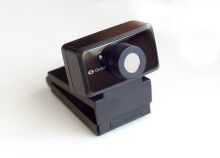 Oculus Rift DK2 positional-tracking camera.
 -
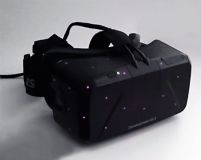 Oculus Rift DK2 with infrared tracking LEDs visible.


References
- ↑ 1.00 1.01 1.02 1.03 1.04 1.05 1.06 1.07 1.08 1.09 1.10 1.11 "Announcing the Oculus Rift Development Kit 2 (DK2)". Oculus VR. 2014-03-19. https://web.archive.org/web/20160203172109/https://www.oculus.com/en-us/blog/announcing-the-oculus-rift-development-kit-2-dk2/. Retrieved 2026-10-14.
- ↑ 2.0 2.1 2.2 2.3 "Oculus Starts Shipping Its Next-Gen Rift VR Headset A Bit Later Than Expected". TechCrunch. 2014-07-24. https://techcrunch.com/2014/07/24/oculus-starts-shipping-its-next-gen-rift-vr-headset-a-bit-later-than-expected/. Retrieved 2026-10-14.
- ↑ 3.00 3.01 3.02 3.03 3.04 3.05 3.06 3.07 3.08 3.09 3.10 3.11 3.12 3.13 3.14 3.15 3.16 3.17 "Development Kit 2: Quick Start Guide, revised 7/25/2014". Oculus VR. 2014-07-25. https://raw.githubusercontent.com/facebookarchive/RiftDK2/master/Documentation/DK2QuickStart.pdf. Retrieved 2026-10-14.
- ↑ 4.0 4.1 4.2 4.3 4.4 4.5 4.6 4.7 4.8 "Oculus Developer Guide: SDK Version 0.4.4". Oculus VR. 2014-12-03. https://raw.githubusercontent.com/BeAnotherLab/The-Machine-to-be-Another/master/Oculus_Developer_Guide_0.4.4.pdf. Retrieved 2026-10-14.
- ↑ 5.00 5.01 5.02 5.03 5.04 5.05 5.06 5.07 5.08 5.09 5.10 5.11 5.12 5.13 5.14 5.15 5.16 5.17 5.18 5.19 5.20 5.21 5.22 5.23 5.24 5.25 5.26 5.27 5.28 5.29 5.30 "DK2 Specification, revision 0.4". Oculus VR. 2014-05-30. https://raw.githubusercontent.com/facebookarchive/RiftDK2/master/Documentation/DK2Specification.pdf. Retrieved 2026-10-14.
- ↑ 6.0 6.1 6.2 6.3 6.4 "Open Source Release of Rift DK2". Oculus VR / Meta Horizon OS Developers. 2017-10-10. https://developers.meta.com/vr/blog/open-source-release-of-rift-dk2/. Retrieved 2026-10-14.
- ↑ 7.0 7.1 7.2 7.3 7.4 7.5 7.6 7.7 7.8 "Developing VR Experiences with the Oculus Rift". Tom Forsyth / Oculus VR, GDC Europe. 2014-08. https://media.gdcvault.com/gdceurope2014/Presentations/830373_Tom_Forsyth.pdf. Retrieved 2026-10-14.
- ↑ 8.0 8.1 8.2 8.3 "DK2 Firmware Specification, revision 0.10". Oculus VR. 2014-04-28. https://raw.githubusercontent.com/facebookarchive/RiftDK2/master/Documentation/DK2FirmwareSpecification.pdf. Retrieved 2026-10-14.
- ↑ 9.0 9.1 9.2 "Positional Tracker DK2 Specification, revision 0.8". Oculus VR. 2014-05-29. https://raw.githubusercontent.com/facebookarchive/RiftDK2/master/Documentation/DK2PositionalTrackerSpecification.pdf. Retrieved 2026-10-14.
- ↑ 10.0 10.1 10.2 Kento Miyajima; Ryugo Kijima (2016-03-31). "Evaluation of Rotational Dynamical Characteristics of Oculus Rift DK2 HMD(<Special issue>VR Psychology VI)". Transactions of the Virtual Reality Society of Japan 21 (1): 131-140. doi:10.18974/tvrsj.21.1_131. Retrieved 2026-10-14.
- ↑ 11.0 11.1 11.2 11.3 "Oculus PC SDK 1.3 Now Available". Oculus VR / Meta Horizon OS Developers. 2016-03-28. https://developers.meta.com/vr/blog/oculus-pc-sdk-1-3-now-available/. Retrieved 2026-10-14.
- ↑ "Facebook to Acquire Oculus". Facebook Newsroom / Meta. 2014-03-25. https://about.fb.com/news/2014/03/facebook-to-acquire-oculus/. Retrieved 2026-10-14.
- ↑ "Over 100,000 DK2s sold since March, says CEO Brendan Iribe". UploadVR. 2015-02-12. https://www.uploadvr.com/over-100000-dk2s-sold-since-march-says-ceo-brendan-iribe/. Retrieved 2026-10-14.
- ↑ 14.0 14.1 14.2 14.3 "Oculus Rift Development Kit 2 Teardown". iFixit. 2014-07-31. https://www.ifixit.com/Teardown/Oculus+Rift+DK2+Teardown/27613. Retrieved 2026-10-14.
- ↑ 15.0 15.1 "Powering the Rift". Oculus VR / Meta Horizon OS Developers. 2015-05-15. https://developers.meta.com/vr/blog/powering-the-rift/. Retrieved 2026-10-14.
- ↑ "Oculus SDK 0.4.4 Release Notes: Runtime Rev 1". Oculus VR. 2014. https://raw.githubusercontent.com/osrf/oculussdk/master/Release_Notes.txt. Retrieved 2026-10-14.
- ↑ "How to install and activate the Oculus Rift with VRED Professional". Autodesk Support. 2025-12-07. https://www.autodesk.com/support/technical/article/caas/sfdcarticles/sfdcarticles/How-to-install-and-activate-the-Oculus-Rift-with-VRED-Professional.html. Retrieved 2026-10-14.
- ↑ "Changelog for Monado: Monado 25.1.0". Monado. 2025-12-09. https://monado.pages.freedesktop.org/monado/_c_h_a_n_g_e_l_o_g.html. Retrieved 2026-10-14.
- ↑ 19.0 19.1 Jacqueline M. Fulvio; Bas Rokers (2017-11-22). "Use of cues in virtual reality depends on visual feedback". Scientific Reports 7: Article 16009. doi:10.1038/s41598-017-16161-3. Retrieved 2026-10-14.
- ↑ 20.0 20.1 Jacqueline M. Fulvio, Huiyuan Miao and Bas Rokers (2021-03-09). "Head jitter enhances three-dimensional motion perception". Journal of Vision 21 (3): Article 12. doi:10.1167/jov.21.3.12. Retrieved 2026-10-14.
- ↑ "Oculus Rift Teardown". iFixit. 2013-04-09. https://www.ifixit.com/Teardown/Oculus+Rift+Teardown/13682. Retrieved 2026-10-14.
- ↑ "Oculus Rift: Step Into the Game: Rewards". Oculus / Kickstarter. 2012. https://www.kickstarter.com/projects/1523379957/oculus-rift-step-into-the-game/rewards. Retrieved 2026-10-14.
- ↑ "Oculus Rift Development Kit 2: Archive README". Oculus VR / Facebook Archive. https://raw.githubusercontent.com/facebookarchive/RiftDK2/master/README.md. Retrieved 2026-10-14.